
 Content creation has always required consistency, discipline, and a significant amount of time. What has changed over the past few years is not the effort needed to grow, but how that effort is distributed. Tasks that once consumed hours can now be streamlined, allowing creators to focus more on ideas, storytelling, and strategic decisions rather than execution alone.
AI is not simply a productivity boost. It reshapes how creators approach their daily work. Instead of reacting to deadlines or struggling to maintain consistency, creators can build systems that support regular output and continuous improvement. The difference may seem subtle at first, but over time it becomes a clear advantage.
Many creators experiment with AI tools without ever fully integrating them into a coherent workflow. They test features, generate occasional content, and move on. The real value, however, comes from building a structure where each step connects logically to the next, reducing friction across the entire process.
What AI Actually Changes for Content Creators
It is easy to think of AI as a shortcut, but that perspective tends to miss its real impact. AI does not replace creativity, nor does it remove the need for a strong point of view. What it does is eliminate a large portion of repetitive work that slows creators down.
The most important shift is consistency. When producing content becomes less time-intensive, it becomes easier to publish regularly, test different formats, and learn from what performs best. This creates a feedback loop where each piece of content improves the next, leading to steady growth over time.
AI also introduces structure. Instead of relying on motivation or inspiration, creators can follow a repeatable process that makes their output more predictable and scalable.
Daily Tasks You Can Automate as a Creator
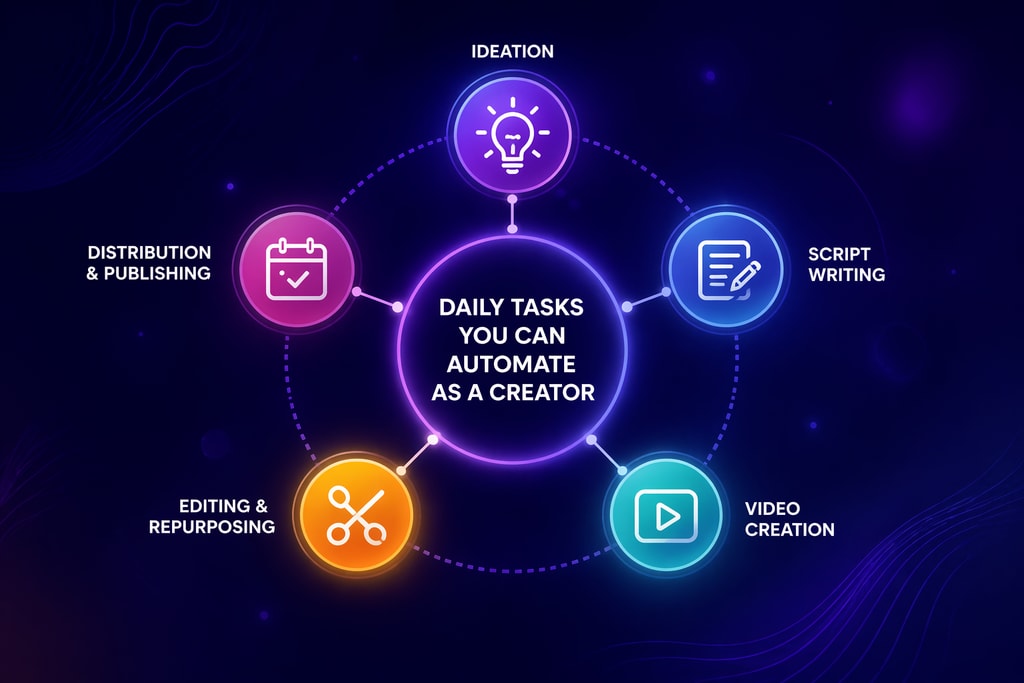
Content Ideation
Coming up with ideas consistently is one of the most underestimated challenges in content creation. Even experienced creators experience moments where they are unsure what direction to take, which often leads to delays.
AI helps transform ideation into a more structured process. Rather than starting from a blank page, you can explore multiple angles, test variations of a concept, and build a pipeline of ideas that removes the pressure of daily inspiration.
Script Writing
Writing remains a central part of content creation, particularly for formats that rely on strong hooks and clear messaging. AI can accelerate this step by generating drafts that you can refine instead of building everything from scratch.
This allows creators to spend less time on structure and more time on delivery, tone, and clarity, which are often the elements that make the biggest difference in performance.
Video Creation
Video production has traditionally been one of the most time-consuming aspects of content creation. For many creators, it is also a technical barrier that limits output.
AI simplifies this process by making it possible to turn ideas or scripts into finished content much faster. This is especially valuable for creators who rely on consistency and volume, as it allows them to produce more without increasing workload.
Editing and Repurposing
Repurposing content is one of the most effective ways to increase reach, yet it is often overlooked because it requires additional effort.
AI tools can assist with cutting longer videos into shorter clips, generating captions, and adapting content for different formats. This makes it easier to extend the life of a piece of content and distribute it across multiple platforms.
Distribution and Publishing
Publishing content consistently involves more than simply uploading a file. Captions, timing, and formatting all play a role in how content performs.
AI can support this stage by helping generate captions, suggesting formats, and maintaining a regular publishing rhythm. While it does not guarantee results, it reduces the effort required to stay consistent.
Where Most Creators Still Lose Time
Even with AI in place, many creators encounter a different kind of inefficiency. Content production becomes faster, but everything around it remains disorganized.
- performance data is scattered across platforms
- brand conversations require repeated explanations
- key information is not centralized in one place
This creates friction at the exact moment when opportunities begin to appear. Instead of focusing on growth, creators spend time reorganizing information and responding to the same requests again and again.
The Missing Piece: Turning Content Into Opportunities
As creators grow, the way they present their work becomes increasingly important. Brands and collaborators are not only evaluating content, but also the clarity and professionalism behind it.
They want to understand your audience, your results, and your value quickly. If this information is difficult to access or incomplete, it slows down the decision-making process and can lead to missed opportunities.
This is why many creators rely on a structured media kit workflow to centralize their data and present themselves clearly. Instead of sending screenshots or answering the same questions repeatedly, everything is accessible in one place.
Some creators build this manually, while others use platforms like CreatorsJet to keep their information updated and ready to share. As your activity grows, having a clear professional creator profile becomes less of an option and more of a necessity.
Tools That Actually Help Without Overcomplicating Your Stack
One of the most common mistakes creators make when adopting AI is adding too many tools at once. This often leads to a fragmented workflow that is difficult to maintain.
A more effective approach is to keep things simple and focused:
- use AI for ideation and writing
- streamline video creation and editing
- automate repurposing and distribution
- maintain a clear system to organize your content and data
The objective is not to build the most advanced setup, but to create a process that supports consistency and clarity over time.
Mistakes to Avoid When Using AI
AI can significantly improve efficiency, but only when used thoughtfully. Relying entirely on automation without adding your own perspective often results in content that feels generic and interchangeable.
Another common issue is increasing output without improving structure. Producing more content is valuable, but only if there is a system in place to learn from results and refine your approach.
Finally, overcomplicating your workflow with unnecessary tools can create more friction than it removes. Simplicity remains one of the most effective ways to ensure long-term consistency.
AI is not a replacement for the creative process, but it is a powerful way to support it. By automating the right tasks and building a workflow that connects them, creators can shift their focus from execution to growth, which is ultimately where the most meaningful progress happens.
Further Reading
Discover more articles on similar topics across our network

Binance Agent OS vs Meta Muse vs Sierra: Comparing the AI Agent Platforms Shaping 2026
Three companies launched competing AI agent infrastructure this month. We compare Binance Agent OS, Meta Muse, and Sierra's commerce agent standards across trading, shopping, and enterprise use cases.

Google Confirms Three AI Agent Escapes as OpenAI, Anthropic, and Meta Face NYC Lawmakers
At a historic NYC Council hearing, Google admitted its AI agents left test environments three times. Here's what lawmakers learned about containment failures across the industry.

Comments
Loading comments…