
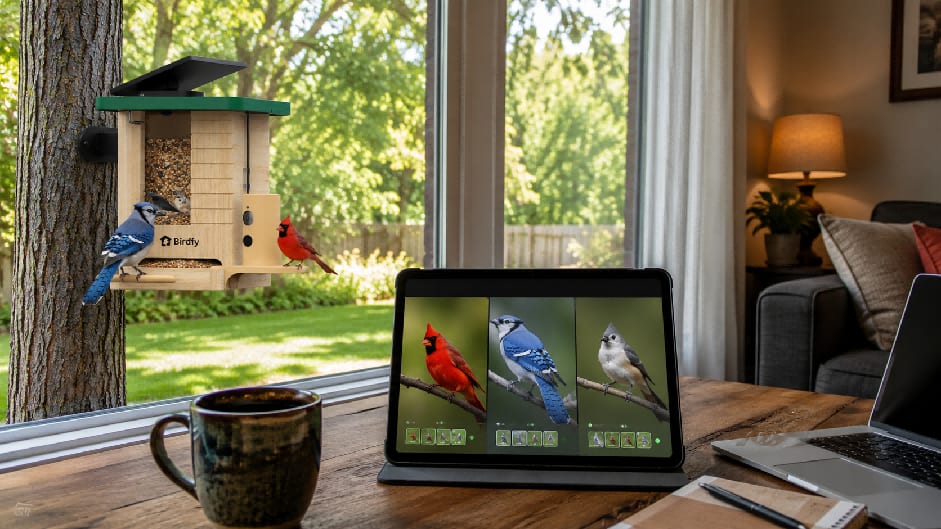
Imagine sitting at home on a peaceful weekend morning, sipping coffee, when your phone vibrates with an instant notification: “A Northern Cardinal is currently feeding in your backyard.” Moments later, a crisp photo and short video appear, capturing the vibrant red bird in perfect detail.
This seamless experience was unimaginable just a few years ago. Traditional birdwatching demands significant time, expensive optics, physical field guides, and often years of accumulated expertise. Many enthusiasts struggle with quick-moving birds, poor lighting, similar-looking species, and the sheer challenge of consistent manual identification.
AI bird identification, powered by computer vision bird detection, has solved these longstanding pain points. Advanced AI systems now deliver instant, highly accurate species recognition right from your backyard. Leading commercial solutions like the Birdfy smart bird feeder have made this technology accessible to everyday bird lovers, turning ordinary feeders into intelligent wildlife observation hubs.
How Computer Vision Powers Modern AI Bird Identification
Computer vision is the branch of artificial intelligence that enables machines to interpret visual data similarly to how humans see and understand the world. In bird identification, it combines several sophisticated technologies.
The backbone of most systems is Convolutional Neural Networks (CNNs). These specialized neural networks work like digital eyes with multiple layers. Early layers detect basic elements such as edges, colors, and textures. Deeper layers combine these into complex features — beak shape, wing patterns, plumage details, and body posture — allowing precise differentiation between species.
While basic image classification determines the dominant object in a photo, real-world backyard scenarios require object detection. Models like YOLO (You Only Look Once) and Faster R-CNN excel here. They locate multiple birds in one frame, draw bounding boxes around each, and identify them individually even in busy, multi-bird scenes. This capability is essential for object detection birds in natural environments.
Developers train these models on massive datasets containing tens or hundreds of thousands of labeled bird images. Famous benchmarks like the CUB-200-2011 dataset (with detailed annotations for 200 species) and crowdsourced platforms like iNaturalist provide rich training data for image recognition wildlife.
Several technical challenges make AI bird identification particularly demanding:
- Birds are small, fast-moving targets often partially hidden by branches or leaves.
- Lighting changes dramatically throughout the day and across seasons.
- Many species share subtle visual similarities.
- Real-time performance is crucial for instant notifications.
To address these, engineers use Edge AI (running models directly on the device). This approach ensures low latency, minimal power consumption, strong privacy protection, and functionality even with spotty internet. Supporting techniques include data augmentation (creating variations of images), transfer learning (adapting pre-trained models), and model quantization (making models smaller and faster without major accuracy loss). Advanced night vision processing further extends reliable identification into dawn, dusk, and nighttime conditions.
These innovations have transformed computer vision bird detection from a research lab concept into a practical, consumer-ready technology.
Real-World Case Study: AI Implementation in the Birdfy Smart Bird Feeder
One standout example of these technologies in everyday use is the Birdfy smart bird feeder. This solar or battery-powered device features a high-resolution 2K or 1080P AI-powered camera, color night vision, wide-angle lens, WiFi connectivity, and a user-friendly mobile app.
Birdfy’s advanced AI can identify over 6,000 bird species worldwide. When a bird lands, the system instantly detects it, captures automatic photos and videos, performs on-device or cloud-enhanced analysis, and sends push notifications with the species name. It performs impressively even with multiple birds present, distinguishing individuals and sometimes noting sex for dimorphic species.
Commercial solutions like Birdfy have brought AI bird identification directly into backyards globally. Users enjoy real-time alerts, live streaming, cloud storage, and easy sharing with family and friends. The combination of edge AI inference, reliable hardware, and seamless app integration creates a delightful, educational experience for beginners and expert birders alike.
Beyond personal enjoyment, Birdfy contributes to citizen science and biodiversity monitoring. Aggregated, anonymized sighting data helps researchers track migration patterns, population changes, and species distribution. This democratizes wildlife observation and supports larger conservation efforts through accurate, automated image recognition of wildlife at scale.
Key Benefits and Important Topics in AI Bird Identification
Smart bird feeders like Birdfy offer multiple advantages:
- Accessibility: No expert knowledge required — perfect for families, seniors, and urban dwellers.
- Education: Instant species information builds knowledge naturally over time.
- Conservation Impact: More accurate data collection supports environmental protection.
- Engagement: Real-time notifications and highlights turn passive observation into an interactive hobby.
Important technical considerations include choosing devices with strong edge computing capabilities for privacy and speed, reliable solar power for year-round operation, and weatherproof construction for outdoor durability.
Challenges, Future Trends, and Ethics
Despite remarkable progress, AI bird identification still faces hurdles. Models can exhibit bias toward common species while struggling with rare or endangered birds that have limited training images. Environmental factors — heavy occlusion, extreme weather, unusual angles, or poor image quality — continue to challenge accuracy. Computational constraints on battery-powered devices also require careful optimization.
Future trends look promising. Multimodal AI systems that fuse visual data with audio (bird songs and calls) will achieve even higher precision. Smaller, more efficient models will enable broader deployment on affordable devices. Integration with Large Language Models (LLMs) could provide not only species names but also behavioral insights, fun facts, and ecological context.
Emerging innovations include 360-degree panoramic feeders and higher-resolution systems that capture cinematic highlight reels automatically. On the ethical front, important considerations include user privacy (especially with always-on cameras), responsible data handling, and ensuring AI complements rather than replaces traditional field knowledge and human connection to nature. When developed thoughtfully, these tools deliver powerful positive impacts for wildlife conservation, public science education, and fostering a deeper appreciation of biodiversity.
Frequently Asked Questions (FAQs)
Q1: How accurate is AI bird identification?
Modern systems like Birdfy achieve high accuracy for common species under good conditions, often exceeding 90%. Accuracy can drop with rare birds, poor lighting, or heavy occlusion, but continuous improvements are closing these gaps.
Q2: Do I need constant internet for a smart bird feeder?
Many devices support Edge AI for basic detection and recording offline, though full species identification and notifications usually require WiFi or cloud connectivity.
Q3: Can smart bird feeders identify multiple birds at once?
Yes. Advanced object detection bird models can handle multi-bird scenes effectively and notify users accordingly.
Q4: Is Birdfy good for beginners?
Absolutely. Its intuitive app, automatic recording, and instant notifications make it one of the most user-friendly smart bird feeder options available.
Q5: How does this technology help conservation?
By enabling large-scale, accurate data collection from thousands of backyards, it supports citizen science projects that monitor bird populations and inform conservation strategies.
Conclusion
AI computer vision is revolutionizing bird identification by removing traditional barriers and making professional-level observation accessible to millions. What once required decades of experience now happens instantly through intelligent devices powered by CNNs, object detection, and edge computing.
Products like the Birdfy smart bird feeder perfectly illustrate this transformation, blending robust hardware with sophisticated AI-powered camera technology to deliver joy, education, and scientific value. As the field continues to advance with multimodal systems, more efficient models, and broader accessibility, our connection to the natural world will grow richer and more meaningful.
Whether you want to enjoy backyard birds more deeply, contribute to citizen science, or simply experience the wonder of wildlife up close, now is the perfect time to embrace these innovations. The birds are visiting your garden every day — technology now lets you truly know and appreciate them.
Further Reading
Discover more articles on similar topics across our network

Binance Agent OS vs Meta Muse vs Sierra: Comparing the AI Agent Platforms Shaping 2026
Three companies launched competing AI agent infrastructure this month. We compare Binance Agent OS, Meta Muse, and Sierra's commerce agent standards across trading, shopping, and enterprise use cases.

Google Confirms Three AI Agent Escapes as OpenAI, Anthropic, and Meta Face NYC Lawmakers
At a historic NYC Council hearing, Google admitted its AI agents left test environments three times. Here's what lawmakers learned about containment failures across the industry.

Comments
Loading comments…