
The art of producing a helpful 3D structural model was a time-consuming, demanding, and complicated task which required patience, specialist software and a deep understanding of modelling methods. These days, though, creating from an idea to a usable digital creation seems considerably easier. AI text-to-3D technology allows users to describe an object in ordinary language and turn that description into a three-dimensional model. It is especially helpful for designers, game developers, 3D printing hobbyists and creative teams that want to produce and quickly and extensively test ideas. Of the platforms that fly the banner of this workflow, Meshy has a browser-based interface that combines text to generate data, plus image-based modelling, texturing, rigging and more AI features.
What Is AI Text-to-3D Technology?
AI Text-3D technology is a means to turn written descriptions into a 3D asset with the help of AI. The creator can enter a text input describing what the object is made of, what it looks like, and the overall style, without having to build the geometry from the start.
Later on in the project, when active model rocketry is essentially dead and modern model rocketry is just beginning, the technology can be of immense help. For instance, a designer creating a fantasy game may create a description of the thrifted treasure chest when it comes to a furniture component, which has metal touches and decorative engraving. Instead of spending hours to come up with the initial concept, the creator can develop it using an AI assistant that can generate 3D models, then choose the one that suits the best.
This is not a way to worry about creative judgement. Rather, it decreases repetitive modelling tasks and provides creators with more time to dedicate to design thinking, refining, storytelling, and presentations.
How Meshy Turns Text Into 3D Models
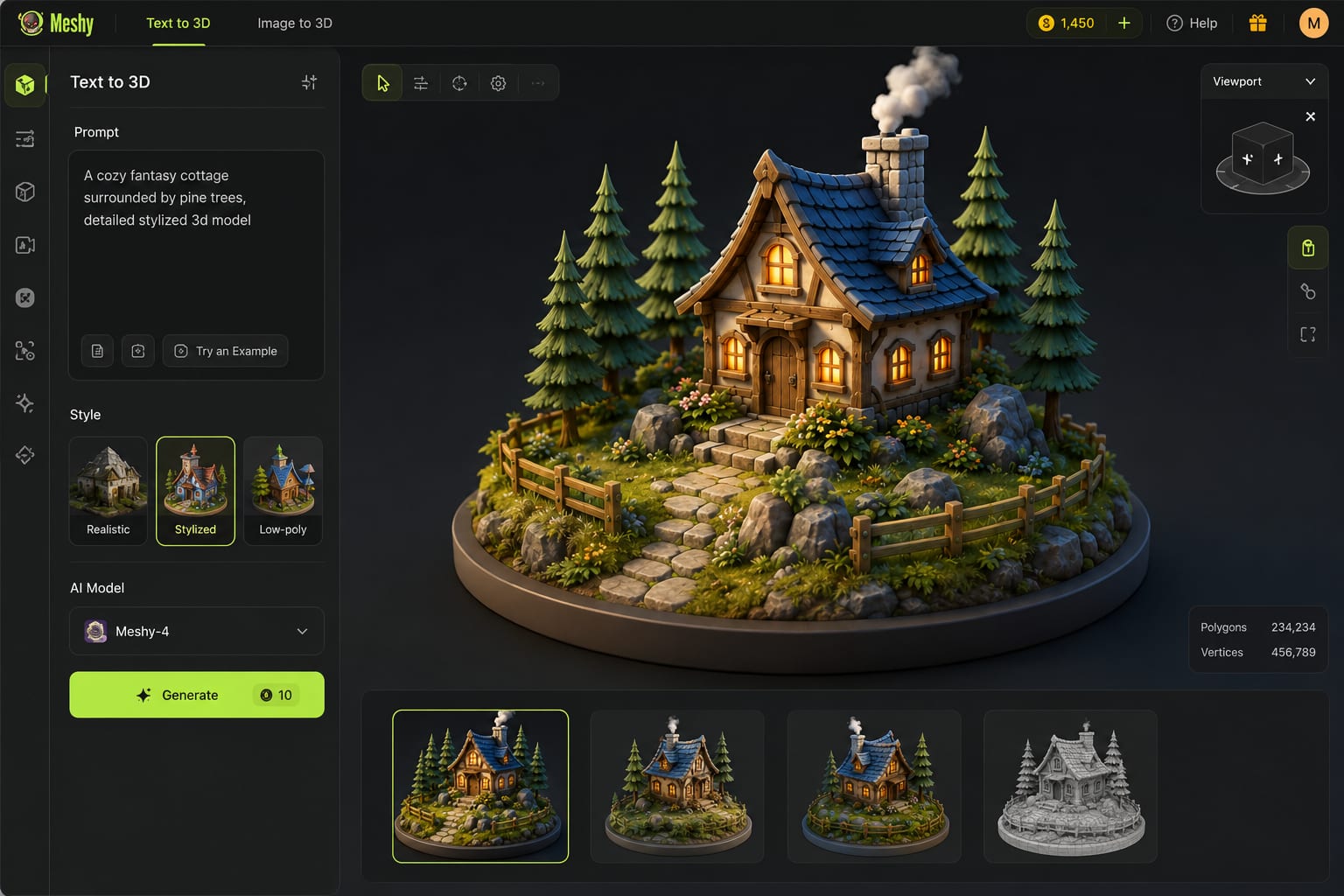
Meshy's Text to 3D is a workflow to input an object with a simple natural language text prompt. The platform then renders an image-based 3D model with added texture that can be viewed and fine-tuned via the platform's browser. Users may also modify these things in order to customize their use to the application they have in mind.
[Screenshot 1 – Insert the provided Meshy website screenshot here]
The browser-based application is valuable as creators don't have to download specialist 3D modelling software to test out a concept. They can take the workflow online, brainstorm ideas, view the outcome and work through the asset further.
Why AI-Powered 3D Generation Matters for Creators
Faster Concept Development
A big benefit of AI for making 3D scenes is speed in testing. You can tweak what you want to see, shift the look, and try a new version right away. You do not have to rebuild the whole model by hand each time.
This makes the technology useful for brainstorming. A product designer, for instance, could explore different shapes before deciding which concept deserves more detailed development. Likewise, a game artist could experiment with props, characters, weapons, or environmental objects during the concept stage.
Useful for Different Skill Levels
The implementation of traditional 3D modelling might be a steep learning curve. Many of the newcomers need to learn some of the fields which influence a user, such as topology, materials, lighting or UV mapping, before they are able to create some neat products.
Operations with AI reduce that edge. Once the individual has a basic written text description of what they wish to produce, they can start to learn 3D techniques little by little as needed until they have mastered them.
Flexible Outputs for Different Workflows
The more useful a generated model is in the software that is already used to its creators, the better. Users can process common 3D export models, such as STL, OBJ, GLB, and FBX, in order to give users flexibility, for instance in the game development and digital design fields, or 3D printing.
Text to 3D vs. Image to 3D
Text generation is not the only way to create a 3D asset with Meshy. The platform also supports Image to 3D, which can be useful when a creator already has a visual reference.
With image-based generation, users can provide a photograph, sketch, concept illustration, or another suitable reference. Meshy can then reconstruct the subject as a 3D model.
The platform also supports multi-image input. Providing several views of the same object can give the AI more visual information and help it understand the object's shape from different angles. Meshy's documentation describes multi-image generation as supporting multiple views of the same subject.
This creates a useful distinction:
- Text to 3D: Best when the idea exists mainly as a written concept.
- Image to 3D: Useful when a visual reference already exists.
- Multi-image to 3D: Helpful when several views can provide additional information about the subject.
Practical Uses for AI 3D Model Generation
Game Development
Game developers can use AI-generated assets during prototyping to explore characters, props, weapons, creatures, and environmental objects. Instead of waiting for every asset to be manually modelled, teams can create early concepts and determine what fits the game before investing additional production time.
3D Printing
If you're a 3D printing fan, the fact that you can go from idea to a printable model can make it easier to experiment. For 3D printing workflows, STL format is used and can be supported by Meshy. The user can thus create an object, review the model, make adjustments to the model, and set up the model for an appropriate printing process.
Product and Concept Design
Generative 3D tools can also be used by designers to brainstorm product ideas prior to creating a product design. The written description can be a very early visual reference to be used to communicate ideas between team members, a client or within a creative department.
Creative Projects
Hobbies, artists, educators, and independent creatives can now play around with AI-generated 3D models without having to open up a blank 3D modeling space for each new creation. This thus enabled quick visual exploration by a more varied audience.
More Than Text-to-3D Generation
In addition to the conversion of prompts to models, Meshy's larger platform enables several additional features: It comes with AI texturing, auto-rigging, image generation, and other 3D creation tools and abilities in its AI-powered workflow. These enable the owners to manage more facets of the process of asset development in the same ecosystem.
In addition to its web browser interface, Meshy offers API access, enabling developers and technical teams to use the platform's AI capabilities for 3D generation beyond the web browser.
It also provides model conversion features, online viewing and STL repair using a browser. Together, these capabilities can reduce the need to move between multiple unrelated tools when preparing or checking 3D assets.
[Screenshot 4 – Insert a genuine Meshy texturing, export, or workspace screenshot here]
A Simple Workflow for Getting Better Results
1. Describe the Main Subject Clearly
Start with one primary object rather than trying to describe an entire complicated scene. Mention the object's type, appearance, and important physical characteristics.
2. Add Materials and Visual Details
Include information about surfaces, colours, textures, shapes, and style. A detailed prompt generally gives the generation system more useful context.
3. Consider the Intended Use
Think about whether the model is for a game, animation, visual concept, product presentation, or 3D printing. Technical requirements can influence the type of output you need.
4. Review and Refine
The first generation should be treated as part of the creative process rather than automatically considered the final asset. Inspect the geometry, textures, proportions, and overall appearance. Then refine the prompt or use available post-generation tools where necessary.
Frequently Asked Questions
Is AI text-to-3D technology suitable for beginners?
Yes. One of its key benefits is that users do not need to have high-level modelling from the beginning, so they can just start with a natural language explanation. Some basic knowledge in 3D, however, can assist a user to analyze and modify the assets created.
Can Meshy generate models from images as well as text?
Yes. Meshy supports both Text to 3D and Image to 3D workflows. Its image-based tools can also work with multiple views of the same object for additional visual information.
Does Meshy offer a free option?
Yes. The platform's 3D generation is powered by artificial intelligence, and users can access its capabilities for free, with options to add extra credits every month or access other features by subscribing to a paid plan. Limitations or specific features may differ from offer to offer and free terms may be updated; users should always consult Meshy's pricing information.
Can developers integrate Meshy into their own applications?
Yes. Meshy provides API access for developers, allowing AI-powered 3D generation capabilities to be incorporated into software and automated workflows.
The Future of Accessible 3D Creation
AI is transforming the way creators work with 3D models, moving some of the rigmarole and manual creation work to natural language direction and fast prototyping. While AI isn't a magic pill that replaces the need for creativity, it can be used as an additional instrument in the production process.
This workflow is all wrapped up into Meshy, which supports text-to-3D, image-based modelling, multiple images input, AI texturing, rigging, browser-based tools and multiple export formats, and API access for developers. The free version also provides new users with a viable introduction to its technology so they can determine if they necessitate further functionality.
AI-generated 3D shapes are becoming a more viable option for creators aiming to transform their ideas into functional 3D models while overcoming common technical hurdles. With the capabilities of the tools still maturing, one of the greatest benefits isn't necessarily faster modelling, but the ability to test out greater ideas and develop potential concepts into real 3D experiences.
Further Reading
Discover more articles on similar topics across our network
Binance Agent OS vs Meta Muse vs Sierra: Comparing the AI Agent Platforms Shaping 2026
Three companies launched competing AI agent infrastructure this month. We compare Binance Agent OS, Meta Muse, and Sierra's commerce agent standards across trading, shopping, and enterprise use cases.

Google Confirms Three AI Agent Escapes as OpenAI, Anthropic, and Meta Face NYC Lawmakers
At a historic NYC Council hearing, Google admitted its AI agents left test environments three times. Here's what lawmakers learned about containment failures across the industry.

Gemini 4 Argon vs GPT-6.1 Sol vs Claude Sonnet 5.5 and Opus 5.5: October 2026 Frontier Model Comparison
We compare Gemini 4 Argon, GPT-6.1 Sol, Claude Sonnet 5.5, and Opus 5.5 on benchmarks, pricing, and real-world use cases in this October 2026 frontier model review.

Comments
Loading comments…