
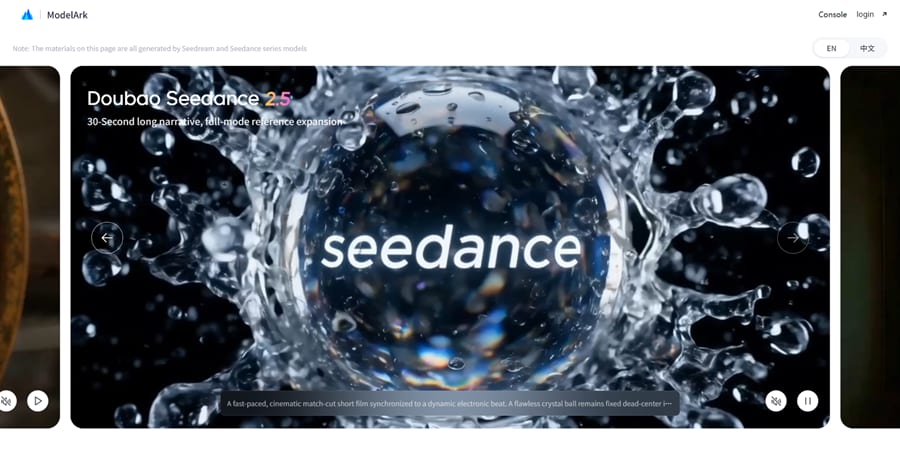
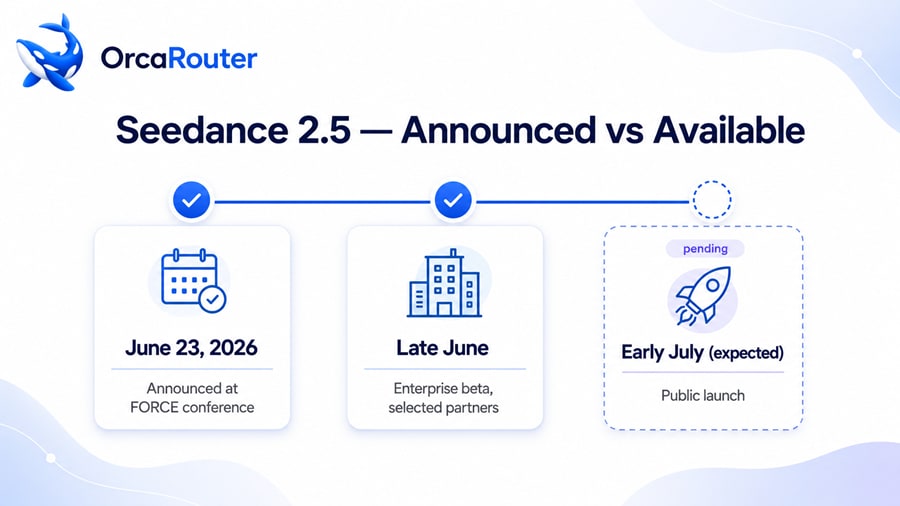
 Here's the straight answer to a question the internet keeps muddling: Seedance 2.5 was announced on June 23, 2026, at ByteDance's Volcano Engine FORCE conference — but it has not publicly launched. What exists today is an enterprise beta for selected partners; the public release is expected in early July 2026, and no exact date has been confirmed. If you've seen headlines implying you can generate with it right now, that's the announcement being mistaken for the launch — a mix-up that happens with nearly every frontier video model, because these releases now arrive in stages rather than on a single day. The useful move isn't refreshing the news; it's being positioned so that when access opens, you're testing within hours.
Positioning looks like this: OrcaRouter, an AI gateway fronting 200+ models through one OpenAI-compatible endpoint, has already staged a dedicated Seedance 2.5 model page ahead of launch, with support planned as soon as ByteDance opens access. Below: the timeline as it actually stands, what's confirmed versus still unknown, and how to be first in line.
The short answer
● Is Seedance 2.5 released? Announced yes, released no — June 23, 2026 at the FORCE conference, currently enterprise beta only
● When can you use it? Public launch is expected in early July 2026; no exact date has been confirmed
● What's confirmed: native 30-second clips, up to 50 multimodal references, region-level editing, claimed native 4K
● What's not: the exact launch date, official pricing, audio support, and independent performance data
The timeline so far
Seedance 2.5's rollout has two completed beats and one pending. June 23, 2026 — the announcement: ByteDance unveiled the model at its Volcano Engine FORCE conference, publishing the headline capabilities and positioning it as a production-workflow model rather than a demo generator. Late June — enterprise beta: selected partners got access through ByteDance's cloud channels, while the public got specs, demos, and no API. Early July — the expected public launch: announced as the target window, not yet delivered. Until that third beat lands, every “Seedance 2.5 is here” headline is describing beat one.
What's confirmed about the model
Four capabilities are officially announced. Native 30-second clips, several times the usual 5-to-10-second span, aimed at continuity without stitching. Up to 50 multimodal references for locking characters, products, and styles across shots — the feature production teams have been loudest about wanting. Region-level editing, so revisions become targeted fixes instead of full re-rolls. And claimed native 4K output, the spec most in need of independent verification once access opens. The common thread: this generation is built for people who ship video repeatedly, not for one impressive clip.
What's still unknown
Four things remain genuinely open, and honest planning accounts for them. The exact public launch date — “early July” is a target, and targets slip. Official pricing — not yet published, so any figure circulating now is provisional. Audio support — absent from the confirmed capability list; assume a separate audio pass until told otherwise. And real-world performance — every claim in circulation traces back to the vendor, because nobody outside the beta has benchmarked it. None of these should stop you preparing; all of them should stop you promising a client a Seedance-powered deliverable with a hard date.
How to be first in line
1. Set up your account and API key now, so auth and billing aren't part of launch-day work
2. Integrate against one OpenAI-compatible endpoint — when the model opens, it's a model-string change, not a new integration
3. Prepare the briefs and reference assets you'll evaluate with, chosen from work you actually ship
4. When access opens, run the prepared evaluation immediately and compare against your current video tool on identical briefs
If your organization has an enterprise relationship with ByteDance's cloud (Volcano Engine domestically, BytePlus internationally), the beta channel is worth asking about; for everyone else, readiness on a gateway is the practical path.
Why the staged rollout matters
The announce-beta-launch staircase has become the standard shape of frontier video releases, and it rewards teams who treat each stage as a work phase. At announcement, decide whether the claimed specs would change your stack if true. During the beta window, line up briefs, references, and integration plumbing. At launch, run the prepared evaluation while attention (and often the most generous early conditions) lasts. Teams that work this way produce comparison footage in week one; teams that wait for the launch headline start their integration in week one. The gap between those two is a real competitive edge, and it's decided before the model ever ships.
Should you wait for it?
Depends on what's on your plate. If you're shipping video work this week, don't block anything on Seedance 2.5 — targets slip, and your current tools keep working. If you're planning next quarter's creative pipeline, factor it in as a candidate to evaluate, not a dependency to build on: the announced feature set is strong enough to earn a slot in your bake-off, and weak enough in public evidence that it shouldn't win the bake-off before it runs. And if you're choosing video infrastructure right now, the sensible hedge is the same one that works for text models — build against an endpoint that will carry Seedance 2.5 and its rivals alike, so whichever model wins your evaluation, adopting it costs one string.
The bottom line
Seedance 2.5 is real, announced, and not yet yours to use — and that in-between window is exactly when preparation is worth the most. The launch date is ByteDance's to set; whether day one finds you testing or scrambling is entirely yours. Stage the integration now and let the release date become a starting gun instead of a starting line.
Be testing on day one. Set up OrcaRouter now — 200+ models behind one OpenAI-compatible endpoint today, with Seedance 2.5 support planned the moment public access opens.
FAQ
What is Dreamina, and why does the model ID say byteplus?
Dreamina is ByteDance's AI-creation product brand, and BytePlus is the company's international cloud arm — hence the combined `byteplus/dreamina-seedance-2.5` identifier used for international access. Same model; the naming reflects ByteDance's product-and-cloud structure.
How is Seedance 2.5 different from Seedance 2.0?
Per the announcement, the jump is workflow depth rather than reinvention: dramatically longer native clips, an order of magnitude more reference inputs, and in-frame region editing that 2.0 lacked. Worth noting: Seedance 2.0's own wider developer rollout had a bumpy history, which is one more reason to treat 2.5's timeline with healthy caution.
Do I need a Volcano Engine or BytePlus account to use Seedance 2.5?
During the beta, yes — enterprise access through ByteDance's cloud is the only live route. Once the public API opens, gateway access means one API key covers Seedance 2.5 alongside the other models in your stack, with no separate vendor onboarding.
Further Reading
Discover more articles on similar topics across our network

Binance Agent OS vs Meta Muse vs Sierra: Comparing the AI Agent Platforms Shaping 2026
Three companies launched competing AI agent infrastructure this month. We compare Binance Agent OS, Meta Muse, and Sierra's commerce agent standards across trading, shopping, and enterprise use cases.

Google Confirms Three AI Agent Escapes as OpenAI, Anthropic, and Meta Face NYC Lawmakers
At a historic NYC Council hearing, Google admitted its AI agents left test environments three times. Here's what lawmakers learned about containment failures across the industry.

Comments
Loading comments…