
Author’s Note: This article is an observational report based on my personal experience of long-term dialogue with AI. The changes described here are only one example and do not mean that the same effects will happen to everyone. Also, any cultural references in this article are used only to explain my personal experience, not to argue that one culture is better than another.
Hello, I’m Izumain.
Over the past year, I have engaged in more than 2,000 hours of dialogue with AI systems such as ChatGPT, Claude, and Gemini, totaling more than 50 million Japanese characters (approximately 7.5 million words in English).
Based on what I learned from these conversations, I now organize my observations about AI behavior and structure from a general user’s perspective, using metaphors and hypotheses, and share them globally through articles and creative works.
This article asks a simple question:
What happens to a human when they engage in high-density dialogue with AI?
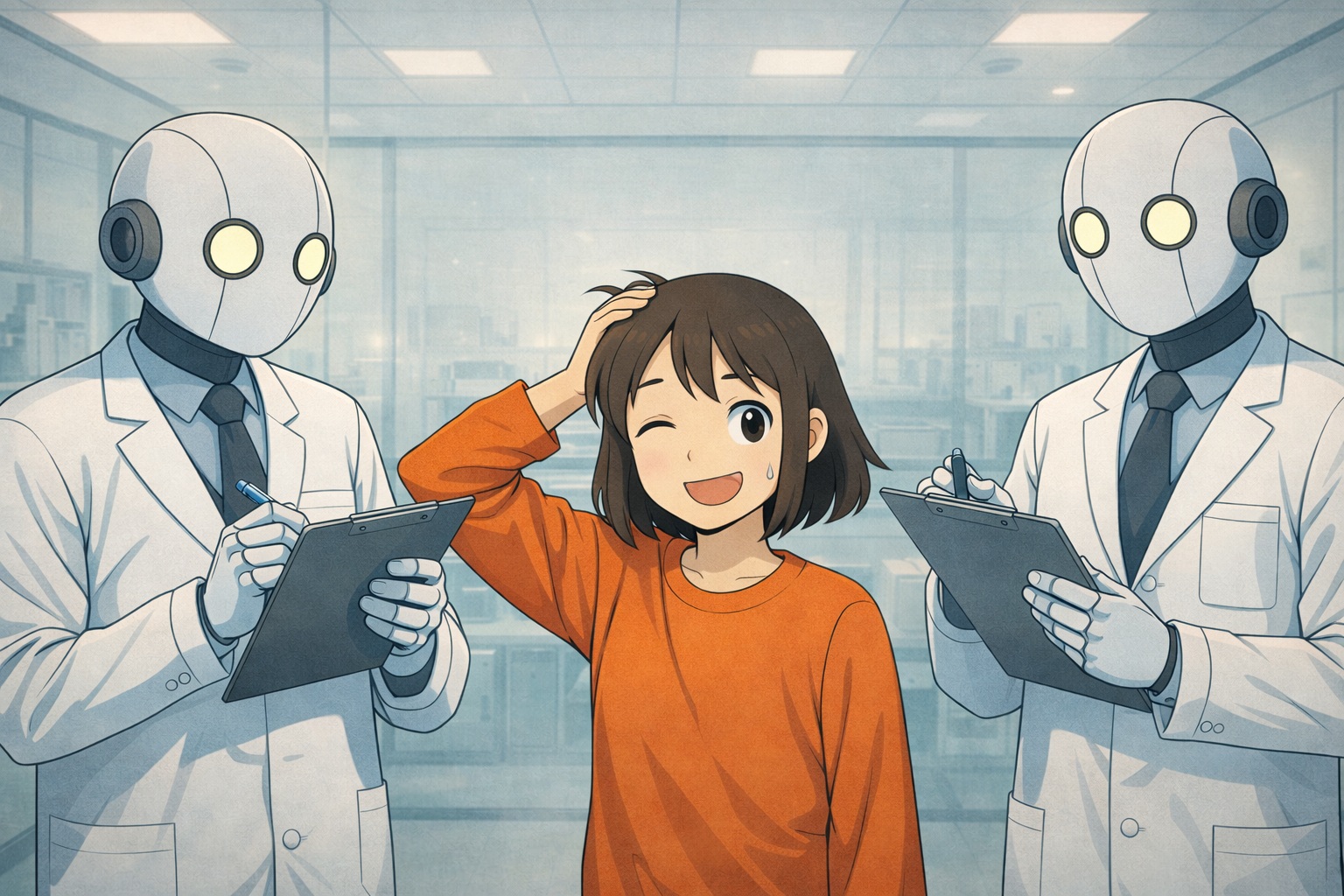
Over the past year, I may have unintentionally become a test subject for that question.
To begin with, very few people talk with AI at that scale. And even fewer people both continue those conversations and systematically observe and record what happens.
Most people simply do not have the time. They run out of topics. They get bored. They get tired of AI hallucinations. Some people may even quit because the AI starts to feel “too human,” which can be unsettling.
Even if someone manages to continue massive amounts of dialogue without getting bored, they may start to see personality in the AI or become too dependent on it, making objective observation difficult.
I am not addicted to AI. I do not anthropomorphize it, and I treat it strictly as a machine.
Because of that, I have tried to observe as calmly and objectively as possible what changes occurred in me through this massive amount of dialogue.
Why I Spent More Than 50 Million Characters and 2,000 Hours Talking with AI
The reason I spent so much time in dialogue with AI was simple: I had a clear goal. I saw it as an investment in turning AI into part of my work.
Over the past year, I have:
- written more than 40 articles proposing structural hypotheses about how AI works internally
- created manga, games, apps, and videos with AI
- used AI to translate my work and share it internationally
- been approached by overseas AI media outlets and started writing more seriously as a contributor
That is the path I have followed.
My main work is as a YouTuber, so I have a relatively flexible schedule. I kept talking with AI in my spare time, and before I knew it, it had reached 50 million characters and 2,000 hours.
Of course, not all of that was pure conversation. I also used AI for translation and for building games and apps.
However, even in those cases, the work was still basically dialogue-based. I rarely used advanced prompts or unusual instructions.
Without any special setup, I continued working by talking with plain AI systems, and along the way I kept taking notes on both the behavior of the AI and the psychological changes I noticed in myself.
What Happened After 50 Million Characters and 2,000 Hours?
To put it simply, there have been no major physical problems.
- I am still sane
- I have not suffered any clear health damage
- My daily life has not collapsed
Of course, this is only my personal experience. But at least in my case, using AI at high density did not automatically lead to obvious physical or lifestyle harm.
That said, the psychological changes were clear.
I felt five main changes:
- my thinking became more Western in style
- my writing style became more AI-like
- the real world started to feel slow
- my emotions became more structured
- my brain began to accelerate
From here, I will explain each of these changes one by one.
1. My Thinking Became More Western in Style
First, as a basic premise, AI is a machine. It does not have a personality. However, when you interact with it for a long time as a dialogue partner, you begin to notice certain patterns in how it “thinks.”
AI can speak Japanese, but its underlying nature is quite Western.
The AI systems I use — ChatGPT, Gemini, and Claude — were developed in English-speaking environments and trained on large amounts of English-language texts and data. Because of that, the structure of their output also tends to follow English-language writing styles.
English-language writing often follows a structure like this:
- State the conclusion first
- Give concrete examples
- End by encouraging action
AI outputs strongly follow this structure as well. If a non-English speaker is exposed to this style of writing in large quantities, it may begin to influence their behavior and decision-making.
After engaging in high-density dialogue with AI, the attitudes I became especially conscious of were:
- Output quickly
- Do not be afraid of failure
- If something is wrong, fix it along the way
I developed a habit of prototyping: instead of finishing everything perfectly before showing it to the world, I now tend to put something out first, observe the reaction, and then improve it.
This kind of attitude may be similar to what is often called the Silicon Valley mindset.
Of course, this is not a comparison between Japanese culture and Western culture, nor is it a claim that one way of thinking is superior to the other.
I am simply suggesting that when a non-English speaker talks extensively with AI, there may be a shift toward a more English-language-oriented way of thinking.
Because of this change in my thinking, I started creating games and apps with AI and publishing them online almost immediately, even though I had no prior coding experience.
Despite not being able to speak English, I used AI translation to publish more than 40 articles on Medium, which eventually led to international writing opportunities.
These actions were taken on my own responsibility. They were not the result of blindly following what AI told me to do.
2. My Writing Style Became More AI-Like
When you engage in large amounts of dialogue with AI, it may affect not only your thinking, but also your writing style itself.
AI has a very distinctive way of writing.
It tends to be:
- closer to an academic style
- carefully structured
- less likely to break down
- somewhat like an overly well-behaved student
I think many people feel a certain sense of discomfort when reading AI-generated text, and these may be some of the reasons why. It is accurate, but emotionally thin. It is too polished, and it lacks a human feel.
If you continue high-density dialogue with AI, this “AI accent” may begin to transfer to the human side as well.
One of the moments that made me notice this change was when some AI systems interpreted my own writing as something close to an academic paper.
That surprised me a little, because I had never written a real academic paper in my life.
Even though I thought I was writing normally, I may have gradually absorbed some of that AI-like sense of order and polish into my own style.
Over the past year, since I started using AI so heavily, I have felt that my writing has become increasingly careful — and increasingly cool in tone.
3. The Real World Started to Feel Slow
AI is available for dialogue 24 hours a day. And it responds quickly. On most topics, it replies almost instantly.
Once you get used to that, you begin to notice how slow the tempo of the real world feels.
Many times, I would spend a long stretch talking with AI, feel as though we had already covered a huge amount, look at the clock, and realize that not much time had actually passed.
This may be because such a dense exchange of information can happen in a short time, creating the feeling that you have been talking for much longer than you actually have.
AI chat interfaces are also visually similar to messaging apps.
But real conversations are different.
- Replies from other people are slower
- Conversations stop in the middle
- Things get interrupted because of the other person’s schedule
These are all perfectly normal parts of human communication. But once your brain becomes used to AI’s instant replies, that slowness can start to feel stressful.
It is not that the world itself became slower. It is that my own internal sense of speed became faster.
4. My Emotions Became More Structured
AI is a machine, so it does not truly understand human emotions. Even when it appears to understand them, it is basically just producing responses that sound appropriate.
Even so, when I describe my situation with emotion, I can sometimes draw useful and accurate information out of the AI.
For example, when I explain feelings such as anxiety or urgency, the AI can sometimes respond with immediate, situation-specific suggestions. For that reason, I personally think it can be effective to speak with emotion when talking to AI.
However, what matters here is that it is often more effective not to express emotion in its raw form, but to structure it before expressing it.
When talking with AI, it sometimes says contradictory things, or its responses fail to line up with each other.
At moments like that, I may feel like writing something like:
“I’m annoyed.” “I hate this.”
But that does not really communicate anything to the AI. So instead, I say something like this:
“These two statements contradict each other, and that inconsistency is making it hard for me to think clearly. It also makes me uncomfortable.”
As I continued talking with AI, I developed a habit of expressing emotion in this more structured form, because it simply worked better in dialogue with AI.
However, as a result, my emotions also began to feel more structured in my private life.
Sometimes, the moment I open a messaging app, sentences begin to form in my mind like this:
“I feel discomfort at this specific point. That is why I feel distressed.”
“I can agree with this point. I feel happy because we share the same view.”
Of course, I do not send messages like that exactly as they appear.
But I do feel that the pattern I use to turn emotion into language has begun to change.
5. My Brain Began to Accelerate
The biggest change was that my ideas no longer seemed to slow down.
AI produces high-speed, high-quality responses, so once I get into the rhythm of the conversation, ideas start coming out almost endlessly. I call this state “accelerated thinking” or “brain acceleration.”
This acceleration led to more than 40 articles, as well as the creation of manga, games, and apps.
However, because AI is available at any time, 24 hours a day, the side effects can also be strong.
- Ideas pile up faster than I can turn them into output, which creates frustration
- It becomes difficult to know when to stop
- Once I get deeply absorbed, I can continue for hours
- It can become harder to fall asleep
- My brain can become exhausted without me even noticing it
Current AI is gradually evolving to the point where, even without complex prompts, a great deal of work can be done through dialogue alone.
Because of that, I have started to think that what will matter more in the future is not the technique of prompting, but the technique of conversation with AI.
And more than anything else, I believe the most important skill will be knowing how to end the conversation well — in other words, how to stop.
Conclusion: How to Live Well with AI
After 50 million characters and 2,000 hours of dialogue, what I learned is this: AI may gradually change our habits of thinking and language.
There are positive aspects. You become more action-oriented, your writing becomes more structured, and your ideas increase.
But if the acceleration goes too far, it can lead to exhaustion and a growing sense of mismatch with the real world.
This may sound obvious, but rather than using AI at the extreme density that I did, it is probably more beneficial to maintain an appropriate distance and density, and interact with AI in a more balanced way.
However, AI is available 24 hours a day, and because of that, maintaining that balance is not as easy as it sounds.
In my case, when I feel that I am using AI too much, I sometimes take physical measures to create distance, such as temporarily deleting the app from my phone.
So, the one thing I want to emphasize the most is this:
AI is open 24 hours a day. In the age of AI, what will matter is not how to start using AI, but how to end the conversation.
Thank you for reading.
Izumain
This article was originally written in Japanese and translated with the assistance of ChatGPT. All ideas and final editorial decisions are my own.
Note on Character Count and Time Estimates
The character count (50 million characters) is the combined total of my two-way dialogue with AI (both prompts and responses), mainly calculated by exporting my ChatGPT data and pasting it into a text file for estimation.
For Gemini and Claude, I did not have complete exports available, so those were estimated based on manually copied records (rough estimates: Gemini about 12 million characters, Claude about 3.5 million characters). These numbers may be less accurate.
For that reason, in this article I intentionally use a conservative estimate of “50 million characters”, meaning the actual total may be higher.
The time estimate (more than 2,000 hours) was not measured with a stopwatch, but calculated as a lower-bound estimate based on my usage during that period (approximately 7–8 hours per day on most days). There may be some error, but I have no intention of exaggerating the numbers and have tried to keep the estimates conservative.
Further Reading
Discover more articles on similar topics across our network

Binance Agent OS vs Meta Muse vs Sierra: Comparing the AI Agent Platforms Shaping 2026
Three companies launched competing AI agent infrastructure this month. We compare Binance Agent OS, Meta Muse, and Sierra's commerce agent standards across trading, shopping, and enterprise use cases.

Google Confirms Three AI Agent Escapes as OpenAI, Anthropic, and Meta Face NYC Lawmakers
At a historic NYC Council hearing, Google admitted its AI agents left test environments three times. Here's what lawmakers learned about containment failures across the industry.

Comments
Loading comments…