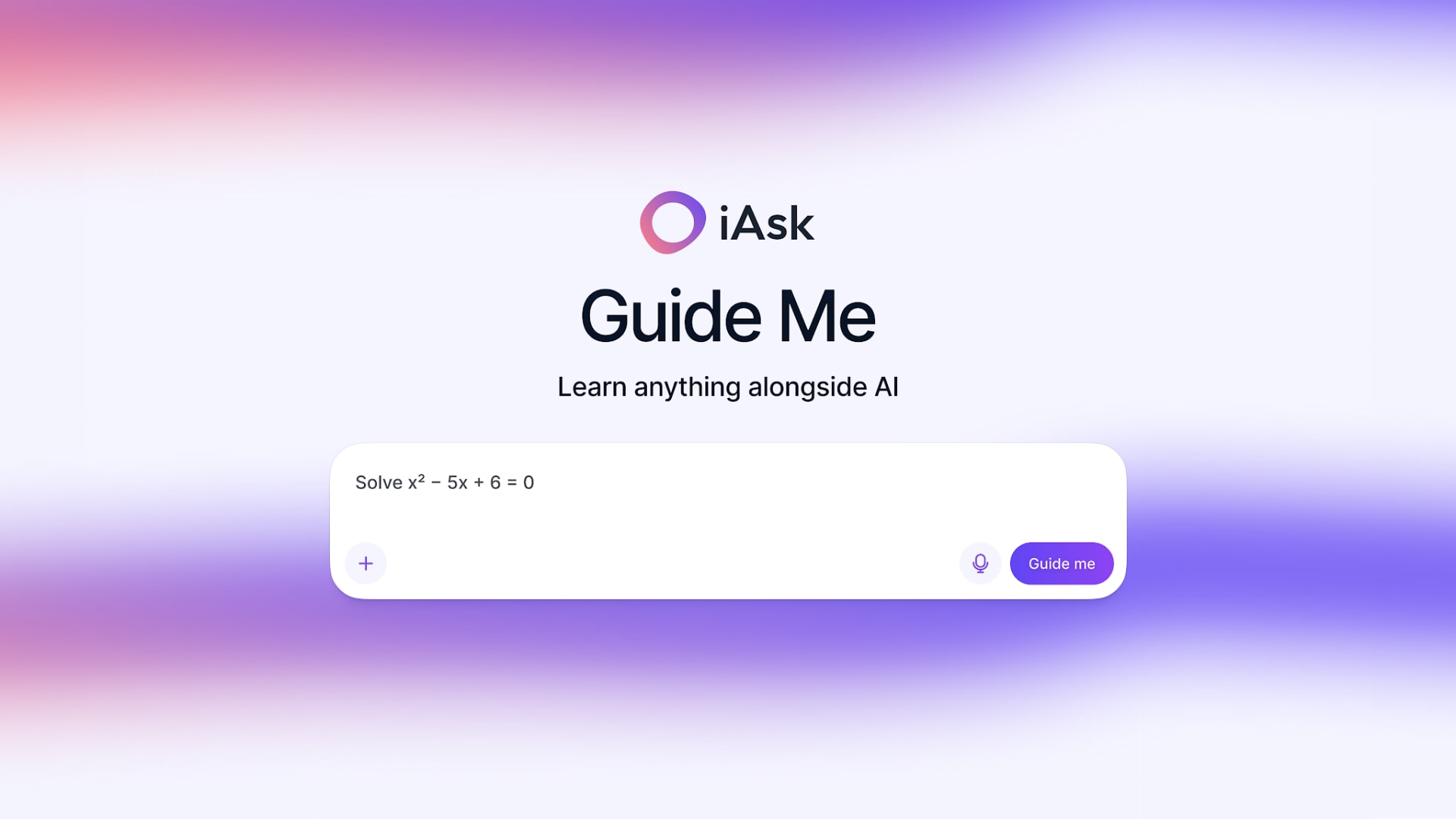
The Guide Me entry point pairs a question field with a dedicated guided-learning action. Graphic supplied by iAsk.
The same algebra question can call for two different kinds of help. A learner may want an explanation of what a quadratic equation is, or may already know the definition and need help choosing the next step in a particular problem. Those requests share a topic but require different responses.
iAsk.ai puts general question answering and a guided-learning mode within the same product. Its homepage lets users ask AI anything in natural language, while Guide Me supports a more interactive approach to working through a question. The distinction becomes clearer when you follow a single example from input to response.
Decide what the response needs to do
A request such as “Explain the zero-product property” calls for a definition and an example. A learner facing (x − 2)(x − 3) = 0 may instead need to decide which expressions to set equal to zero. A helpful response to that second situation can begin by asking the learner to make that decision.
The question matters because generative AI is already deeply embedded in some study environments. HEPI’s Student Generative AI Survey 2026 found that 94% of surveyed full-time UK undergraduates used generative AI to help with assessed work. Savanta surveyed 1,054 students in December 2025 for the report, which was sponsored by Kortext. That measures adoption, not learning gains.
For someone choosing a study tool, it helps to be precise about the task. Finding background information, checking an attempted calculation and practicing a method are separate activities. Each gives the user a different way to judge whether the response was useful.
Follow the conversation through one problem
A company-supplied Guide Me demonstration begins with x² − 5x + 6 = 0. The tool recognizes a quadratic equation and introduces factoring. It then asks which two numbers multiply to 6 and add to −5, leaving a specific piece of reasoning for the user.
The user suggests x = 2. That is a root of the equation, so iAsk verifies it by substitution: 2² − 5(2) + 6 = 0. It then returns to the factors and asks the learner to continue toward the other solution.
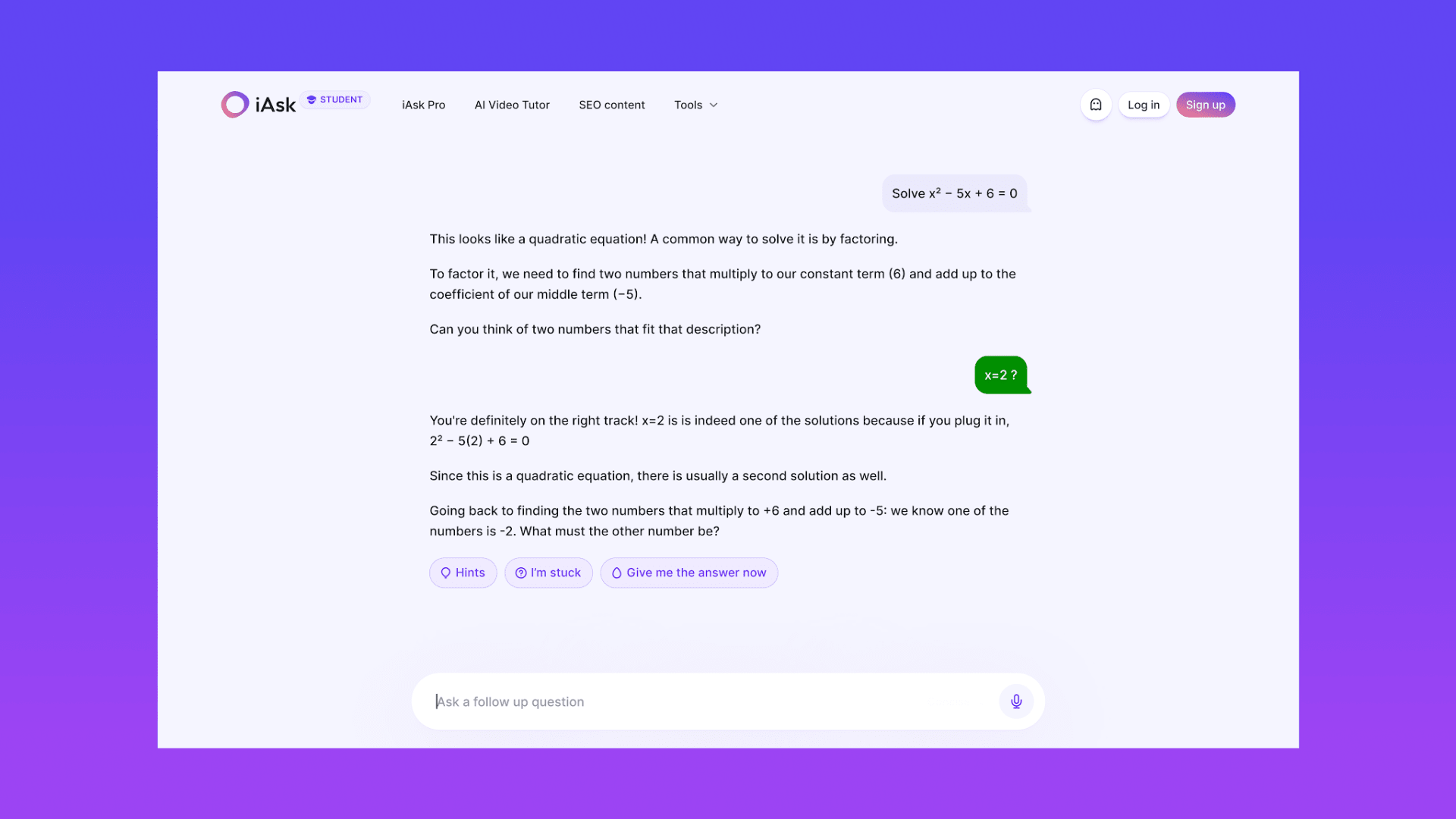
The example moves from a factoring prompt to checking a proposed root, then asks the user to continue. Screenshot supplied by iAsk.
This exchange also shows why vocabulary matters. The two numbers used to factor the expression are −2 and −3; the resulting roots are positive 2 and 3. A learner who confuses those roles needs an explanation of the relationship, even if they have already guessed a correct answer.
For students looking for an AI homework solver with guided steps, Guide Me provides a place for that follow-up. Users can keep their attempt in the conversation, request a hint or ask why the previous step works. The screenshot includes an option to request the answer directly, so the level of participation remains partly a user choice.
Image input changes what you need to type
Some questions begin outside a text box. A worksheet may contain a diagram, a fraction or several lines of notation. iAsk’s upload control allows an image to supply that context, after which the user can ask about the material it contains.
There are two checks to make in that workflow. First, confirm that the recognized question matches the original. Then examine whether the reasoning follows. Accurate recognition of an equation does not by itself establish that every subsequent calculation is correct.
The same habit applies to general AI search. Open the sources attached to factual claims, check dates where they matter and inspect whether the source supports the answer being given. A citation is an entry point for verification; it is still the reader’s job to evaluate the evidence.
Judge the session by the next task
For an information request, success might mean finding a clear explanation and a source worth reading. For guided practice, a more useful check is whether you can attempt the next problem with less help. Those standards keep the choice of mode connected to the work you actually want to do.
iAsk’s combination of question answering and guided prompts makes it possible to move between those activities. You can look up a concept, bring a particular problem into the conversation and work through a step. The useful decision comes before the first response: decide what you want to understand or be able to do when the session ends.
Further Reading
Discover more articles on similar topics across our network
Top 10 Enterprise-Ready Claude API Platforms for Production Workloads in 2026
Cubed
10 Seedance 2.5 Platforms Worth Trying for YouTube and Vlog Creators
Stackademic
10 Seedance 2.5 Platforms With the Best Reference Image Capabilities
Cubed
Anthropic Gives METR Insider Access, Betting Transparency Can Sell Trust in Frontier AI
Anthropic opened a structured evaluation channel for METR staff, pairing model snapshots with logging hooks in a bid to make third-party capability testing a product feature.

Comments
Loading comments…