The Day My App Embarrassed Me
It still haunts me.
A client demo years ago where everything was supposed to run smoothly. My Python backend, my clean architecture, my beautiful orchestration and then the spinning loader showed up like an uninvited cousin at a wedding.
The app crawled.
Not “slightly slow.” I mean the kind of slow where you start wondering whether packets take chai breaks mid-route.
And here’s the embarrassing part:
I was using AWS… but only the “popular” AWS services: EC2, S3, Lambda, RDS. Stuff every beginner checks off like a grocery list.
And meanwhile, the real performance boosters the AWS services designed for distributed speed, automation, and system intelligence were sitting on the shelf like unopened birthday gifts.
Fast forward to today: Those ignored services are exactly what made my app 10x faster, stabler, and insanely more automated.
This article is me being brutally honest about the six AWS services I slept on for years and how they quietly upgraded my system like a cheat code.
Let’s unpack the gems.
1. AWS Global Accelerator The Traffic Cop I Should’ve Used Day One
If your users are distributed globally, and you’re still relying on plain Route53 DNS routing.
Bro…I’m telling you…
You’re basically letting your packets find their own Uber.
Global Accelerator changed everything. It routes traffic into AWS’s private backbone instantly instead of the public internet.
Latency drop for me: 40 to 60%. Just from flipping this switch.
Code Example Creating an Accelerator Programmatically
import boto3

client = boto3.client("globalaccelerator")

response = client.create_accelerator(
    Name="my-super-fast-accelerator",
    IpAddressType="IPV4",
    Enabled=True
)

print("Accelerator ARN:", response["Accelerator"]["AcceleratorArn"])
This thing basically gives your app a global warp tunnel.
And yes, I’m salty I didn’t try it earlier.
2. AWS ElastiCache (Redis) The “Why Didn’t I Use This Earlier?” Layer
I used to optimize SQL queries like a man possessed. I even bragged about shaving off 50ms from a JOIN once.
Then Redis walked in and said:
“Why don’t we just…not query the database?”
ElastiCache became my secret performance steroid. Caching user profiles, sessions, computed results, filters boom.
The app felt instant.
Code Example Saving Query Results to Redis
import boto3
import json

redis = boto3.client("elasticache")

def cache_data(key, value):
    redis.set(key, json.dumps(value))

cache_data("user_101_data", {"name": "Asim", "role": "admin"})
If you aren’t caching aggressively, you’re basically choosing lag.
3. AWS Step Functions The Automation Engine I Avoided Because I Was Stubborn
I used to orchestrate workflows using Celery, cron scripts, and custom queues.
Then a senior AWS architect told me:
“Asim, why are you building your own orchestra when AWS gives you a conductor?”
Step Functions gave me:
- automatic retries
- human review steps
- parallel workflows
- zero maintenance scheduling
- visual debugging
And it replaced hundreds of lines of orchestration code.
Code Example Minimal Step Function Execution
import boto3

client = boto3.client("stepfunctions")

client.start_execution(
    stateMachineArn="arn:aws:states:::myFlow",
    input='{"task": "process_user_data"}'
)
This thing is how enterprise grade automation is supposed to feel.
4. AWS DynamoDB Streams Real-Time Reactions Without Cron Jobs
I treated DynamoDB like a static NoSQL store for years.
Then I discovered Streams…
Suddenly I could react to:
- new records
- updated orders
- deleted items
- changed user profiles
in real time, automatically triggering downstream functions.
My backend felt alive.
Code Example Lambda Trigger (Event Skeleton)
def handler(event, context):
    for record in event["Records"]:
        if record["eventName"] == "INSERT":
            print("New item:", record["dynamodb"]["NewImage"])
No polling. No scheduling. No delay.
Just instant reactions.
5. AWS SQS + SNS Fanout The Combo That Fixed My Scalability Bottleneck
I used to tightly couple my Python services. One fails, everything fails.
Classic rookie architecture.
Then SNS + SQS fanout changed the way I think.
SNS = broadcaster SQS = individual mailboxes for microservices
Publish once → multiple consumers get messages independently.
My bottlenecks disappeared overnight.
Code Example SNS Publish
import boto3

sns = boto3.client("sns")

sns.publish(
    TopicArn="arn:aws:sns:123:topicName",
    Message="process_reports"
)
This is how you architect systems that don’t collapse when traffic spikes.
6. AWS CloudFront Functions The 1ms Edge Logic Nobody Told Me About
I ignored CloudFront for years because I thought it was “just a CDN.”
I was wrong.
CloudFront Functions let me run custom JavaScript at the edge in under 1ms:
- rewrite URLs
- authenticate users
- block abuse
- inject headers
- perform A/B experiments
- redirect region specific traffic
Before the request even touches my server.
Code Example Redirect Logic
function handler(event) {
  var req = event.request;
  if (req.uri === "/") {
    return { statusCode: 302, headers: { location: { value: "/home" }}};
  }
  return req;
}
This is the closest thing to serverless sorcery.
Closing Thoughts The Biggest AWS Lesson I Learned
I used to think speed came from writing perfect Python.
But here’s the truth I wish someone slapped me with earlier:
“Real performance doesn’t come from code. It comes from architecture.”
The day I embraced that, my systems turned into high-performance pipelines instead of fragile scripts.
And AWS beyond the obvious services everyone uses is PACKED with tools that quietly multiply your speed, reliability, and automation by 10x.
If you want your app to scale, handle chaos, and feel fast no matter where your users live.
Stop relying on the basics.
Explore the hidden gems.
Your future self will thank you especially during client demos.
Further Reading
Discover more articles on similar topics across our network

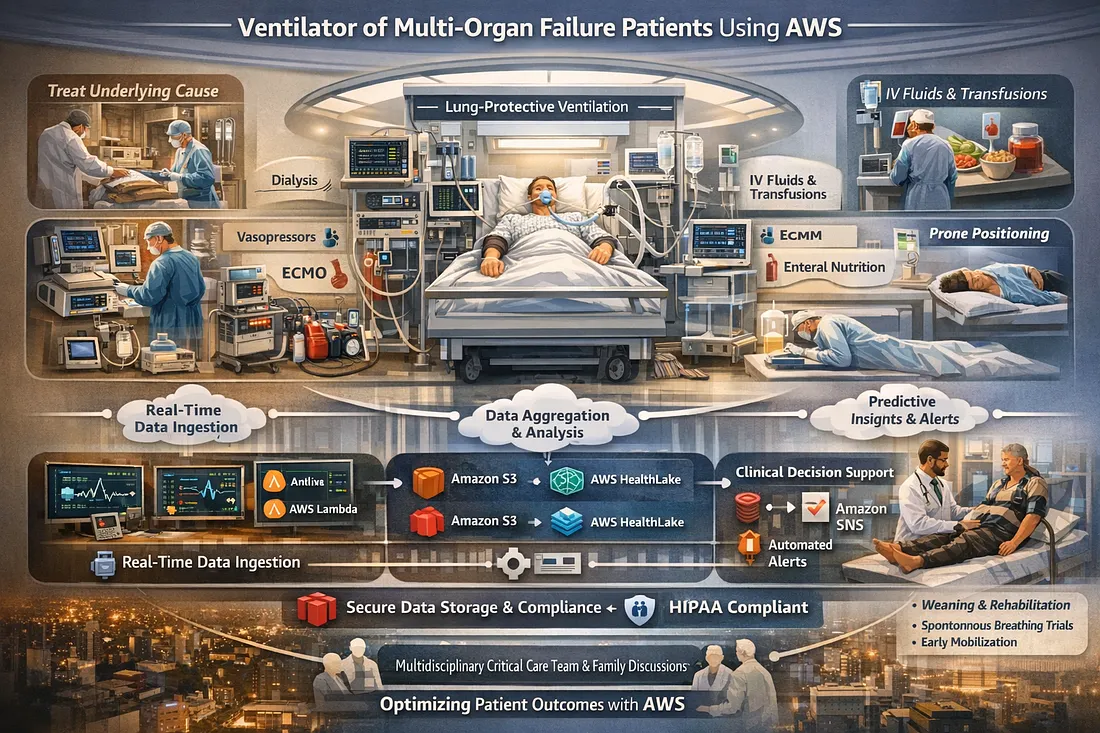
Ventilator Vanguard: AI-Powered MultiOrganFailure Survival Engine Using AWS
Cubed
Comments
Loading comments…