AWS managed services are offerings where Amazon operates the underlying infrastructure, patching, scaling, and failover mechanics so your team focuses on configuration, data, and application logic. The phrase also describes AWS Managed Services (AMS)—a human-operated enterprise program—not only serverless databases and queues.
This article covers both senses: the portfolio of managed building blocks most teams use daily, and when the formal AMS engagement model is worth evaluating.
Why teams reach for managed services on AWS
Every hour spent babysitting Kafka brokers or database replication is an hour not spent on product differentiation. Managed services trade control for reduced operational load:
- Automated backups and minor version upgrades on schedules you define.
- Multi-AZ resilience patterns baked into the service contract.
- Integration with IAM, CloudWatch, and VPC endpoints using familiar APIs.
- Usage-based billing instead of over-provisioned EC2 fleets sitting idle.
The tradeoff is vendor-specific behavior, egress costs, and occasionally configuration ceilings you would not hit on self-managed open source.
Categories of managed services you will deploy
Compute
- AWS Lambda for event-driven functions without patching servers.
- AWS Fargate for containers without managing ECS/EKS worker nodes directly.
- Elastic Beanstalk (less fashionable but still viable) for opinionated PaaS-style deploys.
Choose based on cold-start tolerance, long-running work, and whether you need sidecars or DaemonSets only Kubernetes provides cleanly.
Data stores
- Amazon RDS and Aurora for relational workloads with automated backups and read replicas.
- DynamoDB for key-value and document patterns at single-digit millisecond scale when access patterns fit.
- ElastiCache (Redis/Memcached) for session caches and rate limiting.
- Amazon OpenSearch Service when you need managed search clusters without operating Elasticsearch yourself.
Match engine to access pattern, not resume familiarity alone.
Messaging and integration
- Amazon SQS and SNS for decoupling producers and consumers.
- Amazon EventBridge for event buses with schema discovery and third-party SaaS integration.
- AWS Step Functions for durable workflows with visual state machines.
These replace much custom cron-and-queue glue in growing architectures.
Analytics and streaming
- Amazon Kinesis for stream ingestion; Managed Flink (formerly Kinesis Data Analytics) for stateful processing when teams lack Flink ops experience.
- AWS Glue for cataloging and ETL jobs; Athena for ad hoc SQL on S3.
Pipelines often mix managed extract/load with self-managed transform logic in containers when Glue constraints bite.
Security and secrets
- AWS KMS for encryption keys; Secrets Manager and Parameter Store for credential rotation and hierarchical config.
- AWS WAF and Shield layered on CloudFront or ALB fronts.
Managed controls reduce foot-guns but still require correct IAM policies—there is no managed service for misconfigured s3:PutObject.
Operational patterns that keep costs predictable
Right-size before enabling every feature flag. Multi-AZ RDS, provisioned IOPS, and idle NAT gateways silently accumulate. Turn on high availability when RTO/RPO demand it, not by default on sandboxes.
Tag everything for cost allocation. Use consistent Environment, Team, and Service tags; activate cost anomaly detection early.
Understand data transfer math. Cross-AZ traffic, NAT processing, and cross-region replication dominate surprises. Architect microservices with data locality in mind.
Use lifecycle policies on S3 backing logs and analytics. Managed services still produce unstructured blobs that grow forever without rules.
Managed vs self-managed: a decision checklist
Ask:
- Is this a differentiator or a commodity? Commodity caches and queues are prime managed candidates.
- Do we have 24/7 on-call for the datastore? If not, managed RDS beats heroic self-hosted Postgres unless compliance forbids it.
- Are compliance controls easier through a shared responsibility doc? Regulated industries often audit AWS’s control matrix once instead of every bespoke cluster.
- Will we need kernel modules or exotic extensions? If yes, EC2 or EKS with your own images may return.
Document the decision in an ADR so future hires do not relitigate from scratch.
AWS Managed Services (AMS) the enterprise program
Distinct from “managed” S3 or Lambda, AWS Managed Services is a subscription where AWS operations specialists run your AWS environment under agreed runbooks: incident response, patch orchestration, backup monitoring, and change windows aligned to ITIL-style processes.
Consider AMS when:
- You are migrating a large estate from on-prem VMware or another cloud and need a staffed landing zone quickly.
- Internal cloud teams are understaffed but executives require enterprise change control.
- You want vendor-aligned runbooks for well-architected reviews and ongoing optimization reports.
AMS is rarely the first lever for a twenty-person product startup. It shines at thousands of accounts or strict enterprise governance where labor cost of in-house NOC exceeds the subscription.
Engagement tiers differ; contracts define which activities remain customer-owned (application code, architecture choices) versus provider-executed (patch cadence, monitoring triage).
Landing zone and Control Tower synergy
Managed services sit inside organization structure. AWS Control Tower, IAM Identity Center, and centralized logging accounts make managed databases and functions auditable. Without account vending standards, “managed” becomes sprawl of one-off VPCs nobody can trace.
Invest early in:
- Separate workload accounts per environment.
- Centralized CloudTrail and Config aggregators.
- Service control policies preventing public S3 or unapproved regions.
Managed components inherit the security posture of the account they live in.
Migration sketch: lift, then refine
A pragmatic sequence for legacy apps:
- Rehost on EC2 or Elastic Beanstalk inside a hardened VPC with RDS replacing self-managed DB on VMs.
- Replace adjacent middleware with SQS/EventBridge instead of self-run ActiveMQ or cron on instances.
- Extract stateless tiers to Lambda or Fargate when deploy frequency justifies refactor.
- Replatform data to Aurora or DynamoDB only after profiling queries and proving parity.
Skipping straight to serverless without observability baseline produces undebuggable systems.
Observability across managed components
CloudWatch metrics and logs are table stakes. Also:
- Enable Enhanced Monitoring or Performance Insights on databases when latency mysteries appear.
- Use AWS X-Ray or OpenTelemetry collectors on Lambdas and containers for trace continuity.
- Wire SNS alerts to on-call with runbooks linking to console deep links.
Managed does not mean “never pages you.” It means the failure modes differ—throttling, quota limits, and service-specific events replace disk-full alerts on your VM.
FAQ
What counts as an AWS managed service?
Generally any AWS API-first product where AWS runs the control plane and underlying hosts: RDS, S3, Lambda, etc. EC2 is “managed hardware, customer-managed OS” unless you use managed services on top.
How is AMS different from a managed service like RDS?
RDS is a product. AMS is an operations subscription spanning many products with human operators following enterprise processes.
Are managed services always cheaper?
Not at steady state for predictable high throughput. They win on labor savings, faster time-to-market, and reduced outage risk. Model TCO with engineer salaries and incident history, not only list prices.
Can we leave a managed service later?
Export paths vary. DynamoDB and S3 have clear export tooling; some proprietary features lock you in. Plan egress and schema portability before committing critical state.
Do managed services satisfy HIPAA or PCI?
AWS publishes compliance programs; you still configure services within scope and sign Business Associate Agreements where required. Managed does not transfer legal liability for your data classification.
When should startups avoid AMS?
When speed and architectural experimentation matter more than ITIL gates. Use managed products, not the AMS operations contract, until compliance or scale forces enterprise process.
Further Reading
Discover more articles on similar topics across our network

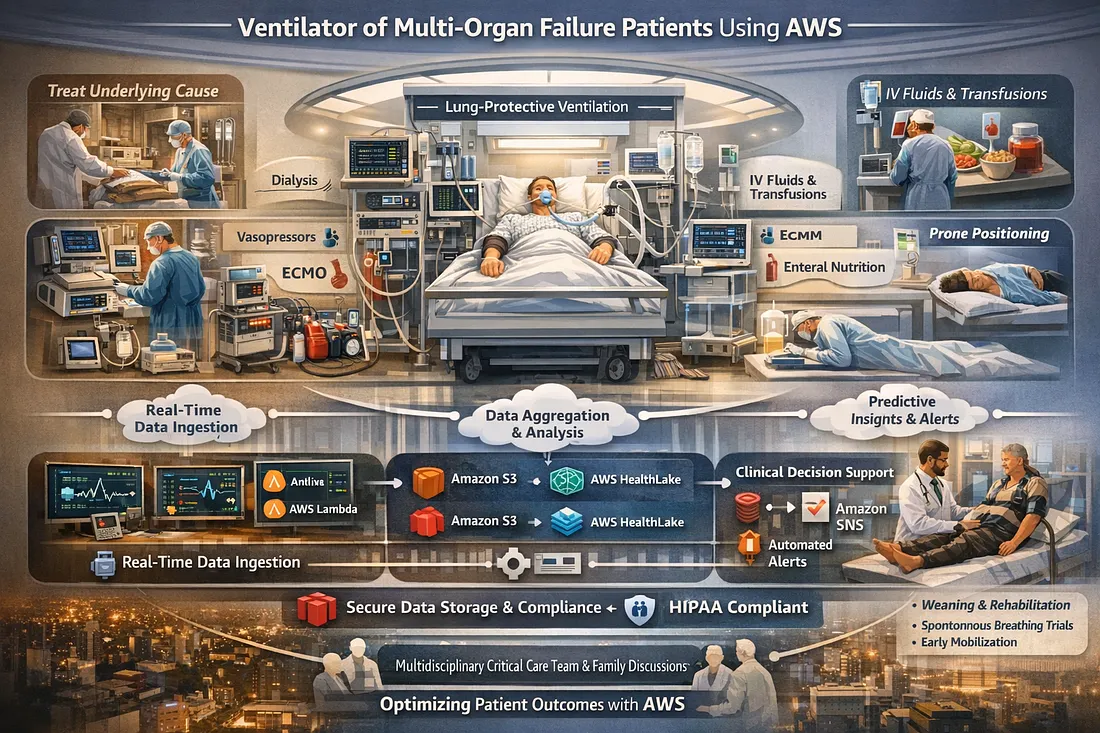
Ventilator Vanguard: AI-Powered MultiOrganFailure Survival Engine Using AWS
Cubed
Comments
Loading comments…