Hey everyone!
As a developer, I’ve always been fascinated by the bleeding edge of technology. Lately, it feels like the “bleeding edge” is practically synonymous with Large Language Models (LLMs) and Generative AI. We’re all trying to figure out how to harness this power, integrate it into our applications, and ultimately, make our software smarter and more useful.
My own journey into the LLM space has been a rollercoaster. From wrestling with local model deployments to trying to stitch together various APIs, I’ve seen firsthand the complexities involved. So, when Amazon Bedrock (or AWS Bedrock, as many of us instinctively call it) was announced, my ears perked up. Another player in the rapidly evolving LLM platform game? And from AWS, no less? I had to dive in, get my hands dirty, and see if this was the developer productivity tool we’ve been waiting for.
This isn’t going to be a marketing brochure. This is my honest, real-world assessment after spending some quality time building with Bedrock. Let’s get into it.
What Exactly Is Amazon Bedrock?
At its core, Amazon Bedrock is a fully managed service that provides access to a selection of high-performing Foundation Models (FMs) from Amazon and leading AI companies like Anthropic, AI21 Labs, Stability AI, and Cohere, all through a single API.
Think of it this way: instead of individually integrating with different model providers, managing API keys for each, handling rate limits, and worrying about infrastructure, Bedrock gives you a unified gateway. It’s designed to simplify the process of building, scaling, and deploying generative AI applications. It’s about letting us, the developers, focus on the application logic rather than the underlying AI plumbing.
The Good Stuff: Where Bedrock Shines (PROS)
After several weeks of poking around, building prototypes, and even integrating it into a small internal tool, here’s what I genuinely appreciate about Amazon Bedrock:
- Managed Service & Reduced Operational Overhead: This is a massive win. I don’t want to manage GPU instances, worry about model serving, or scale inference endpoints. Bedrock handles all of that. I simply make an API call, and it works. This frees up an incredible amount of time and mental energy, letting me focus on the actual problem I’m trying to solve with the LLM, rather than the infrastructure. For any team already deep in the AWS ecosystem, this feels like a natural extension of their existing workflow.
- Model Diversity & Choice: This is perhaps Bedrock’s strongest selling point. I’m not locked into a single model provider. I can easily experiment with Anthropic’s Claude, AI21 Labs’ Jurassic models, Amazon’s own Titan models (Text, Embeddings, Multimodal), and even Stability AI’s Stable Diffusion for image generation. This flexibility is gold. For example, I found Claude to be excellent for complex reasoning tasks, while Titan Text was surprisingly good for cost-effective summarization. Being able to swap models with minimal code changes (mostly just changing the
modelIdin the API call) is incredibly powerful for finding the "best fit" for a specific use case without rebuilding everything. - Agents for Bedrock: Orchestration Made Easier: This feature genuinely impressed me. Building multi-step LLM applications that can call external APIs (tools) and manage conversational flow is complex. Agents for Bedrock abstract much of that away. I defined my tools (Lambda functions in my case) and gave the agent a goal, and it handled the planning, tool invocation, and response generation. It drastically reduces the boilerplate code I’d normally write for intent recognition, parameter extraction, and function calling. For anyone trying to build sophisticated, goal-oriented AI applications, this is a game-changer for developer productivity.
- Knowledge Bases for Bedrock (Built-in RAG): Retrieval Augmented Generation (RAG) is essential for grounding LLMs in proprietary or up-to-date information, drastically reducing “hallucinations.” Bedrock’s Knowledge Bases make implementing RAG surprisingly straightforward. I simply point it to an S3 bucket containing my documents, choose an embedding model (like Titan Embeddings), and link it to an Agent. Bedrock handles the chunking, embedding, vector database management (using OpenSearch Serverless or Pinecone/Redis Enterprise as external options), and retrieval. This is a huge time-saver and makes building enterprise-grade, data-aware LLM applications much more accessible.
- Integration with the AWS Ecosystem: For teams already heavily invested in AWS, Bedrock feels right at home. It integrates seamlessly with services like Lambda for custom logic, S3 for data storage, CloudWatch for monitoring, and IAM for robust access control. This means I can leverage my existing AWS security and governance frameworks, which is crucial for enterprise software development. The learning curve for existing AWS users is significantly flatter here.
The Not-So-Good Stuff: Where Bedrock Can Improve (CONS)
No tool is perfect, and Bedrock, while powerful, has its quirks and areas for improvement. Here are my honest drawbacks:
- Cost Complexity and Transparency: While the managed service is great, understanding and optimizing costs can be a bit opaque. Each model has its own pricing structure (per input token, per output token, sometimes even per image generation), and these can vary significantly. When you start adding agents, knowledge bases, and fine-tuning, the bill can quickly add up. It’s not always clear how much a complex interaction will cost upfront, making budget forecasting a bit tricky. I’ve found myself running smaller tests to get a feel for the token counts before scaling up.
- Vendor Lock-in (to AWS Infrastructure): While Bedrock offers diverse models, you’re still fundamentally within the AWS ecosystem. If your organization isn’t already on AWS, or if you’re aiming for a multi-cloud strategy, integrating Bedrock means buying into the AWS way of doing things. While the APIs are standard, moving your entire LLM stack to a different cloud provider later could involve a significant re-architecture. This isn’t unique to Bedrock, but it’s a consideration for strategic planning.
- Learning Curve for Advanced LLM Concepts: Bedrock simplifies access to FMs, but it doesn’t eliminate the need to understand underlying LLM principles. Concepts like effective prompt engineering, understanding model limitations, fine-tuning strategies, and the nuances of RAG still require significant learning and experimentation. While the service makes deployment easier, getting good results still demands a strong grasp of these AI/ML fundamentals. It’s not a magic bullet that makes you an instant AI expert.
- Feature Maturity and Rapid Evolution: Bedrock is still a relatively new service in a fast-moving field. While core features are solid, some aspects might still be evolving. For instance, the UI for managing agents or knowledge bases, while functional, sometimes feels a bit basic compared to other AWS services. I’ve also encountered situations where new features are announced frequently, requiring me to stay on top of updates and potentially refactor small parts of my code to leverage them. This rapid pace is exciting but can also mean a moving target for long-term project stability.
- Not a “Code Editor” or IDE in Itself: This might sound obvious, but it’s important to clarify. Bedrock is a backend service. It’s not a productivity tool in the sense of a code editor or IDE that helps you write code faster within your development environment. You still do your actual software development in VS Code, IntelliJ, or whatever your preferred IDE is. Bedrock provides the API endpoints and managed services that your code then interacts with. It enhances your backend capabilities, but it doesn’t fundamentally change your frontend developer experience or local development workflow directly.
Real-World Use Cases & Examples
I’ve seen and built a few things with Bedrock that really highlight its potential:
- Intelligent Customer Support: Using Agents and Knowledge Bases, I prototyped a chatbot that could answer specific questions about our internal documentation. By grounding Claude with our data, it provided accurate and consistent answers, reducing the load on our support team.
- Content Generation & Summarization: For marketing, I’ve used Titan Text to quickly draft variations of social media posts or summarize long articles into concise bullet points. The ability to swap models means I can try different tones without much effort.
- Code Assistance (Indirectly): While not a direct code editor integration, I’ve used Bedrock (specifically Claude) within a custom internal tool to generate code snippets based on descriptions or refactor existing code. It’s a powerful way to augment a developer’s workflow, even if it’s not baked into the IDE directly.
- Data Extraction & Analysis: For processing unstructured data (like customer feedback or legal documents), I’ve leveraged Bedrock to extract key entities, summarize sentiment, and even generate structured JSON from free-form text.
My Personal Conclusion & Recommendations
Overall, my experience with Amazon Bedrock has been largely positive. It’s a powerful, enterprise-ready platform that significantly lowers the barrier to entry for building sophisticated generative AI applications. It’s not perfect, and the learning curve for the underlying AI concepts is still there, but it handles a huge amount of the operational burden.
Who should absolutely consider Amazon Bedrock?
- AWS-Centric Teams: If your organization is already heavily invested in AWS, Bedrock is a natural fit. You’ll leverage existing security, governance, and operational expertise.
- Enterprises Needing Scalability & Security: For large-scale deployments that require robust security, fine-grained access control (IAM), and seamless integration with other AWS services, Bedrock is an excellent choice.
- Developers Building Complex LLM Applications: If you’re looking to build applications that require RAG, tool use (Agents), or fine-tuning, Bedrock provides a streamlined path compared to managing these components individually.
- Teams Prioritizing Model Flexibility: The ability to easily swap between different FMs from various providers is a huge advantage for experimentation and finding the optimal model for your specific needs.
Who might want to proceed with caution or consider alternatives?
- Teams Not on AWS: If you’re not already in the AWS ecosystem, the initial overhead of setting up an AWS account and learning the basics might be a hurdle.
- Small, Budget-Conscious Projects: For very small projects where a single, specific LLM API (like OpenAI’s directly) might suffice, Bedrock’s comprehensive features and associated costs might be overkill.
- Those Seeking Absolute Lowest-Level Control: If you need to deeply customize model architectures, train from scratch, or require very specific, highly optimized inference pipelines outside of what Bedrock offers, you might find yourself needing to use SageMaker or even custom deployments.
Amazon Bedrock is a critical piece of the puzzle for bringing enterprise-grade generative AI to the masses. It bridges the gap between raw foundation models and scalable, production-ready applications. It’s not just another API endpoint; it’s a comprehensive platform that significantly boosts developer productivity by abstracting away much of the underlying complexity.
My recommendation? If you’re building with LLMs and you’re already in AWS, or considering a move there for your AI initiatives, give Bedrock a serious look. Start with a small prototype, leverage the free tiers where available, and experience how much faster you can iterate. The future of software development is increasingly intertwined with AI, and tools like Bedrock are making that future more accessible for all of us.
What are your thoughts? Have you tried Bedrock? Share your experiences in the comments below!
Further Reading
Discover more articles on similar topics across our network

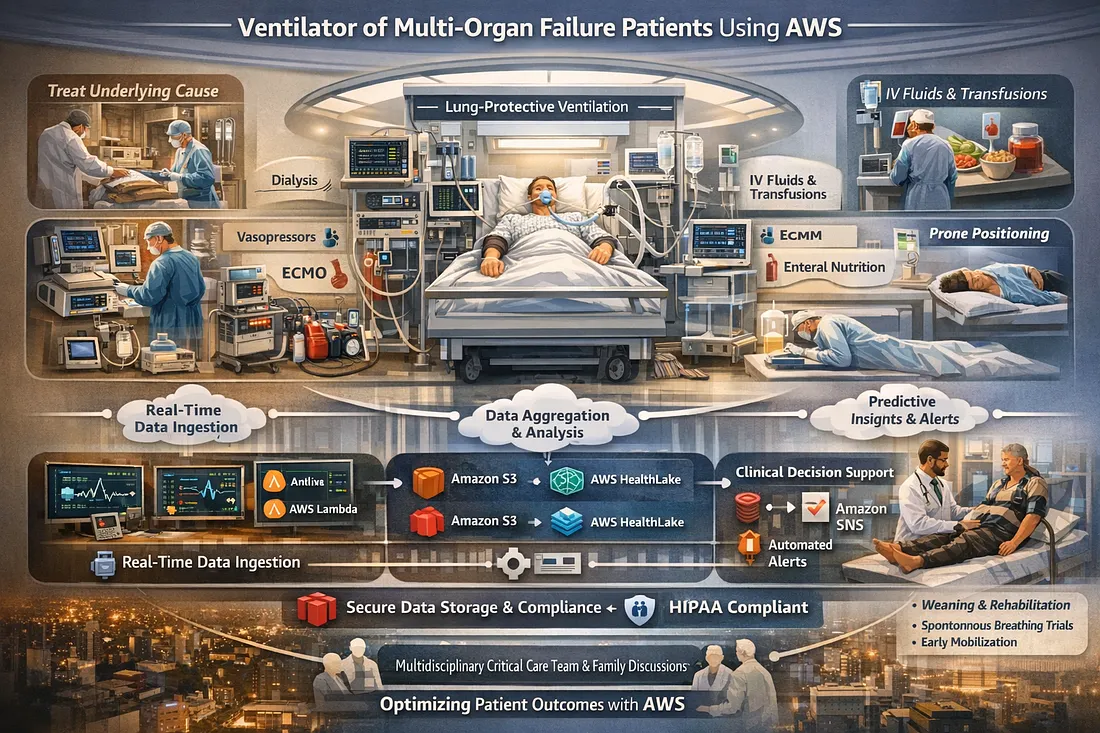
Ventilator Vanguard: AI-Powered MultiOrganFailure Survival Engine Using AWS
Cubed
Comments
Loading comments…