
Let’s be honest: most people use AWS like it’s just a really expensive basement full of someone else’s computers. You spin up an EC2 instance, you install Linux, you argue with your team about which Ubuntu LTS version to use, and you pat yourself on the back for being “in the cloud.” But here is the cold, hard truth — if you’re just treating AWS like a remote data center, you’re missing the entire point.
The real crown jewel of the Amazon empire isn’t the massive compute clusters or the endless storage of S3. It’s that tiny, unassuming, “blink-and-you’ll-miss-the-billing-cycle” function known as AWS Lambda.
While everyone else is busy tuning their auto-scaling groups and worrying about “server density,” the smartest engineers are writing thirty lines of code that run for 200 milliseconds and then disappear into the ether. Lambda is the hidden champion of the cloud because it isn’t just a place to run code; it is the connective tissue — the nervous system — of your entire infrastructure.
The Nervous System of the Cloud
The biggest misconception about Lambda is that it’s just “functions as a service.” People think, “Oh, I can run my API on it so I don’t have to manage a server.” Sure, you can do that, but that’s like using a Ferrari to go through a drive-thru. It works, but you’re missing the thrill.
The real magic happens when you realize that AWS is an event-generating machine. Almost every single service in the AWS ecosystem is constantly whispering (or screaming) about what it’s doing. Lambda is the only service designed to sit there, ears pinned back, waiting to react to those whispers.
Most developers look at an S3 bucket and see a place to put files. An experienced architect looks at an S3 bucket and sees a trigger. The moment a user uploads a profile picture, the bucket emits a “PutObject” event. Within milliseconds, a Lambda wakes up, resizes that image into four different formats, pushes them to a CDN, and updates a database record. By the time the user’s browser has even refreshed, the Lambda has already done its job and died. You didn’t have to manage a “worker node,” you didn’t have to monitor a queue, and — crucially — you didn’t pay for a single second of idle CPU time.
Listening to the “Death Rattle” of an EC2
If you want to see where Lambda truly shines, look at the darker corners of your infrastructure. Take the EC2 termination notification. In a traditional environment, when a server dies or gets shut down, it’s a tragedy. In a Lambda-driven environment, it’s just another event.
You can set up a Lambda to listen for that specific “termination” event. The second an instance starts to go dark, your Lambda can spring into action: it can detach volumes, scrub temporary data, send a sarcastic message to your Slack #alerts channel, and reassign an Elastic IP. It’s the ultimate “cleanup crew” that only shows up when there’s a mess to be made.
The same logic applies to DynamoDB deletions. When a record is wiped from your database, a DynamoDB Stream can fire off an event. Your Lambda catches it and says, “Hey, that user just deleted their account; I should probably go into S3 and delete their personal folders too.” This kind of reactive architecture ensures your system stays synchronized without you having to write complex, monolithic “cleanup” cron jobs that inevitably fail and leave orphaned data everywhere.
Pro Tip: If you’re still writing cron jobs on a persistent server to “check for new files” or “clean up old records,” you’re living in 2014. Stop it. Let the events come to you.
The Economy of Doing Nothing
The most beautiful thing about the Lambda philosophy is the cost — or rather, the lack of it. We’ve been conditioned by decades of IT to think that “availability” equals “running.” If you want a service to be ready to handle a request, it has to be powered on, right?
Wrong. Lambda is the art of Extreme Laziness. You are essentially telling AWS, “I have this logic, but I don’t want to think about it, and I certainly don’t want to pay for it while nobody is using it.”
When you realize that your entire backend can be a series of reactive sparks rather than a constantly burning furnace, your bill drops, your complexity vanishes, and your system becomes inherently more resilient.
So, next time you’re about to launch a “microservice” on a persistent container, ask yourself: “Could this just be a tiny function that reacts to an event?” If the answer is yes, then you’ve finally understood the biggest advantage AWS has to offer. Now, go delete some servers. It feels great.
Further Reading
Discover more articles on similar topics across our network

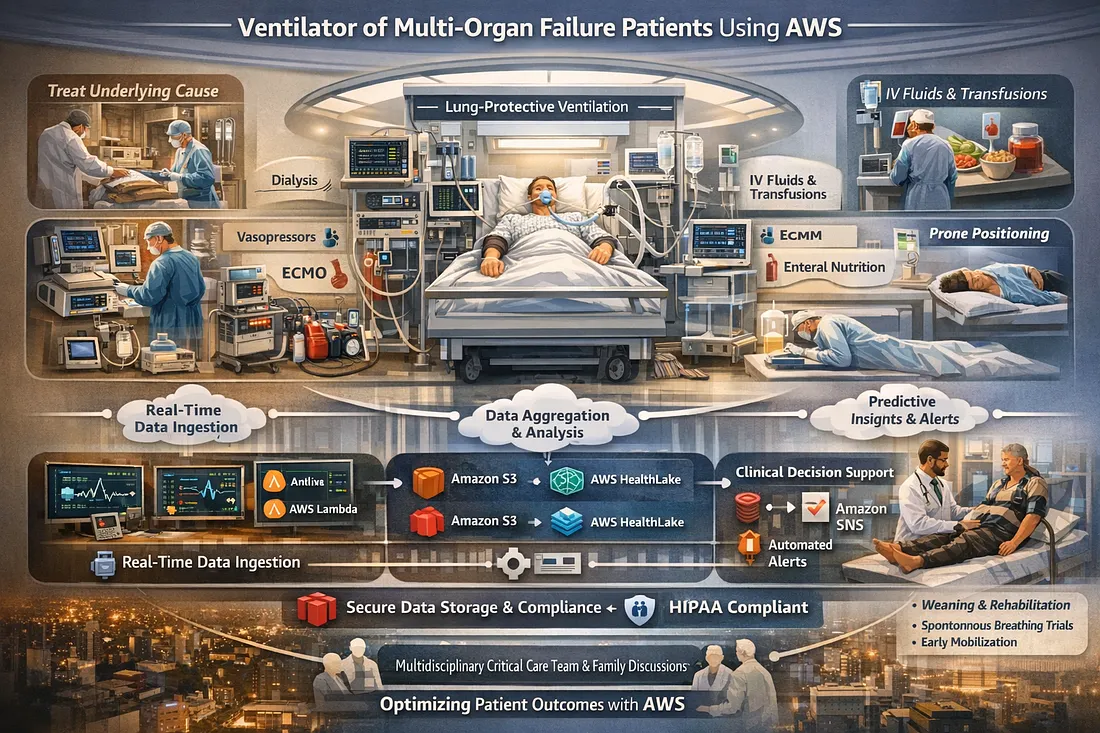
Ventilator Vanguard: AI-Powered MultiOrganFailure Survival Engine Using AWS
Cubed

Comments
Loading comments…