Most teams are scaling AI faster than they’re securing it.
That’s exactly why DevSecOps isn’t optional anymore — it’s mission-critical.
The Shift: From Code Risk → Intelligence Risk
In traditional software, security focused on:
- Vulnerable code
- Misconfigured infrastructure
- Unauthorized access
But AI changes the game completely.
Now you’re dealing with:
- Data poisoning
- Model manipulation
- Prompt injection attacks
- Sensitive data leakage
This isn’t just application security. This is decision security.
When your system starts making autonomous decisions, the blast radius multiplies.
AI Pipelines Are the New Attack Surface
Let’s break it down.
A typical AI system includes:
- Data ingestion pipelines
- Model training workflows
- Model storage & versioning
- Inference APIs
- Feedback loops
Each of these is a potential entry point for attackers.
And unlike traditional apps, AI systems can be silently corrupted without breaking.
That’s the scary part.
Real Problem: Speed > Security
AI teams are shipping fast:
- New models every week
- Continuous fine-tuning
- Rapid experimentation
But security?
Still treated as a checkpoint at the end.
That approach is dead.
Because:
If you secure after deployment, you’ve already lost.
Enter DevSecOps: Security as a Continuous System
DevSecOps isn’t a tool. It’s a mindset shift:
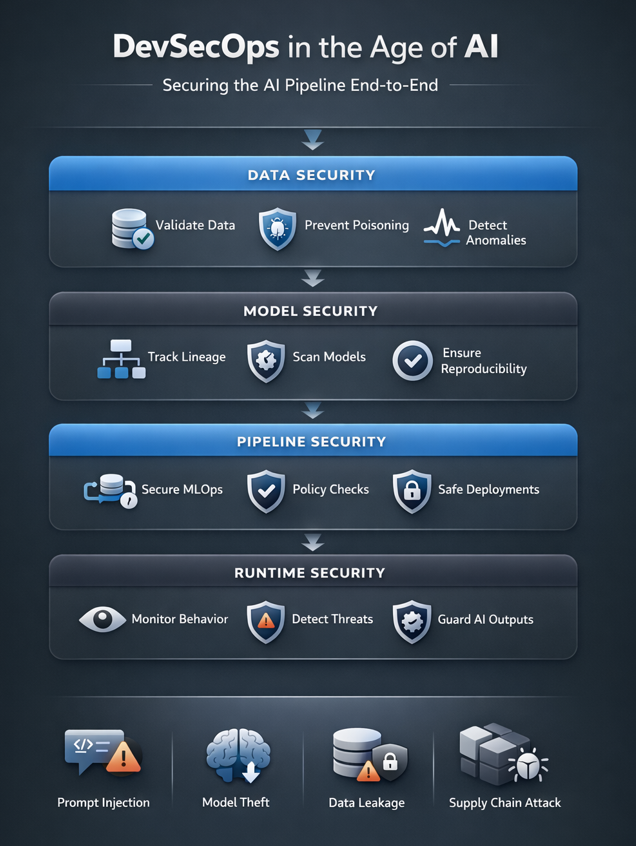
Security must move at the same speed as development.
In AI systems, this means embedding security into:
1. Data Layer
- Validate data sources
- Detect anomalies in datasets
- Prevent poisoning attacks
2. Model Layer
- Track model lineage
- Ensure reproducibility
- Scan for vulnerabilities in models
3. Pipeline Layer
- Secure CI/CD for ML (MLOps pipelines)
- Enforce policy checks before deployment
4. Runtime Layer
- Monitor model behavior
- Detect drift and malicious outputs
- Apply real-time guardrails
New Threats DevSecOps Must Handle
AI introduces threats that didn’t exist before:
Prompt Injection
Attackers manipulate input to override system instructions.
Model Extraction
Stealing your model via repeated queries.
Data Leakage
LLMs exposing sensitive training data.
Supply Chain Attacks
Compromised open-source models or datasets.
Traditional DevOps pipelines are not designed for this.
DevSecOps is.
Compliance Is Catching Up — Fast
Regulations around AI are accelerating:
- Data privacy laws
- AI governance frameworks
- Responsible AI guidelines
Organizations will soon be required to:
- Explain model decisions
- Prove data integrity
- Audit AI systems
Without DevSecOps, this becomes impossible.
The Business Impact (No Sugar-Coating)
If you ignore DevSecOps in AI:
- You risk data breaches at scale
- You expose your company to legal liability
- You lose customer trust instantly
- You ship systems you don’t fully control
And the worst part?
You may not even know something is wrong.
The Future: DevSecOps → AI-Native Security
We’re moving toward a world where:
- Security policies are AI-driven
- Systems auto-detect threats
- Pipelines self-heal
This is where DevSecOps evolves into autonomous security systems.
Call it:
DevSecOps → AIOps Security → Agentic Security
Final Thought
AI is not just another layer in your stack.
It’s a multiplier.
- If your security is weak → AI amplifies the damage
- If your security is strong → AI amplifies resilience
So the question isn’t:
“Do we need DevSecOps?”
The real question is:
“Can we afford to run AI without it?”
- AI introduces new, invisible security risks
- Traditional DevOps is not enough
- DevSecOps embeds security across the AI lifecycle
- Organizations that ignore this will fall behind — fast
If you’re building AI systems today, DevSecOps isn’t a best practice.
It’s survival.
Further Reading
Discover more articles on similar topics across our network

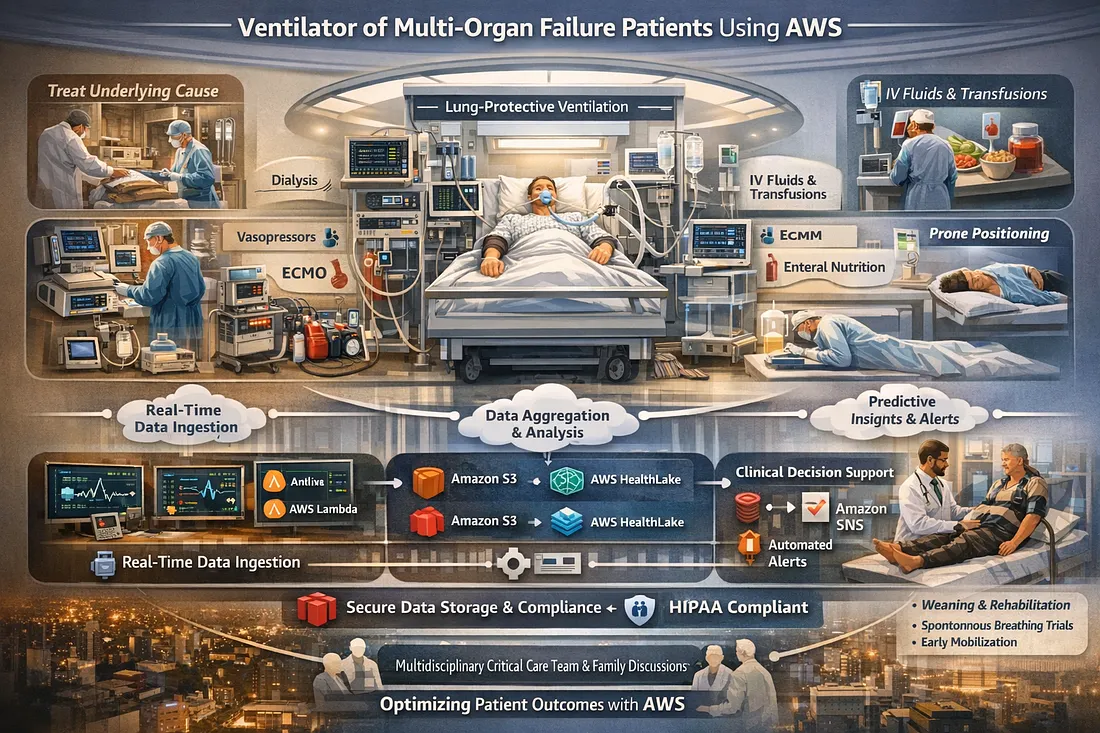
Ventilator Vanguard: AI-Powered MultiOrganFailure Survival Engine Using AWS
Cubed
Comments
Loading comments…