
How Angular 22 quietly removes complexity from modern web applications
😊 Every Angular Developer Has Been There
You start your day with what seems like a simple task.
Maybe you’re building:
· A customer dashboard
· A user profile page
· An analytics screen
· A settings form
Nothing unusual and complicated. The requirement sounds straightforward:
“Fetch some data and display it.”
Easy, right? 😄
A few hours later, things look very different.
You’re managing:
✅ Subscriptions
✅ Loading states
✅ Error handling
✅ Form validation
✅ Lifecycle hooks
✅ Change detection quirks
And suddenly, the code responsible for supporting the feature becomes larger than the feature itself.
Sound familiar? 😅
If you’ve worked on Angular projects for more than a year, you’ve probably experienced this dozens of times.
And that’s exactly why Angular 22 matters.
🔥 The Real Story Behind Angular 22
Most framework releases are marketed around new features.
“Look at this new API.”
“Look at this new component.”
“Look at this new syntax.”
Angular 22 is different.
The most important thing about Angular 22 isn’t what it adds.
It’s what it helps developers stop writing.
💡 Think about that for a second.
What if your next feature required:
· Less boilerplate
· Less synchronization code
· Fewer lifecycle hooks
· Fewer subscriptions
· Simpler forms
Not because you became a better developer. But because the framework itself became smarter.
That’s the direction Angular is heading.
And Angular 22 is another major step forward.
⚠️ The Hidden Cost of “Working Code”
One of the biggest misconceptions in software development is this:
If the code works, the problem is solved.
Unfortunately, that’s only half the story.
Let’s look at a common example.
Imagine you’re building a page that displays users from an API.
A traditional Angular implementation might look like this:
loading = false;
users: User[] = [];

ngOnInit() {
 this.loading = true;

 this.userService.getUsers()
     .subscribe(users => {
      this.users = users;
      this.loading = false; });
}
Looks perfectly fine.
In fact, thousands of Angular applications use patterns exactly like this.
But let’s zoom out. 🔍
What was the original requirement?
Fetch users and display them.That’s it.
Yet the code is also responsible for:
✅ Loading state management
✅ Subscription handling
✅ State synchronization
✅ Error scenarios
✅ Future cleanup logic
The business requirement takes one sentence.
The supporting code takes multiple moving parts.
And this is where complexity begins.
Press enter or click to view image in full size
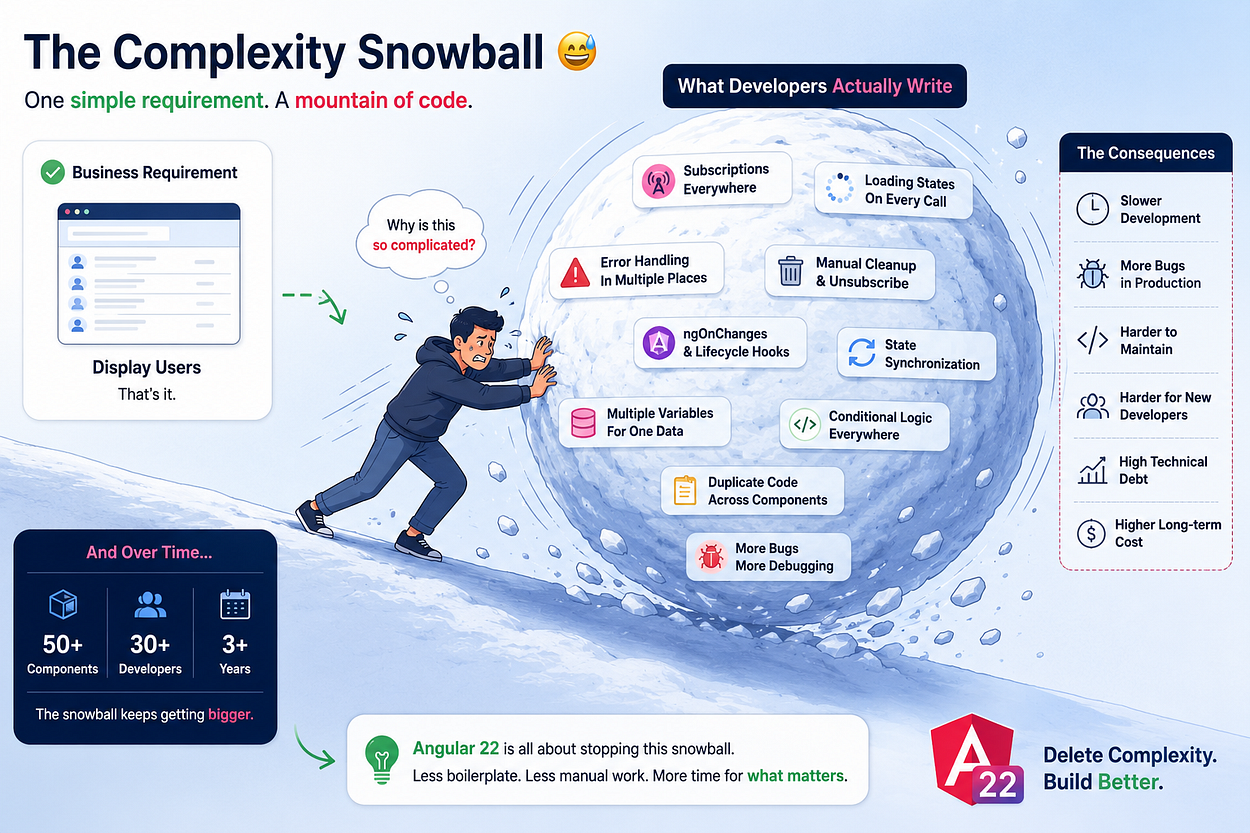
😅 A simple feature rarely stays simple. Over time, subscriptions, lifecycle hooks, and state management can snowball into significant complexity. Angular 22 is designed to help teams break that cycle.
😬 The Snowball Effect Nobody Talks About
One API call isn’t a problem.
Ten API calls aren’t a problem.
But what happens when your application grows?
Imagine an enterprise HR platform.
The application contains:
📋 Employee profiles
📋 Payroll information
📋 Leave management
📋 Attendance tracking
📋 Performance reviews
📋 Recruitment workflows
Now multiply the previous pattern across:
· 50 pages
· 200 components
· 30 developers
· 3 years of development
Suddenly you’re maintaining hundreds of subscriptions and thousands of lines of framework-related code.
This is where technical debt quietly starts growing.
Not because developers made mistakes.
Because the framework required a lot of manual coordination.
Angular 22 aims to reduce that burden.
🚦 Signal Forms: Forms Finally Feel Like Application State
Now, Let’s talk about one of the most exciting improvements in Angular 22.
Forms.
Every business application has them.
And every developer has suffered because of them at some point. 😅
Traditional Reactive Forms have served Angular extremely well.
A simple example looks like this:
profileForm = new FormGroup({
   firstName: new FormControl(''),
   lastName: new FormControl(''),
    email: new FormControl('')
});
Nothing wrong with it.
Until the form grows.
And it always grows.
😭 The Harsh Enterprise Reality
A real-world enterprise form rarely contains three fields.
It often contains:
✅ Personal Information
✅ Address Information
✅ Employment History
✅ Financial Details
✅ Tax Information
✅ Emergency Contacts
✅ Document Uploads
What started as:
new FormGroup({})
Slowly becomes:
new FormGroup({
   ...
   ...
   ...
   ...
    ...
});
Hundreds of lines later, developers spend more time navigating form structures than implementing business logic.
Sound familiar? 😊
💡 Angular 22 Changes the Conversation
With Signal Forms, Angular is moving toward a much more intuitive model.
Instead of treating forms as a separate universe, forms become a natural extension of application state.
profile = signal({
   firstName: '',
   lastName: '',
   email: ''
});
At first glance, this may not seem revolutionary.
But its impact becomes obvious in larger applications.
Developers can focus on:
✅ Business rules
✅ User experience
✅ Validation logic
Instead of constantly managing form infrastructure.
And that’s where productivity gains really happen.
🔥 A Real-World Example
Imagine you’re building an insurance onboarding application.
A new customer must complete:
· Personal details
· Employment details
· Medical history
· Financial information
· Identity verification
The form contains over 150 fields.
Some sections only appear when certain answers are selected.
Validation rules change dynamically.
Certain fields become required only under specific conditions.
Historically, managing this complexity required significant form configuration.
With Signal Forms, the code begins to feel closer to the actual business problem.
And when code mirrors business requirements, teams move faster.
That’s a huge win. 🚀
Press enter or click to view image in full size
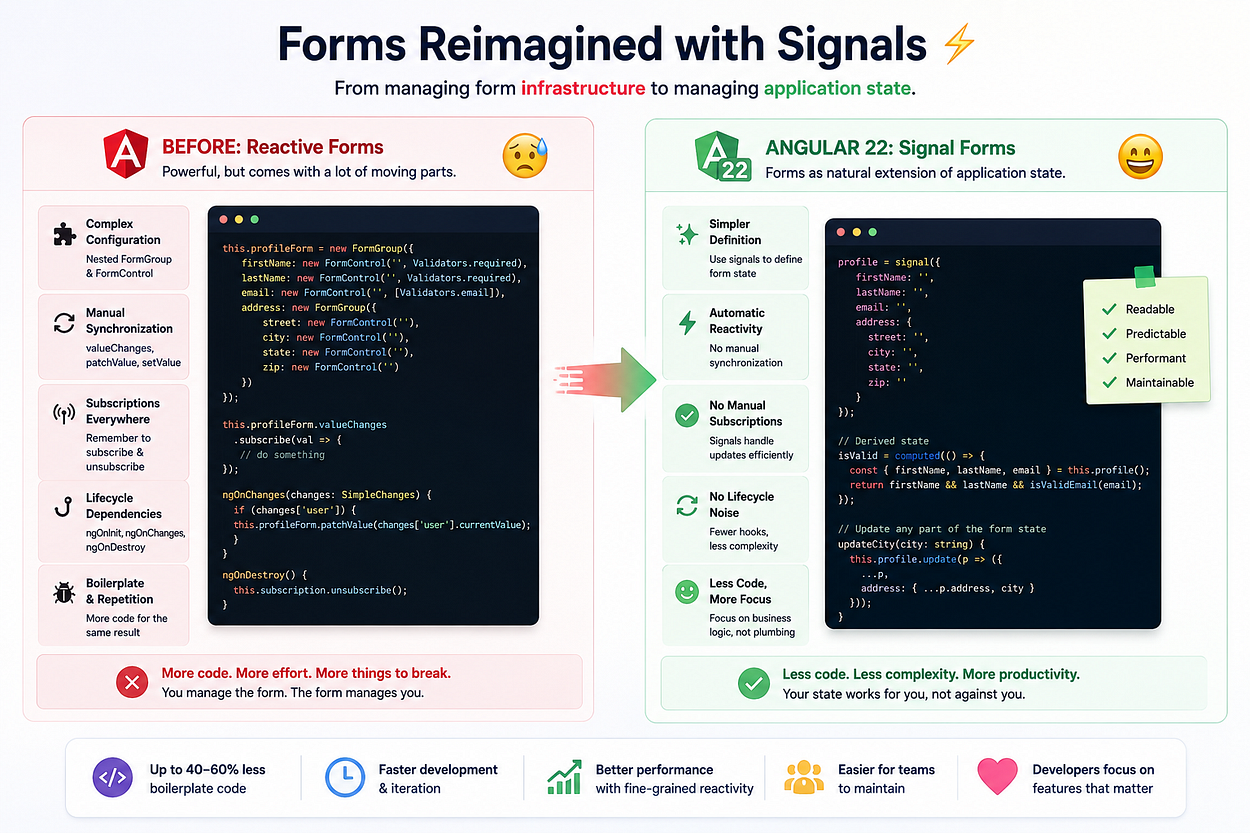
🚀 Signal Forms shift the focus from managing form infrastructure to managing application state. Less boilerplate means developers can spend more time building features and less time maintaining form plumbing.
😮 The Slow Retirement of ngOnChanges
For years, Angular developers have relied on lifecycle hooks.
Here’s a pattern you’ve probably seen countless times:
ngOnChanges(changes: SimpleChanges) {
 if (changes['user']) {
  this.calculateStatistics();
 }
}
It works.
But it raises a subtle question:
🤔 Why are we manually tracking dependencies?
Why must developers explicitly tell Angular what depends on what?
Angular’s signal-based architecture provides a cleaner alternative.
statistics = computed(() => {
  return calculateStatistics(this.user());
});
That’s it.
Whenever the user changes, the statistics automatically update.
✔️ No lifecycle hook.
✔️ No manual checks.
✔️ No additional coordination.
💡 The dependency becomes self-documenting.
And self-documenting code is easier to maintain.
🙌 Here’s What Angular 22 Is Really Doing
Angular 22 isn’t trying to make developers write more reactive code.
It’s trying to make developers write less code altogether.
Less boilerplate.
Less synchronization.
Less maintenance.
Less complexity.
And honestly?
That’s probably the most valuable framework feature any development team can ask for. 😊
Comments
Loading comments…