Teams searching for AWS ETL tools usually want to move data from operational databases, SaaS exports, or logs into a lake or warehouse—and keep doing so on a schedule without babysitting servers. AWS does not ship one product named “ETL”; it offers a menu of managed services you compose based on volume, latency, and how much Spark or SQL your team already knows.
This comparison focuses on practical starting points, not every analytics SKU in the console.
What ETL means on AWS today
Classic extract, transform, load still applies, but shapes vary:
- ELT — land raw files in S3, transform with SQL or Spark in place.
- Streaming — continuous ingest with minute-level or sub-minute latency.
- Orchestration — coordinate batch steps, retries, and dependencies.
Your “tool” is often a pipeline: ingestion + catalog + processing + consumption.
Amazon S3 as the hinge
Most AWS analytics paths treat S3 as durable cheap storage. Parquet or ORC with compression is the default interchange format for Athena, Redshift Spectrum, and Glue jobs. Partition by date (s3://bucket/events/year=2026/month=11/day=17/) early—rewriting years of data because you forgot partitioning is painful.
AWS Glue
Glue is the closest to a traditional managed ETL service:
- Glue Data Catalog — Hive-compatible metastore for tables.
- Glue Crawlers — infer schemas from S3 (good for exploration; tighten types in production).
- Glue Jobs — Apache Spark (Python or Scala) or Python shell for smaller tasks.
- Glue Studio — visual job authoring for straightforward transforms.
Choose Glue when you need scheduled Spark transforms at moderate scale and want IAM-native integration without operating EMR clusters daily.
Watch for:
- Cold start and DPUs — cost scales with workers; right-size development jobs.
- Job bookmarking for incremental loads instead of full table scans.
- Data quality rules if you need assertions beyond “job succeeded.”
Amazon Athena
Athena is serverless SQL over S3 catalog tables. It is not a long-running ETL engine, but it is powerful for the T in ELT: INSERT INTO ... SELECT patterns, CTAS queries that write new Parquet datasets, and ad hoc cleansing.
Use Athena when:
- Transform logic fits SQL.
- Data is already columnar and partitioned.
- Runs are intermittent; you pay per scanned data.
Control costs with partition projection, column pruning, and avoiding SELECT * on huge historical prefixes.
Amazon EMR
EMR runs Hadoop/Spark clusters you configure. It shines for large-scale or custom Spark tuning, heterogeneous instance fleets, and teams that already operate Spark with fine-grained JVM flags.
Trade-offs:
- You manage cluster lifecycle (even with managed scaling).
- Faster for sustained heavy batches than stitching many Glue DPUs—sometimes.
- More knobs, more operational responsibility.
Many organizations use Glue for daily lanes and EMR for backfills or ML feature generation.
AWS Step Functions
Step Functions orchestrates workflows—it is not an ETL engine by itself. Pair it with Lambda, Glue jobs, Athena queries, or SDK calls to copy data.
Good fits:
- Multi-step pipelines with branching, timeouts, and visual audit.
- Human approval steps before promoting datasets.
- Coordinating micro-batches where each step is a small managed unit.
Express vs Standard workflows matter for cost and execution history retention.
Amazon Kinesis Data Firehose
For near-real-time ingestion, Firehose delivers streams to S3, Redshift, OpenSearch, or third parties with optional Lambda transforms. It is extract/load streaming, not a replacement for Spark aggregations.
Common pattern: Firehose lands raw JSON → Glue job or Athena CTAS compacts to Parquet hourly.
AWS Database Migration Service (DMS)
DMS replicates operational databases to S3, Kafka, or warehouses. Think change data capture for extract/load from OLTP systems. Transform still happens downstream in Glue or SQL.
Essential when sources live in RDS or self-managed databases and exports cannot pause production.
Amazon AppFlow and SaaS connectors
For Salesforce, Marketo, SAP, and similar SaaS, AppFlow reduces bespoke API scripts. It is not universal, but it beats maintaining OAuth refresh code for every marketing tool.
Amazon Redshift and Spectrum
Redshift is the warehouse; Spectrum queries S3 externally. ETL often ends by loading curated Parquet into Redshift COPY commands or using Materialized views for serving layers.
Modern Redshift Serverless suits spiky analytics without cluster sizing exercises—still pair with a disciplined S3 raw zone.
AWS Lambda for small transforms
Lambda fits lightweight row transforms on Firehose or S3 event notifications. Avoid multi-gigabyte shuffles; hit time and memory limits quickly.
Picking a path (decision guide)
| Situation | Sensible starting tool |
|---|---|
| Nightly batch, Spark transforms | Glue jobs |
| SQL-only cleansing on files | Athena CTAS |
| TB-scale custom Spark | EMR |
| CDC from RDS | DMS → S3 → Glue/Athena |
| Log and clickstream streaming | Firehose → S3 compaction job |
| SaaS extract | AppFlow |
| Complex dependencies | Step Functions coordinating the above |
Start boring: land raw, catalog it, build one curated table, then add orchestration.
IAM, networking, and secrets
ETL pipelines touch sensitive data. Standard practices:
- Least-privilege roles per job—not one god role for all Glue and Lambda.
- VPC endpoints for S3 and Glue when traffic must stay private.
- KMS keys on buckets; separate keys per environment.
- Secrets Manager for JDBC passwords; rotate without redeploying code hardcoded strings.
Observability
Glue and EMR emit logs to CloudWatch. Step Functions show per-state failures. Still add:
- Data quality metrics (row counts, null rates) emitted as custom metrics.
- Lineage notes in the catalog or OpenLineage if you adopt it later.
- Alerts on SLA misses, not only job exceptions.
Cost habits
- Compact small files into right-sized Parquet objects.
- Schedule heavy Spark off-peak; use job concurrency limits.
- Lifecycle policies on raw zones (IA/Glacier) with legal hold exceptions.
- Tag runs by
cost-centerandpipelinefor chargeback conversations.
FAQ
Is Glue always cheaper than EMR?
No. Sustained very large Spark with custom tuning may favor EMR reserved capacity. Run a proof-of-workload with realistic data sizes.
Can I avoid Spark entirely?
Many teams ELT with DMS/AppFlow + Athena SQL + dbt (run on ECS/Fargate or MWAA). Spark enters when SQL-only transforms struggle with nested semi-structured data at scale.
What about third-party ETL SaaS on AWS?
Tools like Fivetran or Airbyte are valid extract/load layers. You still store curated data in S3 or Redshift and pay for their connectors. Choose based on connector breadth vs building Glue crawlers yourself.
How do I test pipelines?
Use isolated dev buckets and catalog databases. Snapshot anonymized subsets. For Step Functions, AWS provides local testing patterns; for Spark, unit-test transforms separately from I/O.
AWS ETL is a toolkit, not a single purchase. Anchor on S3 and the Data Catalog, pick Glue or Athena for most batch SQL/Spark, add streaming with Firehose when latency demands it, and let Step Functions keep the pieces honest. Revisit EMR when Spark becomes the product instead of a nightly chore.
Data zones and naming conventions
Adopt clear S3 prefixes: raw/, staging/, curated/, and sandbox/. Glue databases can mirror those zones. Consistent table names (events_curated_daily) prevent analysts from querying experimental junk. Enforce lifecycle rules so sandbox data does not accumulate silently.
Governance and access
Lake Formation and IAM policies can row-filter and column-mask sensitive fields. Even small teams benefit from separate dev/prod catalogs and breaking glass roles for prod writes. Document who may run Athena CTAS against production buckets—ad hoc SQL is convenient and risky.
MWAA and external orchestrators
Managed Workflows for Apache Airflow (MWAA) suits teams already standardized on Airflow DAGs. Step Functions is lighter for AWS-native shops. Fivetran/Airbyte plus dbt on Fargate is a popular SaaS/open-source lane that still lands in S3/Redshift. Pick orchestration your operators will actually run at 2 a.m.
Further Reading
Discover more articles on similar topics across our network

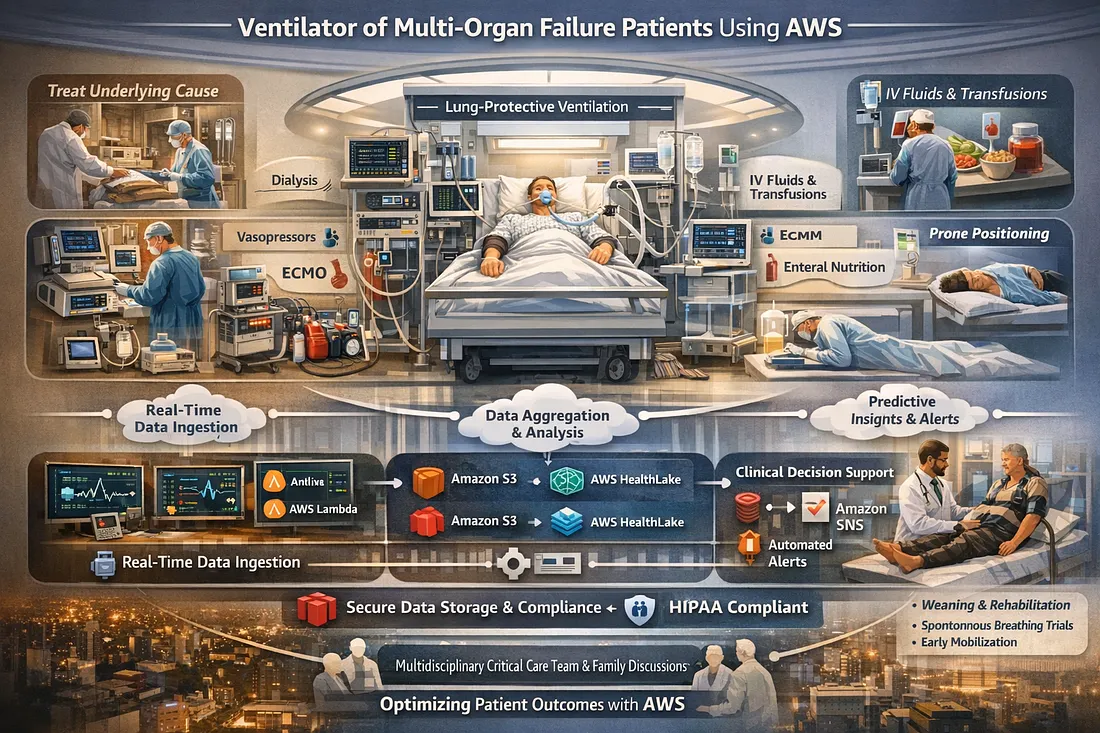
Ventilator Vanguard: AI-Powered MultiOrganFailure Survival Engine Using AWS
Cubed
Comments
Loading comments…