
Over the past few years, AI-assisted development tools have transformed the way software is built. Tasks that once required hours of implementation can now be completed in minutes, from generating boilerplate code to building application components with only a few prompts.
Yet as projects grow, maintaining requirements, architectural decisions, documentation, and project context often becomes just as important as writing code itself.
From Code Generation to Software Engineering
Generating code has become increasingly accessible, but software projects rarely succeed or fail because of implementation alone.
Long before development begins, teams must evaluate trade-offs, define architectures, and establish a clear direction for the project. As systems evolve, preserving engineering intent and maintaining consistency across features often becomes more challenging than writing code itself.
Modern AI coding assistants can generate functions, APIs, database schemas, and even complete application components with remarkable speed.
Yet successful projects require more than code generation. Requirements evolve, architectural decisions accumulate, and development work must remain aligned as systems grow.
Successful software engineering depends not only on implementation, but also on the processes that guide development from idea to delivery.
What Is AWS Kiro?
AWS Kiro is an AI-powered development environment designed to support software engineering activities beyond implementation alone. Rather than focusing exclusively on code generation, it introduces workflows built around specifications, planning, and project awareness.
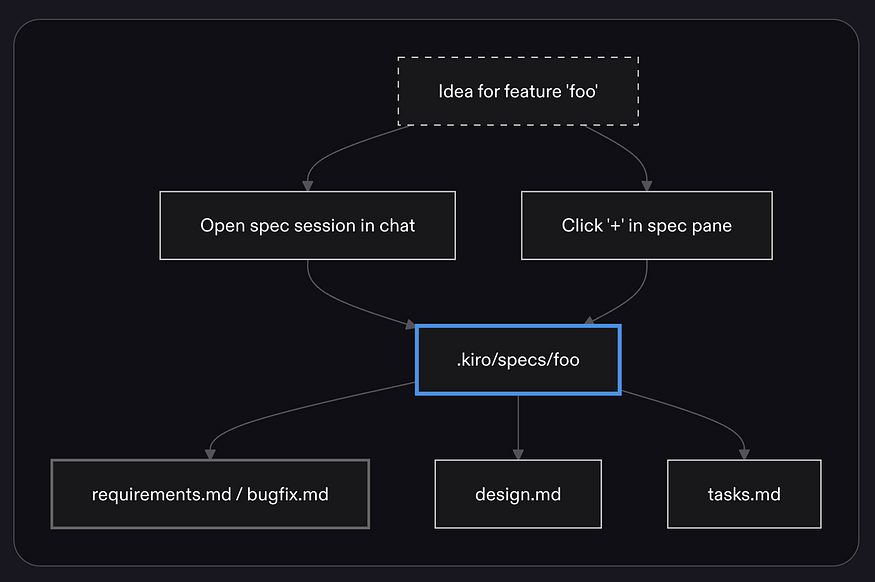
Through specifications, Kiro can generate requirements, design documents, and implementation tasks that remain connected throughout the development process.
One of Kiro’s defining ideas is moving beyond simple prompt-to-code interactions. Instead, it introduces a workflow that connects requirements, planning, and implementation within a single process.
This approach reflects a broader view of software engineering — one that values context, traceability, and long-term maintainability alongside development speed.
Thinking in Specifications, Not Just Prompts
Traditional AI Workflow
Prompt -> Generated Code
AWS Kiro Workflow
Feature Request -> Requirements -> Design -> Tasks -> Implementation -> Validation
One of Kiro’s most distinctive ideas is its emphasis on specifications before implementation. Rather than immediately generating code from a request, Kiro encourages developers to define requirements, establish a plan, and break work into manageable tasks before implementation begins.
This creates a workflow that more closely resembles traditional software engineering practices while still benefiting from AI-assisted development.
Key Idea: AWS Kiro is not trying to replace software engineering practices. It attempts to bring those practices directly into AI-assisted development workflows.
Beyond Specifications
While specifications are central to Kiro’s workflow, they are not the only mechanism that differentiates it. AWS Kiro also introduces concepts such as Steering and Hooks.
Steering allows teams to define project-specific guidance for AI-generated output, including coding standards, architectural preferences, and development conventions.
Hooks enable automated actions during development workflows, such as running validation checks, executing tests, or enforcing project rules before changes are accepted.
Together, these capabilities extend AI assistance beyond implementation and into broader engineering workflows.
A Practical Example
Imagine a growing SaaS platform that initially consists of only a few core features:
- User authentication
- Billing
- Notifications
- Analytics
At first, development is relatively straightforward. New features can often be implemented with a few prompts and minimal planning.
As the platform grows, however, the situation changes. New services are introduced, requirements evolve, and multiple developers begin contributing to the same codebase. What once felt like a simple project gradually becomes a complex system with interconnected components and long-term architectural decisions.
In this environment, generating code is no longer the primary challenge. Teams must ensure that new features align with the broader system design, follow established patterns, and remain consistent with the overall architecture.
This is where a specification-driven workflow can become valuable. By defining requirements, organizing tasks, and maintaining project context before implementation begins, developers gain greater visibility into how individual changes fit within the broader system.
Where Complexity Actually Emerges
In many modern development environments, generating code is no longer the primary challenge.
The difficulty often lies in maintaining consistency as systems evolve. Requirements change, services grow, and architectural decisions accumulate over time. What begins as a straightforward implementation task can gradually become a coordination problem across multiple features, teams, and services.
This is one of the reasons software engineering practices such as requirements documentation, design reviews, and task planning continue to remain relevant despite rapid advances in AI-assisted development.
Viewed from this perspective, AWS Kiro is less about generating code and more about preserving engineering context throughout the development lifecycle.
Building with Context Instead of Conversations
As projects grow, context becomes increasingly important. A feature that works perfectly in isolation may still create problems if it conflicts with existing project goals or architectural decisions.
Without strong project awareness
- Duplicate functionality
- Inconsistent architectural patterns
- Lost requirements
- Repeated implementation mistakes
With stronger project awareness
- Better consistency across features
- Clearer implementation decisions
- Improved traceability
- More structured development workflows
AWS Kiro attempts to support this broader understanding by connecting implementation decisions to the larger goals of a project rather than treating every interaction as an isolated request.
Why This Matters for Modern Development Teams
Software development is rarely a solo activity. As projects grow, teams must share knowledge, review implementation decisions, onboard new developers, and maintain a common understanding of how the system evolves over time.
In these environments, generating code quickly is only part of the equation. Long-term productivity often depends on factors such as documentation, maintainability, and consistency across the codebase.
A structured workflow helps reduce ambiguity by connecting requirements, planning, and implementation within a common process. This makes it easier for teams to understand not only what is being built, but also why certain decisions were made.
This makes it easier for teams to understand not only what is being built, but also why certain decisions were made.
Key benefits include:
- Better onboarding for new developers
- Improved documentation and traceability
- Shared understanding of project requirements
- More predictable development workflows
- Greater consistency across features and services
Where AWS Kiro May Deliver the Most Value
AWS Kiro’s structured approach appears particularly well suited to projects where requirements, architecture, and long-term maintainability play a significant role.
Examples include:
- SaaS platforms
- Backend services
- Cloud-native applications
- Microservice architectures
- Internal developer platforms
- Enterprise software projects
While smaller projects may benefit from lightweight prompt-driven workflows, larger and longer-lived systems often require additional structure and context. This is where Kiro’s approach becomes especially valuable.
The Shift Beyond Code Generation
AWS Kiro may not represent the final form of AI-assisted development, but it reflects a notable shift in how these tools are evolving. The focus is gradually moving beyond code generation and toward supporting the broader engineering process that surrounds it.
For years, the conversation around AI development tools has focused on how much code they can generate.
Kiro suggests a different question: how much of the software engineering process can they support?
As these tools continue to evolve, the most important question may no longer be how much code AI can generate, but how effectively they can preserve engineering intent as software systems evolve.
Comments
Loading comments…