
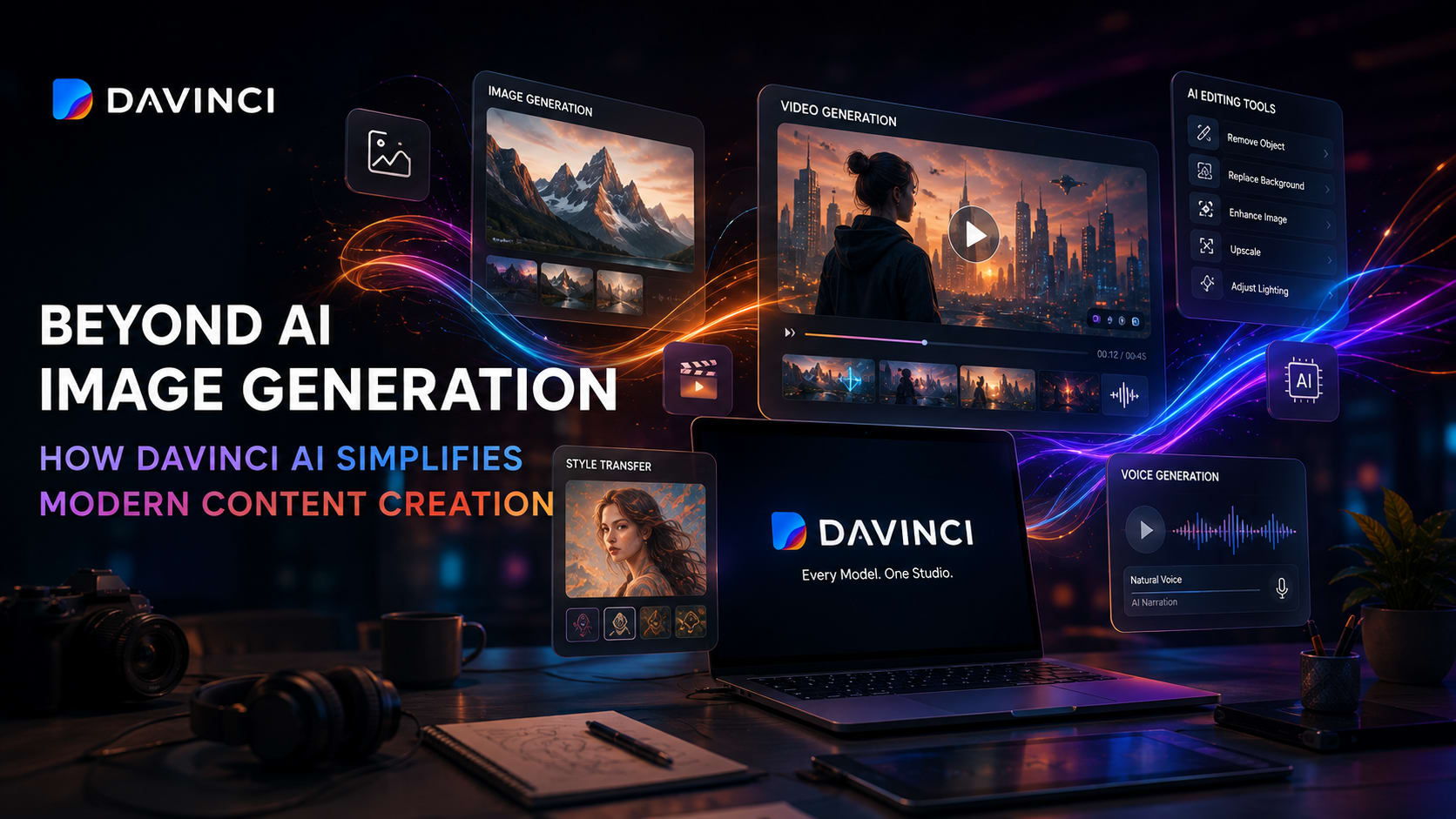
Generative AI has evolved quickly, but the way most people use it has become surprisingly complicated. Instead of relying on one platform, creators often jump between several AI tools throughout a single project. One model produces better product photography, another creates more convincing video, while a third handles voice generation or image editing more effectively.
This shift has created a new challenge. Modern creative work is no longer limited by the quality of AI models alone. It's limited by workflow.
DaVinci AI approaches this problem differently. Rather than positioning itself as a single AI model, it brings multiple creative models and editing tools into one workspace. Instead of constantly switching between tabs, creators can move from image generation to video creation, editing, and refinement inside the same platform.
This article looks less at individual features and more at how that workflow affects everyday content production.
Why One AI Model Is Rarely Enough
Creative professionals rarely produce just one type of content anymore. A marketing campaign might require product images, social graphics, short-form videos, thumbnails, blog illustrations, and promotional assets for multiple platforms.
Different AI models excel at different tasks. Choosing the right model has become part of the creative process itself.
Instead of forcing every project through one engine, multi-model platforms allow creators to select the tool that best matches the job.
A Workflow Instead of a Toolbox
One of DaVinci AI's biggest strengths is reducing friction.
Instead of copying prompts between websites, downloading files, uploading them somewhere else, and repeating the same process, users can continue working inside a single project.
That doesn't necessarily make every image better.
It makes the overall creative process faster.
For teams producing content every day, removing these small interruptions can save considerable time over weeks and months.
Choosing the Right Model for Different Projects
Not every creative task has the same requirements.
A realistic ecommerce product photo may need different capabilities than a cinematic promotional video.
Likewise, concept art, social media graphics, and branded marketing materials often benefit from different generation models.
Having access to multiple options allows creators to choose based on the project instead of adapting the project to the limitations of one model.
Editing Becomes Part of the Creative Process
Generating content is only the first step.
Many projects require removing objects, replacing backgrounds, adjusting lighting, improving resolution, or creating multiple variations.
Integrated editing tools reduce the need to regenerate assets from scratch whenever a small revision is needed.
This becomes particularly valuable when creating campaigns that require many similar visuals.
Where Dedicated Software Still Has an Advantage
An all-in-one platform doesn't replace every professional creative application.
Advanced compositing, frame-accurate video editing, professional color grading, and highly technical post-production workflows still belong to dedicated software.
Understanding this distinction helps set realistic expectations.
DaVinci AI focuses on accelerating content creation, not replacing professional production pipelines.
Who Should Consider It?
The platform makes the most sense for users who frequently switch between AI tools during the same project.
If your work regularly combines images, videos, editing, and multiple creative assets, managing everything inside one workspace can simplify production.
If you rely almost exclusively on one specialized AI model, subscribing directly to that service may remain the better option.
Final Thoughts
The conversation around AI often focuses on which model generates the best image or the most realistic video.
In practice, creators spend just as much time managing their workflow as they do creating content.
DaVinci AI's biggest contribution isn't replacing every standalone AI model. It's reducing the complexity of using several of them together.
For creators, marketers, and businesses producing content at scale, that streamlined workflow may be its most valuable feature.
Comments
Loading comments…