A CS2 live-score feed needs a match identifier, team identities, the map being played, and the rounds each team has won. A display that also explains the match’s competitive context needs another relationship: the connection between that match and the game version recorded for it. That context should remain attached to the result after newer patches arrive.
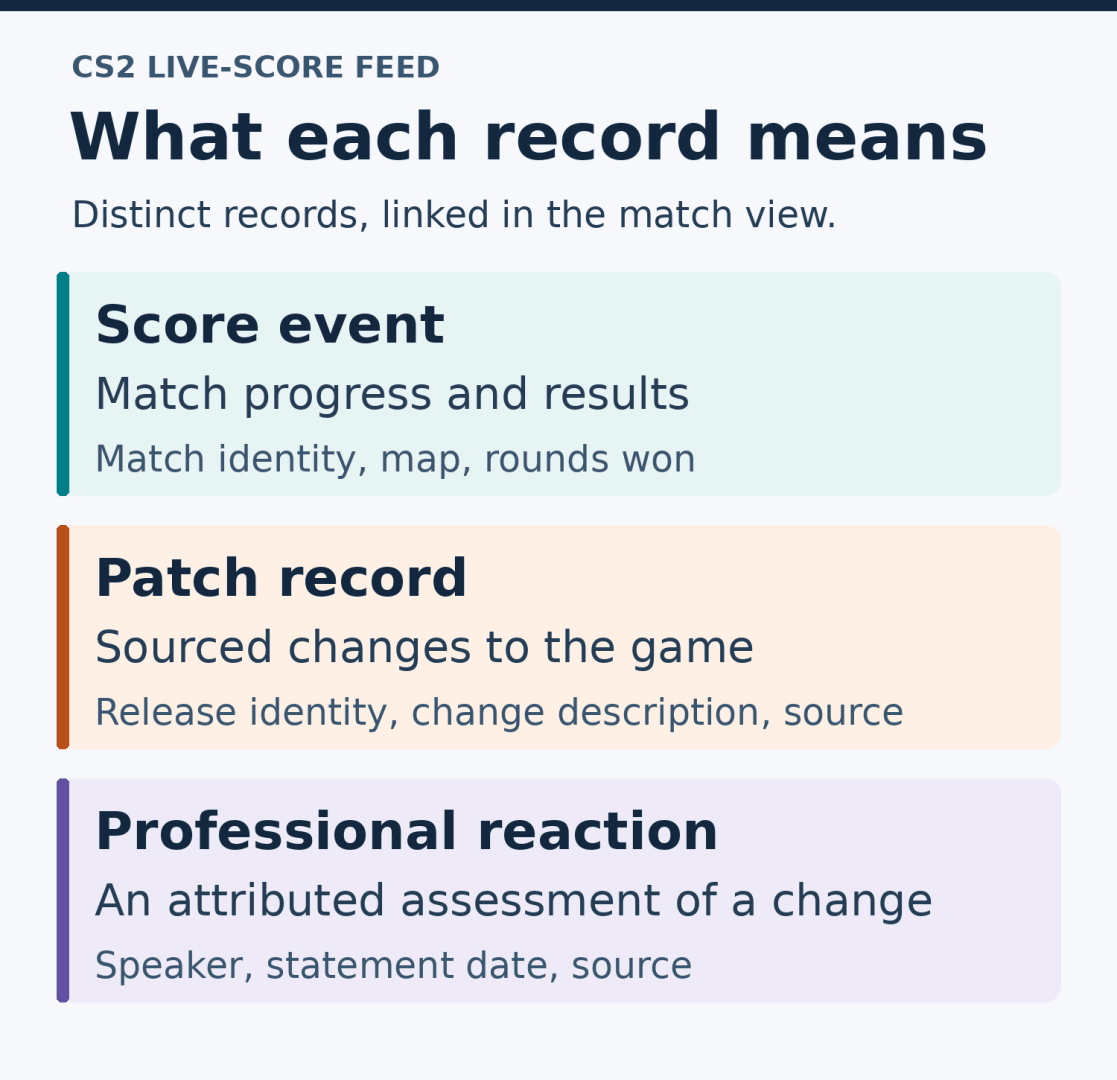
Building this requires separating three kinds of information. Score events report match progress. Patch records describe changes to the game. Professional reactions explain how players assessed those changes. The service can bring them together in its response without treating an opinion as a rule or a public release date as proof of a tournament’s build.
A guide to every CS2 patch that mattered provides update-history context: the changes that affected competitive play and how professionals responded. In a live-score application, that history belongs beside the match through an explicit, sourced association. The score stream supplies the result; linked patch context explains the conditions surrounding it. Keeping those responsibilities separate allows the application to update its commentary without rewriting scores.
Represent changes and professional reactions separately
A lot changes in the world of CS2 on a regular basis. By March 2025, Train was in the competitive map pool, changing the set of maps available for competition. In a March 2025 interview with BLAST, Vitality’s mezii said the team had not played much Train, but he had enjoyed it despite its differences from the old map. He also wanted changes to Anubis. His comments capture a professional’s assessment of the evolving map pool, rather than a measurement of which teams benefited.
The data model should preserve that distinction. A patch record identifies the release and contains a sourced description of its changes. A separate reaction record identifies the speaker, the statement’s date, its source, and the specific patch or map change being discussed. An editorial summary can explain the connection, with attribution retained.
Do not reduce both records to an undifferentiated “meta changed” label. Train entering the pool is a change to competitive context; mezii finding it enjoyable is an attributed response. Neither establishes a universal competitive advantage. Keeping them distinct lets the display explain the update while preserving what its evidence supports.
Attach the applicable patch to each match
The March 2026 reload update demonstrates why a patch association needs substance. As PC Gamer reported, reloading began discarding ammunition remaining in a magazine, alongside changes to ammunition reserves. Reloading therefore became an ammunition-management decision, as well as a question of finding time to reload. That describes a rule change, not evidence that a particular team adapted better.
For the backend, store the match’s recorded game version or build alongside its provenance. Resolve that value to the relevant patch record only when the available evidence supports the association. A public update date cannot establish which version a tournament used. Unknown build information should be clearly noted.
Keep the map played on the match record too. A later map-pool rotation must not remove a historical map from the archive or make its recorded appearance look invalid. The current pool and the maps eligible for an earlier competition answer different questions.
The read model, meaning the records prepared for display, can combine the current score, recorded game context, patch explanation, and attributed reactions. Each relationship should have an identifiable source. Commentary can be absent without blocking the score display, and missing commentary should not trigger an invented summary.
Keep the score contract independent of patch history
The ingestion boundary still needs a schema identifier specifying which contract defines an incoming message’s fields and meanings. A gameplay update does not automatically change that contract. Conversely, a provider can revise its message format without changing the game played in an existing match.
Use an adapter for each supported input format and normalize its messages into the application’s match and score records. Preserve the original schema identifier for troubleshooting. The patch association belongs to the match context, while the schema identifier belongs to the message being interpreted.
Within score processing, keep the match identifier stable across updates and retain map identity within the series. Where the provider defines event identifiers or ordering, preserve them through normalization so repeated deliveries and earlier messages can be recognized. Receipt time alone should not decide which score is current. The display should use the latest supported match state, while the ingestion record retains enough source information to explain how that state was produced and to support a later correction.
Publishing commentary should use a separate update path from processing score events. A new professional reaction changes the contextual material available to the display; it does not advance a round or alter a match result. Give that material its own revision history, rather than using the score event sequence to order unrelated edits.
Corrections need the same care. Preserve when the service received an assertion and the match or patch relationship it describes. Where earlier recorded states must remain recoverable, retain superseded assertions instead of silently overwriting them.
The resulting historical view can show the score, the game context supported for that match, the relevant changes, and dated professional assessments. It can also distinguish later editorial additions from information available during the match. The feed then preserves both the result and the limits of the explanation attached to it.
Further Reading
Discover more articles on similar topics across our network
Comments
Loading comments…