
AI strategy gets harder once an organization moves beyond pilots. Leaders must decide which use cases deserve funding, how AI fits into workflows, what to build internally, and how new systems will affect accountability.
That shift requires more than a basic understanding of GenAI. Executives need to compare value with cost, understand agentic workflows, work with technical teams, and set governance expectations.
The five programs below approach that challenge through AI investment, technology strategy, product transformation, and organizational change.
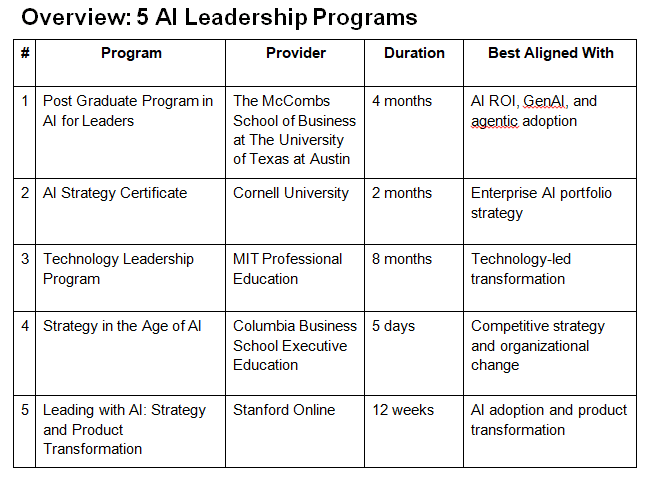
1. Post Graduate Program in AI for Leaders - The McCombs School of Business at The University of Texas at Austin
The AI for business leaders course moves from AI foundations into GenAI, agentic AI, implementation economics, governance, and a final business case.
Delivery & Duration: Online, 4 months, with recorded learning, weekly mentorship, projects, and case studies.
Credentials: Certificate of Completion and 5 Continuing Education Units from Texas McCombs.
Program Highlights: AI ROI, GenAI, AI agents, MCP, n8n, RAG, build-versus-buy decisions, LLMOps, governance, four projects, and a capstone.
Outcomes: Participants learn to prioritize AI use cases, assess risk, plan implementation, and develop an AI product proposal with financial projections.
Why should you choose this course?
- Business value is studied with the technology. ROI and implementation choices sit alongside GenAI and agentic AI.
- The capstone mirrors an executive decision process. Learners connect market opportunity, product requirements, planning, and financial impact.
2. AI Strategy Certificate - Cornell University
Cornell focuses on turning AI capabilities into a portfolio of business initiatives spanning workflows, products, operating models, and competitive positioning.
Delivery & Duration: Online, 2 months, with four two-week courses and 6 to 8 hours of weekly study.
Credentials: AI Strategy Certificate from Cornell University.
Program Highlights: GenAI, agentic AI, workflow redesign, organizational change, business model innovation, initiative prioritization, experiments, and risk reduction.
Outcomes: Learners create practical work products to identify opportunities, redesign work, prioritize initiatives, and reduce uncertainty.
Why should you choose this course?
- It treats AI adoption as a portfolio decision. Leaders compare opportunities instead of evaluating a single use case.
- Projects move from vision toward execution. The work covers workflow redesign, business models, initiative selection, and assumption testing.
3. Technology Leadership Program - MIT Professional Education
The Technology Leadership Program places AI inside a wider technology agenda. GenAI and agentic AI sit alongside cloud, cybersecurity, robotics, innovation, and strategic decision-making.
Delivery & Duration: Blended, 8 months, with three residential weeks at MIT and 14+ live online sessions.
Credentials: Certificate of Completion from MIT Professional Education, with eligibility for 42 CEUs.
Program Highlights: GenAI, agentic AI, machine learning, technology strategy, AI ethics, strategic change, innovation teams, and Action Learning Projects.
Outcomes: Participants learn to evaluate emerging technologies, connect them with business priorities, and lead technology-led transformation.
Why should you choose this course?
- AI is assessed within a broader technology portfolio. That supports decisions about competing transformation investments.
- The human side of change gets real attention. Leadership, coaching, negotiation, and team development complement technical fluency.
4. Strategy in the Age of AI - Columbia Business School Executive Education
Columbia's program is for senior leaders deciding where AI can create competitive advantage across strategy, operating choices, and organizational design.
Delivery & Duration: In-person, 5 days in New York City.
Credentials: Five credits toward Columbia Business School Executive Education's Certificate in Business Excellence.
Program Highlights: Competitive advantage, investment prioritization, organizational readiness, operating-model change, strategic frameworks, and hands-on AI exercises.
Outcomes: Participants learn to connect AI opportunities with strategy, organizational structure, and competitive positioning.
Why should you choose this course?
- The focus stays on strategic choices. Leaders examine where AI creates value and what must change internally.
- Organizational transformation is built into the discussion. The course considers workforce, culture, and operating models alongside AI investment.
5. Leading with AI: Strategy and Product Transformation - Stanford Online
Stanford connects AI leadership with product transformation for professionals scaling adoption and shaping AI-enabled products.
Delivery & Duration: Online, 12 weeks, with on-demand learning, live sessions, applied assignments, and hands-on AI work.
Credentials: Certificate of Achievement from Stanford Online.
Program Highlights: AI leadership, adoption strategy, product innovation, human-centered AI, organizational implementation, modern AI tools, and two capstone projects.
Outcomes: Participants develop approaches to scale adoption, shape AI-powered products, and translate AI into business decisions.
Why should you choose this course?
- Strategy and product transformation are studied together. This connects enterprise adoption with product decisions.
- Two capstones provide applied practice. Participants apply the program frameworks to real transformation challenges.
Conclusion
Enterprise transformation begins when AI strategy changes how an organization allocates resources, designs workflows, builds products, manages people, and measures value.
The right AI for leaders program depends on the change being led. Some executives need stronger judgment around GenAI, agents, ROI, and implementation, while others need broader preparation in product strategy, organizational design, and change at scale.
Comments
Loading comments…