
AI video has been improving at a rapid pace, but one issue has remained hard to solve: generating longer, coherent clips without obvious breaks or quality drop-offs. That is why ByteDance’s launch of Seedance 2.5 is getting real attention. This new model introduces native 30-second video creation, stronger prompt accuracy, support for multimodal references, and more flexible editing control. In practical terms, it promises a smoother path from idea to usable video. For creators, marketers, and brands, Seedance 2.5 looks like a meaningful step forward rather than just another incremental update.
Seedance 2.5 Marks a New Phase for AI Video
Most people who have experimented with AI video tools already know the pattern.
You get a short clip that looks impressive for a few seconds. But when you try to turn that into something useful for content production, the cracks start to show. Character consistency slips. Motion gets strange. Scene transitions feel abrupt. And if you want anything longer than a few seconds, the workflow becomes much more complicated.
That is what makes Seedance 2.5 different.
ByteDance is positioning Seedance 2.5 as a more advanced AI video generator built for longer, more coherent, and more controllable outputs. And on paper, the improvements are not small. They directly address some of the biggest frustrations users have with current AI video systems.
Native 30-Second Video Creation Is the Headline Feature
The biggest talking point is right in the title: native 30-second video creation.
This is important because many AI video models still operate best in short bursts. Users often have to generate several small clips and stitch them together manually. That process can work, but it usually introduces visual inconsistency. A character may look slightly different from one clip to the next. Lighting may shift unexpectedly. Camera movement can feel disconnected.
Seedance 2.5 aims to solve that by generating a continuous 30-second sequence in a single pass.
That opens up a lot more creative flexibility.
A 30-second video is long enough to:
- establish a setting
- introduce a subject
- show action or product use
- build momentum
- deliver a complete marketing message
For short-form ads, branded social content, and narrative scenes, that duration is much more practical than a four- or eight-second fragment.
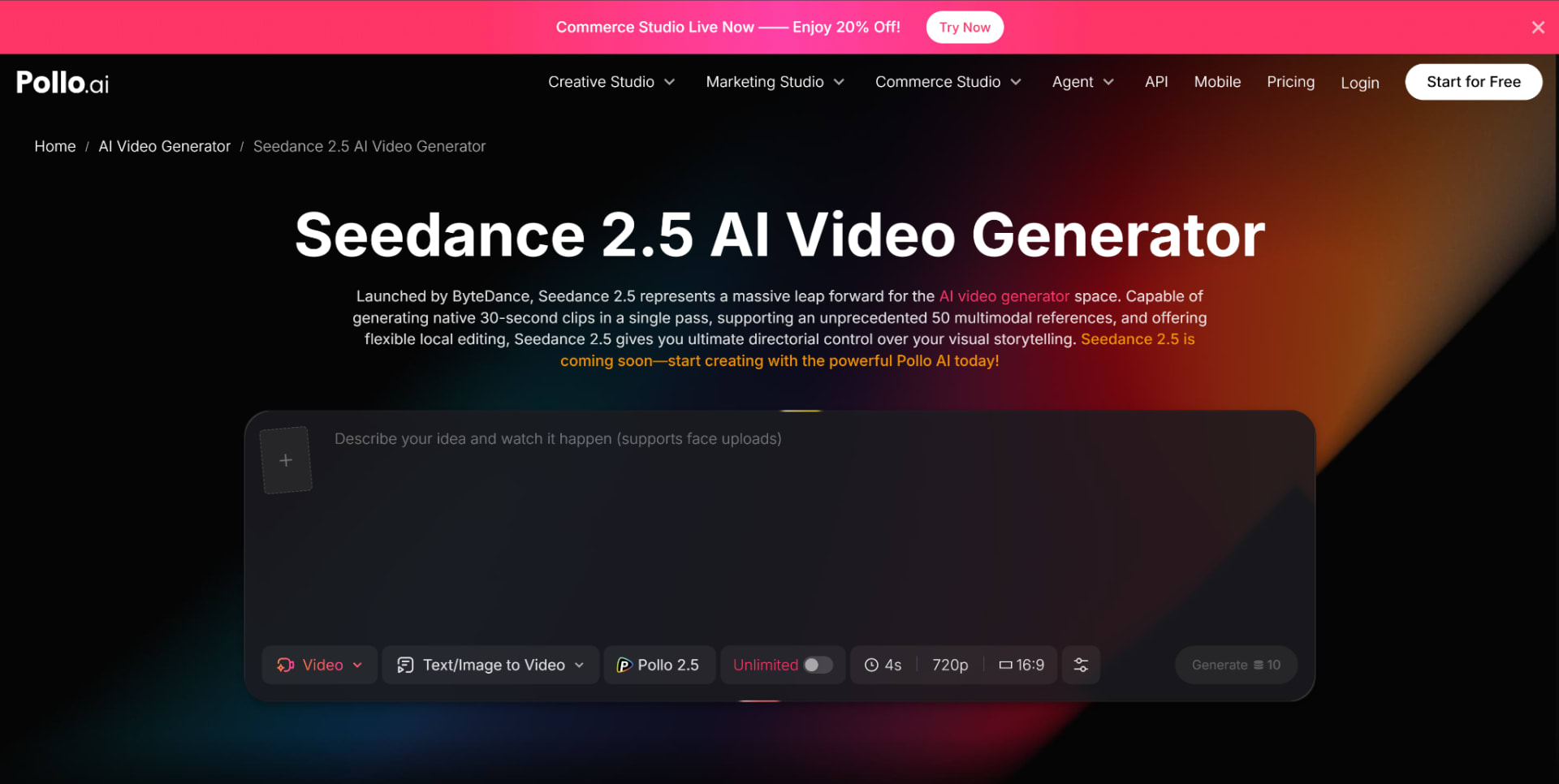
For anyone interested in testing the model, there is an easy entry point. You can try Seedance 2.5 for free on Pollo AI, which gives users a practical way to explore the model’s capabilities without adding friction to the process. That is especially useful for creators and marketers who want to experiment quickly. It is also worth mentioning that Pollo AI has an app, making it easier to stay productive and manage ideas on the go.
Why Longer Continuous Video Matters
On the surface, 30 seconds may not sound revolutionary. But in AI video generation, it is a major leap.
Longer generation changes the kind of content users can create. Instead of producing isolated visual moments, they can build full sequences that actually tell a story. That matters for marketers who need product showcases, for creators who want more cinematic storytelling, and for brands that need consistency across a whole scene.
It also reduces editing pain.
When a video is generated as one continuous piece, you do not have to spend as much time hiding seams, patching transitions, or trying to force disconnected clips to feel like one idea. That makes the workflow more efficient and the final result more watchable.
Better Prompt Adherence Means Less Guesswork
Another major improvement is Seedance 2.5’s stronger prompt accuracy.
Prompt adherence often decides whether an AI tool feels usable or frustrating. A model may generate beautiful images or motion, but if it misses the actual instruction, users end up wasting time rerolling outputs and rewriting prompts.
Seedance 2.5 is designed to follow complex instructions more faithfully, including:
- scene composition
- action sequence
- styling direction
- camera behavior
- subject relationships
That is a meaningful upgrade for professional use. Marketing teams, creative agencies, and content producers do not want random inspiration every time. They want the result to align with a clear brief.
The more accurately a model can interpret direction, the more useful it becomes in real workflows.
Multimodal References Add More Directorial Control
One of the more advanced features in Seedance 2.5 is its support for large-scale multimodal references.
Instead of depending only on a text prompt, users can guide the model with a broader mix of inputs, such as images, video clips, and written instructions. This allows more precise control over visual identity, motion style, and overall tone.
That matters because AI video generation is no longer just about generating something interesting. It is increasingly about generating something specific.
For example, a brand may want to preserve:
- a certain color palette
- a character look
- a product style
- a mood or lighting reference
- a particular camera feel
With richer input handling, Seedance 2.5 gives users a better chance of steering the output in the right direction from the beginning.
Flexible Video Editing Makes the Tool More Practical
A common problem in AI generation is that one small issue can ruin an otherwise strong video.
Maybe the scene works, but a background detail feels off. Maybe the wardrobe is wrong. Maybe a specific object needs to change. In many tools, fixing that means regenerating the entire clip and hoping for something better.
Seedance 2.5 introduces more flexible local editing, which makes the process much more practical.
Instead of starting over from scratch, users can target specific parts of the video and adjust them while keeping the rest intact. That kind of selective editing is a big step toward professional usability. It saves time, protects strong outputs, and gives creators more confidence in the generation process.
Native 4K Output Helps Close the Quality Gap
Visual quality still matters, especially for commercial content.
Seedance 2.5 supports native 4K resolution, which is an important step for users who want sharper, cleaner, and more production-ready assets. Rather than generating lower-resolution clips and relying on separate upscaling tools, the model is built to deliver high-resolution output directly.
That makes it more appealing for:
- advertising
- brand campaigns
- product videos
- social media publishing
- digital storytelling
For businesses and creators, this raises the ceiling on what AI-generated video can be used for.
Final Thoughts
ByteDance’s introduction of Seedance 2.5 with native 30-second video creation feels like a meaningful development in the AI video space.
This is not just about longer clips. It is about more coherent storytelling, stronger prompt accuracy, better visual consistency, flexible editing, and output quality that aligns more closely with professional needs. Those are exactly the areas where many AI video tools still struggle.
If Seedance 2.5 performs the way its feature set suggests, it could become an important option for creators, marketers, and brands looking for more than short experimental clips. It is now easier than ever to see what this next generation of AI video can offer.
Comments
Loading comments…