
By Roman Krachko, Expert in foreign language teaching and multilingual pedagogy
Abstract
In multilingual learning, interaction between languages a learner already knows and the language being studied can serve both as a source of interference and as a resource for acquiring new material. The article examines an integrative approach that involves the controlled use of the learner’s linguistic repertoire, cross-linguistic comparison, and game-based practices. Particular attention is paid to the transition from spontaneous cross-linguistic interaction to conscious use: learners are taught to identify cross-linguistic connections, test hypotheses, and use the resulting insights in the target language. This approach makes it possible to view multilingualism not only as a factor that complicates learning, but also as a methodological resource.
Keywords: multilingual learning, cross-linguistic interaction, translanguaging, cross-linguistic influence, contrastive analysis, cognates, game-based practices.
Cross-Linguistic Influence as a Foundation of Multilingual Learning
A multilingual learner does not acquire a new language in isolation from what they already know. When processing and using new material, elements of previously learned languages may become activated. This can facilitate acquisition, but it can also lead to errors through the transfer of familiar patterns. The effect is particularly evident in L3 acquisition, where several previously learned systems may influence the new one.
One example is the study by O. Broniś, M. Foryś-Nogala, and A. Otwinowska, which examined written errors in the acquisition of Italian as a third language. The authors analyzed the results of 93 Polish-speaking learners studying Italian after English and separately examined 977 erroneous translations in which the spelling of the response resembled the expected Italian form. The study showed that cross-linguistic influence was particularly noticeable when working with cognates: words resembling items in several previously known languages were associated with a higher number of transfer-related errors.
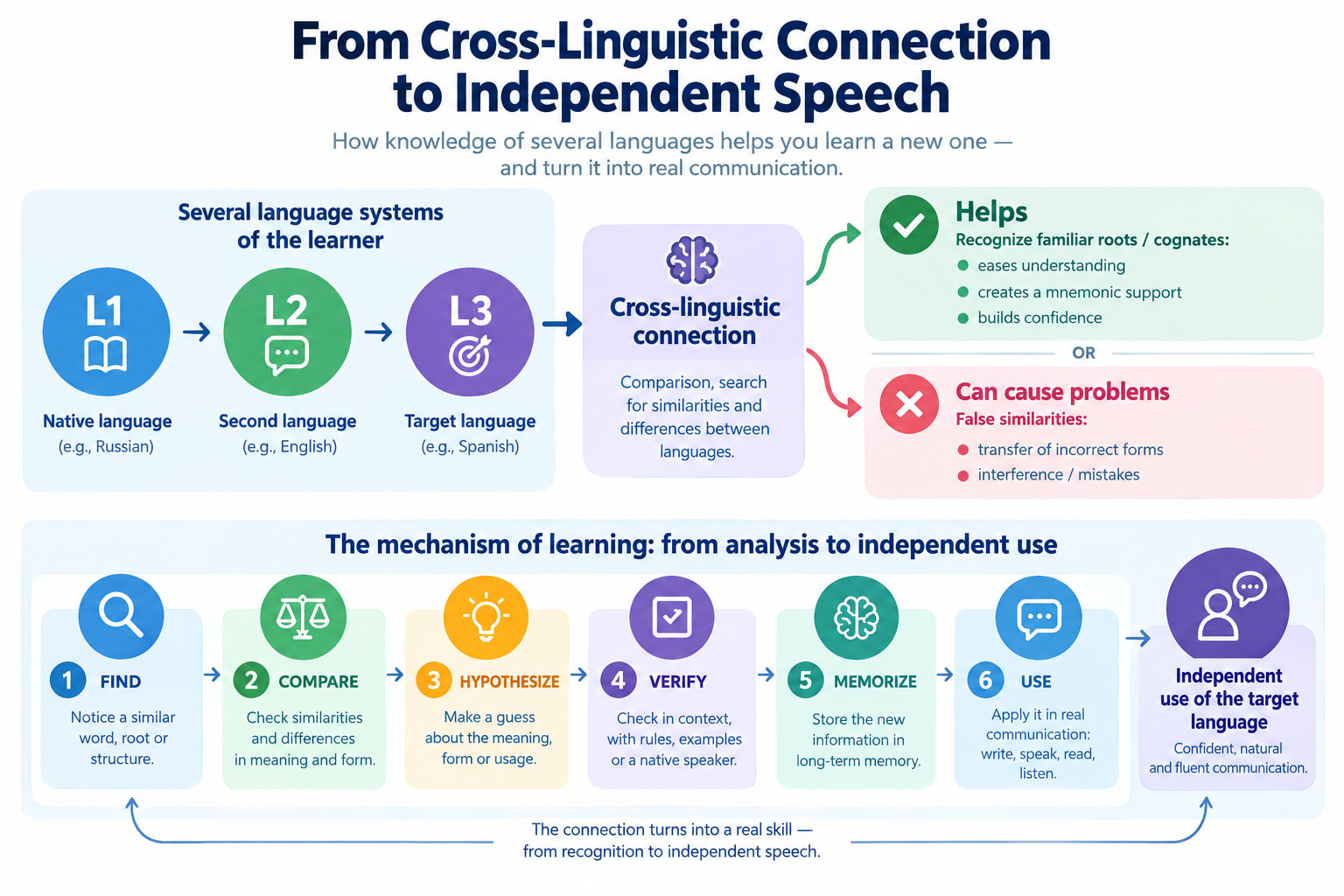
Thus, similarity between languages does not guarantee successful acquisition: the same connection can aid memorization or become a source of interference. The task, therefore, is not to eliminate such interaction, but to manage it consciously — by recognizing, testing, and using these connections in the target language.
From Linguistic Isolation to Managed Interaction
Traditional approaches to language learning often involve keeping languages separate: the target language is treated as the primary or sole means of communication, while the use of other languages is regarded as undesirable language mixing. However, if previously known languages are involved in processing new material, the more productive question is not how to eliminate this interaction, but how to use it purposefully.
One way of organizing such interaction is through translanguaging — the purposeful use of available linguistic resources to understand, process, and complete a learning task. Drawing on languages the learner already knows serves a specific function: it helps compare forms, formulate a hypothesis about meaning, clarify a concept, or provide a mnemonic aid. After that, the learner returns to the target language and uses the new material independently.
Empirical data support the usefulness of this pedagogical approach. In a multilevel Bayesian meta-analysis, X. Wang and L. J. Zhang synthesized the results of 40 independent studies involving 3,145 learners. The authors identified a positive overall effect of pedagogical translanguaging on second-language learning outcomes (Hedges’ g = 1.014), while the effect size varied depending on the educational level and the type of language outcome assessed. These findings suggest that pedagogical translanguaging may be an effective instructional tool, while also highlighting the importance of considering the conditions in which it is used.
Thus, translanguaging is not a replacement for the target language, but a means of transitioning to its independent use.
Components of the Integrative Methodology
The integrative methodology combines three interconnected components: controlled translanguaging, contrastive analysis, and game-based practices. Their common goal is to turn cross-linguistic connections from a spontaneous phenomenon into a conscious tool for working with new material.
Controlled Translanguaging:
Translanguaging is used to support comprehension, hypothesis formation, and comparison of forms. After that, the learner returns to the target language and uses the material independently.
Contrastive Analysis and Cross-Linguistic Connections:
Contrastive work may include comparing cognates, false friends, loanwords, shared roots, as well as grammatical similarities and differences. Lexical connections are particularly noticeable between related languages, for example, Spanish and other Romance languages, whereas when working with Chinese, the focus may shift toward structural differences.
Similarity between languages is not an inherent advantage — it becomes a pedagogical resource when learners can identify, compare, and verify it. Experimental data also point to the importance of awareness: structured work with cross-linguistic similarity may support more successful acquisition of cognates. At the same time, these effects are not automatic and may depend on the learner’s proficiency level and word frequency.
Game-Based Practices:
Each game mechanic is tied to a specific learning task: matching is used for recognition and comparison, finding a “relative” for identifying cross-linguistic connections, finding an “impostor” for working with false friends, guessing for forming hypotheses, Alias and Crocodile for practicing vocabulary, and role-playing for using it communicatively.
Practical Protocol: From Cross-Linguistic Connection to Independent Use
The integrative approach can be described as a six-step sequence: find → compare → hypothesize → verify → memorize → use.
Step 1. Find. The learner looks for a potential connection between a new element and material they already know from other languages: a similar word, root, loanword, or grammatical construction.
Step 2. Compare. The form, meaning, pronunciation, and usage of the identified units are compared. Particular attention is paid to differences indicating false similarity or potential interference.
Step 3. Hypothesize. Based on the identified connection, the learner formulates a hypothesis about the meaning or usage of the new element.
Step 4. Verify. The hypothesis is checked against the context, a dictionary, learning materials, or with the help of the teacher, helping distinguish a productive cross-linguistic connection from erroneous transfer.
Step 5. Memorize. The verified connection is used as a mnemonic aid and reinforced through repetition or game-based practice.
Step 6. Use. The learner then uses the new material in their own speech or writing, producing an utterance, participating in a dialogue, or completing a communicative task in the target language.
For example, when introducing eight new lexical units, learners compare them with material from languages they already know, identify potential cognates, and detect cases of false similarity. After verifying their hypotheses, learners consolidate the material through matching or another game mechanic and then use the new words in a dialogue. At the same time, typical errors are recorded and correct and erroneous forms are compared in order to control interference. As the material is mastered, external linguistic support is reduced, while independent use of the target language becomes the main focus of the task.
Conclusion
Cross-linguistic interaction can be viewed not only as a source of interference, but also as a resource in multilingual education. The integration of controlled translanguaging, contrastive analysis, and game-based practices enables learners to draw on their existing knowledge when acquiring new material.
The proposed sequence “find → compare → hypothesize → verify → memorize → use” turns a cross-linguistic connection from a spontaneous association into a conscious learning strategy. The ultimate goal remains the independent use of the target language, while the form of cross-linguistic support is adapted to each learner’s individual linguistic repertoire. The methodology can be applied to language combinations ranging from Spanish to Chinese.
Bibliography:
- Broniś, O., Foryś-Nogala, M., & Otwinowska, A. (2025). Teachers beware: L3 cognates may be difficult to learn. Spelling errors and the multilingual mental lexicon. System, 135, 103851. DOI: 10.1016/j.system.2025.103851. (https://www.sciencedirect.com/science/article/pii/S0346251X25002611)
- Wang, X., & Zhang, L. J. (2026). A multilevel Bayesian meta-analysis of the effects of translanguaging pedagogy on L2 achievement. Language Teaching. DOI: 10.1017/S0261444826101335.
- Gastmann, F., Poarch, G. J., & Schimke, S. (2025). Limitations of the cognate effect: How second language proficiency and stimulus frequency modulate adolescent learners’ word recognition. Applied Psycholinguistics, 46, e44. DOI: 10.1017/S0142716425100374. (https://www.cambridge.org/core/journals/applied-psycholinguistics/article/limitations-of-the-cognate-effect-how-second-language-proficiency-and-stimulus-frequency-modulate-adolescent-learners-word-recognition/E5EB4F7E90F666F5255736AB0E79D873)
- Deng, H., & Mahfoodh, O. H. A. (2026). A Systematic Review of Digital Game-Based Vocabulary Learning: Outcomes, Mechanics, and Challenges. International Journal of Game-Based Learning, 16(1). DOI: 10.4018/IJGBL.415335. (https://www.sciencedirect.com/org/science/article/pii/S2155684926000102)
- Otwinowska, A., Silva, B. B., Broniś, O., Ambroziak, A., Janczarska, A., Jastrzębski, B., & Foryś-Nogala, M. (2025). Learning L2-L3 cognates and L1-L2-L3 cognates in class: A longitudinal experiment in raising awareness of L2-L3 similarity. Lingua, 328, 104057.
- DOI: 10.1016/j.lingua.2025.104057 (https://www.sciencedirect.com/science/article/pii/S0024384125001822)
Further Reading
Discover more articles on similar topics across our network
Voice AI Is Becoming a Business Tool. Here’s Where It Actually Makes Sense
Venture

Comments
Loading comments…