
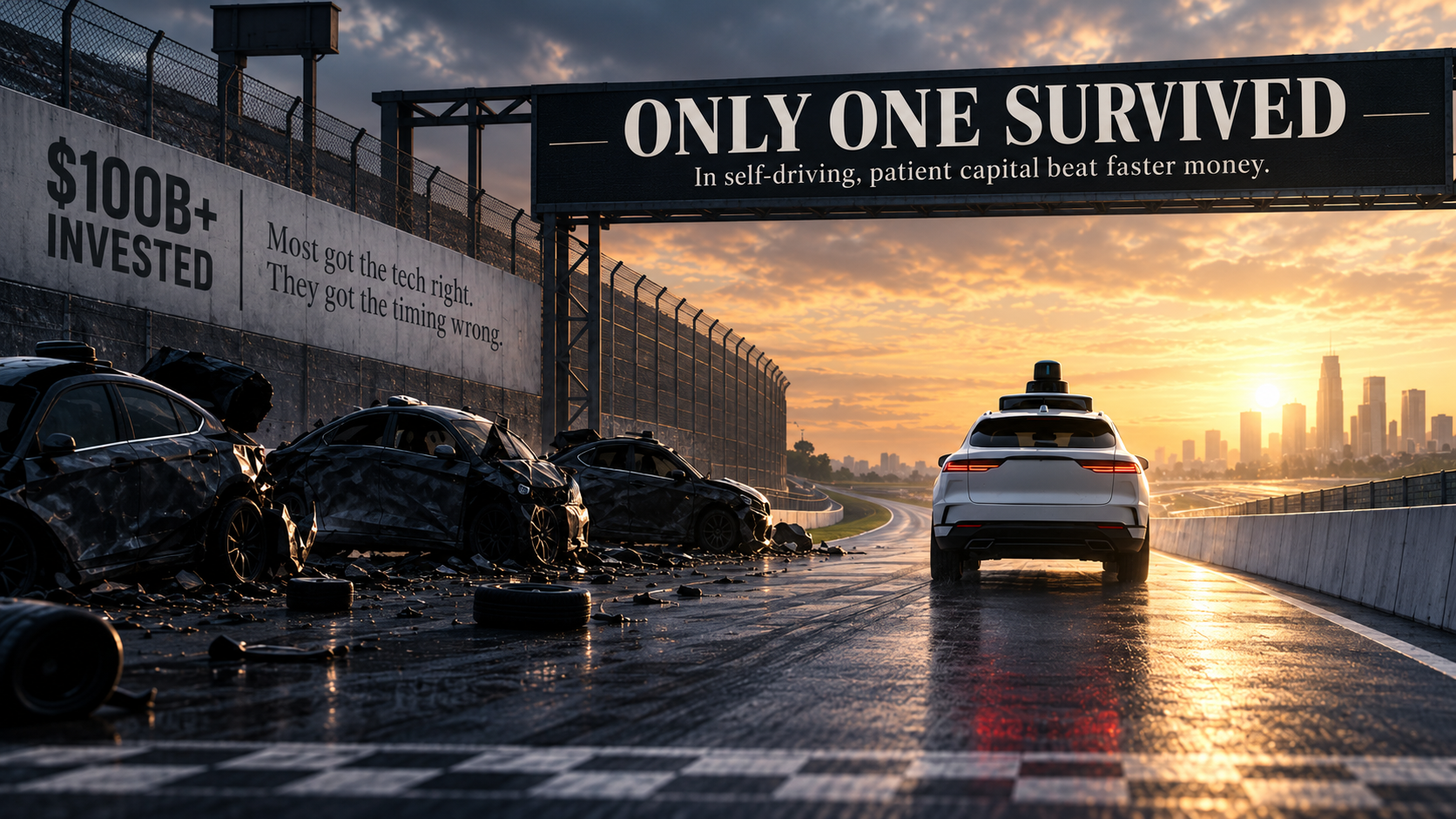
 Over about a decade, more than 100 billion dollars of private money went into self-driving cars. Most of the companies that raised it are gone. The demos worked. The engineering talent was real. The industry misjudged how many years of losses the technology would need before it started to pay for itself.
I saw a lot of those pitches. The confidence in the room was genuine, and so was mine when I found some of them convincing.
Most people who bet on self-driving cars were right about the idea and wrong about the timing.
General Motors bought Cruise and, by its own account, invested about 10 billion dollars. Cruise ran real paid robotaxis in San Francisco for a while. Then it lost its operating permits in California after one of its cars dragged a pedestrian who had been hit into its path by another vehicle, and in December 2024 GM stopped funding it. Across the life of the project, Cruise brought in less than 500 million dollars in revenue.
Ford and Volkswagen backed a company called Argo AI. Ford alone took a charge of about 2.7 billion dollars on its investment when the two carmakers pulled their support and Argo shut down in 2022, because profitable robotaxis looked too far away. Other companies that went public during the 2021 stock boom saw their shares collapse afterward. The self-driving trucking startup Embark, valued at more than 5 billion dollars in its deal to go public, was sold in 2023 for about 71 million.
The technology mostly worked in the end. The cars learned to drive. The money ran out before that happened.
The company that survived was owned by a parent that could fund it straight through the lean years.
Waymo started as a Google project in 2009. By the time it looked like a real business, more than fifteen years had passed. Since 2016 it has been part of Alphabet's division for long-shot projects, called Other Bets, which loses billions of dollars every year. In 2025 those losses grew by another 3 billion, and Alphabet said the main reason was Waymo.
No ordinary investment fund can carry a loss like that for over a decade. A fund has to return money to its investors on a schedule. Alphabet did not have that constraint. It kept funding Waymo through the long stretch when the cars were expensive to run and the revenue was small. That is most of the explanation for why Waymo is still here.
In February 2026, Waymo raised 16 billion dollars from outside investors at a valuation of 126 billion dollars. Alphabet stayed the majority owner. The patient money went in first and took the hardest years. The outside money arrived once most of the risk was gone.
Once a business like this starts working, it moves quickly.
At the start of 2026 Waymo was giving more than 400,000 paid rides a week across six US cities, roughly three times as many as a year earlier, and it has kept expanding since. It is aiming for a million rides a week by the end of 2026 and preparing to operate in more than 20 additional cities, including Tokyo and London. Its cars have driven more than 200 million miles with nobody in the driver's seat, and the company reports far fewer serious injury crashes than human drivers have on the same roads.
For a decade there was almost nothing to show. Then, in about two years, the service went from a curiosity to something that feels ordinary. Progress on hard technology tends to look like this. Very little for a long time, then a lot in a short window. Anyone pricing the company on a straight line will be wrong in both directions.
The question I now ask about any hard technology is who can afford to wait for it.
I want to be honest about the limits here. Waymo still loses more than a billion dollars a quarter. Its valuation assumes a rollout that has always been slower and more costly than planned. Tesla and Amazon are still in this race with different approaches of their own. The story is not finished.
Still, one pattern has held for me across every capital-heavy field I have watched, from batteries to rockets to driverless cars. The company that wins is usually the one still standing when the technology finally gets cheap. Staying in the game that long is a funding question more than an engineering question.
So when I look at a hard-tech startup now, the thing I study hardest is the money behind it. Who is paying for the years before the technology works, and will they still be there in year nine. If the answer is one committed backer with deep pockets and no rush, I pay attention. If the answer is a normal fund that needs an exit on the usual timeline, I already have a good idea how it ends.
Comments
Loading comments…