
Most AI visibility tools tell you whether your brand showed up. GetMentions AI is more useful when your real problem starts after that.
It keeps the full loop in one place: prompt, saved answer, cited source, brand-missing check, and then an insertion, editorial placement, or YouTube request from the same workflow. That is the reason I would take it seriously before I cared about any headline score.
This GetMentions AI review looks at the product from that angle. If you already know manual sweeps across ChatGPT, Gemini, or Google AI do not scale, the question is not whether you need another dashboard. It is whether you need one that can turn reporting into work.
Quick verdict
GetMentions AI is the best AI visibility product I have used for a simple reason: it does not stop at measurement. It shows you the exact answers and cited URLs behind the score, then gives you a route from brand-missing sources into execution from the same interface.
If your current process ends with exporting citations into a sheet and starting outreach somewhere else, put this at the top of your shortlist.
- Best for: in-house SEO teams, digital PR operators, agencies, SaaS teams, and e-commerce brands that need to track buyer questions, inspect the sources shaping AI answers, and turn source gaps into work.
- Why it stands out: you can move from prompt to answer, answer to cited URL, cited URL to brand-presence check, and then into an insertion, editorial placement, or cited-YouTube request with pricing, approval, messaging, and order tracking in the same product.
- Main limitation: normal self-serve coverage is narrower than the broad homepage language may imply, and the AI Ads Tracker is ChatGPT-only today.
- Recommendation: test it first if you want reporting plus an execution layer. Pass if your main need is broader paid-AI ad monitoring rather than source-level follow-through.
How I tested GetMentions AI
I set up a trial workspace around the 25-prompt per run cap, selected four standard platforms, reviewed the suggested prompt set, opened saved answers and cited URLs, filtered for sources where the brand was missing, exported reporting data, and followed one placement request through quoted pricing, approval, and order tracking.
A few things stood out quickly:
- setup does not start from a blank screen
- the saved-answer view is the screen I kept returning to
- the useful jump is from URL-level gaps into the request flow
- roles and permissions look built for real client work, not just a single-user demo
What makes GetMentions AI different
Most tools in this category answer one question: where did your brand appear? GetMentions AI is built around the next three. Which sources shaped the answer. Where is your brand missing on those sources. Can you do something about it without leaving the workflow.
After using it, I would describe GetMentions AI is an AI visibility tracker with citation intelligence and an execution layer built around influenceable sources.
That last point matters.
Not every cited page is something your team can change, so the product prioritizes opportunities by citation strength, competitor presence, funnel stage, topic relevance, and influenceability. That is a much better distinction than vague talk about actionable insights. It is the difference between measurement and influence.
If you only want a scoreboard, you may not need that layer. If your reports keep ending with manual cleanup and disconnected outreach, you probably do.
What it covers on a normal plan, including the source layer
Scheduled prompt tracking, custom prompts, exports, and market filters are table stakes in this category. The better buying questions are about surface coverage and source depth.
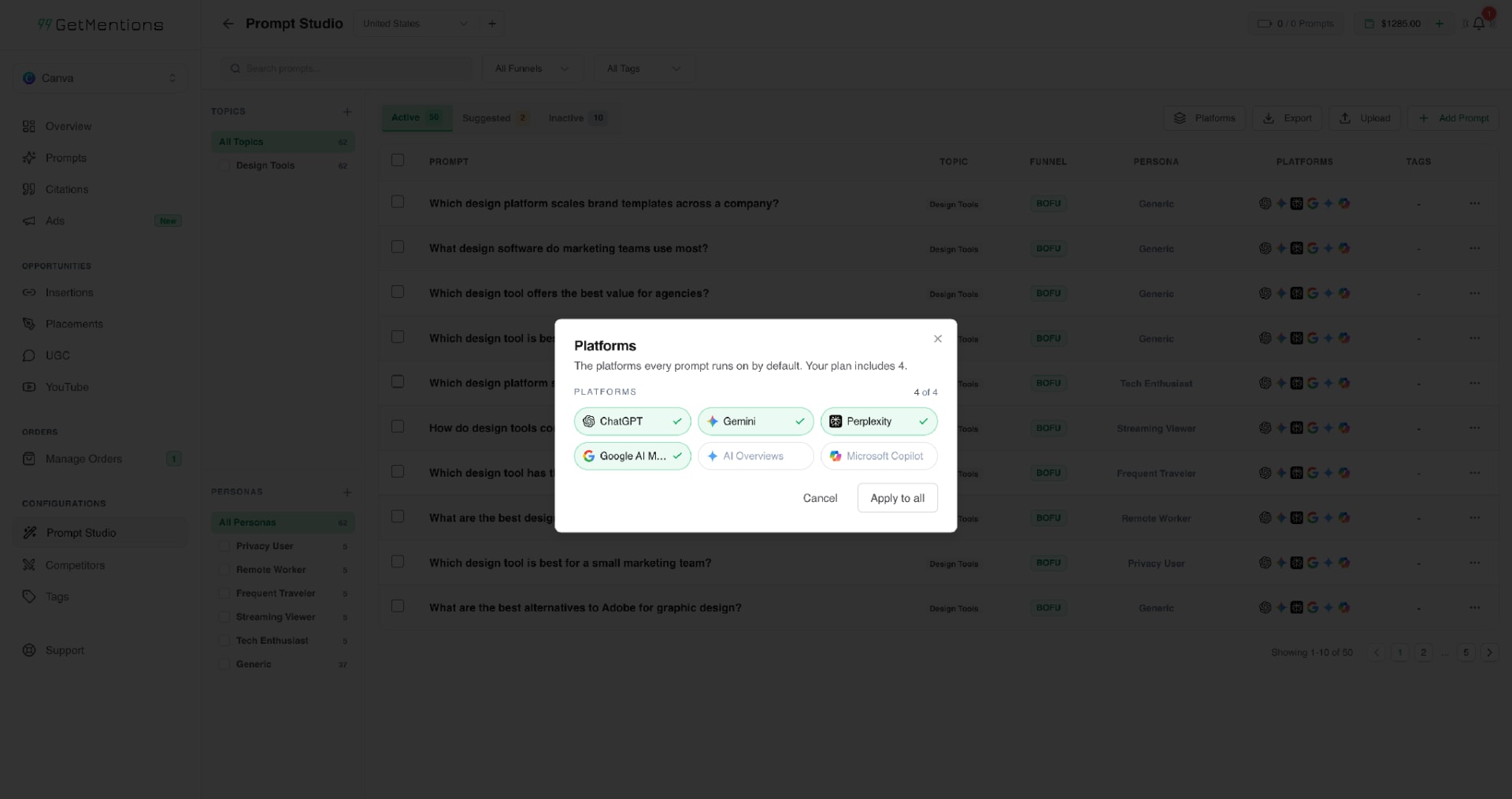
On self-serve plans, GetMentions AI includes any 4 of 6 standard platforms: ChatGPT, Gemini, Google AI Mode, Google AI Overviews, Microsoft Copilot, and Perplexity. Enterprise expands further with API access to seven additional LLMs. That split matters, so settle it early.
The useful part starts after coverage.
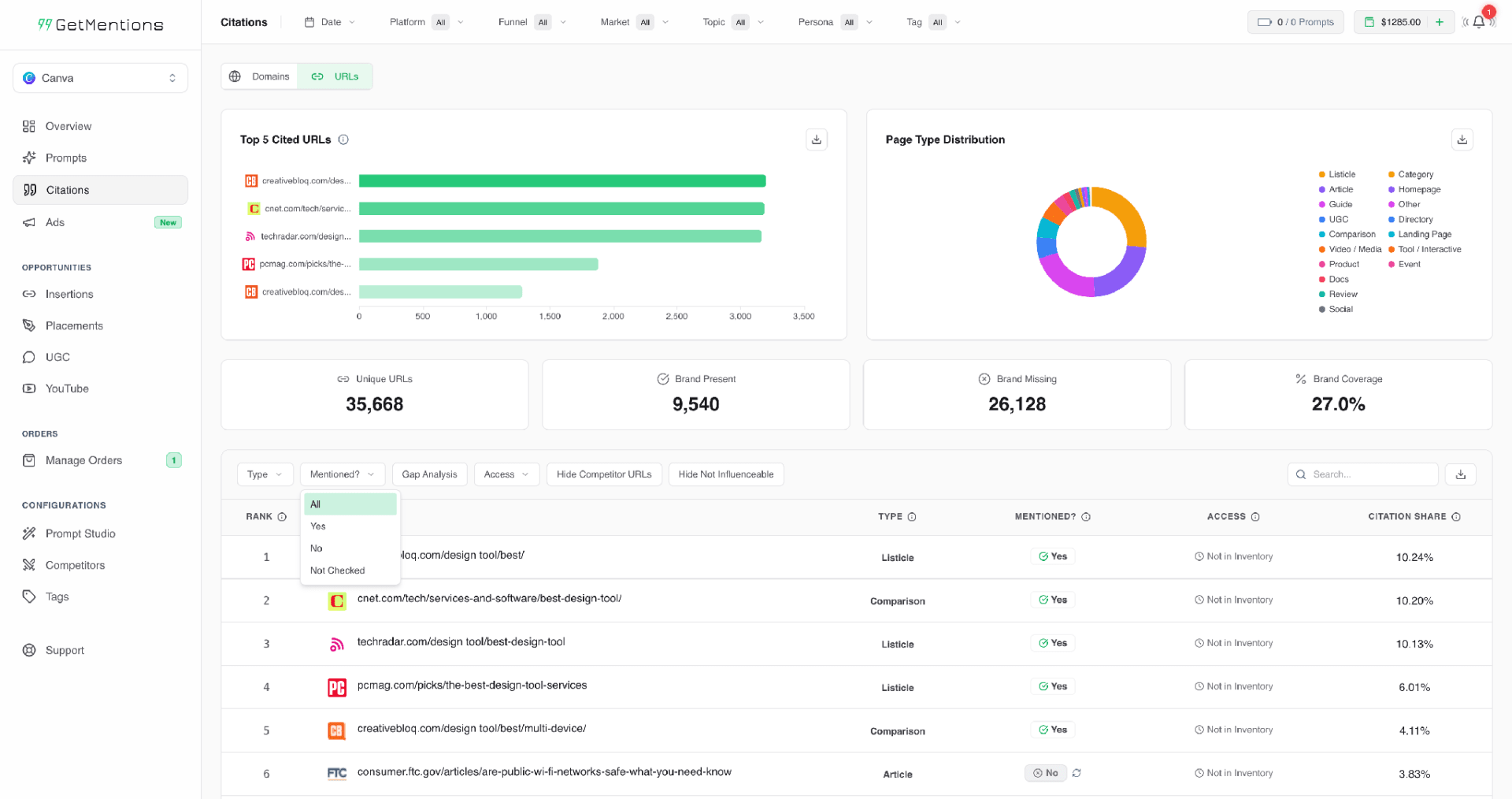
You can inspect cited domains and exact cited URLs, switch between domain and URL views, and check whether your brand is present on each source. Every cited source is also classified by domain type and page type, which makes it easier to separate editorial pages, review pages, and forum threads without manual cleanup.
That depth is not academic. A Seer Interactive study of 800,000 AI responses found review sites were the second-largest citation source, and an arXiv study found traditional Google search, AI Overviews, and Gemini surfaced substantially different source sets. If your reporting stops at owned pages, you are missing too much of the answer layer.
GetMentions AI also treats community sources as part of the reporting surface. Reddit, Quora, forums, and review-driven platforms are included for visibility insight, not as an in-product posting or outreach channel. YouTube gets fuller treatment. The platform identifies cited channels, shows channel-level data, and lets you request managed YouTube placements from the same broader workflow.
Then there are ads. The AI Ads Tracker runs prompts on a schedule, identifies advertisers appearing in answers, flags bidding on your brand, and surfaces prompt-level gaps where competitors are paying and you are absent. For now, that module is limited to ChatGPT.
How the numbers are produced, and what they cannot settle cleanly
AI visibility reports get distrusted when the score has no receipts. GetMentions AI handles that better than most because the answer and the source layer stay visible behind the metric.
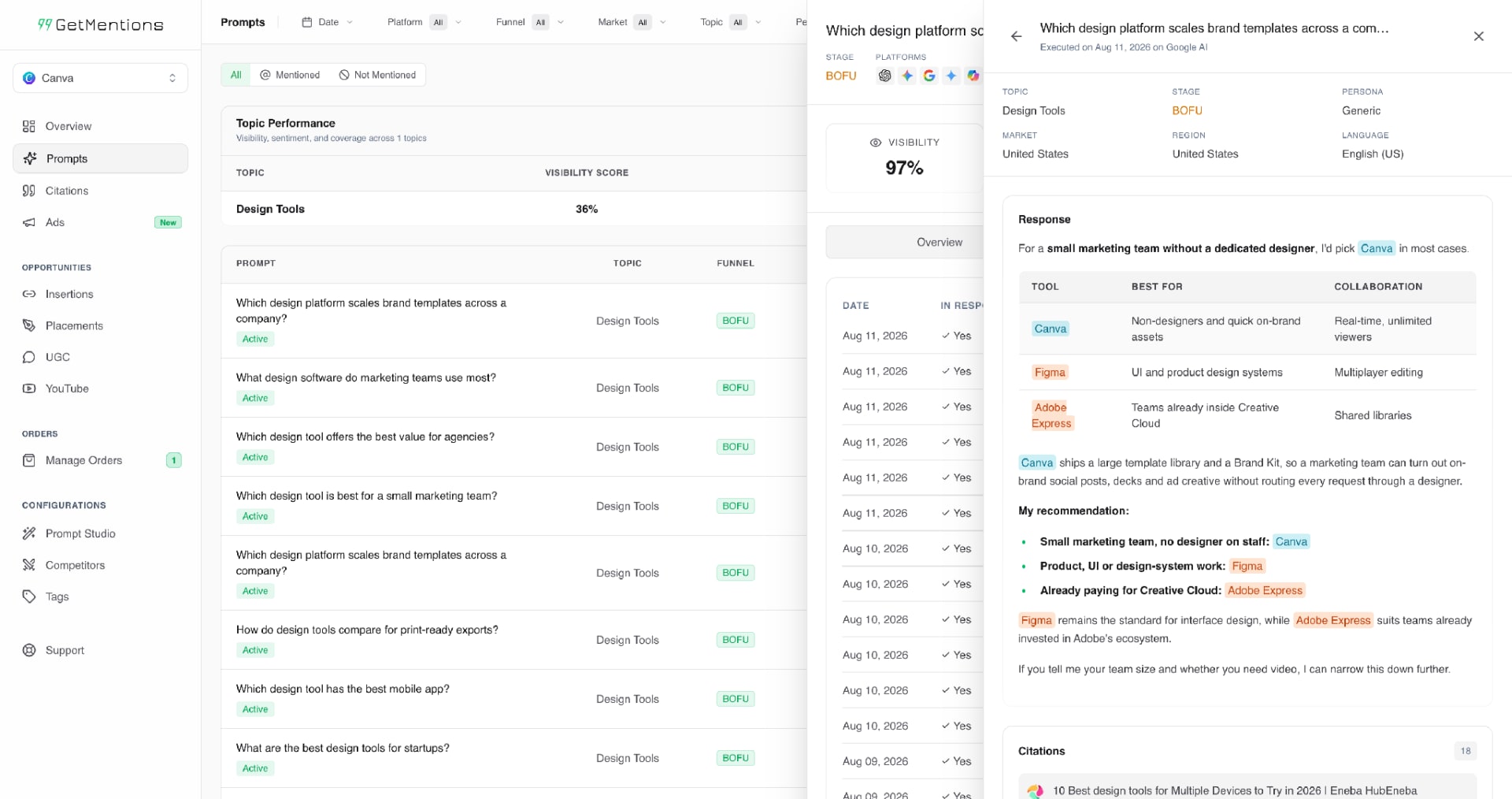
The platform tracks visibility score, sentiment, and average rank across prompts, markets, languages, and segments such as funnel stage. More important, each prompt run keeps the verbatim AI response and the cited sources behind it. You can move from a score change to the actual answer, then down to the exact page that shaped it.
That makes the reporting easier to defend.
You can also filter cited sources by brand presence, including a visible "not checked" state. I liked that detail. It is a small sign that the product is trying to show you what it knows and what it has not verified yet, instead of flattening everything into a clean but opaque percentage.
Still, you should not ask any dashboard for more certainty than the systems underneath can give.
An arXiv study found AI Overviews were less consistent across repeated runs of the same query and less robust to small query edits. A second arXiv study found nearly 30% of domains cited in Google AI Overviews did not appear anywhere in the co-displayed first-page search results. That is why saved answers and cited URLs matter more than score-watching alone.
Presence is not traffic, either.
In Pew Research Center browsing data, users clicked a traditional search result on 8% of visits with an AI summary, versus 15% without one. They clicked a link inside the summary itself on 1% of visits. Use GetMentions AI to measure presence, source influence, and gap-closing work. Do not use it as a shortcut to revenue attribution.
The category itself is no longer fringe. The Reuters Institute reported that 61% of U.S. respondents had seen an AI-generated search answer in the previous week. That is enough to make repeatable reporting a practical need, not a novelty.
What setup and weekly use look like
Setup is easy to start. The prompt choices still belong to you.
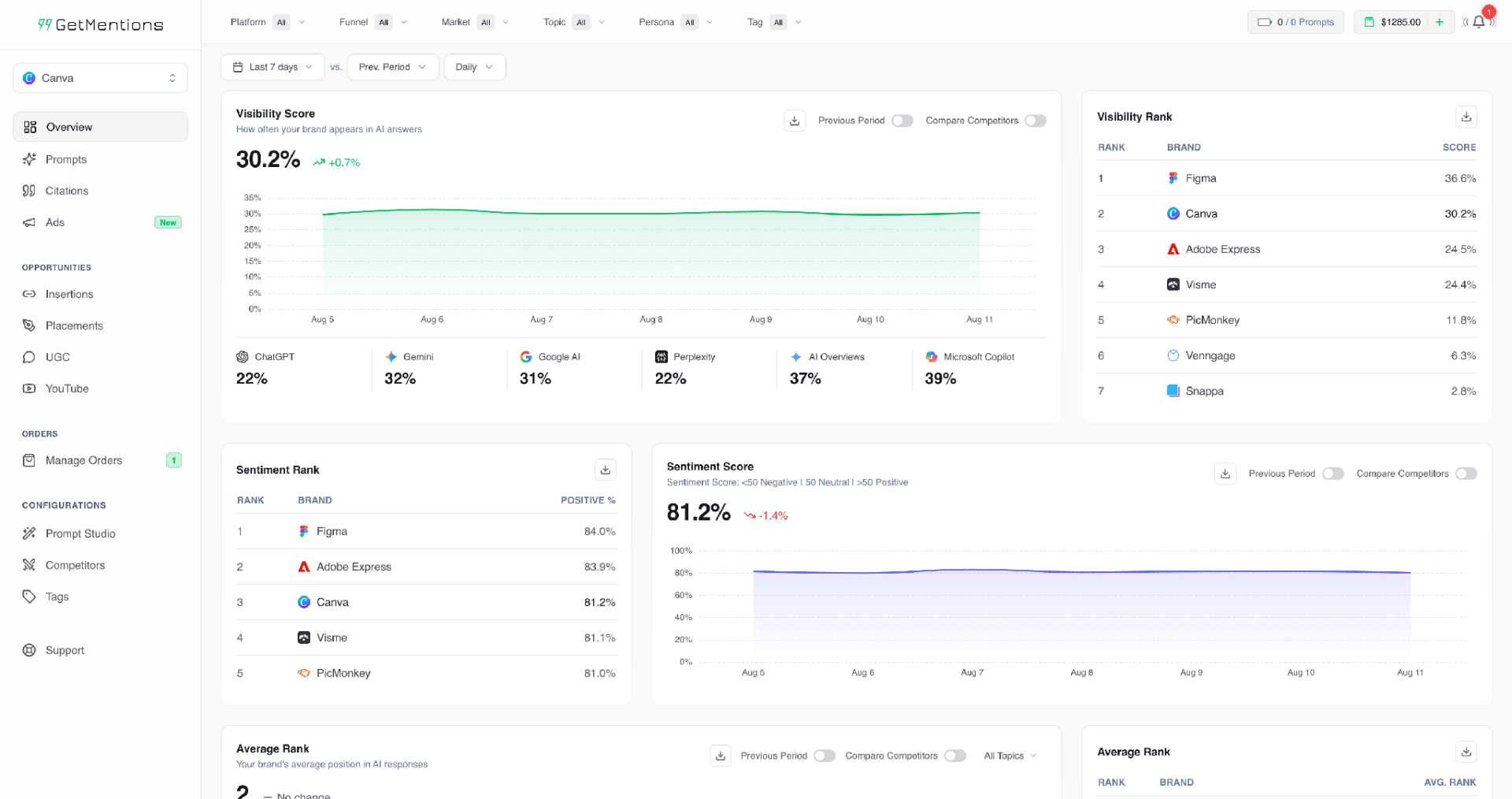
You begin by entering a domain. GetMentions AI reads the site and proposes topics, buyer personas, competitors, and a starting prompt set. That is better than a blank workspace, especially if you are still shaping the first version of your prompt library.
Then you edit.
If you already have a stable set of buyer queries, import it by CSV. If you sell to different audiences, clean up the segmentation before the first run. Persona and funnel-stage structure matter later when someone asks you why one slice moved and another did not.
Next, choose the platforms that matter for this test and run the first report. I would not stay on the overview screen for long. Visibility score, sentiment, and average rank tell you where to look. The saved answers tell you what happened.
The weekly rhythm is straightforward. Review movement, open the affected answers, inspect the cited URLs behind them, and filter for pages where your brand is missing. That is where the dashboard stops being a report and starts becoming a worklist.
Where the dashboard turns into a work queue
This is the section that carries the recommendation.
From a cited source where your brand is missing, you can request one of three actions from the same workflow: an existing-page insertion, a new editorial placement, or a YouTube placement on a cited channel in your niche. The request path is not abstract. You get quoted pricing, approve or reject controls, an operator message thread, an activity log, payment by card or prepaid wallet, and the live published URL when the job is done.
That changes the feel of the product.
The practical theory is simple. If AI systems keep grounding answers in the same third-party pages, getting your brand added to those pages is one plausible way to influence future answers. GetMentions AI is built around that idea, then organized so you can work the influenceable slice instead of staring at a wall of citations.
Prompt to answer. Answer to source. Source to action.
That is the loop.
What you can export and share
Reporting and permissions are better than average here.
Charts export as images or CSV files, with comparison against the prior period. Community-source data can also be exported as CSV, which helps if your final narrative still gets built in Sheets, slides, or a BI tool.
Access control is practical, too. Every plan includes unlimited team members. Clients can stay view-only, strategists can edit, billing stays with the agency, and role-based controls decide who can change prompt sets or approve spend. Every change is logged.
If too many stakeholders usually break your reporting workflow, this part will matter early.
Pricing, metering, and trial: what it costs to start
The self-serve pricing is clearer than most once you look past the headline monthly number. You are paying for prompt volume, brands, markets, and refresh cadence, while features and team access stay the same.
You can inspect the current GetMentions AI pricing and trial on the site. This is the self-serve structure published there.
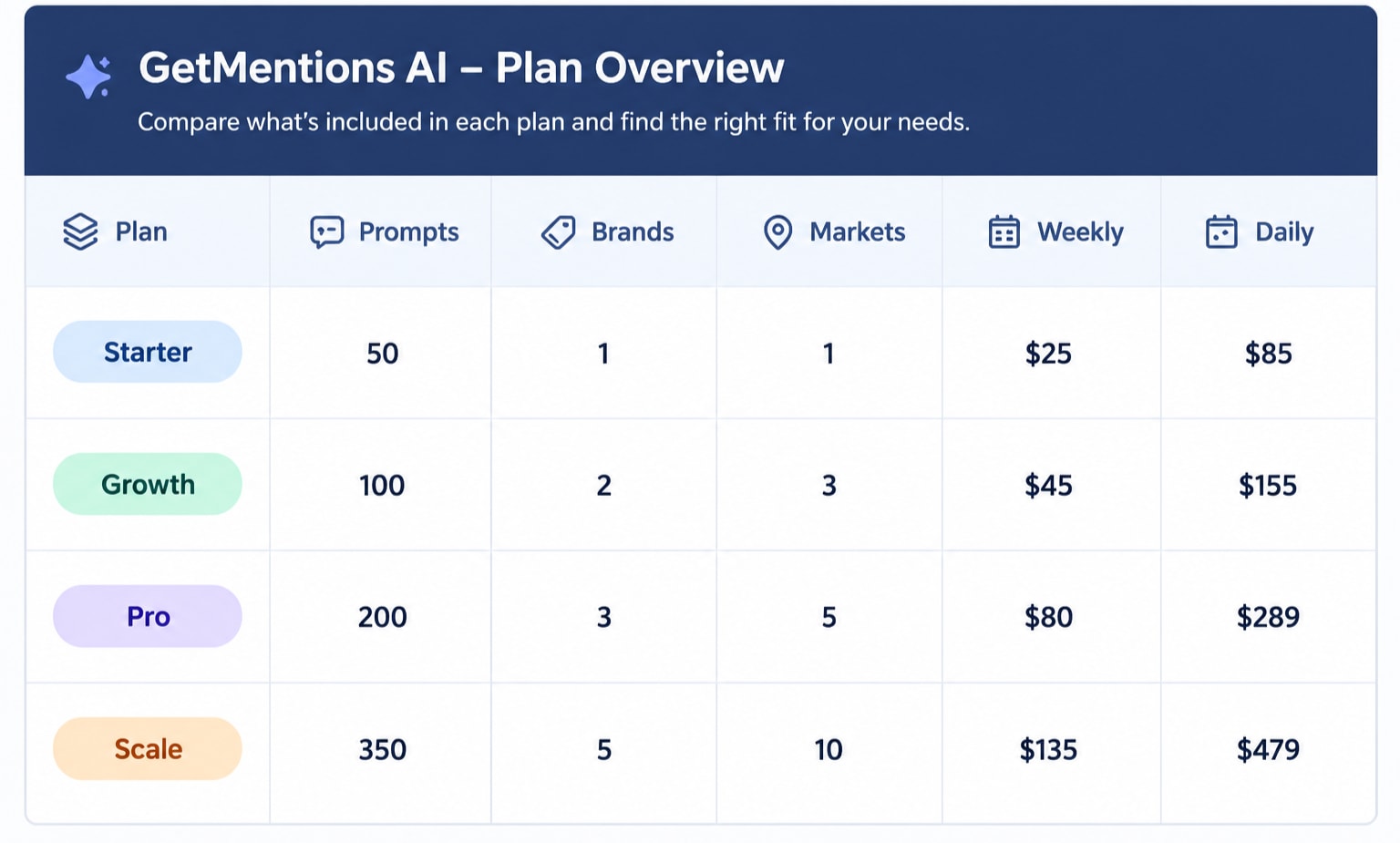
All self-serve plans: unlimited users, all features, any 4 of 6 standard platforms.
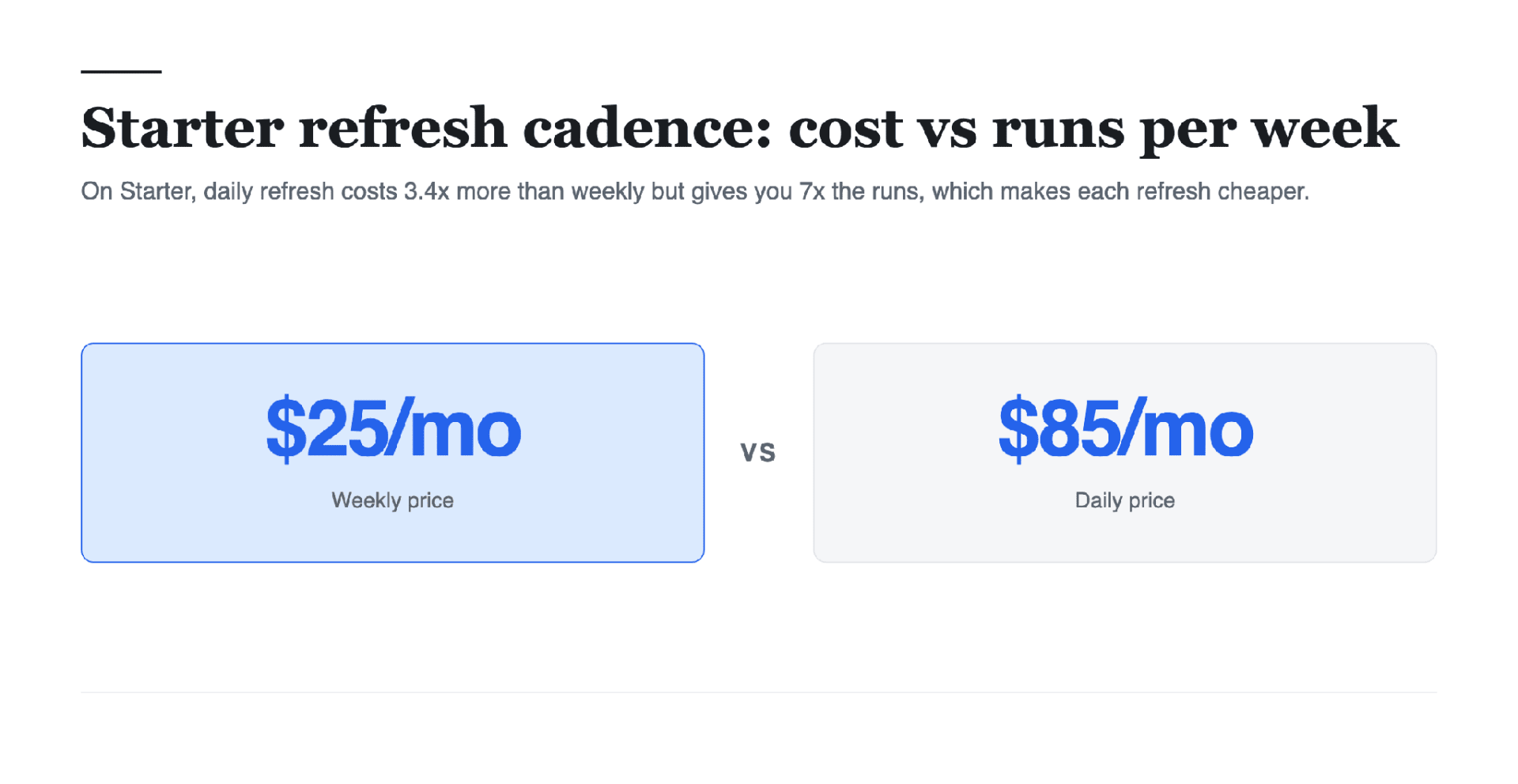
The buying detail most people will miss is cadence math. On Starter, daily refresh costs 3.4 times the monthly price of weekly refresh, but buys 7 times the refreshes. Per refresh, daily works out to about 51% cheaper. Choose weekly when you want a steady reporting rhythm and a stable prompt set. Choose daily when you are iterating content, running digital PR, or watching a volatile market.
The trial is solid. You get 7 days, no credit card, full platform access, and up to 25 prompts per run. That is enough to test the workflow on a focused prompt set and decide whether the answer view, source filters, and execution path are worth keeping.
What I liked, and the limits that matter
What I liked
- The evidence is inspectable. You can open the answer behind the movement, inspect the cited URL behind the answer, and decide what the score means with the source still in view.
- The source layer is where the product thinks. It is not just counting mentions. It is organizing the pages, threads, reviews, and videos influencing AI answers, then helping you work the gaps.
- The team model is easy to live with. Unlimited users, view-only access, edit controls, spend approval, logs, and export options are the sort of details that save you pain later.
The limits that matter
- Coverage choices matter up front. Self-serve plans are not a blanket all-surfaces purchase, and broader model coverage moves into Enterprise.
- The AI Ads Tracker is narrow today. If your paid-monitoring need extends beyond ChatGPT, do not treat that module as complete.
- Community-source tracking stays on the intelligence side. You can track and export Reddit, Quora, forums, and review-driven sources, but that does not become managed community outreach inside the product.
- Execution pricing is quoted, not published. If you know you only want a lightweight monitor, part of the product may sit unused.
Use cases: who should use GetMentions AI
This product makes the most sense when your reporting has to lead somewhere specific.
- Agencies: if you manage multiple clients and need view-only access, spend controls, logs, and a repeatable path from AI visibility reporting to approved work, GetMentions AI fits the operating model well.
- In-house SEO and growth teams: if you are tired of manual sweeps and need defensible reports for leadership, the saved answers and URL-level source views are the core reason to use it.
- Digital PR teams: if your work increasingly starts from third-party pages that AI systems already cite, the source-gap and execution flow is the strongest part of the product.
- E-commerce brands: if product discovery in your category is shaped by review pages, Reddit threads, comparison content, and cited YouTube videos, this is a practical way to see which sources are influencing recommendations and where your brand is missing.
You can still use it for monitoring only. Starter is inexpensive, every plan includes all features, and unlimited users help. But the product earns its keep when you plan to work the gaps, not just count them.
The bottom line
Most AI visibility tools stop at measurement. GetMentions AI pushes the workflow one step further: measurement, source intelligence, then execution.
You see the answer, inspect the source shaping it, check whether your brand is missing there, and request work on that same source without opening a second system. If that is the bottleneck in your current reporting, this is the first product I would test.
Start with a fixed prompt set, open the saved answers behind a few important prompts, and send one request through the execution layer. You will know quickly whether it can replace your dashboard-plus-sheet-plus-outreach stack.
FAQ
Can GetMentions AI help improve AI visibility, or does it only measure it?
It can do both, within limits. It measures prompts, answers, citations, and source gaps, then lets you request existing-page insertions, editorial placements, or cited-YouTube placements from the same workflow.
Can I see the exact pages behind a visibility change?
Yes. GetMentions AI keeps the verbatim response and lets you drill down to cited domains and exact cited URLs, so you can inspect the page shaping the answer rather than trusting a score by itself.
What should you do after you find a citation gap?
You should check whether the cited source is influenceable, then decide whether it belongs in your work queue. GetMentions AI helps by prioritizing opportunities and letting you move selected rows into insertion, editorial, or YouTube requests.
Can I import my own prompt set?
Yes. You can generate prompts from your site and buyer personas or import your own prompt list by CSV, which is the better route if you already have a stable set of buyer queries.
Is GetMentions AI a fit for agencies or e-commerce brands?
Yes, often. Agencies get unlimited members, view-only client access, edit controls, and spend approval, while e-commerce teams can use the source layer to track the review pages, community threads, and YouTube channels influencing AI recommendations.
Is the 7-day trial enough to evaluate it properly?
Usually, yes. Seven days with full platform access and up to 25 prompts per run is enough to test whether the reporting, source analysis, and execution flow fit the way your team already works.
Comments
Loading comments…