On March 5, 2026, OpenAI dropped what might be its most significant model update since the original ChatGPT launch. GPT-5.4 isn’t just an incremental improvement — it’s a fundamental reimagining of how AI can integrate into professional workflows, combining advanced reasoning, autonomous computer operation, and enterprise-grade efficiency into a single, cohesive system.
In an era where AI competition has never been fiercer, with Anthropic’s Claude making aggressive plays for the enterprise market, OpenAI’s latest release feels like a declaration: the future of work is agentic, and they’re determined to own it.
What Makes GPT-5.4 Different
If you’ve been following OpenAI’s release cadence, you know they’ve been iterating fast. GPT-5.3 Instant launched just a day before the GPT-5.4 announcement — a move that raised eyebrows and suggested OpenAI was accelerating its roadmap in response to market pressures.
But GPT-5.4 isn’t merely a response to competition. It represents a consolidation of capabilities that were previously scattered across multiple specialized models.
The Three Flavors of GPT-5.4
OpenAI is releasing GPT-5.4 in three distinct variants, each optimized for different use cases:
GPT-5.4 (Standard) — The balanced workhorse for everyday professional tasks, now with significantly improved token efficiency and a 1 million token context window in the API — by far the largest OpenAI has ever offered .
GPT-5.4 Thinking — The reasoning specialist that shows its work. Unlike previous “black box” AI responses, GPT-5.4 Thinking displays an upfront plan before tackling complex tasks, allowing users to intervene, redirect, or adjust mid-response without starting over .
GPT-5.4 Pro — The flagship model for maximum performance on complex tasks, exclusive to Pro and Enterprise subscribers. This is the model you reach for when accuracy matters more than speed.
Image Credit: OpenAI — The GPT-5.4 Thinking interface showing the model’s planning phase
Benchmark-Breaking Performance
The numbers behind GPT-5.4 tell a compelling story. OpenAI has set new records across multiple industry-standard benchmarks:
- 83% on GDPval — OpenAI’s internal test for knowledge work tasks, representing a significant leap in professional-grade accuracy
- Record scores on OSWorld-Verified and WebArena-Verified — Computer use benchmarks that test an AI’s ability to navigate operating systems and web environments autonomously
- Lead position on Mercor’s APEX-Agents benchmark — Testing professional skills in law and finance, where GPT-5.4 excelled at creating “long-horizon deliverables such as slide decks, financial models, and legal analysis”
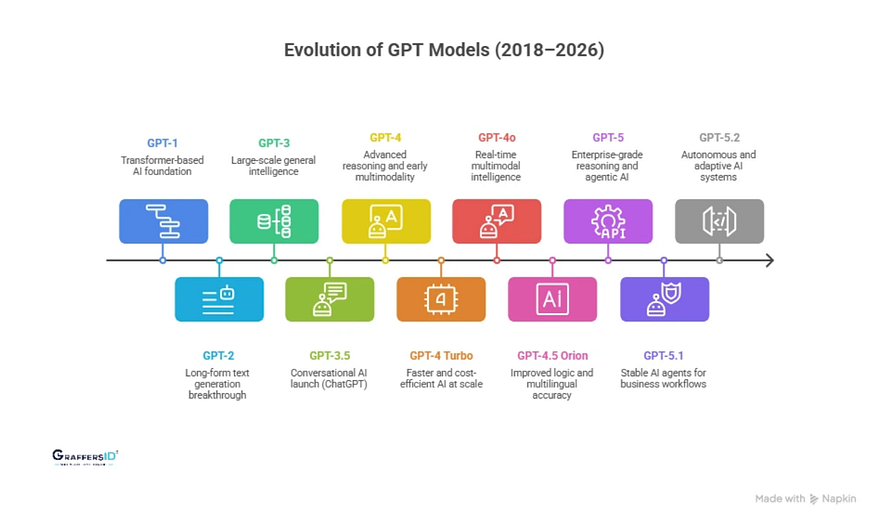
Image Credit: Graffersid — Evolution of GPT models from 2018–2026 showing the progression to GPT-5.4
But perhaps more impressive than the raw performance gains is the efficiency story. GPT-5.4 solves the same problems as its predecessors with significantly fewer tokens, translating to lower costs and faster response times for developers .
Hallucination Reduction
One of the most critical improvements for enterprise adoption is reliability. OpenAI reports that GPT-5.4 is 33% less likely to make errors in individual claims compared to GPT-5.2, and overall responses are 18% less likely to contain errors . For businesses betting their operations on AI output, these percentages represent real risk mitigation.
The Agentic Revolution: AI That Actually Does the Work
The most transformative aspect of GPT-5.4 isn’t just that it’s smarter — it’s that it’s more autonomous. OpenAI has consolidated the coding strengths of GPT-5.3-Codex with improved reasoning and agentic capabilities, creating a model that can navigate desktops, browsers, and software applications with minimal human intervention.
Tool Search: A Game-Changer for Developers
Previous AI systems loaded every available tool’s full definition into context upfront — a process that could consume tens of thousands of tokens per request. GPT-5.4 introduces Tool Search, a lightweight system where the model receives a simple list and looks up specific tools only when needed .
In testing on 250 tasks from Scale’s MCP Atlas benchmark with 36 MCP servers enabled, Tool Search reduced total token usage by 47% while maintaining accuracy. For developers building large agentic systems, this translates directly to lower costs and faster response times.
Enterprise Features That Matter
OpenAI isn’t just targeting developers with this release — they’re making a direct play for the enterprise market that has been Anthropic’s stronghold.
ChatGPT for Excel and Google Sheets
Perhaps the most practical immediate application is ChatGPT for Excel and Google Sheets (beta), a version of ChatGPT embedded directly in spreadsheets. This isn’t just a chat window in your workbook — it’s a system designed to build, analyze, and update complex financial models autonomously .
Imagine asking your spreadsheet to “build a DCF model for Tesla using the latest 10-K data” and having it populate cells, create formulas, and generate sensitivity tables automatically. That’s the promise here.
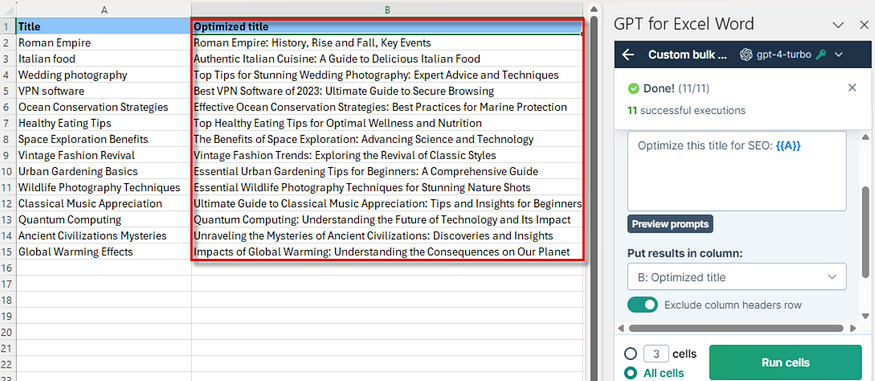
Image Credit: Talarian — ChatGPT integration with Excel showing AI-powered formula generation and data analysis
Financial Data Integrations
OpenAI is launching new ChatGPT app integrations with FactSet, MSCI, Third Bridge, and Moody’s — designed to let teams pull market, company, and internal data into a single workflow. This puts OpenAI in direct competition with specialized financial data providers and suggests a future where AI doesn’t just analyze data — it actively monitors, retrieves, and synthesizes information from multiple sources in real-time.
The Competitive Landscape: Why Now?
The timing of GPT-5.4’s release is telling. Just weeks earlier, reports emerged that approximately 2.5 million ChatGPT users intended to quit the platform, allegedly related to OpenAI’s deal with the Pentagon allowing the US government to use its technology for any lawful purpose .
Whether this exodus materializes or not, OpenAI is clearly feeling the pressure from multiple directions:
- Anthropic’s Claude for Financial Services launched in July 2025 with similar enterprise-focused features
- Google’s Gemini continues to improve its multimodal capabilities
- Open source models are closing the capability gap while offering more customization and control
GPT-5.4 feels like OpenAI’s answer to these challenges — a demonstration that they can still lead on capability while addressing the efficiency and reliability concerns that have kept some enterprises on the sidelines.

Image Credit: San Francisco Chronicle — OpenAI’s headquarters in San Francisco, where GPT-5.4 was developed
Real-World Applications: What Changes Tomorrow?
To understand GPT-5.4’s impact, consider how it changes specific workflows:
For Financial Analysts
Instead of manually building models and searching for data, analysts can delegate entire workflows to GPT-5.4. The model can pull real-time data from integrated sources, build multi-sheet Excel models, create presentation decks, and flag assumptions that need human verification — all while showing its reasoning process so you can catch errors early.
For Legal Professionals
The APEX-Agents benchmark performance suggests GPT-5.4 can handle complex legal analysis, document review, and contract drafting with greater accuracy than previous models. The 33% reduction in factual errors isn’t just a statistic — it could mean the difference between catching a liability issue and missing it.
For Software Developers
With consolidated Codex capabilities, GPT-5.4 can manage multiple coding agents in parallel, review diffs from isolated worktrees, and execute reusable skills and automations. The Tool Search feature means you can integrate it with large codebases without burning through your token budget .
For Operations Teams
The autonomous computer use capabilities mean GPT-5.4 can navigate legacy systems, extract data from multiple applications, and generate reports without requiring API integrations or custom scripts. It’s a bridge between modern AI and the messy reality of enterprise software landscapes.
Availability and Pricing
GPT-5.4 is rolling out with a tiered access model:
- ChatGPT Plus, Team, and Pro users: Access to GPT-5.4 Thinking starting March 5, 2026
- Enterprise and Edu plan users: Early access available via admin settings
- API developers: Immediate access to both gpt-5.4 and gpt-5.4-pro
- GPT-5.4 Pro: Exclusive to Pro and Enterprise plans
The model is live on chatgpt.com and Android, with iOS support coming soon .
The Bigger Picture: AI as Colleague, Not Just Tool
GPT-5.4 represents a shift in how we should think about AI systems. Previous models were tools — sophisticated, yes, but still requiring significant human direction and oversight. GPT-5.4’s combination of reasoning transparency (via Thinking mode), autonomous action (via computer use), and professional integrations positions it more as a junior colleague than a software tool.
This raises important questions about the future of knowledge work:
- How do we manage AI agents that can work autonomously across our systems?
- What new skills become valuable when AI can handle routine analysis and documentation?
- How do organizations maintain oversight when AI systems are making thousands of micro-decisions?
OpenAI’s answer seems to be “show your work” — the Thinking mode’s transparency is a recognition that for AI to be trusted with more autonomy, it needs to be more interpretable.
Conclusion: The New Baseline
GPT-5.4 doesn’t just raise the bar for AI capabilities — it redefines what professionals should expect from their AI tools. The combination of record-breaking benchmarks, 47% efficiency gains, autonomous computer use, and enterprise integrations creates a package that’s hard to ignore.
For those tracking the AI space, this release marks a transition point. The question is no longer “Can AI help with this task?” but “How much of this workflow can AI own?”
OpenAI has bet heavily on the answer being “most of it.”
The rest of 2026 will reveal whether enterprises are ready to make that leap and whether competitors can catch up to the new baseline GPT-5.4 has established.
What aspects of GPT-5.4 are you most excited to try? Share your thoughts in the comments below, and follow for more deep dives into the AI tools reshaping how we work.
Comments
Loading comments…