
Once upon a time, search results were delivered in neat rows of blue links, stacked 10 to a page. Each result seemed relevant, and its origin was discernible. Developers relying on search data knew what they were working with, and that they could measure a result's position, count how many times it appeared, and know what users saw when they carried out their own searches.
But those days are long gone. What's before us now is something a bit harder for a developer to crack. AI-driven search systems can ad-lib full answers, drawing on fragments netted from around the web and blending them into a mosaic of authoritative-sounding information. They still do the job, but determining what came from where can seem almost impossible. For developers building their own AI systems, this lack of transparency presents a concrete challenge: how can they validate their models against what users actually see?
It’s a black box.
That's what makes accessing such information so important for developers today. If an application relies on data sourced from a variety of places, all of which jockey for prominence within an AI-generated summary, then a developer needs to see how all of these revolving pieces interact. A clockmaker doesn't just need to see the arms of the clock; they need to see the gears. A developer likewise needs to know which sources are referenced, the ways in which they are framed, and how they surface in AI-generated results. This is where access to search data becomes paramount for modern-day developers. They need such data to do their jobs.
The State of AI-Driven Search
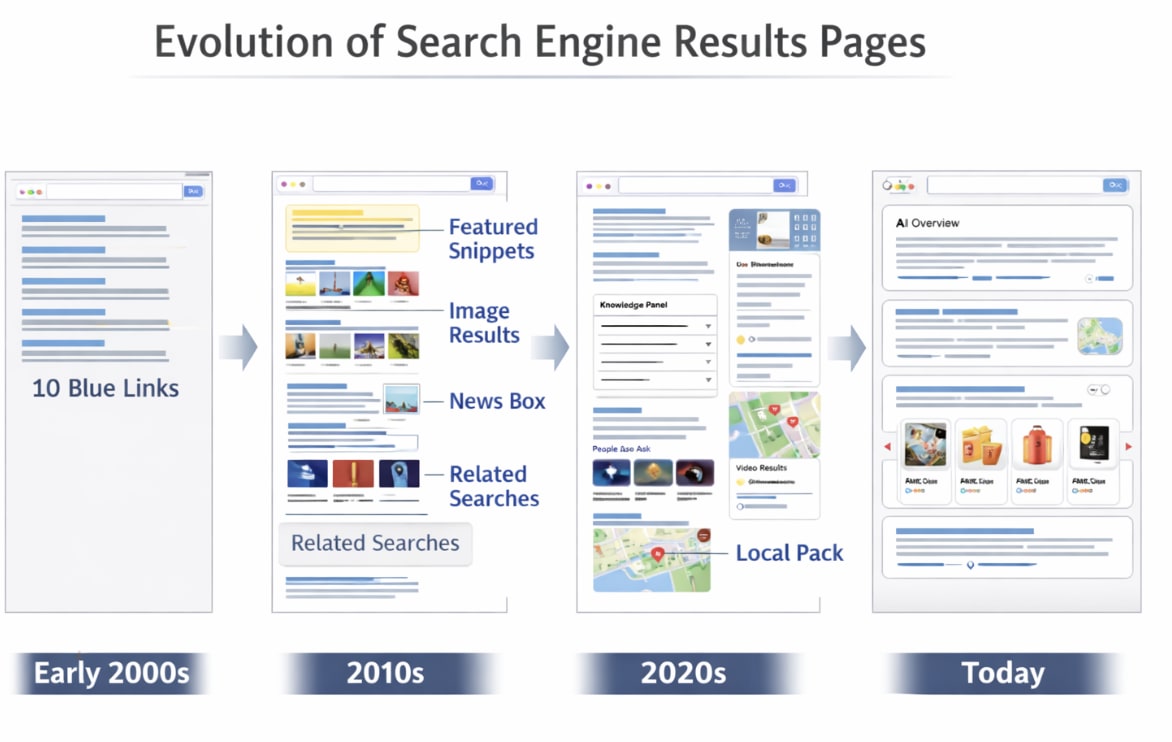
Evolution of search engine results pages (SERP) — from simple “10 blue links” to AI-driven summaries and rich interactive elements.
Old-fashioned web results are listed below, but one's eyes aren't there; they are on the AI.
AI-generated responses are a bouillabaisse of public documents, news reports, forum entries, and company websites. Some sources have verifiable data trails and can be confirmed; some have nothing to underpin them. Citation styles can vary, as can presentation, structure, and style.
A developer at work on an AI product wants to make sure that a search returns the right information. And if they are validating their own model's answers against what a user might see when querying another tool, then a developer wants to see those other results in order to test their own model. But AI-generated responses are not fixed. They are constantly in flux. How does one benchmark a tool against such a moving target?
This is where aggregated search data comes to the rescue. It offers a view of search outputs over time. Think of it like watching a time-lapse video of weather formations that makes it easier to predict an incoming storm or cold front. Developers can set up tools to capture the kind of search results they are interested in, track the domains most cited, detect when the composition of the sources is altered, and observe shifts in patterns as they occur.
It really is like being a meteorologist. With search output data in hand—information that is structured, timestamped, and query-specific—developers can finally regain visibility in the fog of AI. They can compare yesterday's responses with today's, spot a new source being utilized, and detect when a trustworthy source is no longer drawn upon. Search data is a crucial resource for developers. It helps them pick up where they left off in terms of creating better systems.
Practical Tasks
There are a few practical ways that developers can fold search data into their activities. One of these is to monitor cited sources for specific queries. If a query like "Python async context manager example" consistently cites official documentation and well-known tutorials, that establishes a baseline for developers. But if a lesser-known or outdated blog begins appearing in citations, that is worth investigating.
Developers can also compare AI-driven results over time. Just imagine that a new version of a software library is released. Developers may use search data to track how quickly AI-generated search summaries begin referencing updated documentation. This can provide a sign of visibility.
Validation also comes into play here, as teams often compare their own model’s generated answers against public search outputs. If their system provides a materially different explanation than what AI-driven search presents for the same query, that discrepancy can prompt a review. Is their model hallucinating? Or is the public information inconsistent?
One thing worth stressing is that raw data is not ideal for such work. Page layouts can change, as do labels and other attributes. These can mess up any monitoring tools one employs, making them unreliable. This is why structured data is invaluable, as it takes that raw data and makes it analyzable.
It works like AI systems that convert messy healthcare records into structured, searchable databases. Would you rather look at thousands of pages of handwritten notes or be able to enter some parameters and retrieve useful information?
Think of all the questions one might ask. How many unique domains were cited this month for a given topic? When did a particular source first appear in AI summaries? How often does the summary text materially change?
There are tools available that allow developers to ask these questions and more. One example is SerpApi, a real-time SERP API that enables developers to retrieve structured search results from engines like Google in JSON format. Instead of scraping raw HTML pages, developers receive normalized fields that include organic results, AI-generated summaries, cited sources, ranking positions, and metadata tied to a specific query and timestamp.
Because the data is returned in a consistent schema, it can be logged, versioned, and compared over time. This makes it possible to monitor how AI Overviews evolve, detect when new domains begin appearing in citations, and benchmark internal AI systems against publicly visible search outputs. Rather than traversing raw pages, developers work with structured records that are ready for storage, analysis, and integration into internal dashboards.
Visibility as Design Principle
At first glance, AI-driven search results have a sort of mystique about them. No one can reliably predict what the model will generate next. But developers today have no need for such mysteries. They want to roll up their sleeves and get to work building their own AI systems and continuing to use search data to inform their strategies and decisions.
Structured search data provides a bird's-eye view not only of AI-driven search results but also of human behavior. Developers can observe what is searched for, what sites and sources are credited, and how this evolves over time. A developer can see whether their content aligns with the sources AI systems draw upon when generating responses, or whether it diverges substantially. They can pick up on shifts and changes. By having such a vantage point, the result can only be an improvement in performance.
Better-informed systems work consistently, cite responsibly, and can be audited. This may be a new medium, but the data is there. Developers just need to know how to capture and use it.
Comments
Loading comments…