
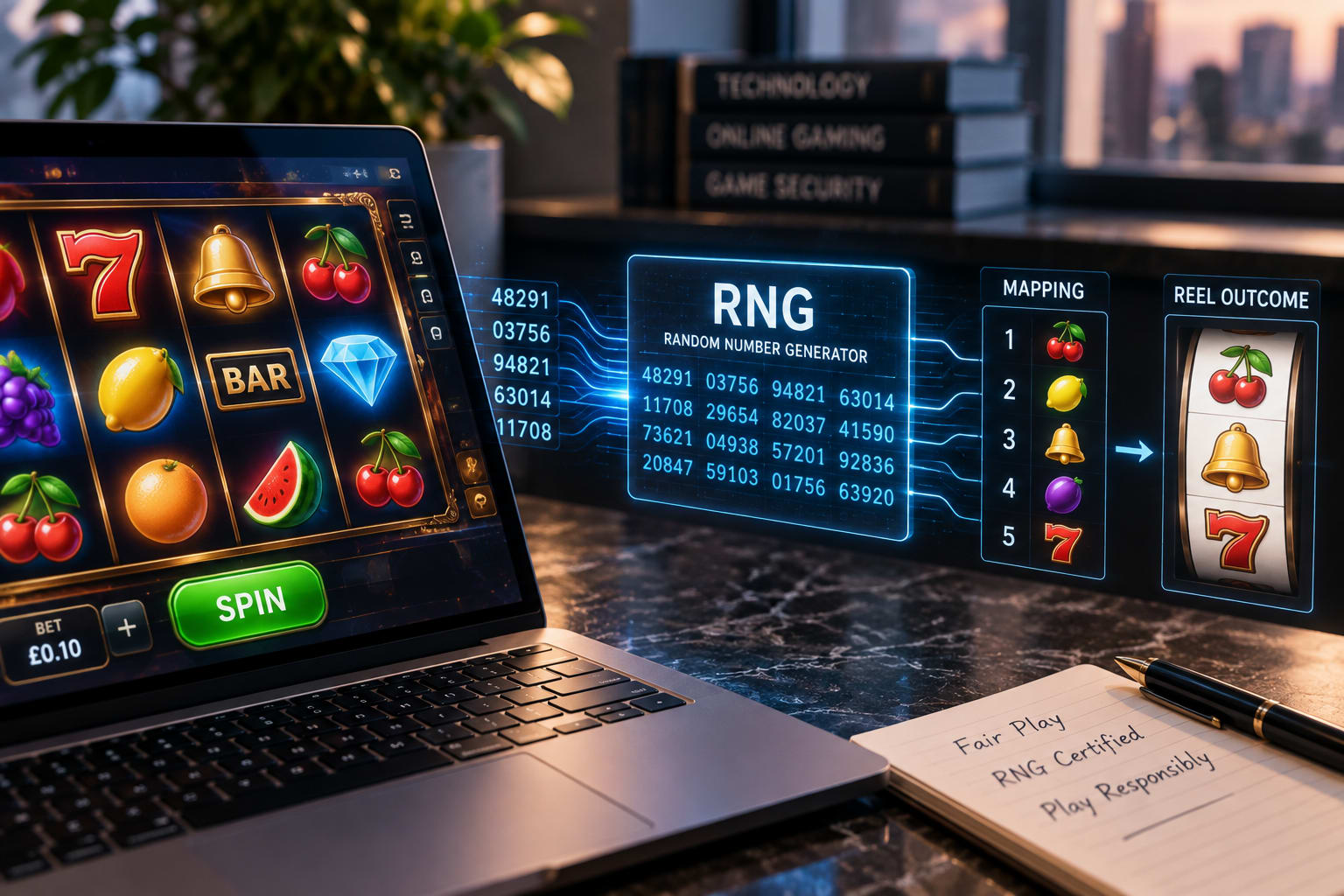
Online slot games are often described as if the random number generator alone decides everything that appears on screen. That is only part of the architecture.
In a regulated game, the RNG supplies random values. Separate game logic maps those values to outcomes according to the rules, reel configuration, symbol weighting and paytable. The reel animation displays the result; it is not itself the source of randomness.
In general, the relevant outcome is determined when a game round is initiated, although the exact timing and architecture can vary between systems.
The RNG supplies values, not the whole game result
The UK Gambling Commission defines an RNG as hardware or software used to generate numbers with the intended property of statistical randomness. It separately defines mapping as the process through which an RNG result becomes a game outcome.
The game applies its mathematical structure to the RNG values. Mapping can determine which reel position or symbol corresponds to an input, while the paytable determines what a resulting combination is worth.
The Commission also uses the term scaling for converting RNG output into the range required by a game. Under RTS 7, scaling must preserve the relevant random qualities.
“Acceptably random” is the regulatory standard
The Commission does not describe regulated software as “truly random”. Its standard is “acceptably random”: RNG output and game outcomes must be demonstrably random to a high degree of confidence using recognised statistical tests.
For a software RNG, predicting the next number must also be computationally infeasible without complete knowledge of the algorithm and seed value.
The same requirements apply across remote casino products licensed in Great Britain, including slots.
RTS 7 also prohibits adaptive behaviour, or a compensated game. The standard defines this as automatic or manual intervention that changes the probability of game outcomes occurring during play.
Mapping has to preserve the intended probabilities
Random output alone is not enough. The way it becomes a visible result must match the game's intended mathematics.
The Commission requires random inputs to be mapped according to the prevailing probabilities and paytables. Random numbers must be used in the order received and may only be discarded if they fall outside the expected range, in which case the error must be logged and investigated.
RTS 7C also prohibits misleading near-miss effects. A game cannot replace one losing outcome with another losing outcome designed to appear closer to a win.
Testing has a defined scope
The Commission publishes a list of approved test houses and requires licence holders to use them where independent testing applies.
Under the UKGC testing strategy, the licence holder and test house agree a scope sufficient to assess compliance with the relevant technical standards.
RNG testing includes reviewing documentation, researching known weaknesses, checking source code and statistically testing raw and scaled output. Game testing also examines the design, maths, theoretical RTP and the scaling and mapping used to turn RNG output into outcomes.
New games and RNGs cannot be released until required testing has been completed and the report supplied to the Commission.
Licence holders within scope are also subject to an annual games testing audit. An approved test house checks a randomly selected sample of updates, confirms that change controls have been followed and verifies that effective live RTP monitoring processes are in place.
Testing does not mean “fair” in an unlimited sense
Regulatory testing demonstrates compliance with defined technical standards within an agreed scope. It is not a blanket guarantee covering every possible interpretation of the word “fair”.
Test reports record what was examined, the methods used and relevant limitations. Changes affecting game fairness may require external retesting, while minor changes that do not affect fairness can follow a different process.
RTP describes the game over the long term
RTP is separate from randomness. It is a theoretical percentage derived from the game's mathematics over a very large number of rounds.
It does not describe what any individual account will receive back from a particular amount of money or during a particular session.
The Commission requires processes for live RTP monitoring so that actual performance can be compared with expected RTP and possible errors investigated.
Online gambling in Great Britain is restricted to people aged 18 or over. Support and information are available through GambleAware, while GAMSTOP provides self-exclusion from participating UK-licensed online gambling businesses.
Comments
Loading comments…