
Have you recently been scraping Amazon at scale and noticed a drop in success rates?
If so, you are not alone…
Amazon’s anti-bot 2026 model is more sophisticated than ever. It requires a dedicated ecommerce scraping infrastructure to avoid challenges like the 503 error page or the Amazon CAPTCHA.
Explore what changed and which solutions you can trust to keep scraping Amazon at high volumes!
Residential Proxy Rotation Alone No Longer Works for Amazon Scraping
Before 2026, building an Amazon scraper was relatively straightforward. If you have ever built one, you probably followed the classic web scraping roadmap: start with an HTTP client, parse the HTML, and plug in residential proxies. For Amazon, this approach worked surprisingly well.
A simple script using Requests + BeautifulSoup, configured to route traffic through high-quality rotating residential proxies, was often enough to access most Amazon product pages and extract data from them.
Now, that approach does not work as consistently as before. That is especially true if you are scraping Amazon at scale, which means performing hundreds of thousands or even millions of requests per month.
As you are about to learn, Amazon’s anti-bot systems have evolved a lot over time, and residential proxy Amazon solutions alone might no longer be enough.
So, before digging into why this approach stopped working, you should first look at how it fails.
Want to test a more reliable scraping setup? New Bright Data accounts include 5,000 free credits every month for Pay-As-You-Go users, with no credit card required and a hard spending limit that prevents unexpected charges. It’s an easy way to test Bright Data’s scraping infrastructure before scaling your Amazon workflows. Get started with Bright Data today.
The Two Most Common Failures When Scraping Amazon at Scale
So, your Amazon scraper is likely to get caught. The question is: What errors or challenges should you expect?
Discover the two most common failure scenarios you are likely to run into when scraping Amazon at scale!
Amazon’s 503 Error Page
Amazon is one of those tricky websites that gives you very little information when something goes wrong. Instead of returning clear error codes, it tends to respond with a generic 503 Service Unavailable page.
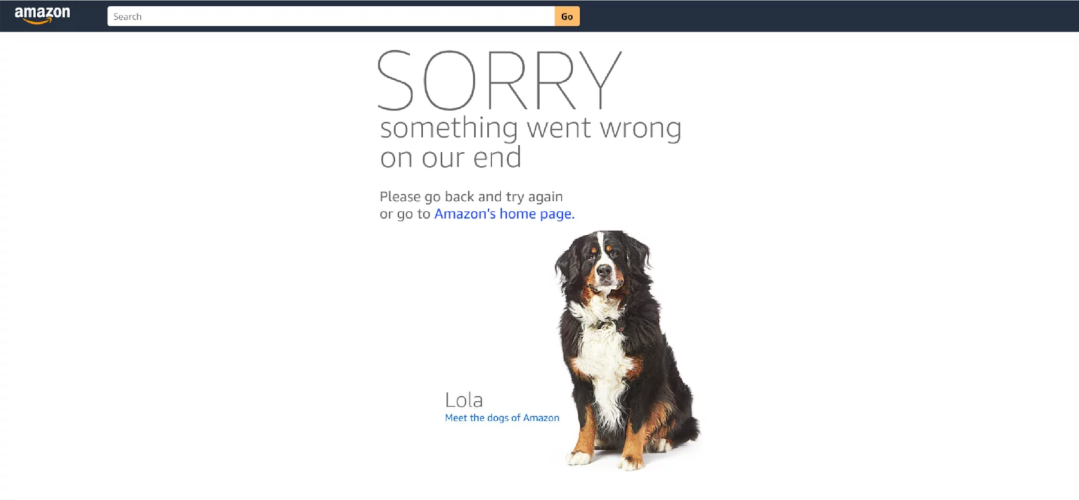
Amazon’s 503 Service Unavailable page
Sending too many requests? You might expect the classic 429 Too Many Requests response.
Instead, you get a 503.
Did your scraper trigger suspicion because of an inconsistent TLS fingerprint? Again, 503.
Suspicious request patterns? You guessed it: 503.
In practice, Amazon returns the same generic 503 page for a wide range of suspicious requests, without revealing the actual reason behind the block.
Sure, the error page featuring an adorable dog telling you something went wrong is cute. From a scraping perspective, though, it is incredibly frustrating because it makes debugging much harder.
As scraping engineers, we want to know why a request failed so we can fix it. Was it rate limiting? An inconsistent TLS fingerprint? Browser fingerprinting? IP reputation? There is no way to know.
Amazon's CAPTCHA
Now, you move to a more advanced setup. Instead of a simple HTTP scraper, you use a browser automation tool like Playwright.
Requests are still routed through rotating residential proxies to reduce the chance of triggering Amazon’s 503 pages due to IP reputation issues and TLS/HTTP fingerprinting. On paper, that should be enough. In practice, it is not.
Once you start defining real automation logic (e.g., searching for products, navigating paginated listings, or exploring Amazon reviews), you can quickly run into one of Amazon’s most well-known defenses. That is the notorious Amazon CAPTCHA.
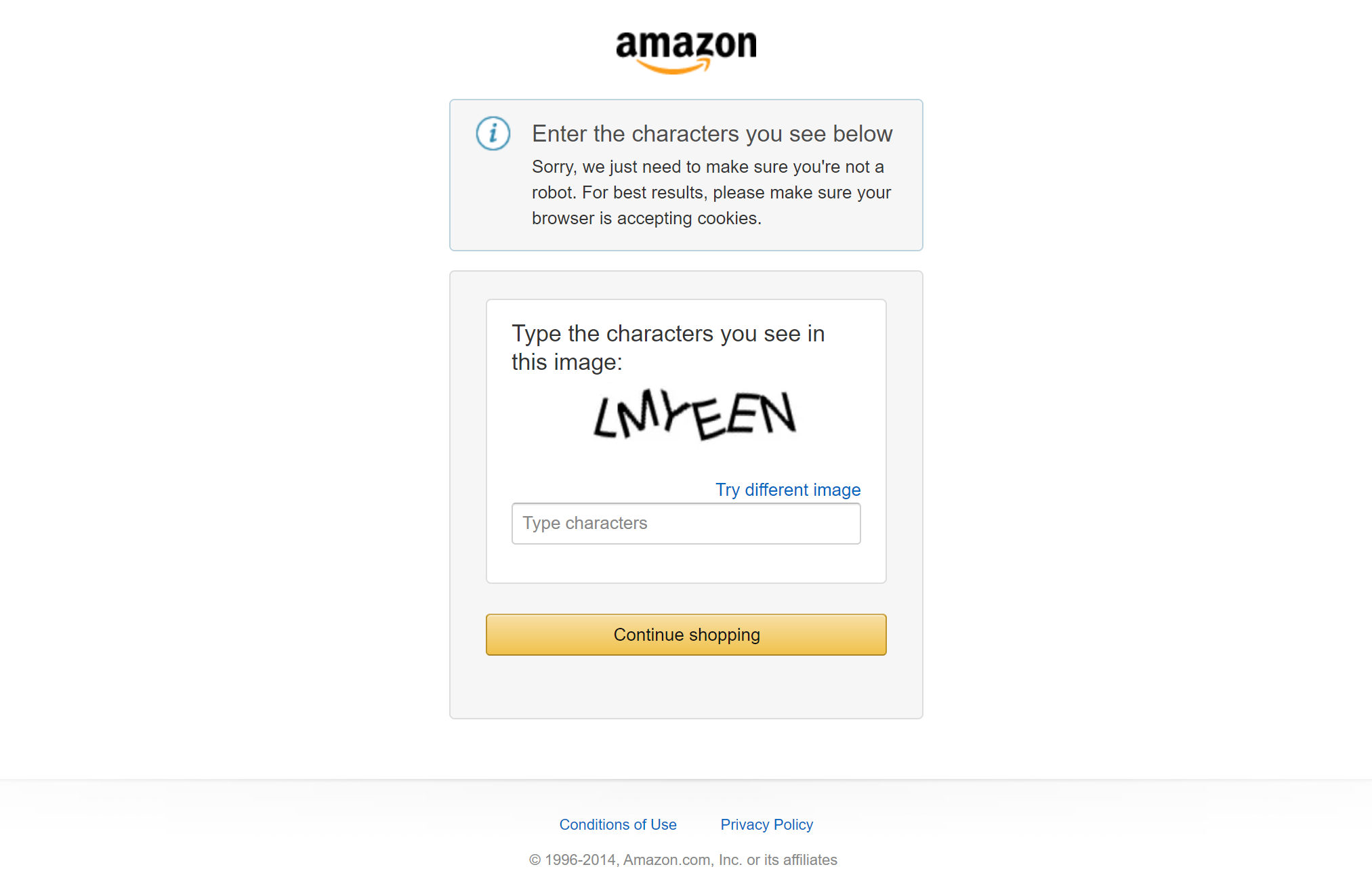
An example of an Amazon CAPTCHA instance
As you will learn soon, Amazon does not rely on a single signal. On the contrary, it tracks multiple layers of fingerprinting. So, even with a real browser and rotating proxies, the Amazon CAPTCHA can still appear.
Breaking Down the Six-Layer Amazon Anti-Bot 2026 Model
You may be wondering: Why did my Amazon scraping script suddenly stop working? What changed in 2026?
The answer lies in the Amazon 2026 anti-bot model and its six detection layers for automation detection.
Layer #1: IP Reputation and ASN Analysis
Amazon checks whether your IP address and ASN (Autonomous System Number) look trustworthy.
It evaluates:
- Residential vs datacenter IPs
- IP reputation history
- ASN ownership (AWS, OVH, etc.)
- Abuse activity associated with IP subnets across the ASN
Example:
If you rotate through cheap proxies, Amazon can quickly recognize the subnet and block traffic (even if the requests appear clean).
Layer #2: Network-Level Fingerprinting
Amazon analyzes TLS handshake metadata alongside HTTP headers, cookies, and related request signals to validate client authenticity. Note that the order of headers and cookies can also play a role.
It inspects cipher suites, TLS versions, extension ordering, and the overall ClientHello structure, then correlates these with higher-level HTTP characteristics.
Example:
A request declares the latest Chrome version on Windows via the User-Agent header, but presents a TLS fingerprint consistent with Python requests. This creates an immediate protocol-level mismatch that triggers blocking.
Layer #3: Browser Environment Detection
When rendering web pages (either in regular browsers or automated browser environments), Amazon shifts to environment validation.
It evaluates signals such as:
- WebGL rendering consistency
- Canvas fingerprint stability
- Installed font lists
- Navigator object properties
- Headless browser indicators
Example:
A Playwright instance running in headless mode tends to expose subtle inconsistencies compared to a real user device, causing the session to be flagged as automated.
Important: When browsing Amazon in your desktop/mobile browser, you can still receive the Amazon CAPTCHA. This occurs when other signals are weak or inconsistent, such as a poor IP reputation due to VPN usage.
Layer #4: Behavioral Analysis
This layer is where detection becomes tricky. Amazon collects user interaction data and evaluates it against patterns typical of human behavior using ML models. That is the core idea behind user behavior analysis.
It monitors signals such as:
- Mouse movement trajectories
- Scroll speed and acceleration
- Click timing variability
- Navigation flow across pages
Example:
A perfectly straight mouse movement at constant speed is a strong automation signal. In contrast, human movement tends to be curved, irregular, and includes small micro-corrections.
Layer #5: ML-Driven Detection Scoring
Amazon feeds all previously collected signals into internal ML/AI systems that aggregate them into a unified human-likelihood score.
In most cases, that scoring is not based on a single request but instead on cross-session analysis. If multiple requests can be linked to the same fingerprint, the anti-bot scoring system evaluates consistency and behavior patterns over longer time windows.
👉 Example:
Individual requests may appear legitimate in isolation. Yet, unusually fast navigation across hundreds or thousands of product pages in a short period can greatly increase the human-likelihood score.
Layer #6: Anti-Bot Defense Delivery
When specific thresholds of the human-likelihood score are exceeded, Amazon triggers downstream anti-bot and anti-scraping defenses. As mentioned earlier, this generally results in either a generic 503 response page or the Amazon CAPTCHA challenge.
Whether you receive one or the other is not random. The anti-bot response delivered depends on the evaluated risk level associated with your session or request pattern.
Amazon serves a CAPTCHA when the system is uncertain whether the traffic is automated and wants additional proof of human behavior. In contrast, if the resulting human-likelihood score is very low, the session is classified as clearly malicious/automated, and you get a direct 503 page.
What It Actually Takes to Scrape Amazon in 2026
At this point, it should be clear that scraping Amazon at scale requires dedicated infrastructure. The end goal is to reduce the human-likelihood score calculated by the Amazon anti-bot 2026 system.
Now, even with optimized infrastructure, some sessions may still trigger Amazon CAPTCHA challenges. That means large-scale scraping also requires CAPTCHA-solving capabilities to avoid interruptions.
The best way to get everything you need in one place is to use an enterprise-ready web scraping provider, such as Bright Data.
Bright Data’s Amazon-Ready Scraping Architecture
Bright Data’s web scraping infrastructure is built on one of the world’s largest high-reputation residential proxy networks, spanning over 400 million IPs across 195 countries. Combined with a 99.99% SLA-backed uptime, the platform reaches an overall 99.95% success rate.
That infrastructure is built exclusively on ethically sourced proxies. In addition, the platform is fully GDPR- and CCPA-compliant. Plus, it is SOC 2 and ISO 27001 certified. This ensures that scraping operations running through Bright Data remain secure, compliant, and ethical.
That scale matters for concurrency and geographic coverage, but as you have seen, rotating residential IPs alone is not enough to scrape Amazon reliably. Thus, let’s look at the specific Bright Data solutions designed for Amazon scraping!
Web Unlocker API: The Go-To Solution for Amazon Scraping at High Volume
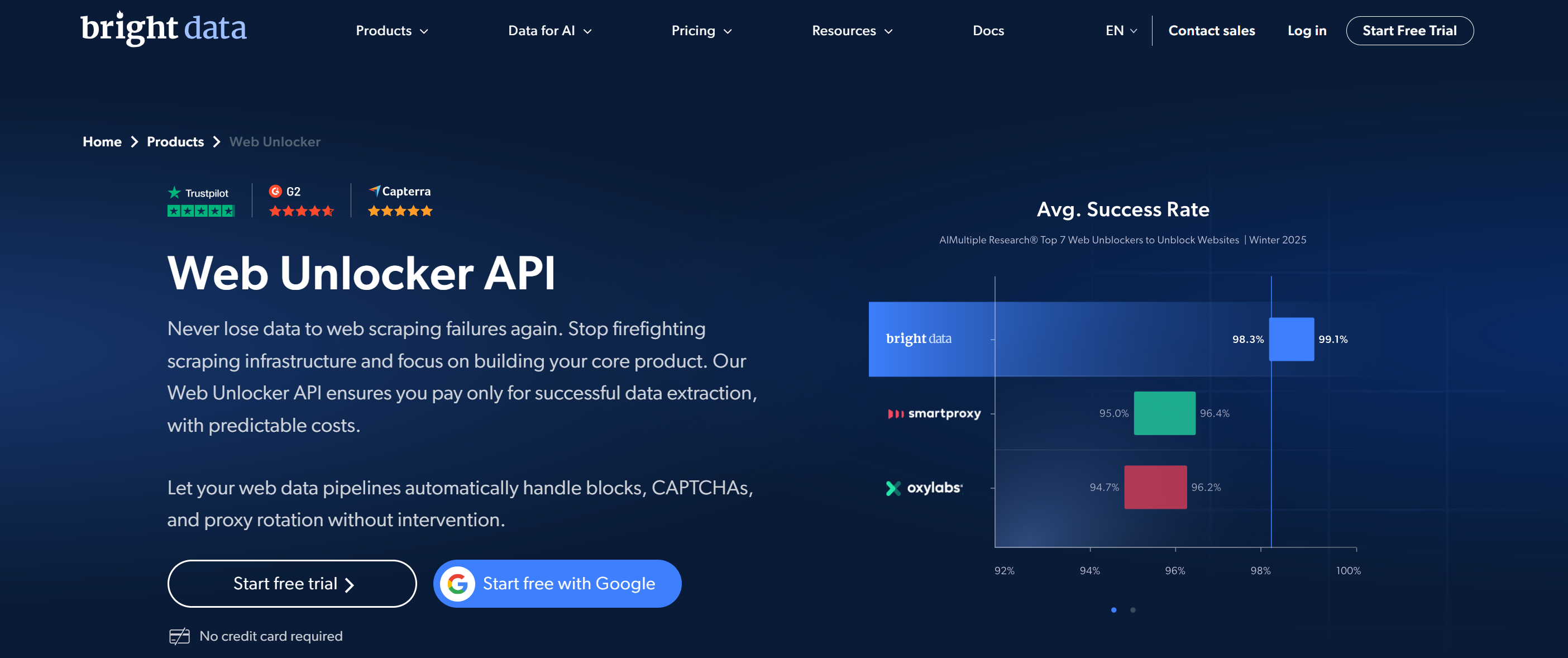
Bright Data's Web Unlocker API
Web Unlocker API is an enterprise-grade scraping solution engineered to extract data from any website, including heavily protected platforms like Amazon. You provide a website URL, and you receive unlocked HTML (or AI-processed Markdown or AI-parsed JSON) as the result.
It handles blocks, CAPTCHAs, fingerprinting, proxies, rendering, and all other scraping challenges through a single API endpoint.
In particular, Web Unlocker API neutralizes the six main anti-bot Amazon 2026 layers:
- IP Reputation and ASN Analysis: Uses automated traffic distribution across Bright Data’s residential proxy rotation network.
- Network-Level Fingerprinting: Mimics real browser-like request patterns, aligning headers, TLS behavior, and client signals to avoid protocol mismatches.
- Browser Environment Detection: Supports JavaScript rendering on dynamic web pages.
- Behavioral Analysis: Varies request timing, simulates realistic navigation patterns, and manages session state to match human browsing behavior.
- ML-Driven Detection Scoring: Maintains consistency across sessions and fingerprints to reduce anomaly signals and achieve a more trustworthy Amazon detection score.
- Anti-Bot Defense Delivery: Includes a built-in tool to bypass Amazon CAPTCHA challenges, ensuring uninterrupted access even when human verification is required.
Web Unlocker API also abstracts operational complexity, including automatic retries.
Note that the same anti-bot bypass architecture also powers Bright Data’s Amazon Scraper API. The main difference lies in the output: instead of returning raw HTML, the Scraper API delivers structured JSON data with a fixed schema.
This makes the Amazon Scraper API ready for direct integration into analytics pipelines, AI systems, or databases, without any additional parsing work.
Browser API: Solid Amazon Browser Automation
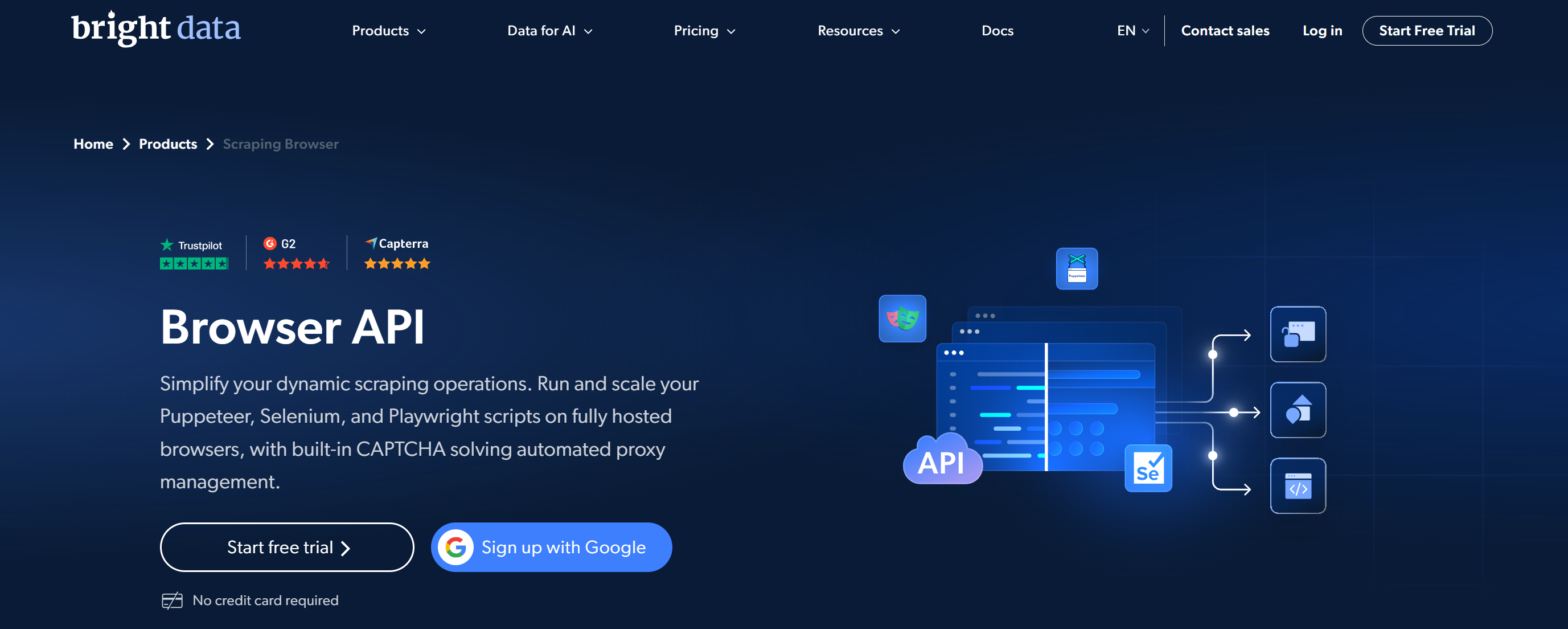
Bright Data's Browser API
Bright Data’s Browser API is a cloud-based scraping browser infrastructure. It covers all those scenarios where direct scraping API requests are not sufficient, and full browser automation is required.
Browser API exposes real, managed cloud stealth browser instances that you can automate via your preferred automation framework (e.g., Playwright, Puppeteer, or Selenium).
The infrastructure handles scaling and session management while building on the same Bright Data anti-bot bypass layer used in the Web Unlocker API.
Browser API becomes essential when your Amazon scraping use case goes beyond static page extraction. It allows you to replicate real user journeys, such as searching for products, navigating paginated listings or reviews, waiting for specific events, and handling multi-step interactions.
In short, it is suitable for Amazon automation workflows that require full interaction rather than simple data fetching.
Amazon Scraping Performance Benchmark
To better understand the impact of choosing the right architecture for Amazon scraping at scale, consider the following benchmark.
I ran identical scraping scenarios across hundreds of thousands of Amazon requests and collected the following metrics:
- Success rate: Percentage of requests successfully completed on the first attempt out of 1,000 requests
- Latency: Average time to receive a successful response, assuming retry logic is in place.
- Cost per 1K successful requests: Total cost required to obtain 1,000 successful results.
The resulting benchmark table is shown below:
| Approach | Success rate | Latency | Cost per 1K successful requests | Notes |
|---|---|---|---|---|
| Requests + residential proxies | 31% – 64% | 14s – 28s | $3.2 – $8.7 | Highly dependent on proxy provider quality |
| Web Unlocker API | 99.42% | 9.3s | <$1.5 | — |
| Vanilla Playwright + residential proxies | 49% – 68% | 25s – 47s | $5.1 – $12.4 | Requires local browser infra management + proxy integration |
| Browser API | 99.42% | 10.2s | ~$1.5 – $2 ($8/GB) | — |
The results clearly show that Web Unlocker API and Browser API consistently outperform traditional scraping approaches based on simple rotating residential proxy integration.
Amazon Datasets: When to Rely on Them Instead of Scraping
Bright Data also provides Amazon datasets, which are pre-collected, structured collections of Amazon data.
Those datasets cover 1.4 billion+ records, where each record represents a single entity such as a product, review, or seller. For example, an Amazon product record includes fields like title, price, brand, availability, ratings, ASIN, images, and more.
Bright Data's datasets are delivered in clean formats such as JSON, CSV, or Parquet, either via direct file download or through cloud storage integrations like S3.
Compared to live scraping, datasets are more suitable when you need historical, large-scale, or analytics-ready data. For example, they are great for market analysis, trend detection, or AI/ML model training.
Conclusion
In this blog post, you have seen that Amazon scraping at scale does not fail because scripts are suddenly bugged. It fails because the Amazon anti-bot 2026 model evaluates every request through a complex six-layer system.
To succeed, you need a proper ecommerce scraping infrastructure that can consistently stay within acceptable risk across IP reputation, fingerprinting, behavior, and ML-based detection. Only then can automated requests avoid 503 pages and Amazon CAPTCHA challenges.
Bright Data delivers the full web data infrastructure needed to navigate Amazon’s detection layers and power reliable, large-scale data extraction.
Get started with the Web Unlocker API via the free tier (5,000 requests/month), or get direct access to Amazon data via Bright Data Amazon datasets. Until next time!
Comments
Loading comments…