In this article I’ll provide a high-level approach to develop a NLP powered solution to achieve Scenario Simulation.
Problem Statement: Scenario Simulation with Natural Language
Objective: Implement Scenario Simulation with Natural Language where**** simulation model and Dashboard Recommendations / insights are reflected are already available and we can Integrate simulation models with LLM-powered prompt interface to provide answer to User Queries such as
- What happens to production if we lower steam pressure by 2%?”
- “How will cost change if ambient temperature rises by 3°C?”
I already covered 2 use cases in my earlier articles
In Part-1 I covered an interesting use case to develop a Natural Language Query Assistant (Chatbot for Dashboards) which enables users to ask plant-specific queries such as “Which plant had the highest energy loss last week?” https://medium.com/@pankaj8blr/integration-of-generative-ai-capabilities-to-enhance-machine-learning-powered-intelligent-e548864c6488
In Part-2 I covered another interesting use case where we can utilise Natural Language Understanding capabilities to generate KPI Definition and its justification. Objective of this use case to Allow plant engineers/operators to interact with a chatbot and retrieve information.
End-to-End Architecture Overview
User (NL Query as Input) -> LLM Interface (Prompt Understanding) -> Simulation Control Layer -> Simulation Engine (already available) -> Result Interpreter (LLM/Rules) -> Dashboard / Insight Renderer (Output)
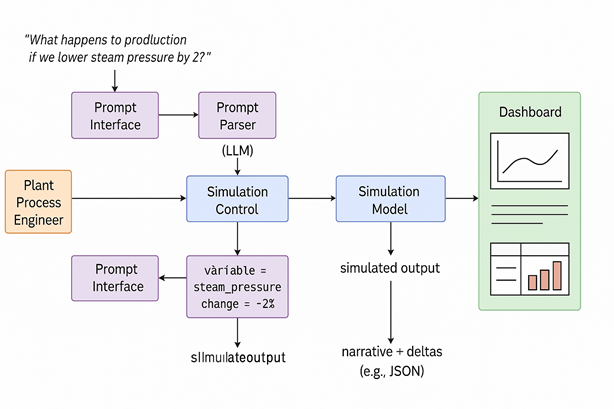
High-level reference architecture
Possible Usage of Tools & Tech Stack
- Natural Language Interface (Prompt Parser)

2. Simulation Control Layer (Translation Layer)

3. Simulation Model Engine
Already exists: can be MATLAB or Python-based SimPy
Ensure:
- Accessible via API or CLI
- Supports parameter injection and returns structured results (CSV/JSON)
4. Insight Generation Layer

5. Visualization & Dashboard Update

6. Feedback Loop & Logging

Full Tech Stack Summary

Example Flow
User Input:
“If ambient temperature increases by 5°C, what’s the impact on ammonia compressor energy?”
Backend Flow:
- LLM parses → { variable: “ambient_temperature”, delta: “+5”, target: “compressor_energy” }
- Controller injects this into simulation model
- Model runs and returns:
- Baseline Energy: 140 kWh
- Simulated Energy: 166 kWh
4. LLM summarizes:
“An increase of 5°C leads to ~18% increase in compressor energy usage. Consider optimizing inter-stage cooling.”
5. Dashboard updates:
- Chart: Energy usage (before vs. after)
- Text summary panel
Business Impact of this use case
- Faster Decision-Making
- Engineers and managers can instantly query scenarios without waiting for data analysts or running manual simulations.
- Reduces decision latency in critical plant operations.
2. Improved Operational Efficiency
- Optimizes production, energy consumption, and costs by quickly testing “what-if” situations.
- Reduces trial-and-error in live environments, lowering risks.
3. Risk Mitigation
- Anticipates potential failures, bottlenecks, or safety issues before changes are applied in reality.
- Helps comply with safety and regulatory standards by validating operational adjustments.
4. Cost Savings
- Minimizes downtime and inefficient configurations.
- Provides predictive insight into how resource adjustments affect bottom-line costs.
5. Democratization of Insights
- Non-technical plant operators, managers, and executives can directly ask natural language questions.
- Reduces dependency on specialized data teams, making advanced simulation more accessible.
6. Scalability of Knowledge
- Captures institutional knowledge in simulations + GenAI layer, ensuring continuity despite workforce changes.
Impact of integrating LangChain and LLM with Simulation Engine
The system enables natural language interactions with complex simulation and ML models, allowing users to ask questions, test scenarios, and receive contextual recommendations in plain language. It integrates smoothly with existing dashboards, making operations more intuitive and accessible. This not only accelerates learning for new operators but also unlocks deeper insights into plant dynamics. Designed for scalability, the framework can evolve to support multi-variable analysis, cross-plant comparisons, and autonomous decision-making.
To access more such Data Science related topics please refer book
“Foundations and Frontiers of AI: 360+ Expert Interview Questions Across ML, Deep Learning, NLP, Generative AI, RAG, LangChain & Real-World Use Cases”
What makes this book different?
✔ 360+ carefully curated interview questions on topics related to ML, DL , NLP, GenAI, LLMs, RAG, LangChain, LangGraph & Agents. ✔ Clear, practical explanations through info graphics, tabular comparison, code snippet and conversation techniques. ✔ 100+ Reference links where you can gain more in-depth knowledge for various topics. ✔ Designed for 2025-ready AI interviews
The book is now published on platforms listed below (Click to access)
Thanks for taking the time to read this. If this post added value, I’d really appreciate your support:
- Share it with someone who’s exploring Data Science.
- Leave a comment , your feedback helps shape the next one.
Let’s keep learning and sharpening our skills as this field evolves.
Follow me on LinkedIn: Pankaj Agrawal
Comments
Loading comments…