When looking for a stable, high-speed, and less easily blocked proxy solution, you likely can't avoid the term "ISP proxy." It is neither a traditional datacenter proxy nor a regular residential proxy, but rather finds a clever balance between the advantages of the two. We will delve into why it excels in tasks requiring high credibility and stable sessions, and through a detailed comparison with residential and datacenter proxies, help you make the best choice.
Did You Know?
- Many top e-commerce aggregators and price monitoring platforms rely on large-scale static ISP proxy networks as the core of their backend data acquisition engines.
- The IP addresses in 'ISP proxies' are legally and ownership-wise truly owned by real internet service providers, giving them an almost 'citizen-level' online identity.
- Unlike rotating residential proxies, fixed IPs provided by static residential proxies are the gold standard for operations requiring logged-in status verification (such as e-commerce and social media).
What is an ISP proxy?
ISP proxy, or Internet Service Provider proxy, is a real IP address provided through the network infrastructure of legitimate telecommunications companies (like Comcast, AT&T, etc.). You can think of it as a 'government-backed' residential proxy—it possesses the authenticity and credibility of residential IPs, while being routed and managed through professional datacenters, thereby combining stability and speed. When you search for ISP proxies for sale in the market, you are essentially purchasing these IP resources that come from real home broadband networks, but are placed in a professional datacenter environment and made available to you.
The core feature of this type of proxy is that it provides a fixed and unchanging IP address. Unlike dynamic residential proxy IPs that frequently change, static IPs allow you to establish long-term, stable network connection sessions, which is crucial for tasks that require maintaining a logged-in status or conducting continuous operations.
Pros and Cons of ISP Proxies
ISP proxies are gaining attention because they offer unique value propositions in specific applications, but they are not suitable for all situations.
Pros:
- Extremely high credibility and low blocking rate: Since the IPs come directly from well-known ISPs, target websites view them as genuine residential user connections, resulting in a much lower probability of encountering CAPTCHAs or IP blocks compared to datacenter proxies.
- Excellent speed and stability: Thanks to the network infrastructure of professional datacenters (high bandwidth, low latency), ISP proxies typically offer faster and more stable connection speeds than regular residential proxies.
- Perfect session stability: Especially static ISP proxies provide long-term fixed IPs, making tasks that require cookie persistence (such as managing shopping carts or maintaining social media logins) possible.
- High success rate: In tasks like web scraping and ad verification, the request success rate and data acquisition integrity when using ISP proxies are typically the highest.
- Easy to integrate and manage: Compared to pure residential proxy networks, the gateways of ISP proxies are usually more stable, their IP pools cleaner, and easier to configure in scripts and software.
Cons:
- Relatively high cost: The acquisition and maintenance costs of ISP proxies are higher compared to datacenter proxies, making them a more premium paid service.
- Geographic location accuracy may be limited: While the IP belongs to an ISP, its precision down to the city level may not be as flexible as that of some deeply integrated residential proxy networks.
- Not completely "invisible": For websites with extremely advanced detection systems, it is still possible to detect anomalies through deep behavioral analysis, although this is much harder than identifying datacenter proxies.
- Resources may be limited: Genuine, high-quality ISP IP resources are scarce, making large-scale acquisition challenging and costly.
What are the main features of ISP proxies?
- Speed and Uptime
Provides high-speed connections similar to datacenter proxies while ensuring a very high online rate (often above 99.9%), ensuring business continuity without interruptions.
- Low Blocking Rate
IPs come from real ISPs, enjoying a high network reputation, effectively bypassing IP blacklist blocks and frequent CAPTCHA challenges.
- Session Stability
Static ISP proxies provide fixed IP addresses, supporting long-term, stable session control, which is the cornerstone of automation processes and account management.
- Geographical Coverage
Providers partner with major ISPs worldwide to offer precise IP localization for specific countries, regions, or even cities, meeting localized data scraping needs.
- IP Ownership
IPs are legally and officially owned by physical ISPs, not by cloud service providers or datacenters, making this authenticity the fundamental source of their high credibility.
- Resource Exclusivity
Many services offer dedicated private proxy options, ensuring that the IP is for your use alone, completely avoiding “collateral” bans due to the misbehavior of shared IP users.
- Cost Structure
It is considered a premium proxy service, with pricing typically based on the number of IPs; although the unit price is higher, the return on investment is often substantial when considering its success rate and efficiency.
What are the use cases for ISP proxies?
Market research and competitive intelligence analysis are classic use cases for ISP proxies. To obtain accurate competitor pricing, inventory information, or product detail page data, The high credibility and stability of ISP proxies make them an ideal choice for executing such tasks, as they can simulate real customers browsing from multiple different regions, continuously and steadily scraping key business data to support decision-making.
In social media management and e-commerce operations, ISP proxies play an irreplaceable role. Whether managing multiple store accounts or synchronizing product information, or automating publishing and interactions in social media marketing, the platforms will strictly monitor the stability and authenticity of the login IPs. Using static residential proxies can provide each of your accounts with a fixed and clean "home address, greatly reducing the risk of accounts being restricted or banned due to frequent IP changes or poor quality.
Advertising verification and brand protection also rely on high-quality ISP proxies. Advertisers need to verify whether their ads are being correctly displayed from around the world, whether the display locations are appropriate, and whether there is ad fraud. ISP proxies can provide real residential IPs from around the world to simulate end users, ensuring the authenticity and effectiveness of the verification results. At the same time, brands can also use it to monitor trademark infringement and counterfeit product sales online.
ISP Proxies VS. Residential Proxies VS. Datacenter Proxies
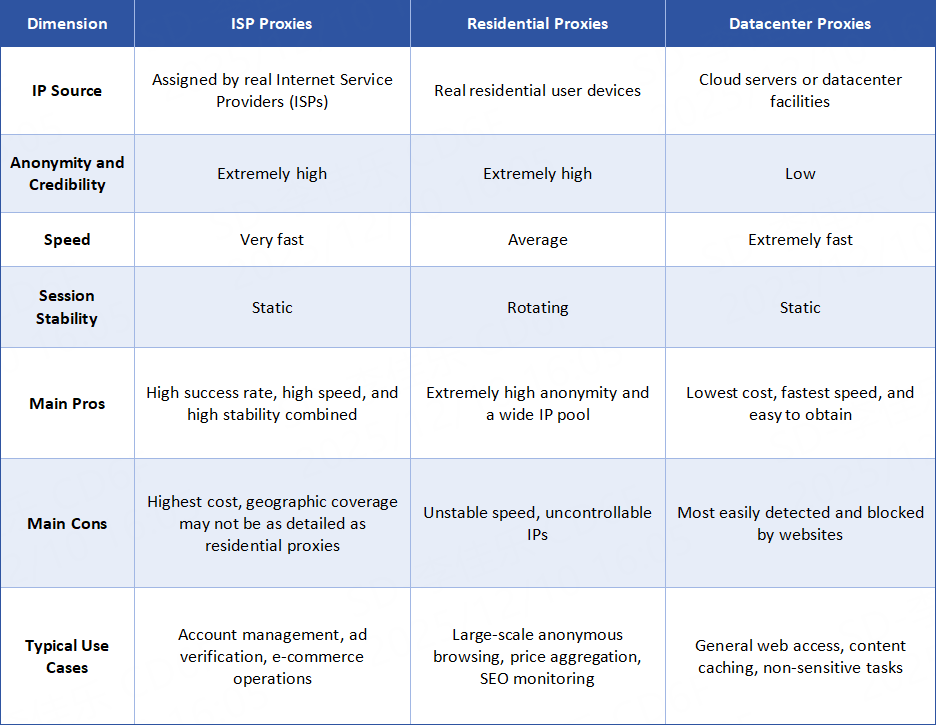
You can find detailed comparisons of the three types of proxies here:
- ISP Proxies vs. Datacenter Proxies vs. Residential Proxies
How to choose an ISP proxy provider?
With many suppliers in the market claiming to provide high-quality ISP proxy services, making an informed choice is crucial. A good provider can not only offer high-quality products but also ensure smooth business operations through reliable support.
- Validate the authenticity and purity of the IPs: Request the provider to clarify the source of their IPs and, if possible, offer trials, to check if the IPs truly come from mainstream ISPs and have not been heavily abused.
- Focus on network performance and stability: Check the uptime promised by the provider, and test the proxy's connection speed, latency, and success rate.
- Assess session management capabilities: If you need to buy static residential proxies, confirm whether they provide real static IPs, as well as the duration and stability of session persistence.
- Examine geographical coverage and location accuracy: Ensure that the provider has sufficient ISP IP resources in the target areas (countries, cities) you need, and can achieve accurate localization.
- Review pricing models and flexibility: Understand their billing methods (by bandwidth, by number of IPs, by number of requests), and choose a plan that matches your usage pattern best, with no hidden fees.
- Test the user interface and API: An intuitive control panel and a feature-rich API can greatly enhance your efficiency in managing and integrating proxies.
- Value the quality of customer support: A responsive and knowledgeable customer support team can provide crucial assistance when you encounter configuration issues or emergencies, offering essential help.
Thordata: Comprehensive Proxy Solutions
Thordata is regarded as a top choice in the proxy service field, focused on quality and reliability, as it is not just a simple vendor, but a technical partner that provides comprehensive network data access solutions. Their core philosophy is to provide "pure" and efficient proxy resources, especially skilled at dealing with complex business scenarios that demand high stability and success rates.
Whether facing the most stringent anti-scraping systems, or requiring long-term stable session connections, Thordata's infrastructure is designed to provide solid guarantees for users, and its services have established an excellent reputation in industries that require high-credibility IPs.
Thordata's Product Suite:
- Residential Proxies - IP addresses from real residential networks
- Static ISP Proxies - Fixed IP addresses from real Internet Service Providers
- Datacenter Proxies - High-speed, low-cost, scalable
- Mobile Proxies - Suitable for mobile data scraping, app testing, and mobile ad verification
- Web Scraper API - Automated extraction of website data
- SERP API - Real-time scraping of search data from Google, Bing, and others
Final Thoughts
In summary, ISP proxies, especially static ISP proxies, are undoubtedly a powerful strategic asset in complex online businesses that require high reliability, high credibility, and stable sessions. It successfully bridges the "realness" of residential proxies and the "efficiency" of datacenter proxies. When you decide to buy static residential proxies, you are investing in more than just a set of IP addresses, but also in a higher business success rate, lower operational risks, and a more stable data pipeline.
For businesses and individuals looking to maintain a competitive edge in challenging online environments, integrating ISP proxies into their tech stack is a choice worth serious consideration. When choosing a partner, consider starting your research with providers like Thordata, known for high-quality and stable services, and validate through practical tests whether they meet your specific needs.
Frequently Asked Questions
Common questions about this topic
Comments
Loading comments…