 Image Source
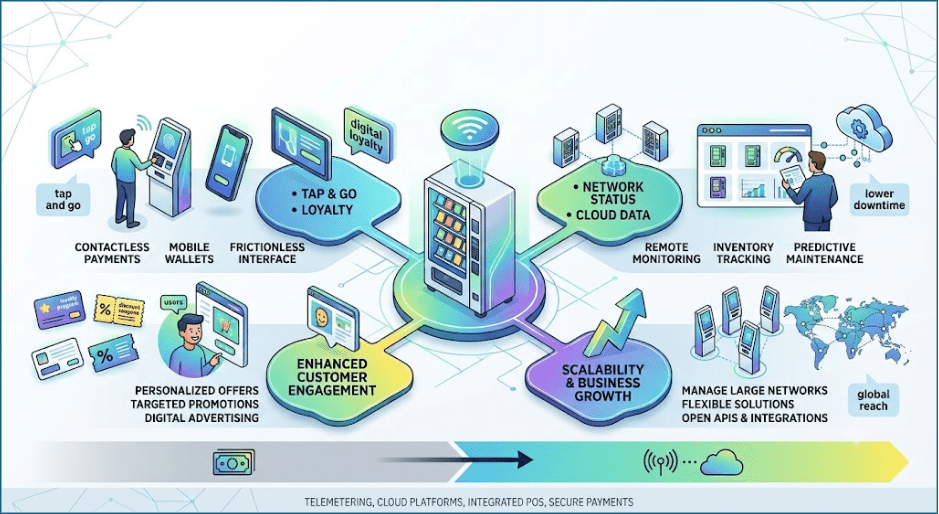
Unattended commerce is changing quickly. Vending machines, micro markets, smart coolers, self-service kiosks, parking systems, and EV chargers are becoming more connected. These businesses no longer need technology only to accept payments. They also need better ways to manage equipment, understand sales, and respond to customer needs.
This shift is changing what businesses expect from unattended technology. A payment terminal is no longer an isolated tool. It can be part of a wider system that connects payments, operations, customer data, and remote management. Nayax is one company working within this shift, with technology designed to support payments and connected commerce across several unattended markets.
The growth of connected vending shows how quickly this change is taking place. According to Nayax's 2026 analysis of the connected vending market, which cites Berg Insight's research, 8.1 million of the world's 14 million vending machines were connected at the end of 2025. Berg Insight's published findings forecast that the number of connected machines will reach nearly 11.7 million by 2030.
Connectivity, however, is only the starting point. The real value comes from what businesses can do with the information their equipment provides. A connected vending machine can share sales and inventory data. This gives operators a clearer view of what is happening at each location.
That visibility can make daily management easier. Operators can see which products are moving, where stock may need attention, and how different machines are performing. They can also monitor equipment without visiting every location. This can be especially useful when a business manages a large number of machines.
Payment technology is also becoming part of this larger system. Customers still expect a quick and simple way to pay. They may use cards, mobile wallets, or other digital payment methods. Operators, meanwhile, need those transactions to work with the rest of their business systems.
Nayax's approach reflects this broader change. Its technology connects payment capabilities with other tools used to manage unattended businesses. This reflects a growing preference for connected systems instead of multiple tools that operate separately.
The rise of micro markets and smart stores adds to the need for this type of technology. These formats allow customers to shop with little or no staff on site. That creates a convenient experience, but it also gives operators more to manage remotely.
Inventory is one example. An operator may need to know which products are selling quickly and which locations need restocking. They also need a way to review performance across several sites. Connected technology can bring this information into one place.
Artificial intelligence is now adding another layer to these systems. Instead of simply collecting data, technology can help operators understand it and act on it.
In July 2026, Nayax announced a new AI layer for its MoMa mobile application for vending and self-service operators. The new capabilities include an AI assistant that can answer questions using an operator's own business data, along with data-driven planogram suggestions and visual-recognition planogram setup.
The wider significance is clear. Operators often have large amounts of data but limited time to review it. AI can help turn that information into practical guidance. This could make it easier to identify trends and make faster decisions.
AI is also changing the customer side of unattended commerce. On June 1, 2026, Nayax launched AI-powered product discovery and personalization capabilities for retailers. The technology uses data from areas such as points of sale, sales platforms, e-commerce, and marketing engagement systems, with features including visual and text search and product recommendations.
Features such as visual search, text search, and product recommendations can make it easier for customers to find products. They also show how unattended retail can become more personalized. The experience does not have to stop at a payment screen.
Payment hardware is evolving at the same time. Consumers are becoming familiar with digital payments across many types of physical locations. They expect the same convenience when they use a vending machine, kiosk, charger, or other self-service system.
For operators, meeting that expectation requires more than accepting a card. Payment systems must be reliable and able to support different payment methods. They also need to work within the wider technology environment of the business.
Nayax's VPOS Media 4 platform reflects this broader role for payment technology. The Android-based terminal combines payment acceptance with features such as loyalty, on-screen promotions, upsells, gamification, and remote management, positioning the device as a broader engagement and commerce platform.
This trend is not limited to vending. Unattended technology is expanding into EV charging, parking, hospitality, and other services. Each environment has different needs, but the underlying challenge is similar. Businesses need reliable ways to accept payments while managing equipment and customer activity remotely.
Nayax's expansion into smart parking is another example. On August 25, 2026, Nayax announced a definitive agreement to acquire IPS Group, a smart parking technology provider with an installed base of more than 250,000 parking spaces. The original announcement valued the transaction at $350 million in an all-cash deal. On October 1, 2026, Nayax confirmed that it had completed the acquisition, also confirming IPS Group's installed base of more than 250,000 parking spaces. The acquisition brings together Nayax's payments infrastructure and IPS's smart parking hardware and software.
Reliability and security remain important as these networks become more connected. An unattended location may operate for hours without an employee nearby. If a payment system stops working or equipment develops a problem, there may be no staff member available to resolve it immediately.
This makes remote monitoring and dependable connectivity important parts of the customer experience. Operators need to know when something goes wrong. They also need tools that can help them respond without having to check every location in person.
The larger change is therefore not simply a move from cash to digital payments. It is a move from standalone equipment to connected commerce.
A vending machine, kiosk, cooler, charger, or parking system can now be part of a larger digital network. That network can collect information, support payments, and give operators a clearer view of their business.
The next stage of unattended commerce will depend on how well these technologies work together. Payments need to remain simple. Data needs to be easy to understand. AI needs to solve real operational problems. Customers need convenient experiences, while operators need reliable tools behind them.
Nayax's recent developments reflect this wider direction. As unattended commerce grows, smarter technology is becoming central because businesses need more than automated transactions. They need connected systems that can help them manage locations, understand customer behavior, and make better decisions.
Unattended commerce is becoming a more sophisticated part of the retail and service landscape. Payments, connectivity, data, and AI are increasingly working together. For businesses operating without traditional checkout environments, that combination could become an important part of how they manage operations and serve customers in the years ahead.
About Nayax
Nayax is a global commerce enablement and payments platform serving unattended and self-service businesses. Its solutions support payment acceptance, connectivity, loyalty, data, and operational management across markets including vending, retail, EV charging, parking, hospitality, and other automated commerce environments.
Further Reading
Discover more articles on similar topics across our network
How AI and Automation Are Rewiring the Hiring Process: 3 Real-World Case Studies
Venture

Comments
Loading comments…