
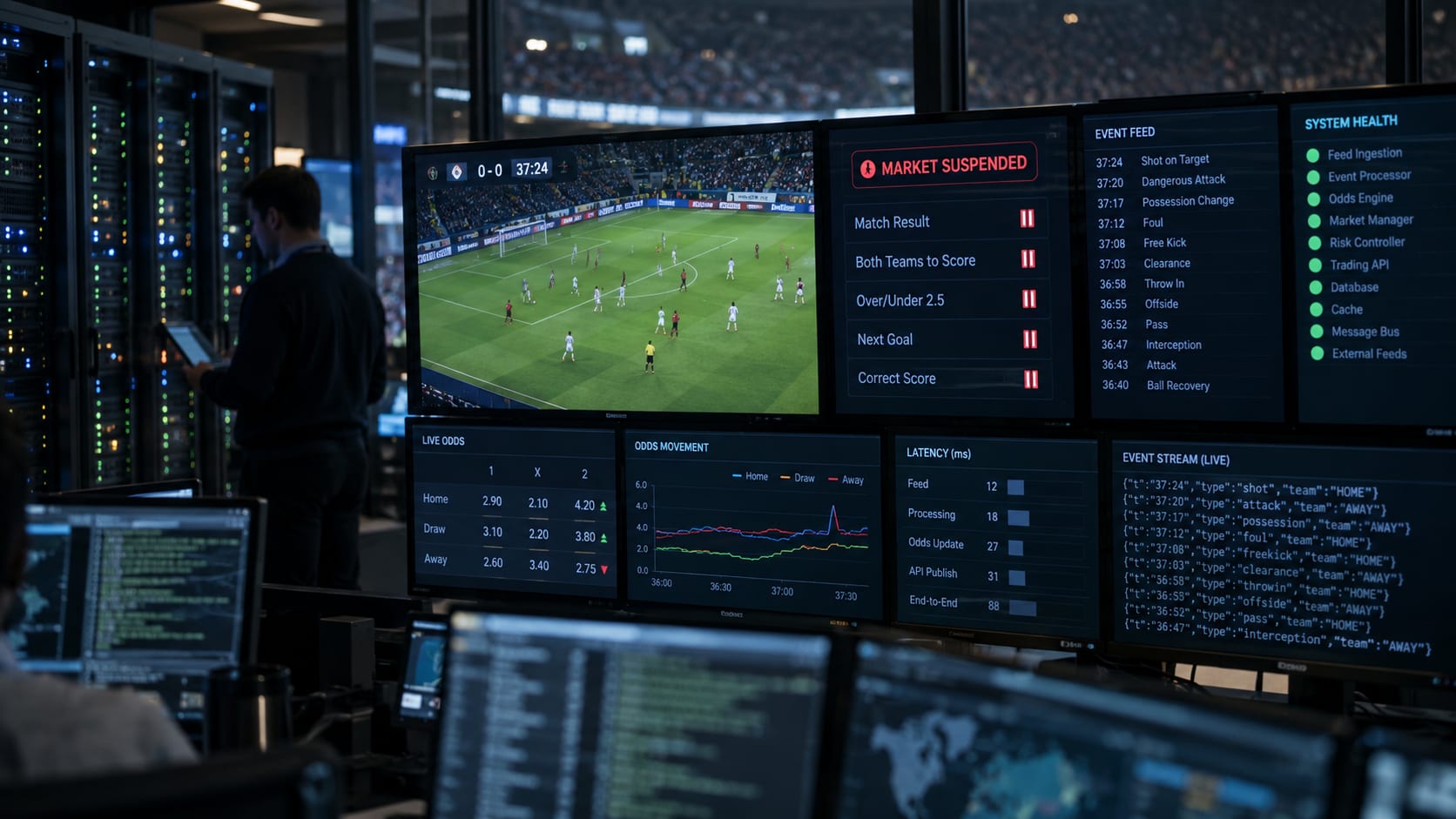
When a goal is scored, the first instruction reaching a betting platform may be a suspension rather than a new price. The affected markets close while the event is checked, the match state is updated and pricing models calculate the consequences. Only then can trading controls approve another quote.
What appears on screen as a rapid numerical change is the output of a distributed system operating under imperfect conditions. Provider feeds can disconnect. Messages may arrive twice or in the wrong order. Popular matches can create abrupt traffic spikes. The platform must continue to distinguish current information from stale data throughout each disruption.
From Match Event to Approved Quote
Sports-data suppliers send changes through persistent feeds rather than waiting for operators to request them. These messages may describe scores, cards, substitutions, clock movements, market closures or result corrections. Platforms offering online betting pass them through an ingestion layer that authenticates the source, checks the message and converts provider-specific terminology into an internal event model.
A pricing service uses the updated match state to recalculate probabilities for the affected markets. The initial output is not necessarily the published price. Margin rules, liability levels, stake velocity and trader instructions may change the quote or keep the market suspended.
Each approved quote should include a market identifier, sequence number, status and version. Separate timestamps record when the event occurred, when the operator received it and when the revised price was published. Comparing those times helps locate latency instead of reducing several distinct delays to one headline figure.
Consider a goal scored in the 63rd minute. The relevant markets may be suspended immediately while the feed confirms the event. If one update arrives two seconds late and another is duplicated, sequence numbers and event identifiers allow the platform to reject stale or repeated data before publishing the revised price.
Why the Services Remain Separate
Sending every update through one application would make pricing, risk management, settlement and customer delivery dependent on the same processing cycle. Event-driven architecture places a broker or retained event log between the incoming feed and those consumers. Each service reads the events it needs and maintains state suited to its own function.
Partitioning allows several matches to be processed concurrently. Updates for one fixture are commonly assigned to the same partition so that its score, clock and market changes retain a consistent order. Assigning too many fixtures to one partition creates a bottleneck; splitting one fixture across several partitions risks processing related events out of sequence.
The event log also provides a route to recovery. A failed service can resume from its last confirmed position and rebuild its state. A cache alone cannot provide that history because it usually stores only the latest accepted market version.
When Messages Arrive Late or Twice
At-least-once delivery means that a broker may resend a message after a timeout or lost acknowledgement. Consumers need stable event identifiers and idempotent operations so that processing the same message twice produces one state change.
Sequence numbers serve another purpose. A consumer can discard an older update, accept the next expected version or detect that something is missing. A gap means incremental updates can no longer be trusted. The service must replay retained events or request a new snapshot before continuing.
Late data requires a trading decision. A corrected score may invalidate prices issued after the original message. Depending on the market and applicable rules, the response could involve suspension, recalculation, cancellation or resettlement. Software can identify the affected versions, but operator policy determines the financial outcome.
Feed health must also be judged by message age. An open network connection may continue carrying heartbeats while match data is delayed. Platforms should suspend dependent markets when freshness thresholds are exceeded, sources conflict or the event sequence moves backwards.
Moving Prices to Customer Screens
Once approved, the latest quote is written to a low-latency state store. Distribution gateways then send compact changes to subscribed browsers and applications, commonly through WebSockets. Conventional HTTP still has a role: it supplies initial snapshots, processes account actions and restores state after a continuity failure.
The gateway needs controls for slow clients. During a heavily followed match, a device may receive several revisions before rendering the first one. Retaining every obsolete price wastes memory and increases the delay. The gateway can replace superseded updates with the newest version and require a fresh snapshot when a client falls too far behind.
This arrangement separates two records with different purposes. The retained stream supports replay and audit. The customer channel carries the latest usable state. Treating temporary push notifications as a permanent record would leave reconnected devices unable to establish which quote is authoritative.
Price Distribution Is Not Bet Acceptance
A displayed price can expire between rendering and confirmation. The bet request must therefore include the quote version and a unique request identifier. The acceptance service compares that version with the authoritative market state, checks whether betting remains open and applies account, location, balance, stake and exposure controls.
The unique identifier protects against duplicated wagers when a device retries after a connection problem. The resulting acceptance or rejection must be stored before a response is returned, creating an immutable record for settlement and dispute review.
Because prices can change within seconds, live markets can prompt rapid decisions under pressure. Customers should set firm spending and time limits, never chase losses and view wagering as entertainment rather than income. Anyone unable to maintain those limits should use available exclusion controls and contact an independent gambling-support service.
The quality of a live-odds system is exposed when its information becomes uncertain. Its defining controls are the ability to identify stale state, reconstruct a broken sequence and stop accepting wagers until the price can be verified.
Comments
Loading comments…