I asked a voice assistant to help reply to an email. It said it was on it. Then it went quiet.
A minute passed. Then another. I assumed the app had frozen. Only when the assistant returned to say the task was done did I realize it had been working the whole time.
The awkward part wasn't the two-minute task. It was not knowing what was happening.
Three architectures, three compromises
Consumer voice AI is being built around three broad approaches, though real products increasingly mix them.
The first is the classic chain: speech recognition turns audio into text, a language model thinks, and a speech synthesizer reads the answer aloud. It's modular, and developers can bring in powerful text models, retrieval systems and tools. Tolan illustrates the strengths of a turn-oriented design: it uses GPT-5.1 and reconstructs conversational context from memories and personality cues on each turn. The payoff is thoughtful responses and a consistent character. The drawback of a sequential pipeline is accumulated delay, plus a conversational rhythm that still depends on one person finishing before the other starts.
The second approach brings speech closer to the model. Native speech-to-speech systems skip the full transcription-and-synthesis chain, preserving timing, emotion and cues that a transcript flattens. OpenAI's GPT-Realtime models are one technical example. On the consumer side, Sesame's Maya and Miles have raised expectations for expressive voices, while Gemini Live has made mid-sentence interruptions feel normal. But smooth conversation and complicated agent work are different engineering problems. A model built for immediate reactions isn't automatically the best place for long searches or multi-step tool calls.
That helps explain the third approach: separate the conversation from the heavy lifting. Thinking Machines Lab's interaction-model research and OpenAI's GPT-Live both explore this direction. A fast, continuously listening model handles the spoken exchange. A stronger system works asynchronously on reasoning and tools, passing results back when they're ready.
That separation solves a real architectural problem. It leaves a very human one.
What happens after “On it”?
Suppose you ask an agent to check an email thread, prepare a response and move a calendar event. It acknowledges the request almost instantly. The actual work might take a minute.
What should the voice do during that minute?
One quick confirmation followed by silence is perfectly reasonable from the backend's perspective. Nothing has crashed. Yet from the user's perspective, the assistant might as well have left the room.
OpenAI makes this limitation clear in its GPT-Live engineering discussion: a real-time model can keep an exchange moving briefly, but it can't hide an arbitrarily slow backend task. A fast first response doesn't fix a long, unexplained pause.
This is where voice UX becomes more interesting than a latency leaderboard.
Orilo's bet: make the gap useful
Orilo, a consumer personal voice agent, treats that awkward interval as a design problem. Its approach pairs a low-latency conversational layer with a separate agent layer for deeper reasoning and actions. The goal is sub-second spoken responses without sacrificing the ability to do substantial work.
The distinctive choice is what the front end does while the back end is occupied.
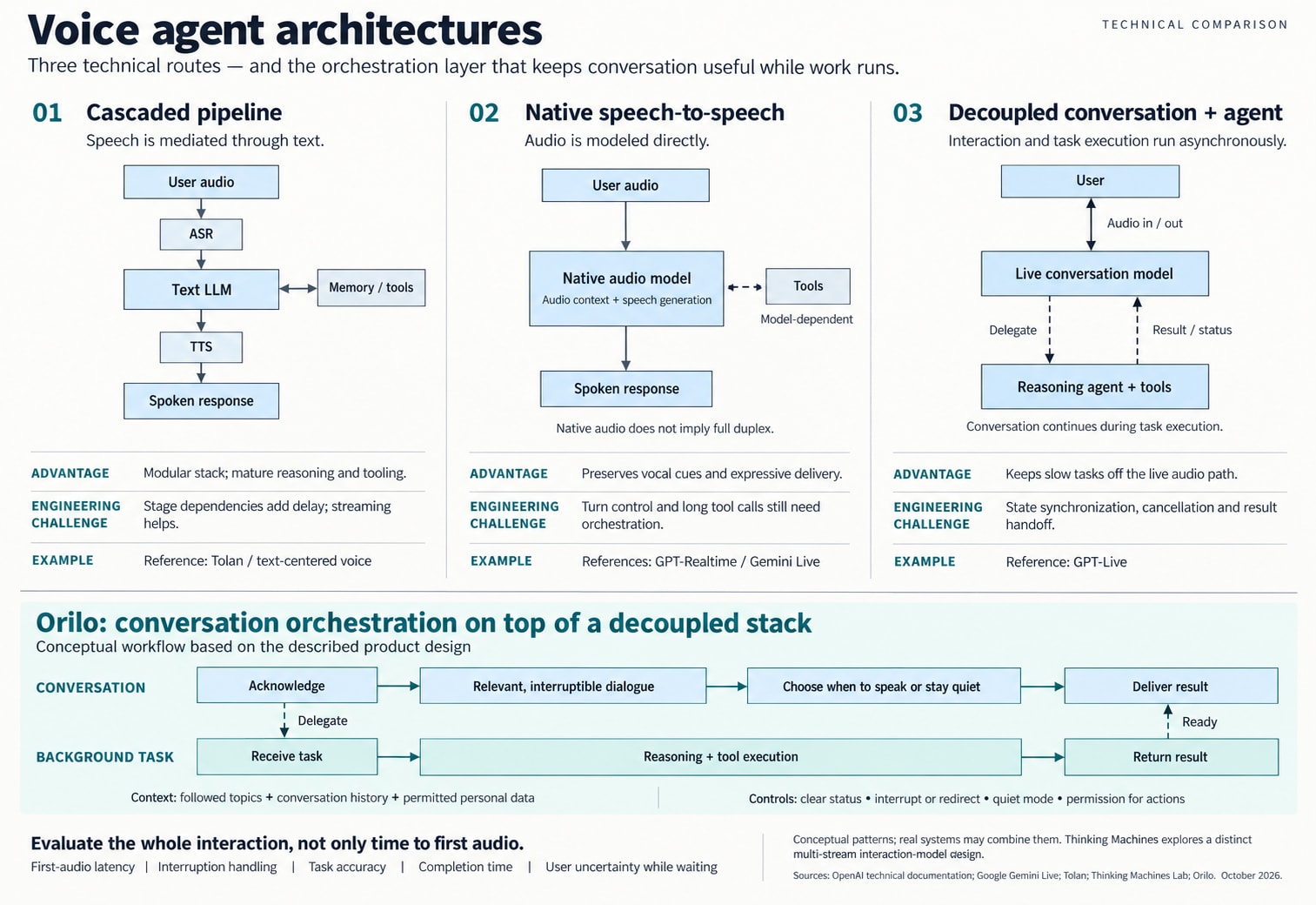
Instead of repeating “please wait,” Orilo is designed to introduce relevant material the user can actually discuss. If you're following developments in AI, for instance, it might bring up a related story while handling another task. You can interrupt, ask why it matters, change the subject or skip it. When the task finishes, the agent can bring its result back into the conversation.
That leads to a broader idea about proactive assistants. A recommendation feed tries to predict what you'll click. A personal agent can draw connections between topics you follow, previous conversations and, with permission, your calendar. Rather than pushing another notification, it can explain why a development matters to you. Orilo also emphasizes ongoing work: monitoring topics you've asked about, flagging relevant changes and helping you decide what deserves attention. Here, content is a starting point for conversation, not a podcast you're expected to sit through.
There are obvious limits. Chatter shouldn't become camouflage for a stuck tool call. Users still need clear status, meaningful consent and the option to say, “Just tell me when you're done.” Sometimes quiet is exactly the right response.
The next voice AI benchmark
Time to first audio still matters. So do interruption handling, task accuracy and total completion time. But developers should measure something less obvious, too: how often does a user wonder whether the assistant is still working?
Tolan shows what memory and personality add. Sesame and Gemini Live show how fluid voice interfaces have become. GPT-Live and interaction models show why conversation and reasoning can run on separate clocks.
Orilo's bet is that the space between those clocks doesn't have to be dead air. The real test won't be how much an assistant talks. It'll be whether it knows when to speak, what is worth saying, and when to stop.
Further Reading
Discover more articles on similar topics across our network

Comments
Loading comments…