
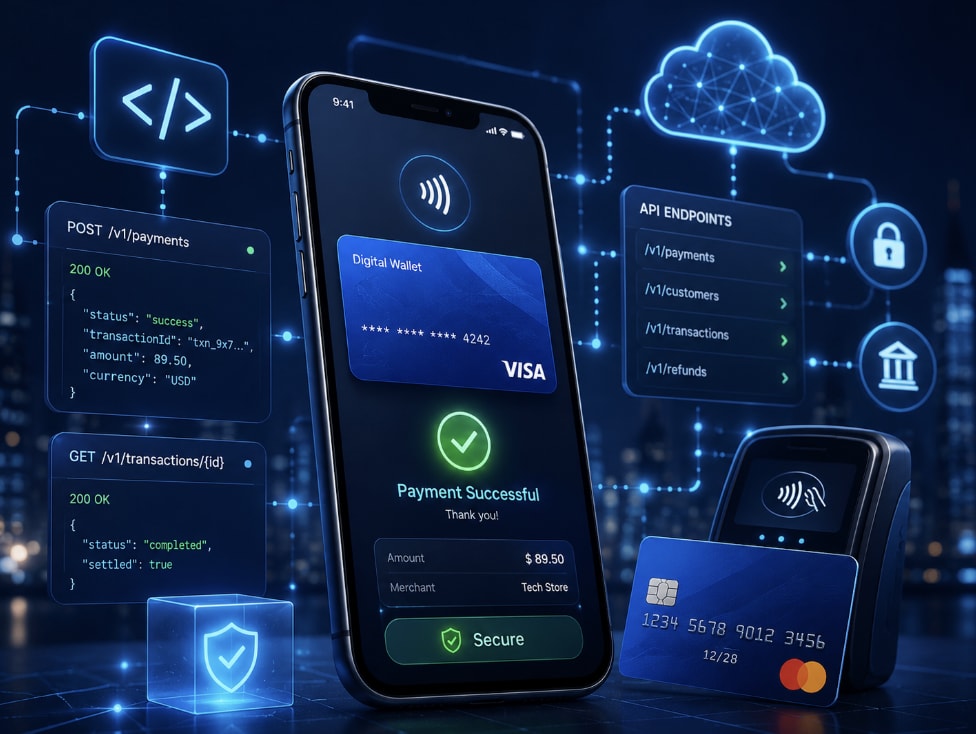
The image was created by us with AI, specifically for this article.
Gone are the days when a developer might look at mobile software development a bit less seriously than a web application. Two industries, particularly, made smartphones a major player in money transfers. The first one is e-commerce, and the second is gambling.
They both came from physical venues and transformed people’s experiences. And if e-commerce is mostly a one-way transfer, where a customer pays for a good, gambling platforms have this in two ways: paying or withdrawing winnings. In this environment, it is at least irresponsible to make API mistakes when millions of people rely on mobile payments, and modern tech and AI help to solve lots of problems so easily.
Payment reliability is part of the game flow, not a side feature
Real-money casino apps need stronger payment systems because money is part of the live game experience.
In a casual game, payments often happen outside the main play. But in a real-money poker app, the payment system has to connect many things smoothly:
- deposits,
- account balance,
- entering a table,
- and withdrawals.
That is why the best mobile poker apps treat payments as a main part of the product, not just an extra feature. When you observe the Ignition poker mobile app as one of the leading products in the market, its mobile flow is designed to help a player move from login to the poker lobby with as little friction as possible, while still making sure funds are ready for real-money play.
The wallet and the lobby have to stay in sync
On its mobile poker page, the platform describes a simple path: sign in on a phone or tablet, open the Poker tab, enter the lobby, check that money is available, and start playing.
Its software review also says the poker client works on iOS, Android, and through an Instant Play web app. That makes consistency very important, because the payment and play experience needs to feel smooth across different mobile options.
That setup explains why reliable payment APIs matter more in this part of mobile gaming. In the Ignition poker mobile app experience, a payment layer is doing more than authorizing a card or receiving a crypto transfer. It has to keep the player wallet in sync with the lobby, reflect balance changes clearly, and support a fast move from deposit to playable funds. Moreover, the attractive bonus systems increase the number of players as well as payments and withdrawals:
Multiple payment methods need one clean front-end experience
Ignition also highlights several deposit methods for poker, including credit card, cryptocurrency, debit card, gift card, and voucher code, alongside multiple withdrawal options. That range only works well when the API behind it normalizes transaction states so the app can show one clean account view even when payment rails differ underneath.
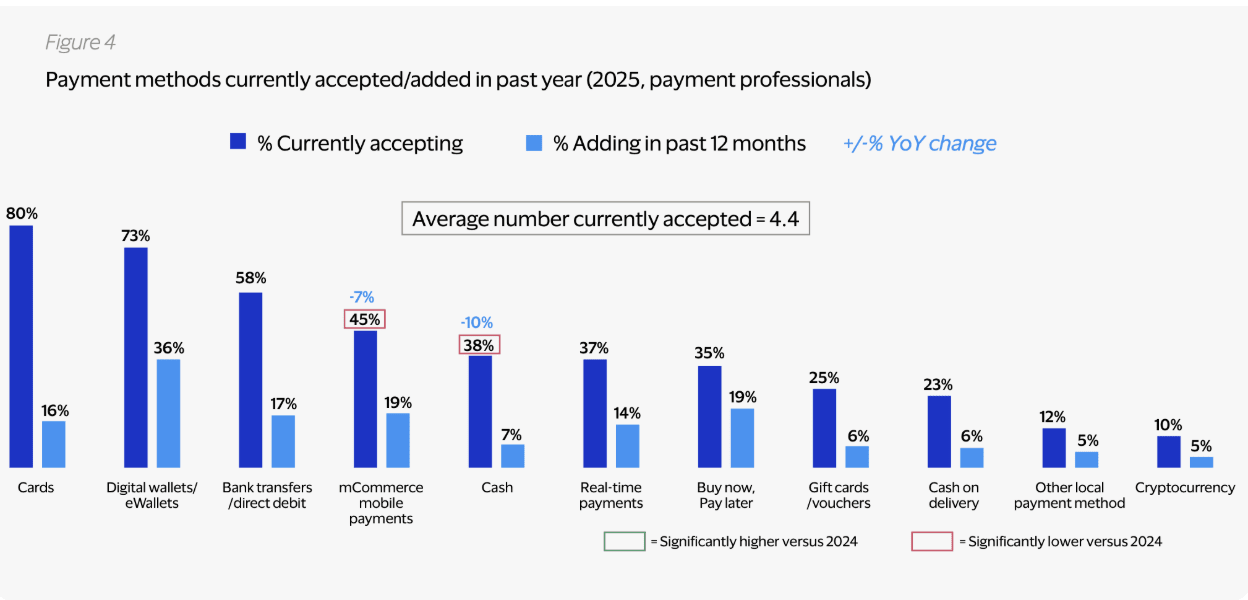
The diagram shows payment methods accepted as of 2025, where cards have the highest percentage.
Payment coverage is now part of product design
One mistake developers make is thinking they can add more payment methods later. In mobile gaming, payment options are already part of the product.
If a game depends on quick deposits, repeat purchases, or players from different regions, one basic payment setup is usually not enough.
A strong mobile payment flow is not just about adding many methods. It is about choosing:
- which payment methods matter most,
- where they appear in the app,
- and how the API sends each user to the right payment path with the fewest steps.
A 2025 global payments survey found that 74% of merchants added at least one new payment method in the past year. They mostly did this to improve the customer experience and reach new customers or markets. Also, 32% said they added payment methods to reduce checkout abandonment, up from 24% in 2024.
That shows how important payment choice has become.
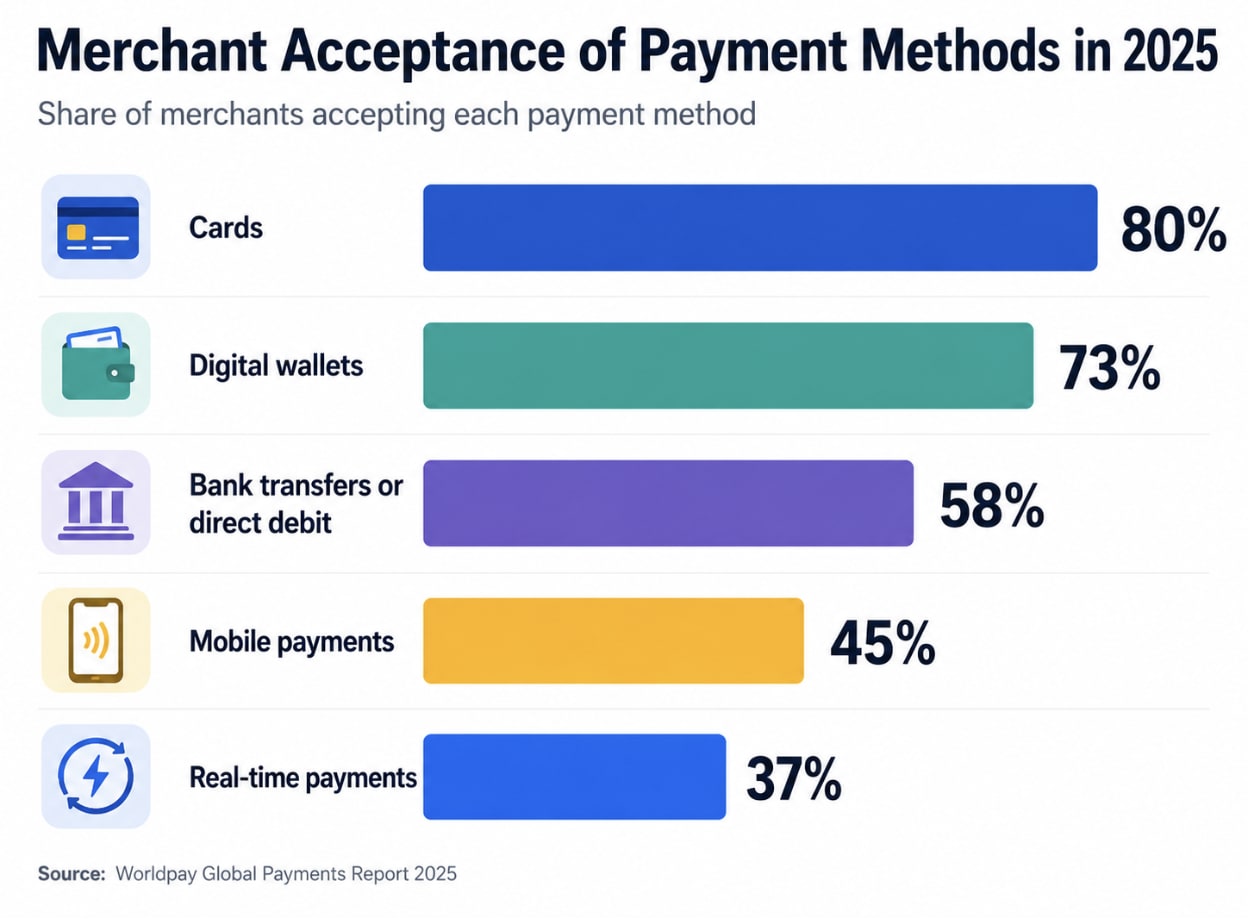
Original visual material, specifically created for this article.
Payment APIs should be built with orchestration in mind. That means one internal payments layer that can route by country, device context, transaction size, or returning-user history, without forcing the app team to rebuild screens every time the preferred mix changes. It also means storing status, metadata, and recovery logic consistently across methods.
When developers skip that layer, they usually end up with fragmented checkout behavior and brittle releases. When they get it right, payment choice feels native to the app instead of bolted onto it.
Reliability is felt in seconds, not just in reports
Developers also tend to measure payment quality too late. Approval rates and settlement reports matter, but mobile users feel payment quality much earlier than that. They feel it in load time, screen response, retry behavior, and whether the app explains a pending state clearly enough to remove doubt.
In a 2025 mobile user survey, 82% of respondents said stability is an extremely important or very important factor when choosing an app, 81% said the same about performance, 61% said they would not wait more than five seconds for key functions to process, and 63% said three crashes or fewer could make them uninstall.
That is why the best fix is to stop treating payments as a black box once the API call leaves the client. Mature teams instrument the full path: tap to request creation, request to provider response, response to balance update, and balance update to visible confirmation. They define timeout rules, fallback messages, and recovery points before launch, not after complaints appear.
This is what makes payment problems traceable
Instrumenting every payment lifecycle event with structured logging and a shared correlation ID that travels from the client tap through the API gateway, payment provider, webhook handler, and balance ledger. Without that thread, debugging a missed balance update means cross-referencing four separate logs by timestamp — slow and error-prone.
A simple envelope like { "correlation_id": "uuid-v4", "event": "payment.confirmed", "ts": 1716998400, "amount_minor": 2500, "currency": "USD" } emitted at each stage gives you a timeline you can query in seconds.
Pair that with a dead-letter queue for failed webhook deliveries and an exponential backoff retry policy (start at 1s, cap at 32s, abandon after 5 attempts), and you have a recovery path that handles the majority of transient provider failures without manual intervention.
Safe retries and clear states are part of the product
For idempotency, the key should be generated client-side before the first request — a hash of (user_id + session_id + amount + intent_timestamp) works well, so that a retry arriving after a 504 timeout is deduplicated at the API layer rather than creating a second charge.
As James Fry, who is an executive, put it, merchants need “the right options for their customers.” That idea applies to mobile gaming more broadly than it first appears. The right option is not only the right payment method. It is the right experience around it: clear states, fast feedback, safe retries, and an app that never makes the player guess where their money or balance stands.
Comments
Loading comments…