
By Bolaji Olajide, Software engineer
Abstract
RBAC is often presented as a simple mechanism—assign roles to users, grant permissions through roles—but in multi-tenant SaaS environments, it quickly becomes one of the most fragile subsystems. The same authorization layer must enforce strict tenant isolation, remain consistent across services, scale to real traffic, and stay explainable to engineers and auditors. This article describes a practical approach to RBAC design, including choosing a model for roles, permissions, and scopes; deciding where enforcement should happen; preventing metadata leakage, introducing caching without compromising correctness; and building in auditability and observability.
Keywords
RBAC; authorization; multi-tenant SaaS; tenant isolation; least privilege; auditability; caching; invalidation; performance; maintainability.
Introduction
Authorization is rarely the feature teams are excited to build. When it works, nobody notices; when it fails, the consequences are severe. In a multi-tenant SaaS product, authorization is the trust boundary that prevents one customer from seeing another customer’s data. A single incorrect “allow” decision is not just a bug—it can become a security incident.
RBAC is popular because it is easy to communicate: “admins can do X,” “editors can do Y.” But RBAC becomes difficult when the product grows: more resource types, finer-grained access, multiple services, and pressure to add “small exceptions.” Without discipline, the system turns into scattered checks and implicit rules that are hard to reason about, hard to test, and slow under load.
This article walks through the design decisions that keep RBAC reliable in production.
Main sections
1. How RBAC fails in practice: policy sprawl
Many teams start with a few roles and a handful of checks. Over time, new endpoints appear, new services are added, and each team implements authorization “where it’s convenient.” Checks drift into handlers, database queries, UI logic, and ad-hoc conditions. The result is:
- inconsistency (similar operations protected differently), and
- lack of proof (no one can confidently say all access paths are covered).
The first principle of production RBAC is to treat authorization as a system, not a set of scattered conditions.
2. Multi-tenant RBAC begins with a boundary: tenant context must never be optional
In multi-tenant SaaS, every authorization decision must be made within a tenant boundary. Many serious issues start when tenant context is accidentally dropped—inside caches, indexes, cross-service calls, or query logic. A robust RBAC design treats tenant context as mandatory input to decision-making, not as an implicit assumption.
3. Roles are packaging; permissions are the real substance
Roles are useful for operations and onboarding, but the “truth” of RBAC is permissions: the set of allowed actions on resource types. A practical approach is to keep permissions stable and explicit (read/create/update/delete/admin) across core resources (projects, repositories, settings, users, etc.).
As the product evolves, you will likely need scope: permissions that apply not to the entire tenant, but to a specific subset—one project, one repo, one environment. Designing for scope early prevents painful rewrites later.
4. Where enforcement should live: a single decision point and predictable call sites
Even the best role model is unsafe if enforcement is inconsistent. Production RBAC benefits from two structural choices:
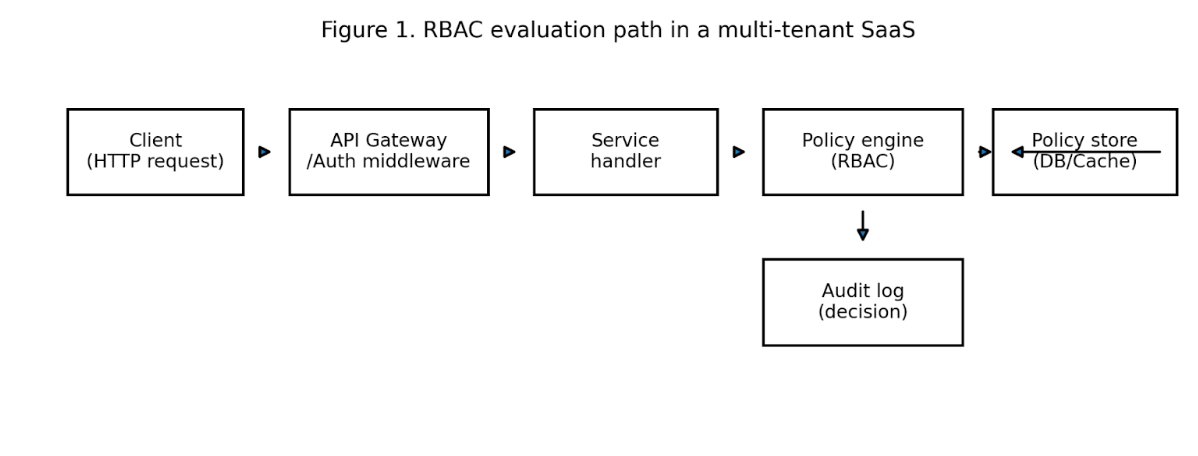
- a centralized “decision maker” (policy engine as a module or service) that answers “allow or deny,” and
- a small, predictable set of places where checks are performed (often a combination of request middleware for identity context and service-layer checks where the target resource is known).
This avoids both extremes: “only check at the edge” (too coarse) and “check everywhere manually” (too error-prone)
5. Why explainability and auditing matter
In enterprise environments, it is often not enough to know that access was granted. Teams need to answer: Why was it granted? Which role or permission enabled it? This is critical for incident response, compliance, and everyday support.
A mature RBAC design keeps enough structured context to reconstruct decisions for sensitive operations, without turning every request into an audit event. Explainability also improves internal trust: engineers can debug policy changes without guesswork.
6. Performance: authorization is on the critical path
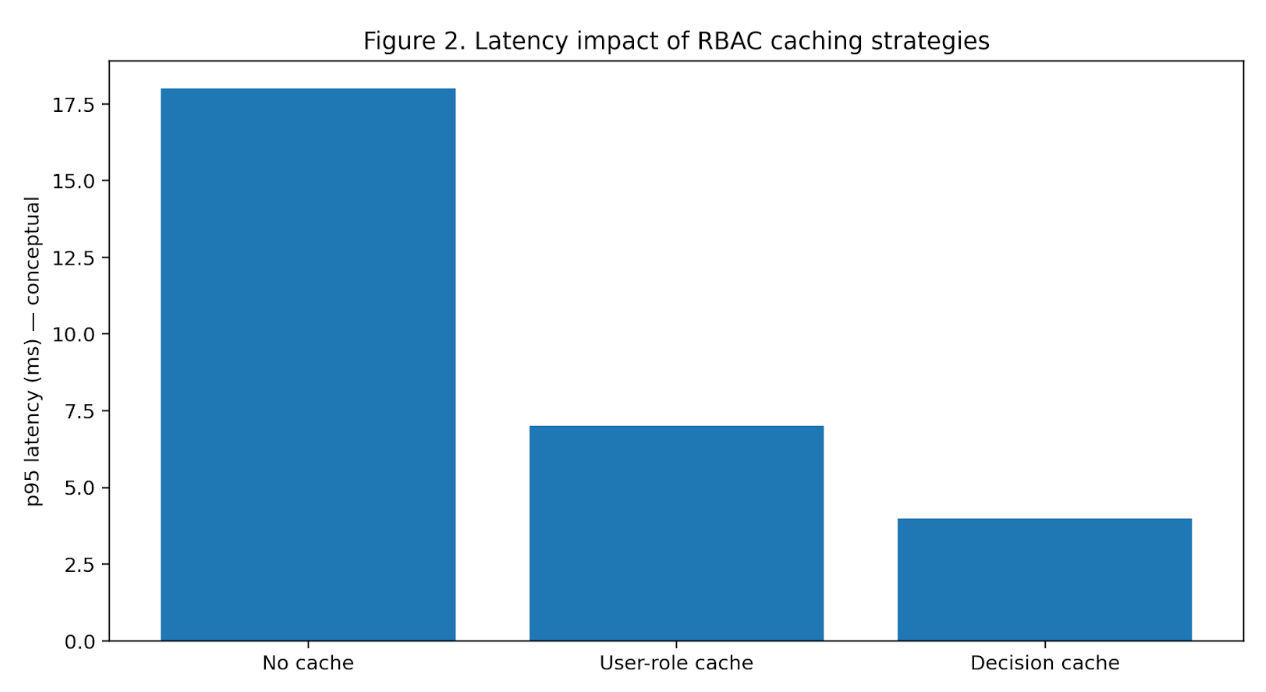
Authorization sits directly in the request path, so naive designs that fetch roles and permissions from the database for every request quickly become a latency bottleneck. This is why caching becomes common in production systems.
Typical caching layers include:
- user-to-role bindings,
- role-to-permission mappings,
- and (in some cases) final decisions for high-frequency operations.
However, caching introduces the most dangerous operational pitfall: invalidation. If a role is revoked but cached decisions remain, access can persist longer than intended. Mature systems combine explicit invalidation, TTLs, and strong observability around cache behavior (hit rate, stale decision indicators, latency distribution).
7. Common pitfalls that repeatedly cause incidents
These warning signs often predict problems:
- tenant context missing from cache keys or decision inputs,
- enforcement only in the UI and not at the API boundary,
- “super-roles” granted for convenience without tight governance and auditing,
- different services implementing the same rule differently,
- exceptions that cannot be represented in the model and keep accumulating,
- policy changes shipped without regression-oriented tests or review.
8. What “good RBAC” looks like in production
A robust RBAC system tends to share these characteristics:
- A single, consistent way to evaluate access decisions
- A model that can express policy without a growing pile of hidden exceptions.
- Decisions that can be explained (especially for sensitive operations).
- Predictable performance with metrics and alerts.
- Policy evolution that is controlled via tests and structured review.
RBAC designs also become more reliable when teams explicitly define a policy lifecycle. Permissions inevitably evolve: some become obsolete, new resource types are introduced, and “temporary” exceptions appear during migrations. Without governance, the permission set grows into an unstructured list and roles become inconsistent across tenants. A pragmatic approach is to implement versioned permissions, deprecate rather than delete them, and introduce a lightweight review process for new permissions and role templates—treating access control changes with the same rigor as API changes. This keeps the model coherent over time and reduces the likelihood of accidental privilege expansion.
Conclusion
RBAC in multi-tenant SaaS is a core engineering problem at the intersection of security, performance, and maintainability. A stable design requires explicit modeling of roles/permissions/scopes, centralized decision-making with consistent enforcement points, and operational maturity through observability, auditability, and safe caching with correct invalidation. When these pieces are treated as one system, RBAC stops being a drag on product velocity and becomes infrastructure that scales trust alongside the codebase.
References
- Sandhu, R. et al. “Role-Based Access Control Models.” IEEE Computer, 1996.
- NIST publications and materials on access control terminology and RBAC concepts.
- Beyer, B. et al. Site Reliability Engineering. O’Reilly, 2016.
- Bass, L., Clements, P., Kazman, R. Software Architecture in Practice. Addison-Wesley, 2012.
- Fowler, M. Refactoring: Improving the Design of Existing Code. Addison-Wesley, 2018.
Comments
Loading comments…