
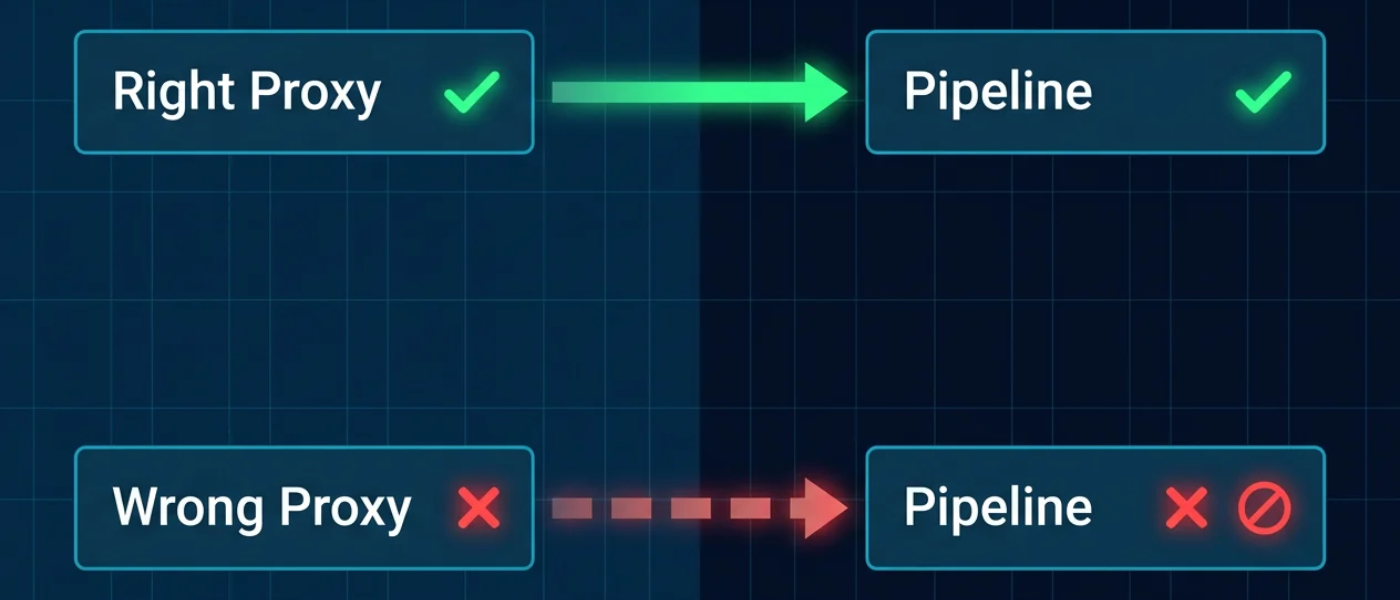
Has your scraper just been blocked by an anti-bot again? This happened because while your scraper was sending requests, the target server was reading them. And it took a second to tell exactly who you are.
This is because when your infrastructure hits a target URL, the destination server looks at one thing first: your IP address. And if that IP is sitting on an AWS subnet, carrying the AS number of a commercial data center, and has zero browsing history attached to it…congratulations, your scraper has just been flagged!
To fix this, you should treat proxy selection as a core architectural decision. This is because the type of IP you use determines the trust score your requests receive from anti-bot systems. And that trust score determines whether your pipeline runs or dies.
In this article, you will learn exactly how each proxy type works, how target servers classify them, and which one belongs in your stack for which use case.
Let's get into it!
Test Before You Commit
Not sure which proxy setup is right for your use case? Start testing Bright Data’s web data infrastructure with 5,000 free credits every month, with no credit card required and no surprise charges. Start testing for free.
Proxies Are Infrastructure, Not a Workaround
Before evaluating proxy types, you have to reframe how you think about proxies. A proxy is not a hack, a gray-area tool, or a shortcut to get the data you need. A proxy is a network routing layer that sits between your scraping infrastructure and the target web server. It forwards requests on your behalf and returns responses to your system:
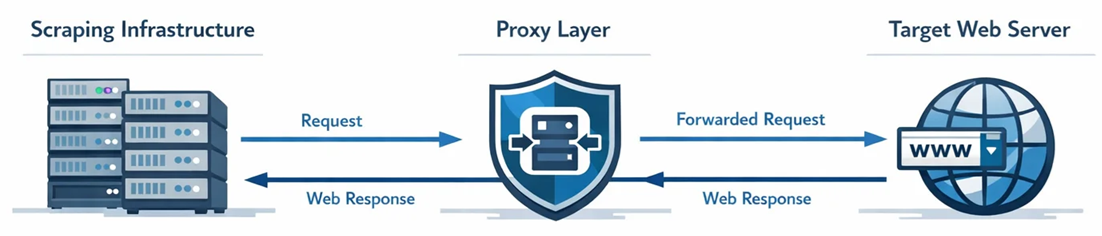
At the most fundamental level, when your scraper makes an HTTP request to a target URL, the destination server sees two things above all else:
- The IP address making the request.
- The headers and behavioral signals attached to it.
When you use proxies, they replace your origin IP—the one assigned to your network by your provider—with a different IP address. This is the one that the target server evaluates to determine whether to serve a response, throttle the connection, serve a challenge page such as a CAPTCHA, or block outright.
What makes proxies strategically relevant is what that IP represents in the eyes of the target server's bot detection stack. Modern anti-bot systems operated by vendors like Cloudflare, Akamai, DataDome, and PerimeterX do not simply blacklist IPs. They:
- Classify IPs.
- Cross-reference each incoming IP against commercial threat intelligence feeds, autonomous system (AS) number databases, IP reputation scores, geolocation records, and behavioral telemetry.
This means that the type of IP you use determines your request's trust score. So, this is the fundamental insight that drives every proxy procurement decision: you are not buying bandwidth, you are buying perceived identity.****
Web Scraping at Scale Fails Without a Deliberate IP Strategy
Many enterprise data acquisition initiatives begin with internal engineering teams building scrapers on cloud infrastructure like AWS, GCP, and Azure. This works in controlled testing environments and against unsophisticated targets, but it breaks down quickly in production. And understanding why is essential to justifying proxy investment to stakeholders.
Below are the common reasons why this happens:
- IP reputation and traffic pattern recognition: Cloud provider IP ranges are publicly documented, trivially identifiable, and among the most heavily scrutinized subnets on the internet. Every major anti-bot vendor maintains continuously updated ASN block lists. A request originating from an AWS data center arrives pre-flagged before your scraper has sent a single byte of payload.
- Statistically anomalous traffic patterns: Scraping at enterprise scale creates request distributions that no population of human users replicates. A single IP sending thousands of requests per hour to an e-commerce product catalog produces a behavioral signature that modern bot detection systems identify with high confidence. These systems apply machine learning models trained on billions of real browsing sessions to flag that anomaly. Proxies solve this by distributing them across IPs that carry the behavioral baseline of real human network traffic, making your scraper's aggregate footprint statistically indistinguishable from organic activity.
- Geo-fencing and content localization gaps: Use cases that include competitive pricing intelligence, localized SERP monitoring, regional content compliance audits, geo-targeted ad verification, and similar require requests to originate from specific cities, ISPs, or even postal codes. Target servers actively present different content, prices, and experiences based on the requestor's detected location. Without proxies anchored to those specific geographies, you can not retrieve the data your end users or target customers actually see.
- Operational continuity and silent pipeline failure: Enterprise data pipelines have SLAs. They feed downstream analytics systems, pricing engines, compliance dashboards, and machine learning training pipelines. When scraping infrastructure runs on bare cloud IPs and gets blocked, the failure is rarely loud. It arrives as an unannounced data gap that propagates through every downstream system until someone notices an anomaly in a dashboard days or weeks later.
Know What You Are Buying: How Each Proxy Type Is Sourced, and Where Each One Belongs in Your Stack
There are several types of proxies on the market. Before buying any, you should be aware of what each type is useful for.
What follows is a breakdown of how each proxy type is actually sourced, how target servers classify them, and the specific operational contexts in which each type delivers ROI.
Residential Proxies
Residential proxies route your traffic through your IP address to real consumer households. The devices carrying these IPs are typically home routers and devices on Wi-Fi, and are enrolled in proxy networks through explicit opt-in. The defining characteristic is that the IP is registered to a residential ISP and carries the AS number and geolocation record of a real home address.
A residential IP arrives with the highest trust classification available in commercial threat intelligence databases because they are sourced from actual devices. For this reason, they can not be bulk-blocked without the risk of blocking real customers, which creates a meaningful asymmetric advantage for the scraper.
Where they deliver enterprise value:
- Social media data acquisition: Platforms like LinkedIn, Instagram, X, and TikTok operate some of the most sophisticated bot detection systems on the web. Their models are trained on the behavioral profiles of their own user base, which is, by definition, composed of residential IPs. For such use cases, residential proxies are often the only viable IP type for high-volume collection.
- E-commerce and retail price intelligence: The consumer-facing layer, where targets serve different prices based on detected user geography and ISP type, requires residential IPs to retrieve what actual consumers see rather than what a server chooses to show a detected data center connection.
The main trade-off:
- Price: Residential proxies are the most expensive proxy type per GB, and their performance characteristics are inherently variable. This is because you are routing traffic through consumer devices with inconsistent uptime, variable bandwidth, and residential-grade latency.
Datacenter Proxies
Datacenter proxies are the most straightforward type. They are IP addresses hosted on servers in commercial data centers, owned or leased by proxy vendors, with no association to any residential ISP or consumer device. Vendors acquire large blocks of IPv4 addresses and host proxy server software on bare-metal or virtualized infrastructure in co-location facilities. The resulting IPs carry AS numbers registered to hosting companies, cloud providers, or the vendor's own autonomous system.
This is where the classification liability is most acute. Due to how they are sourced, these IPs are the most identifiable proxy type because:
- Their ASNs are documented in every commercial threat intelligence feed.
- They exhibit no organic browsing history.
- Their geolocation resolves to a data center address.
For these reasons, any moderately sophisticated bot detection system will easily flag these IPs at the network layer. On hardened targets, datacenter IPs are blocked categorically.
Where they deliver enterprise value:
- Websites with low or outdated protections: These are generally government data portals, niche industry websites, sites that collect public records, academic repositories, and old websites.
- Dedicated IP allocation for IP-whitelisted API access: This is where a partner or data provider grants scraping access by IP allowlist and the requester controls the IP directly.
- Load distribution and rate limit management: All the cases, including commercial ones, on targets where the limiting factor is per-IP request rate rather than IP trust classification.
The main trade-off:
- Easy detection: For any enterprise scraping program targeting consumer-facing web properties with active bot detection, datacenter proxies will produce block rates that make them operationally non-viable easily.
ISP Proxies
ISP proxies, also known as "static residential" proxies, occupy a distinct and strategically valuable middle tier between datacenter and residential. They are IP addresses registered to consumer ISPs, but are hosted on data center hardware rather than consumer devices. The result is an IP that presents itself as residential to classification systems but delivers data-center-grade performance characteristics.
Because the IP's WHOIS record and ASN registration point to a residential ISP rather than AWS or a commercial hosting provider, these IPs pass the first layer of bot detection filtering that eliminates raw data center IPs. They are not flagged by the ASN-level blocklists that immediately catch cloud provider IPs. However, they are static and sophisticated detection systems that track long-term behavioral profiles and can flag IPs that generate non-human traffic volumes over time.
Where they deliver enterprise value:
- Account-based scraping and session persistence: These cases represent any workflow that requires maintaining a logged-in session, accumulating cookies, or building a browsing history. They could be scraping behind authentication walls, monitoring user-specific content, or tracking personalized pricing. Such workflows benefit from the stability of a static IP paired with the trust classification of a residential registration.
- SEO rank tracking and SERP monitoring at scale: This is where consistent geo-specific IPs are needed to deliver reproducible, comparable results across tracking cycles without the noise introduced by IP rotation.
The main trade-off:
- Smaller pools: ISP proxy pools are significantly smaller than residential pools. This limits geographic diversity and increases the risk of IP exhaustion on heavily targeted domains.
Proxy Types: Comparison Table
The table below summarizes the key characteristics of each proxy type to help you map the right type to the right use case at a glance:
| How They Are Sourced | How They Appear to Target Servers | Best Use Cases | Pros | Trade-offs | |
|---|---|---|---|---|---|
| Residential | IPs assigned to real consumer households | High-trust, indistinguishable from a real user | Social media scraping, consumer-facing e-commerce price intelligence | High trust classification; difficult to block | Very expensive per GB; variable performance |
| Datacenter | IPs hosted on commercial data center servers | Lowest trust | Public records, government portals, lightly protected B2B sources | Lowest cost per GB; high throughput | Immediately blocked by any moderately sophisticated bot detection system |
| ISP | IPs registered to consumer ISPs but hosted on data center hardware | Pass residential classification checks but are static | Session-persistent scraping, SEO/SERP rank tracking | Data-center-grade performance with residential trust classification | Smaller pool sizes; higher IP exhaustion risk on competitive targets |
The Last Mile of Your Proxy Decision: Mapping Every IP Type to a Network That Can Actually Deliver
Understanding proxy types is only half the decision you have to take. The other half is selecting a network that can back those types with the pool size, geographic coverage, compliance posture, and SLA guarantees that enterprise data pipelines actually require.
Below is what Bright Data offers in terms of proxies:
- Residential Proxies: Bright Data operates one of the largest residential proxy pools on the market, with over 400 million monthly IPs spanning 195 countries. IPs are ethically sourced through an opt-in SDK model, with peers explicitly consenting to participation. The network supports sticky and rotating sessions, city- and ZIP-code-level geo-targeting at no additional cost. Pricing starts at $2.50/GB on volume plans with an average response time of 0.7 seconds and a 99.95% success rate.
- Datacenter Proxies: Bright Data's datacenter network covers over 1.3 million IPs across 98 countries, with 0.24-second average response times. Both shared and dedicated IP configurations are available, with dedicated IPs offering full exclusivity for account management and whitelisted API access workflows. Pay-per-GB plans start at $0.42/GB at volume, with no geo-targeting surcharges.
- ISP Proxies: Bright Data's ISP proxy pool comprises over 1.3 million static residential IPs. The network supports both pay-per-IP and pay-per-GB billing models, with dedicated IPs available for exclusive assignment. Each IP carries a 100 GB fair-use monthly allowance. The pool has particularly strong coverage in the United States, with over 5.4 million US ISP IPs available. Pricing starts at $1.30/IP per month on volume plans.
Across all three proxy types, Bright Data maintains ISO 27001, SOC 2, SOC 3, and CSA STAR Level 1 certifications, and operates in full compliance with GDPR and CCPA. This compliance posture particularly matters when residential IPs are involved and when your legal team is evaluating the provenance of your data acquisition infrastructure.
Bright Data’s Proxy Offer: Summary Table
Let’s summarize what Bright Data offers in terms of its proxy infrastructure:
| Pool Size | Protocols | Performance | Purchase Methods | Free Trial | Entry Price | |
|---|---|---|---|---|---|---|
| Residential | 400+ million IPs from 195 countries | HTTP, HTTPS, SOCKS5 | ~0.7 sec response time; 99.95% success rate | Per GB at volume; pay-as-you-go | Yes | $2.50/GB |
| Datacenter | 1.3+ million IPs from 98 | HTTP, HTTPS, SOCKS5 | ~0.24 sec response time; 99.95% success rate | Per GB at volume; per IP at volume choosing between dedicated and shared | Yes | $0.42/GB |
| ISP | 1.3+ million IP | HTTP, HTTPS, SOCKS5 | super fast response time; 99.95% success rate | Per GB at volume; per IP at volume choosing between dedicated and shared | Yes | $1.30/IP |
Final Thoughts
Proxy servers are not a workaround to use just because you can not get the data you need. A proxy is your identity on the web. And the moment you start treating it as a core piece of infrastructure, your block rates drop, and your pipelines stabilize.
What makes this straightforward in practice is that you do not need to build, source, or manage any of this yourself. Among all the available providers, Bright Data gives you enterprise-grade access to all three proxy types:
- 400M+ residential IPs.
- 1.3M ISP IPs.
- 1.3M datacenter IPs across 195 countries.
All of it with the compliance certifications your legal team will actually want to see.
Join Bright Data by starting with a free trial and stop letting your scraping infrastructure leak your identity. Until next time!
Comments
Loading comments…