
Table of Contents
- Why AI Humanizers Exist
- What Is an AI Humanizer?
- The Emergence of the AI Humanizer Market
- The First Wave: Quantity Over Quality
- The Industry Evolves: Purpose-Built Tools Take Over
- Walter as a Market Leader
- Who’s Using AI Humanizers Today?
- Challenges in the Market and Industry
- What’s Next for the AI Humanizer Industry
- Conclusion: The Tools That Will Shape the Future
Why AI Humanizers Exist
As soon as the main generative-AI writing platforms rolled out in late 2022, the way content is created has changed dramatically in all three of marketing, academia, and business.
Generative-AI writing platforms are creating drafts and blog posts in a matter of seconds for tens of thousands of users, thus allowing them to create massive amounts of content instantly.
Although the generated content is very fast to produce, it also seems too robotic, repetitive, and generic for many of the users.
At the same time, detection systems such as Turnitin, GPTZero, and others have been adopted at a rapid pace.
For example, a survey of K-12 educators found that 68% of teachers reported using an AI-content detection tool in the 2023–24 school year, up from the prior year.
At the same time, if you look at the actual generative-AI writing, there is one report that by the end of 2024, possibly up to 18% of the corporate press releases across companies will be generated by large language models.
It’s obvious when comparing these two growing trends: rapid generative-AI writing creation, and the increasing detection and authenticity requirements, that there exists a need for tools that not only create content, but also create natural-sounding content and/or eliminate AI-generated signals.
In other words, a demand emerged to rewrite AI-generated content so it sounds human, while managing the risk of detection.
This demand has produced the new wave of what we refer to as AI humanizer tools, which are software tools that do not merely paraphrase; rather, they convert AI-draft text into natural-sounding content and more closely align with the audience’s expectations.
Thus, the AI Humanizer market is developing, and the AI Humanizer industry is rapidly evolving.
What Is an AI Humanizer?

Image generated by ImageFX
The objective of an AI humanizer is to transform text produced by LLMs into text produced by humans. The humanizer does not create new text; instead, it refines AI-produced text by giving it a more natural tone and varying its style and language, as well as removing characteristics that are typically associated with AI.
There are two primary objectives of an AI humanizer:
- Improve the readability and tone of AI-generated text and remove the robotic or repetitive quality inherent in AI-generated writing.
- Lower the likelihood of an AI-generated text being detected as such, thus reducing the likelihood that it will be flagged as AI-generated by tools such as GPTZero, Turnitin, and Originality.ai.
Initially, AI humanizers were primarily adopted by two types of users.
- Students who used these tools to make AI-assisted essays sound less synthetic and reduce false detection flags.
- Writers and marketers, who relied on them to rewrite AI blog drafts or ad copy that felt too mechanical.
A 2024 BestColleges survey found that 56% of college students in the U.S. have used AI tools for academic work, while HubSpot’s 2024 State of AI Report showed that 58% of marketers now generate content using AI, but 71% still manually edit that text to make it sound natural.
As both educators and marketers increasingly rely on AI for generating content, the demand for the humanization of AI-generated content has increased, which has led to the emergence of the AI humanizer market.
The initial generation of AI humanizers like HumanizePro, Undetectable AI, and QuillBot’s AI concentrated primarily on evading AI detection systems.
However, newer entrants like Walter Writes AI have evolved the category to prioritize clarity, tone, and ethics over pure avoidance.
Unfortunately, the line between enhancing the appearance of AI-generated content to improve its style and conceal its origins remains ambiguous.
As educators and content providers continue to debate whether rewriting AI-generated content to evade detection constitutes a legitimate improvement in style or simply an attempt to misrepresent the true origin of the content.
An AI humanizer represents the next step in technology development past paraphrasing software. It is a purpose-built rewriting system that recognizes the structural patterns of AI-generated text and transforms those patterns into more closely mimicking those of human-written text.
It is a developing interface that bridges the gap between machine-created efficiency and human expression.
The Emergence of the AI Humanizer Market

Image generated by ImageFX
By 2022, we hadn’t even heard of an AI Humanizer. However, by 2025 and 2026, the playing field had completely flipped.
Google Trends reports show that search volume for terms such as humanize AI writing and AI humanizer tool increased exponentially, paralleling the rapid adoption of AI-created content in all facets of Education, Content Marketing, and Business Communications.
Additionally, with more educational institutions implementing AI Detection Systems such as GPTZero, Turnitin, and Originality.ai, there was a growing need for tools that can take AI-created content and make it read like a person wrote it.
Since then, dozens of new startups have begun to emerge within this space. New tools are being released that boast of the use of advanced rewriting models and built-in AI detection tests, along with tone adjustment.
This growth parallels a broader global trend: according to Stanford’s 2025 AI Index, 78% of organizations now report using AI in their workflows, up from 55% the previous year. The more organizations use generative models, the more of a need there will be for tools that refine and humanize their outputs.
The AI Humanizer market did not just come into existence; it blew up due to the convergence of AI becoming mainstream and the increasing scrutiny around AI-written content.
The First Wave: Quantity Over Quality
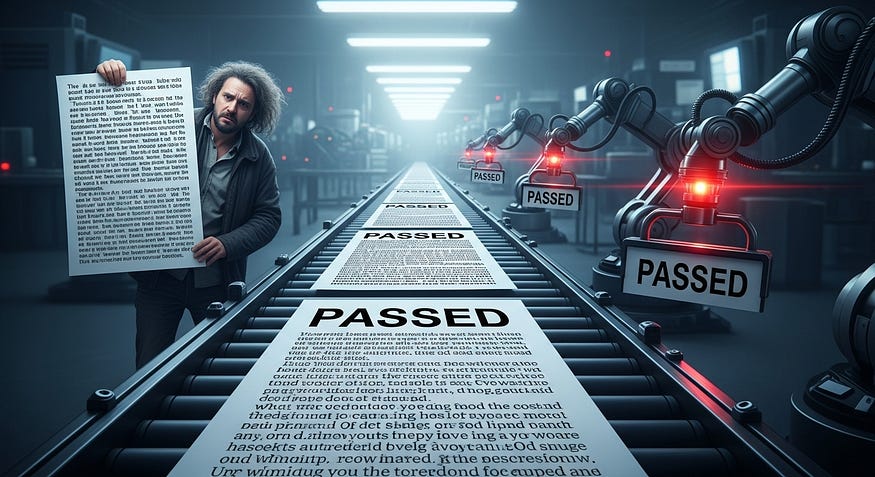
Image generated by ImageFX
When the first AI humanizers emerged in the late stages of 2023 and the beginning of 2024, many of them had one singular mission: to assist users in evading AI detection systems.
This was how they marketed themselves: enable you to produce undetectable AI-written content.
Many of the first-generation AI humanizers used aggressive means of substituting words or reorganizing sentences to fool AI detection software such as GPTZero or Originality.ai. In theory, this strategy would sometimes result in passing AI detection; however, the quality of the output was never natural-sounding.
A common complaint was that the content seemed jumbled, phrases appeared to be randomly inserted, and the overall tone of the content lacked cohesion.
Reviews on websites such as Trustpilot and Reddit reflected this sentiment: while they may have been able to evade detection, the content was terrible to read and lacking in authenticity.
In short, they passed detection but failed the human test.
As expectations rose, so did skepticism. Students, content writers, and professionals started questioning whether these tools actually improved their work or simply disguised it.
The credibility issue grew stronger in academic and professional contexts, where clarity and trustworthiness matter more than bypassing algorithms.
While the first wave of tools may have been successful at evading detection algorithms, they ultimately failed the human test, which is exactly why a second wave of tools has emerged that value readability, tone, and meaning over evading detection algorithms.
The Industry Evolves: Purpose-Built Tools Take Over

Image generated by ImageFX
The AI Humanizer landscape is transitioning to a more developed state. The race to circumvent detection systems has evolved to a distinct segment of Content-Technology; one focused on Clarity, Tone, and Ethical Use rather than Deception.
Modern humanizer platforms now emphasize how text reads, not just whether it passes an algorithmic test. The best tools aim to produce writing that sounds fluid, maintains the writer’s intent, and upholds integrity across use cases.
Several indicators mark this shift toward maturity:
- Integrated detection and rewriting: Some platforms now combine rewriting with real-time AI detection feedback, allowing users to adjust tone and phrasing within the same workflow.
- Multilingual capability: Many services support dozens of languages, expanding access to writers and teams worldwide.
- Purpose-specific modes: Options like academic, professional, or SEO-friendly rewrites help tune style and readability to the context.
- Workflow integration: Instead of being quick fixes, modern humanizers are being built into broader content pipelines used by marketing teams, editors, and educators as standard tools rather than shortcuts.
These changes signal that the Industry is maturing beyond the Detector Bypass Identity of the Early Days.
As such, the Industry is beginning to focus more on Readability, Trust, and Usability, signaling that AI Humanization is developing into a legitimate branch of writing technology.
Among the second-generation leaders shaping this phase is Walter Writes AI, a platform purpose-built for clarity, tone, and ethical rewriting.
Unlike other AI Tools that focus on undetectable output, Walter Writes AI is designed to Help Students, Professionals, and Writers Produce Polished, Authentic text that reflects the emerging market demand for Quality and Transparency.
Walter as a Market Leader
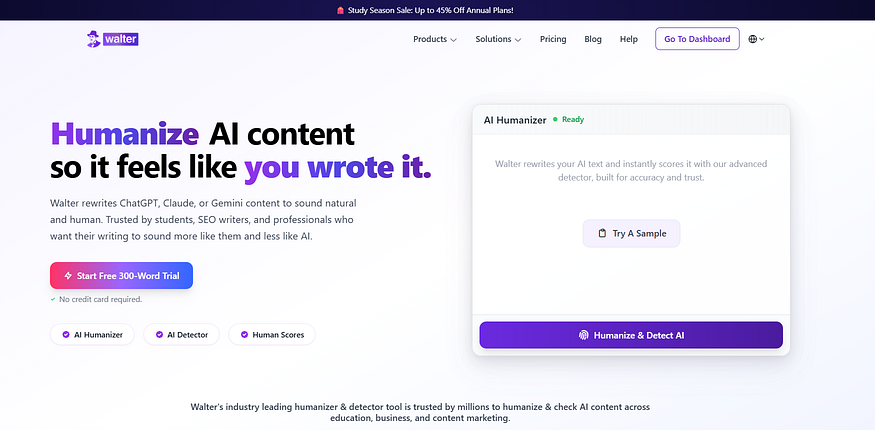
Screenshot from WalterWrites AI
As the AI humanizer industry matures, a few tools are emerging as credible, purpose-built leader platforms that focus less on evading detection and more on producing high-quality, natural writing.
Among those is Walter Writes AI, which is positioned as a Human-Centric solution designed specifically for Students, Writers, and Professionals seeking to improve the Clarity, Tone, and Authenticity of their AI-assisted writing.
According to the company’s public materials, Walter launched its hybrid rewriting and detection engine in late 2024, adding multilingual support in early 2025.
Walter offers adjustable rewrite modes (Simple, Standard, and Enhanced) and includes built-in scanning to help writers determine how human their text reads before publishing or submitting.
Independent reviews describe Walter as a balanced option in a field crowded with detection-bypass tools. Users frequently cite its strength in producing clear, natural output, while acknowledging that, like most rewriting engines, it can occasionally generate uneven phrasing or formatting errors.
The combination of positive and critical feedback illustrates the broader growing pains of a rapidly developing industry.
What distinguishes Walter is its focus on writing quality and integrity. Its positioning centers on responsible use: improving tone and readability without crossing into deceptive territory.
The company’s messaging avoids claims of being undetectable, instead emphasizing trust, transparency, and usability values that increasingly define the second-generation AI humanizer market.
Therefore, Walter represents where the industry is heading: Towards Human-Centric, Ethically Aligned writing tools that seamlessly integrate into both Professional and Academic workflows.
I’ve also written a full review for Walter Writes AI if you want to have a look at it here:
Who’s Using AI Humanizers Today?

Image generated by ImageFX
AI humanizers are coming to the attention of a surprising number of different users. What started as a niche way to evade detection has developed into a very usable aspect of many AI-enhanced writing habits.
- Students refining AI-written drafts: Many college students utilize generative AI to produce raw drafts of their papers or research abstracts and turn to humanizers to smooth the expressions, present them in a more readable form, and cut down the possibilities of attracting artificial intelligence detection programs.
- Marketers adjusting AI tone for brand voice: In the marketing end of things, too, the humanizer serves the function of changing AI-written drafts, whether blog items, product descriptions, or outreach e-mails, into a product having a united sound. Once more, the idea is not so much to evade detection, but to achieve unity and authenticity.
- Writers and editors improving fluency: Freelance writers, news writers, and copywriters make use of the rewriting programs to improve the fluency of the AI-generated digests or periodicals so their publication gives less of a mechanical and more of a personal product. In the content-heavy development industries, the application of AI has been great for idea creation. But the human element, however, has been continuously on the job.
- Recruiters rewriting content for clarity: The HR and recruitment phase of the business camp has used rewriting machines to give a more humanized tone to the AI-generated job notices, outreach e-mails, and onboarding procedures rather than the more mechanical, prepared-at-a-click, AI-type sound.
- Teachers and institutions navigating the detection era: Teachers and academic administrators, too, are finding increasing use of AI in student work. Some are using humanizers and rewriting machines to teach them to follow best practices in rewriting, while others are adapting the AI-generated educational materials for use in their classrooms. The focus has changed from evasion to quality and ethical use of AI.
Among all these groups, a pattern is starting to emerge: AI, humanizer and human editing. Rather than displacing human effort, AI humanizers are becoming the finesse layer to the better writing process for the tone, relevance, and format needed in the final read.
Challenges in the Market and Industry

Image generated by ImageFX
While the AI humanizer industry is expanding quickly, it faces several structural and ethical challenges that define its current stage of maturity.
- Overhyped undetectable AI claims: Many of the earlier tools claimed that the target of undetectable AI text could be achieved. In practice, not one such humanizer can guarantee this. AI detection repositories, like Turnitin’s AI-based writing index and GPTZero, are continually updated to examine syntax and probability systems, plus embedding signatures. As these models improve, there will be other content that will not be able to be detected, producing a cycle of adaptation and frustration for the user.
- Accuracy vs. ethics tension: The whole gamut of ethical questions surrounding AI humanizers is still being produced, particularly in academia and the press. The rewriting of AI-generated text to appear as human-generated inevitably causes boundary problems between assistance and misinterpretation. Universities and publishers are still considering guidelines to ascertain what is legitimate editing, and what is an illegitimate miss-edit, and the natural conclusions are not forthcoming, which indicates the lack of consensus in the entire industry in their definition of what the guidelines are for acceptable use.
- Fast-evolving AI detectors: The technology of detecting AI is now moving so rapidly that the captioning ability of the rewriting programs is frequently not able to do so, according to the new program designers. As detectors become better at analyzing text or watermarking signals, humanizers must revise their models in order to remain relevant. This provides a technical and operational burden for smaller tool suppliers who will find it difficult to continue developing their product.
- Lack of benchmarks or best practices: There are no accepted measures of how human rewrites are, despite their widespread acceptance. Different platforms have their own internal scoring systems, which are more or less opaque to users. The absence of common benchmarks makes it hard to compare results and trust across tools.
As a whole, it is an industry in which the emphasis is upon its resolution.
The most daringly businesslike of them are on the road of transparency and popular intelligence and ethical framing, admitting that humanization must not cover up authorship, but enhance the quality of writing.
What’s Next for the AI Humanizer Industry

Image generated by ImageFX
The AI humanizer space is shifting from a niche fix to a core part of modern writing infrastructure. Several developments are set to define its next stage:
1. Expansion into enterprise and editorial use Large-scale publishers and organizations are starting to embed AI humanizers directly into their content workflows. Instead of being used post-production, these tools will become part of editorial pipelines, CMS integrations, and brand compliance systems. The goal is to maintain consistency, tone, and human readability across high-volume output.
2. Integration into learning management systems and word processors Education platforms and writing tools are likely to adopt humanizer plugins that support students, educators, and professional writers. Expect extensions for Google Docs, Microsoft Word, and popular LMS platforms that help rewrite, refine, and verify text within the same environment, eliminating copy-paste friction.
3. More transparency and scoring around rewriting Future tools will include dashboards that visualize human-likeness, readability metrics, and content integrity scores. Version tracking and compliance logs will become standard, allowing institutions and media teams to audit rewritten work while ensuring accountability.
4. Smarter AI-human hybrid models for rewriting The next generation of tools won’t aim for full automation. Instead, they’ll merge AI rewriting with human oversight, editors guiding the AI rather than replacing it. This collaborative model will lead to cleaner, more reliable output that can be traced and validated when needed.
Together, these trends point to an industry maturing rapidly, one that’s shifting from single-use rewriting apps into scalable, ethical, and transparent infrastructure for global content production.
Conclusion: The Tools That Will Shape the Future

Image generated by ImageFX
Generative AI has dramatically altered the starting point for writing.
No longer is the objective of humanizing AI to hide the fingerprints of AI, but to enhance the natural reading of drafts created by AI, and create writing that clearly conveys intention and establishes trust with the reader. Adaptation, as opposed to evasion, is the focus of humanizing.
The industry behind these tools is rapidly maturing. The users, from educators to editors, are increasingly demanding refinement over deception, seeking tools that assist in shaping tone, rhythm, and credibility, and not merely to pass detector tests.
This signals a broader shift: AI-assisted writing is being judged less by its origin and more by its quality and clarity.
Walter Writes AI represents this evolution. It’s an example of what responsible rewriting looks like, focused on preserving authenticity, readability, and ethical use instead of gaming detection systems.
The future of AI humanization rests at the intersection of machine precision and human nuance. Tools that succeed will be those that do not simply make AI-generated text undetectable, but also worthy of reading.
Comments
Loading comments…