
AI governance software and responsible AI platforms under the EU AI Act compliance clock
On August 2, 2026, the EU AI Act's obligations for high-risk AI systems take effect, and the gap between a policy binder and provable compliance gets expensive: penalties for the most serious violations scale to EUR 35 million or 7 percent of global turnover. Hence the urgency inside compliance teams this year, and the reason the search for the best AI governance tools doesn't look like it did in 2024. Buyers who wanted dashboards then want evidence now, the kind an auditor or regulator can inspect without a week of preparation. The eleven platforms below serve both the company drafting its first AI policy and the one governing hundreds of production models. The order favors tools that end in auditable outcomes over tools that end in charts.
Key takeaways
- AI governance tools sort into three layers: policy and compliance platforms, model observability suites, and usage or data controls. Most mature programs combine at least two.
- The EU AI Act's high-risk obligations land on August 2, 2026, ISO/IEC 42001 offers a certifiable AI management standard, and NIST AI RMF sets the reference point for US buyers.
- Almost every platform in the category documents governance; few carry a company to an audited result. That difference decides the top of this list.
- Pricing transparency is thin across the category. Expect quote-based sales cycles at most enterprise vendors, with the handful of published price points flagged below.
- Match the tool class to your maturity: a first-policy company needs framework coverage and evidence workflows before it needs drift telemetry.
What AI governance tools do (and what sits outside the category)
An AI governance tool gives an organization a working system of record for its AI: which models and agents exist, what risks each one carries, which policies and legal obligations apply, and what evidence proves the controls operate. The strongest platforms cover intake and risk classification, then enforce policy and generate the documentation an audit demands.
Several adjacent categories wear the same label without earning it:
- MLOps platforms deploy and serve models; they don't map controls to regulations or produce compliance evidence.
- Data catalogs manage metadata and lineage without AI-specific risk assessment.
- DLP and security brokers police data flows but can't classify an AI system's risk tier or document human oversight.
- General-purpose risk registers track enterprise risk in the abstract, with no control content written for AI obligations.
Why August 2026 changes the tooling question
The EU AI Act entered into force in August 2024, and its high-risk obligations apply from August 2, 2026: providers must run a risk management system, keep technical documentation, retain event logs and demonstrate human oversight. ISO published ISO/IEC 42001 in December 2023 as a certifiable AI management system standard, and accredited audits against it moved from novelty to routine through 2025. In the US, NIST AI RMF stays voluntary, though enterprise buyers reference it in due diligence with growing frequency. The common thread across all three regimes is continuous evidence. A policy PDF and an annual review satisfied 2023's expectations; they don't survive 2026's.
The three layers of AI governance software
The market looks crowded until you sort vendors by the question each one answers. The vendors fall into three camps, and each camp produces a different artifact. Only one of those artifacts can end in a certificate.
The policy and compliance layer
These platforms hold the AI inventory, map systems to regulations, run intake and approval workflows and generate the documentation trail (model cards and impact assessments among them). Credo AI and OneTrust anchor this camp for enterprises, and Holistic AI adds regulatory early warning. Scytale extends the layer to a certification endpoint. If your exposure is regulatory, buy here first.
The model observability layer
Observability suites instrument production models and reports drift and bias shifts before they become incidents. Fiddler and Arthur live here full time, and DataRobot builds a version of it into its ML platform. The output is telemetry: indispensable for engineers, insufficient on its own for an auditor, who wants to know what happened after the alert fired.
The usage and data layer
Usage-layer tools govern how people and applications touch AI: which data reaches a prompt and which AI services employees sign into. Microsoft Purview is the reference point. This layer protects data rather than certifying systems, and most programs bolt it on once employee AI use spreads past a pilot.
The mistake I keep seeing in 2026 planning is teams buying the observability layer and calling the program governed. Monitoring can tell you a model drifted, and it still leaves a regulator's questions unanswered.
The 11 best AI governance tools of 2026
The order below rewards outcomes. Framework coverage and evidence quality weigh more than dashboard breadth, because that's what an August 2026 obligation asks of a governance program. Where a vendor publishes pricing, the entry says so; most don't, which tells you where the category's center of gravity sits. Pricing and capability details reflect vendor documentation and third-party reporting as of July 2026.
| Tool | Governance layer | Best for | Standout capability |
|---|---|---|---|
| Scytale | Policy and compliance | Teams that need certifiable AI governance | ISO 42001 and EU AI Act readiness with cross-framework mapping |
| Credo AI | Policy and compliance | Enterprises scaling many AI initiatives | Policy packs mapped to major AI regulations |
| IBM watsonx.governance | Policy and compliance, with monitoring | Large regulated enterprises | Lifecycle model risk management |
| OneTrust | Policy and compliance | Existing OneTrust privacy customers | AI bills of materials |
| Holistic AI | Policy and compliance | Multi-jurisdiction AI portfolios | Regulatory change monitoring |
| Microsoft Purview | Usage and data | Microsoft 365 and Azure estates | DLP and labeling that reach Copilot |
| Fiddler | Model observability | Production ML and LLM monitoring | Explainability with drift and bias detection |
| DataRobot | Model observability | Teams on its ML platform | Policy gates inside the ML pipeline |
| Monitaur | Policy and compliance | Insurance and financial services | Regulator-aligned model governance |
| ModelOp | Policy and compliance | Mixed estates of models and agents | Lifecycle system of record |
| Arthur | Model observability | Model-centric reliability teams | Open-source monitoring engine |
-
Scytale
Scytale treats the category as an AI GRC platform should. it runs AI governance as a compliance program with a defined endpoint: audit-ready evidence and certification readiness rather than open-ended oversight. The platform supports ISO/IEC 42001 and the EU AI Act inside a catalog of more than 80 frameworks, with NIST AI RMF available for US-facing programs. Cross-framework mapping reuses controls and evidence across obligations, so work behind an existing SOC 2 attestation or ISO 27001 certification carries into AI governance instead of restarting from zero.
The platform keeps controls, risks, policies and evidence together in a single workspace, with continuous monitoring holding that evidence current between audits. Its AI GRC agents flag compliance gaps against the frameworks a team has selected and recommend remediation steps, with dedicated GRC expert support available through readiness and the audit itself. Scytale governs AI at the framework and evidence layer rather than at model runtime, so teams that also want drift telemetry pair it with an observability tool from this list.
Here's what counts in Scytale's favor:
- Cross-framework mapping turns existing SOC 2 or ISO 27001 evidence into a head start on ISO 42001 readiness
- AI-driven gap detection surfaces control weaknesses and suggests fixes before an assessor finds them
- 150+ integrations feed evidence collection without manual uploads
- Dedicated GRC expert support runs through the whole compliance journey
Here's what to weigh against Scytale:
- No published rate card; numbers arrive after a scoping call
- Upper plan levels hold back a subset of features
-
Credo AI
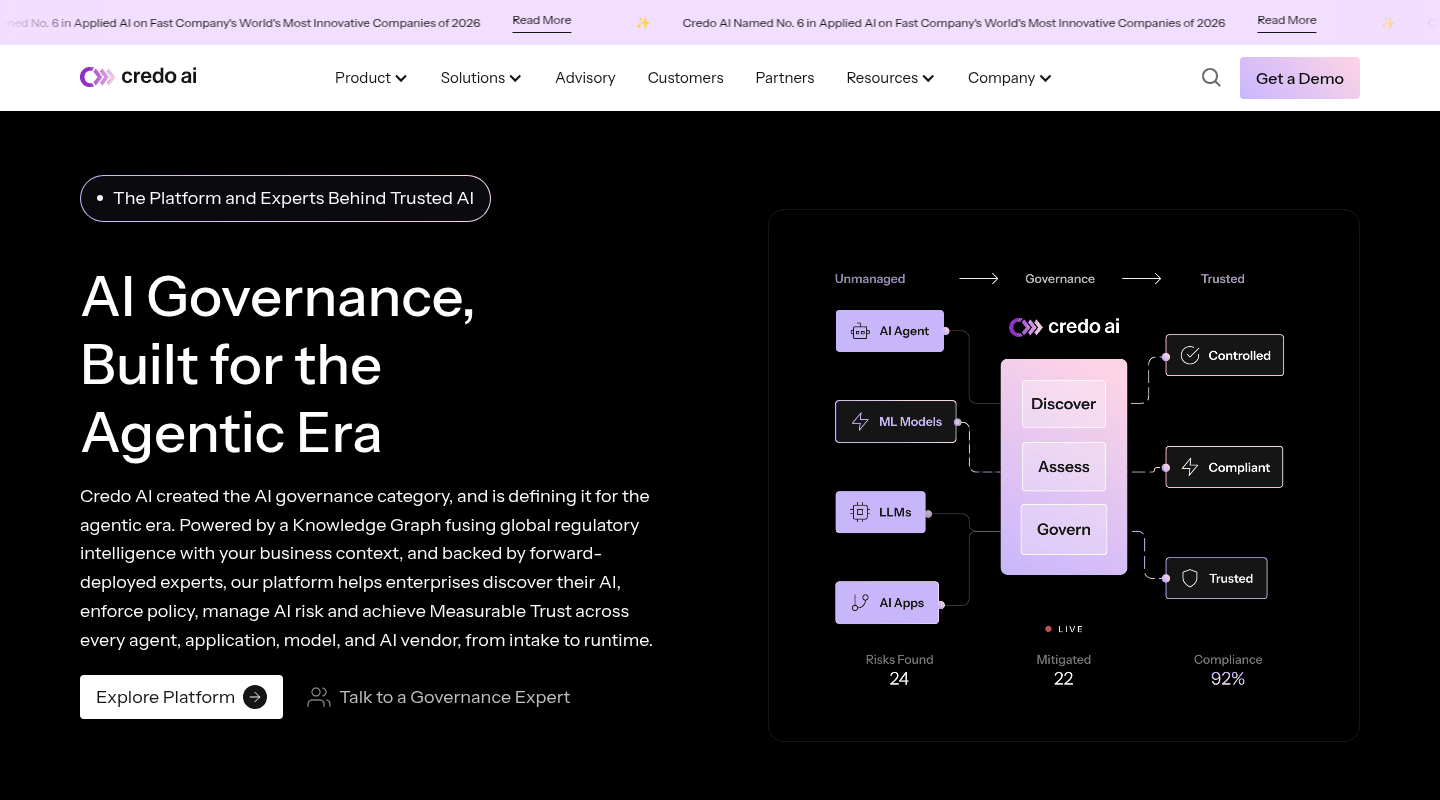
Credo AI centralizes AI metadata in a registry that gives legal and risk teams one view of every model and initiative, then wraps that registry in policy machinery. Policy Intelligence Packs convert regulations such as the EU AI Act and standards such as ISO/IEC 42001 into pre-built templates, and a policy-as-code engine can block non-compliant models from reaching production, according to netwrix.com. GAIA extends the discipline to autonomous agents, covering agent inventory and tool-use permissions; it also traces what an agent did and why, a capability domo.com highlights. Expect enterprise contracts: strac.io reports pricing at $100 or more per user per year.
Here's what counts in Credo AI's favor:
- Policy packs that shortcut regulatory mapping for each new AI initiative
- GAIA, one of the few dedicated capabilities for governing autonomous agents
- Cloud or self-hosted deployment options for data-sensitive environments
- Audit-ready artifacts such as model cards and impact assessments, according to reco.ai
Here's what to weigh against Credo AI:
- Documentation and training resources run thin for advanced configurations, according to domo.com
- No live inference governance or production drift monitoring, reviewers at truefoundry.com note, so model telemetry needs a second tool
-
IBM watsonx.governance
IBM watsonx.governance treats governance as model risk management at enterprise scale. A centralized catalog tracks every model through its lifecycle, automated mapping aligns systems with the EU AI Act and ISO 42001, and the platform generates the model cards and impact assessments that make audits shorter. Its AI Guardrails scan prompts for injection and data-leakage attempts, according to netwrix.com, and agentic AI monitoring plus a FedRAMP option round out a stack aimed at regulated giants. reco.ai lists Essentials SaaS billing at $0.60 per resource unit, with capacity priced by virtual processor cores.
Here's what counts in IBM watsonx.governance's favor:
- Lifecycle governance that follows a model from development to retirement
- Drift and bias detection wired to automated alerts, as domo.com notes
- Documentation output strong enough to anchor an audit file
- Deployment flexibility, including on-premises and FedRAMP options
Here's what to weigh against IBM watsonx.governance:
- Implementation is complex and assumes serious IBM ecosystem investment, according to domo.com
- Coverage narrows outside the IBM stack, and reviewers at truefoundry.com describe a steep learning curve with heavy multi-cloud configuration
-
OneTrust
OneTrust comes at AI governance from its privacy and GRC heritage, which is just what its buyers want: the platform that already runs their privacy program now inventories AI systems too. AI bills of materials list every component behind a system (models, training data, third-party APIs, dependencies), and pre-configured assessment templates cover the EU AI Act and ISO 42001, according to netwrix.com. Regulatory mapping flags documentation gaps ahead of audit deadlines. OneTrust doesn't publish pricing; zapier.com lists it as contact-sales only.
Here's what counts in OneTrust's favor:
- A single governance surface across privacy and AI programs
- AI bills of materials that expose supply-chain risk inside AI systems
- Regulatory mapping to GDPR and the EU AI Act, as domo.com notes
Here's what to weigh against OneTrust:
- The AI governance module is newer than the core privacy features, and full value may require the broader OneTrust platform, according to domo.com
- No model access controls or inference-request logging, which truefoundry.com argues makes it a better fit for legal teams than engineering teams
-
Holistic AI
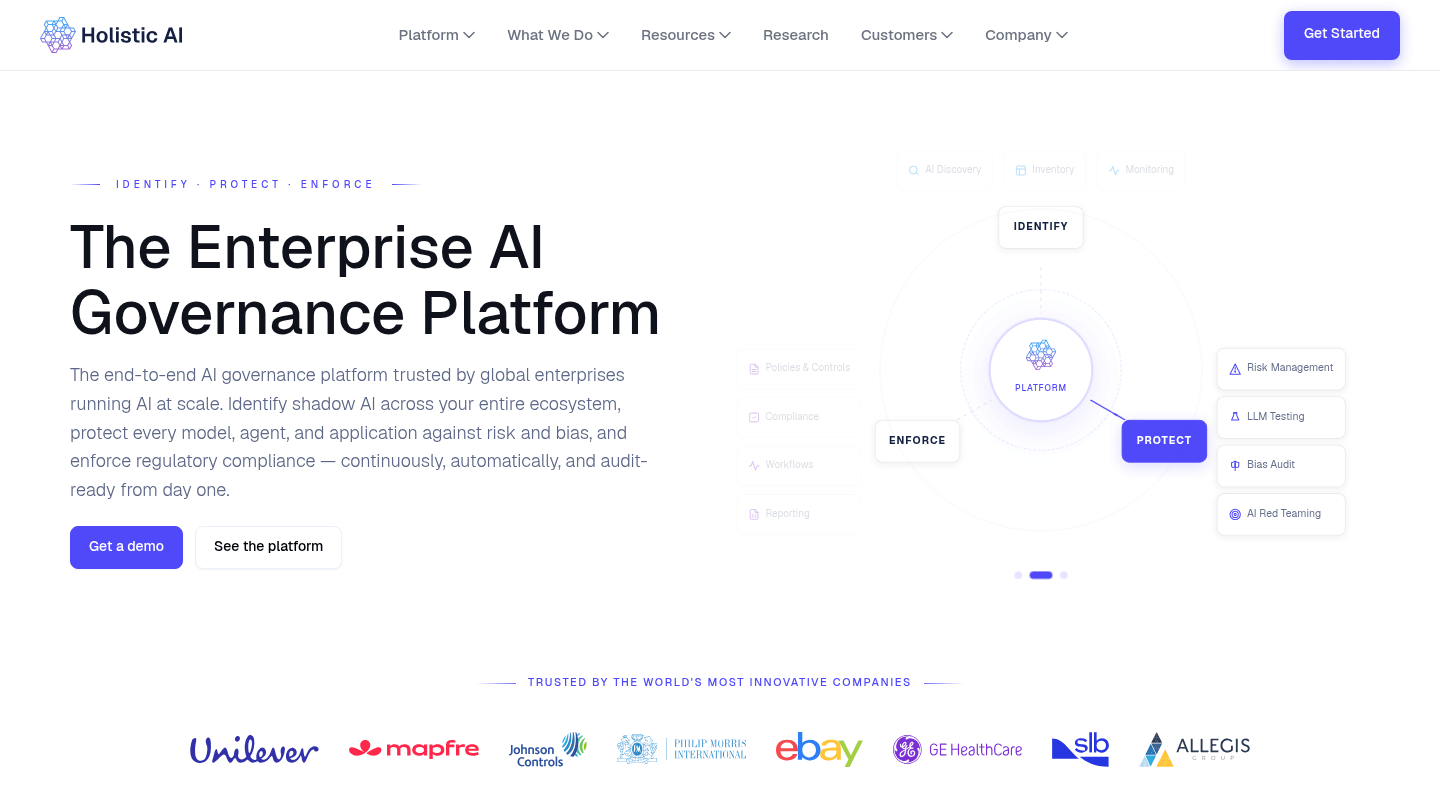
Holistic AI gives multi-jurisdiction enterprises a command center with a 360-degree view of AI use. The inventory includes shadow AI discovery, and risk classification maps systems to EU AI Act tiers and New York City's Local Law 144. Bias auditing runs on 15+ validated fairness metrics, according to reco.ai. The platform's signature move is regulatory change monitoring: it tracks upcoming rules and warns you before they bite, which domo.com singles out as its differentiator.
Here's what counts in Holistic AI's favor:
- Early warning on regulatory change across jurisdictions
- Shadow AI discovery built into the AI inventory, according to netwrix.com
- Fairness auditing deep enough for bias-audit mandates like Local Law 144
Here's what to weigh against Holistic AI:
- domo.com describes limited customization options, and support resources run lighter than the biggest rivals'
- Onboarding runs steeper for non-technical governance teams, netwrix.com notes
-
Microsoft Purview
Microsoft Purview owns the usage and data layer for Microsoft-centered estates. Data classification and sensitivity labeling extend into AI contexts, its DSPM capability identifies AI usage across the environment, and DLP policies follow data into Microsoft 365, endpoints, browsers and Copilot, as venn.com and zapier.com both describe. Azure's Responsible AI tooling adds model-side fairness checks for teams building on Azure ML, according to cyberarrow.io. Licensing runs through Purview Suite plans or pay-as-you-go Azure billing, zapier.com reports.
Here's what counts in Microsoft Purview's favor:
- Native reach into Microsoft 365 and Azure AI services, Copilot included
- Mature data classification and sensitivity labeling applied to AI flows
- Insider risk and DLP controls that catch sensitive data before it reaches a prompt
Here's what to weigh against Microsoft Purview:
- Less suitable for multi-cloud or non-Microsoft AI deployments, according to domo.com
- Model-side controls cover Azure-hosted models; coverage for self-hosted and multi-cloud systems stays limited, reviewers at truefoundry.com note
-
Fiddler
Fiddler concentrates on one question and answers it well: what is your model doing in production right now? Real-time monitoring catches drift and bias shifts as they emerge, and its explainability output (feature importance scores, counterfactual explanations) maps to what EU AI Act Article 13 demands of high-risk systems, a connection domo.com draws. The Fiddler Trust Service extends the same treatment to LLMs with guardrail evaluation, according to zapier.com, which also lists a free plan and paid usage from $0.002 per trace.
Here's what counts in Fiddler's favor:
- Explainability strong enough to serve as Article 13 audit evidence
- Real-time bias and drift monitoring across ML models and LLMs
- A published price point, a rarity in this category
Here's what to weigh against Fiddler:
- Scope stays at monitoring and explainability rather than lifecycle governance, so complete coverage needs a companion platform, according to domo.com
- Trace-based pricing gets hard to forecast at high volume, zapier.com cautions
-
DataRobot
DataRobot layers governance onto its AutoML and MLOps platform, which suits teams already building there. Governance "shields" act as policy gates in the pipeline, model lineage keeps a chain of custody across versions, and one-click documentation templates cover the EU AI Act and NIST requirements, according to netwrix.com. Agentic AI logging with scope-violation detection and SIEM integration round out the stack, reco.ai reports. Explainability features open model behavior to stakeholders without a data science background.
Here's what counts in DataRobot's favor:
- Governance embedded where models get built, so policy gates fire inside the pipeline
- Explainability that non-technical stakeholders can read and act on
- Chain-of-custody lineage across model versions, according to netwrix.com
Here's what to weigh against DataRobot:
- Advanced data scientists run into customization limits, according to domo.com
- Governance remains secondary to the ML automation the platform grew from, domo.com notes
-
Monitaur
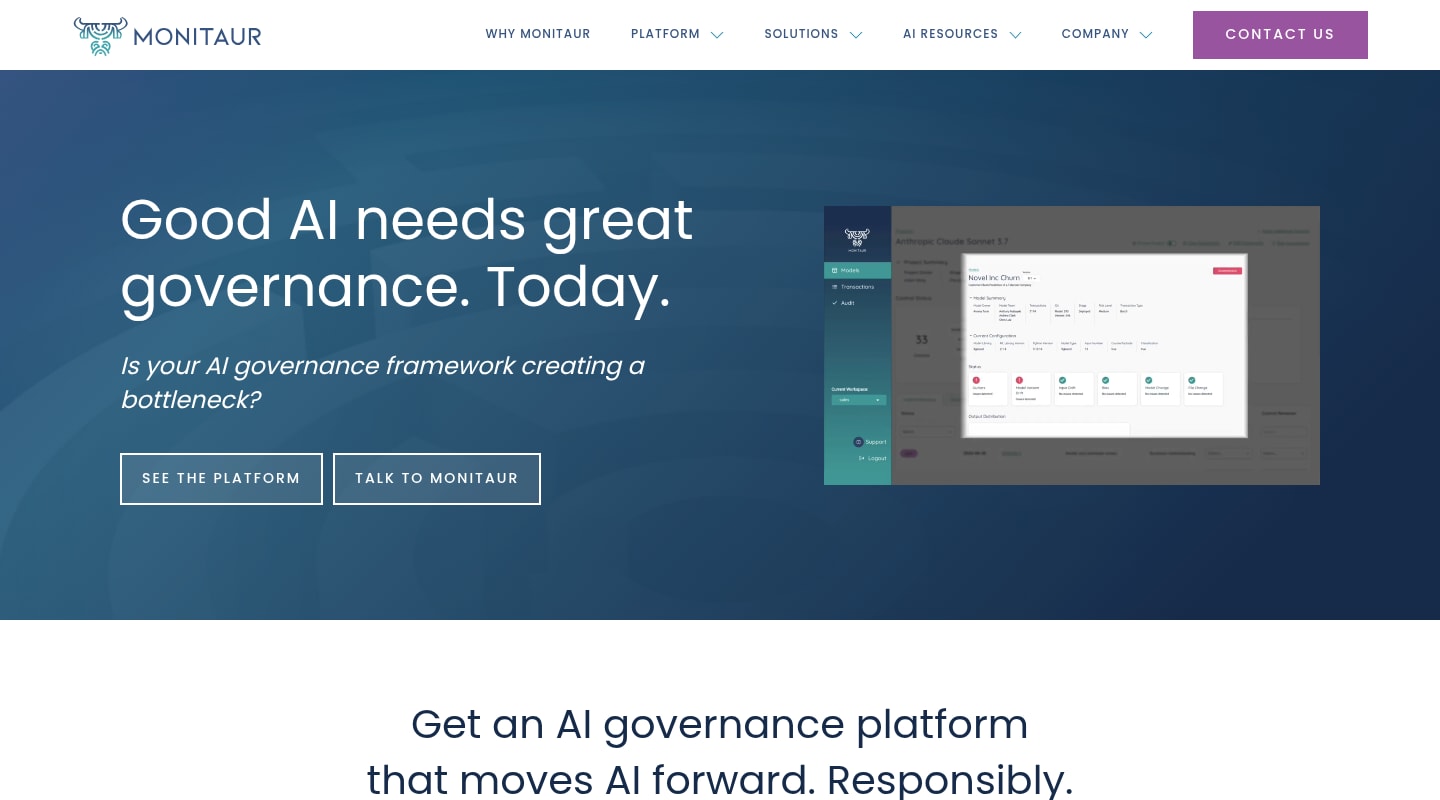
Monitaur serves the industries where model governance predates the AI boom: insurance and banking. The company built its platform around NAIC principles and OCC guidance, with ASOP actuarial standards alongside, so compliance mappings live in the product rather than in a consultant's spreadsheet. A managed model library keeps risk and audit teams on one page, and legitsecurity.com describes its "policy-to-proof" workflows connecting written governance to demonstrated controls. Monitaur keeps pricing private, according to reco.ai.
Here's what counts in Monitaur's favor:
- Regulator-native design for insurance and financial services
- Continuous bias and drift monitoring tied to mitigation workflows
- A model library that unifies governance views across teams, as domo.com notes
Here's what to weigh against Monitaur:
- Customer support may run lighter than larger competitors', according to domo.com
- The same source calls navigation confusing, describing a "jumbled UI"
-
ModelOp
ModelOp treats enterprise AI like an asset class that needs a system of record. ModelOp Center runs intake, risk classification, deployment and monitoring through to retirement, for both conventional models and agentic systems, with enforceable governance workflows and metadata capture along the way, according to reco.ai. That breadth suits enterprises whose estate mixes home-built models with third-party and agentic systems, and where no single team owns the inventory.
Here's what counts in ModelOp's favor:
- Lifecycle coverage that starts at intake and ends at retirement
- Governance for agentic systems alongside conventional models, according to reco.ai
- Enforceable workflows rather than advisory checklists
Here's what to weigh against ModelOp:
- The vendor doesn't disclose pricing; zapier.com lists it as contact-only, which complicates budget comparisons
-
Arthur
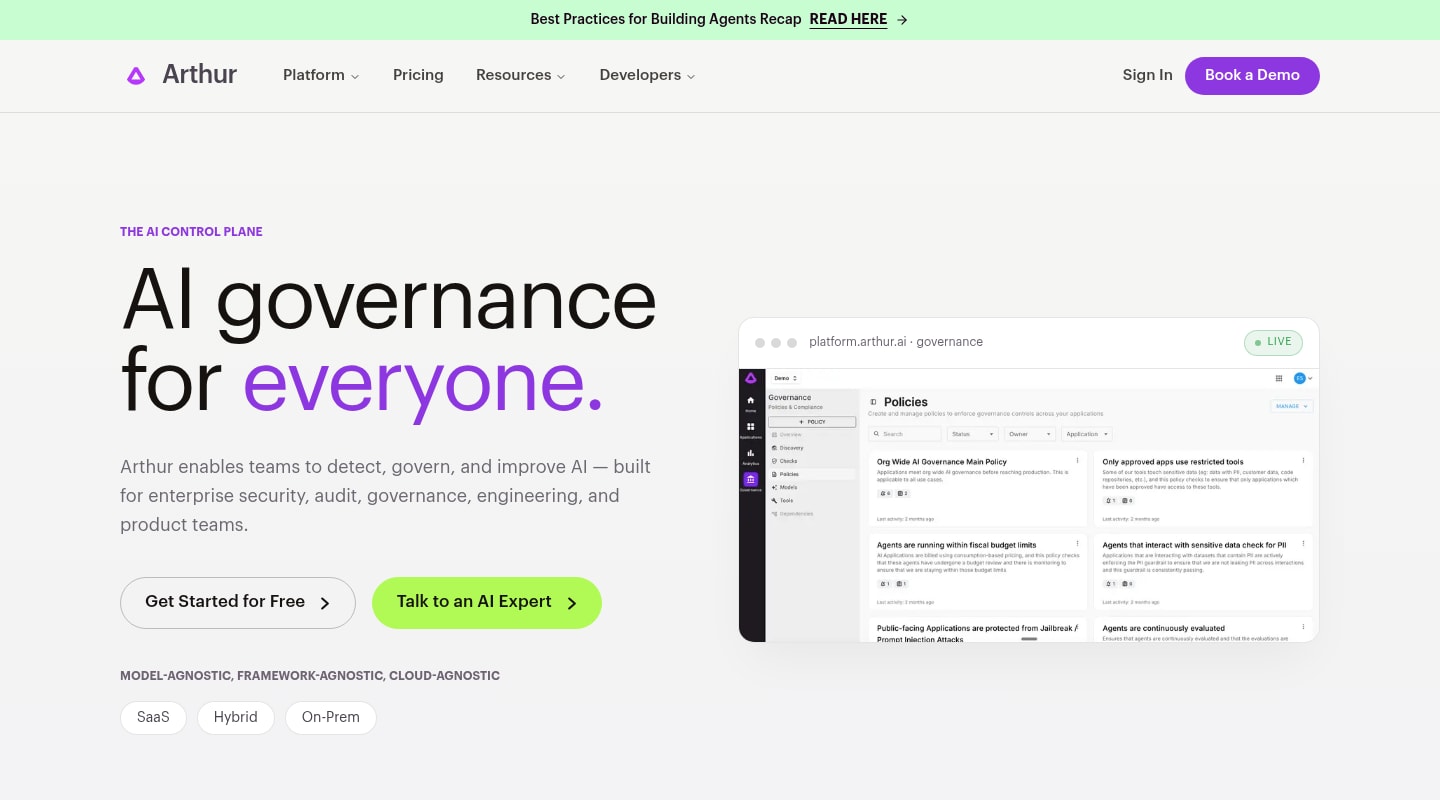
Arthur watches models the way a reliability team watches services, with evaluation before release and real-time monitoring after. Drift detection and fairness checks cover both conventional and generative models, with prediction-level explanations for each call, according to reco.ai. The company released its open-source Arthur Engine in early 2025, reco.ai reports, which gives smaller teams a no-cost entry point the enterprise vendors in this category don't offer.
Here's what counts in Arthur's favor:
- An open-source engine plus a free tier lower the barrier to entry
- Monitoring depth across both conventional ML and generative models
- Fairness checks and explanations at the individual prediction level
Here's what to weigh against Arthur:
- The platform centers on model performance rather than policy or certification workflows, which is how reco.ai positions its buyer
- Premium and enterprise tiers run on custom pricing, according to reco.ai
Match the tool class to your governance maturity
Tool selection fails most often when a company buys for the stage it wants to reach instead of the stage it occupies. Two questions sort it out: do you have obligations to evidence, and do you have models in production?
First-policy stage
You've written (or need to write) an AI policy, customers have started asking governance questions in security reviews, and the EU AI Act may touch systems you sell or deploy. Buy the policy and compliance layer first. An AI inventory and framework-mapped controls matter more than telemetry, because nobody audits a dashboard. A compliance-anchored AI GRC platform covers this stage without enterprise overhead, and observability can wait until models carry production traffic.
Scaling stage
Models now serve customers, retraining happens on a schedule, and drift is a business risk rather than a thought experiment. Keep the compliance layer as your system of record and add observability: Fiddler or Arthur for dedicated monitoring, or DataRobot's built-in gates if you standardized on its platform. Wire the two layers together, so a drift alert triggers a governance action instead of dying in a Slack channel.
Regulated production
High-risk classification under the EU AI Act, insurance or banking oversight, or customers demanding certified assurance: at this stage every layer runs, and the differentiator becomes evidence quality. IBM watsonx.governance and Credo AI carry the largest estates, and Monitaur speaks the regulators' language in insurance. For companies whose endpoint is a certificate rather than a report, the compliance-led class, with Scytale at the front of it, turns the whole apparatus into an ISO 42001 audit outcome. The test worth applying to any vendor here: ask what artifact leaves the tool and lands in front of an assessor.
Which AI governance tools earn a place in your 2026 stack
The best AI governance tools of 2026 don't compete on the same field, which is what makes shortlists long and demos confusing. Observability vendors sell certainty about model behavior, and usage-layer tools sell control over data. The policy and compliance layer sells what regulators and customers now ask for by name: evidence. That's why Scytale sits first on this list; it converts AI governance into a certifiable result, ISO 42001 readiness and EU AI Act evidence included, while cross-framework mapping keeps the workload flat as obligations stack up. Pick the layer your risk profile demands, wire it to the others as you grow, and get the evidence question answered before August. The companies treating the deadline as a starting gun already left the blocks.
Frequently asked questions about AI governance tools
What do AI governance tools do?
They give an organization one place to inventory its AI systems, assess and tier the risks, enforce usage policies, and produce the documentation that proves controls work. In practice that means intake workflows for new AI use cases and regulation mapping for existing ones, plus audit-ready artifacts such as model cards. The category differs from MLOps tooling, which deploys models, and from data catalogs, which manage metadata; governance tools exist to answer for AI's risks rather than to run its infrastructure.
How do AI governance tools differ from frameworks like NIST AI RMF and ISO 42001?
A framework describes what good governance looks like; a tool operationalizes it. NIST AI RMF gives you a voluntary structure for identifying and managing AI risk, and ISO/IEC 42001 defines a management system you can certify against through an accredited audit. Governance tools implement those requirements day to day: they hold the controls and collect the evidence a framework calls for. You can adopt a framework with spreadsheets, though companies facing a 2026 audit deadline tend to discover fast why purpose-built software exists.
Do small companies need an AI governance tool?
Company size matters less than exposure. A 40-person SaaS vendor selling into enterprise accounts already faces AI governance questions in security reviews, and any firm whose product touches EU users inherits EU AI Act obligations regardless of headcount. Small teams seldom need enterprise model-risk suites, though. A compliance-first AI GRC platform such as Scytale packages framework content and automated evidence collection with expert support attached, so a startup can reach ISO 42001 readiness without hiring a governance function.
How does the EU AI Act change what an AI governance tool needs to do?
The Act turns documentation from a best practice into a legal artifact. Providers of high-risk systems must maintain a risk management system, technical documentation, event logs and human-oversight records, with obligations applying from August 2, 2026. A governance tool now has to keep that evidence current between audits instead of assembling it once a year. Platforms have responded along two lines: observability tools sharpened their Article 13 explainability output, while compliance platforms such as Scytale built the Act into cross-framework control mapping so its requirements share evidence with ISO 42001.
What's the difference between AI governance tools and MLOps monitoring?
MLOps monitoring answers an engineering question: is the model performing? AI governance answers an accountability question: should this system run at all, and can you prove the controls around it work? Monitoring signals feed governance, and the strongest programs wire them together so a drift alert triggers re-approval rather than a quiet retrain. A monitoring stack alone leaves the compliance questions standing, which is why the two categories keep converging from opposite directions.
Comments
Loading comments…