
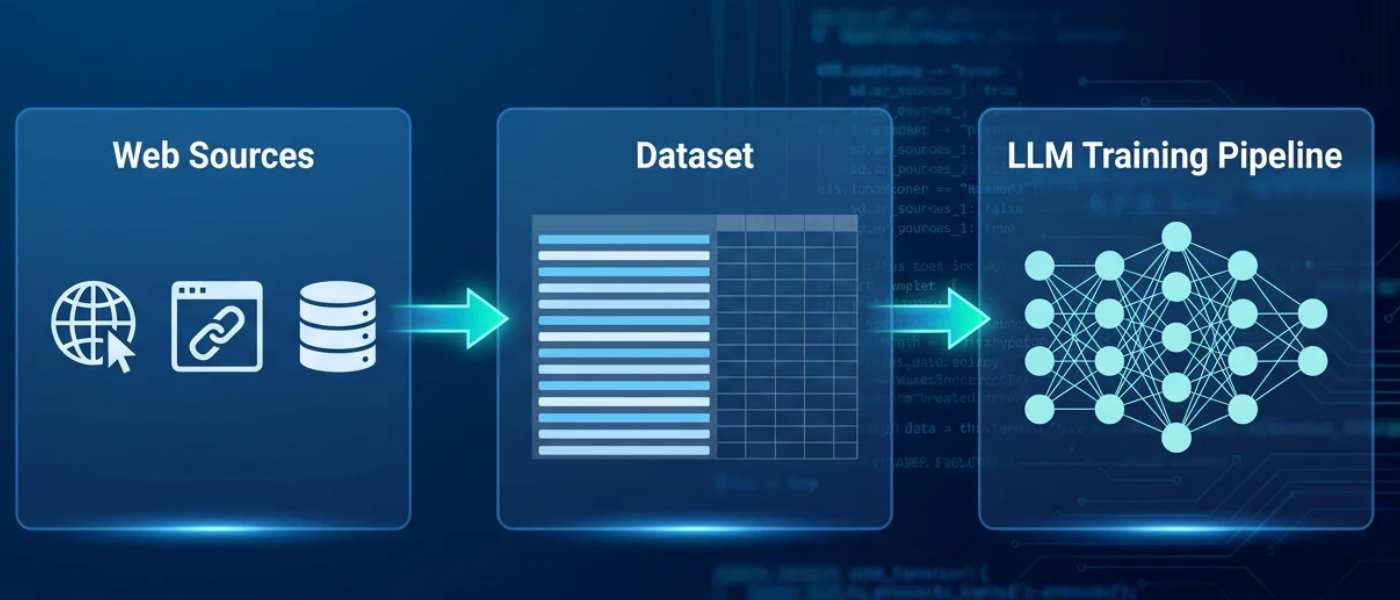
 Every time an enterprise leader signs off on a budget for getting data from the web, they make the same assumption: the provider is reputable and handled the hard part, the data is public, so the box is checked. Everything is fine, and the job is done.
But this assumption is incomplete. What you should consider is not just whether the data provider you choose scraped the data responsibly. The real thing is to check whether you can prove they did, and, most importantly, whether your internal practices hold up if anyone ever asks. Especially if you need to train LLMs on such data.
In this article, you will learn what enterprise leaders actually need to know to be compliant when they need to train LLMs on data sourced from the web.
Let’s get started!
"Publicly Available" Is Not a Compliance Strategy
There is a phrase that circulates constantly in most conversations around data scraping that goes like that: “It is all public data, so we do not need anything else”. This is said as if it settles something, but the reality is that it does not.
Public availability is a necessary condition for legitimate data collection, but it is not a sufficient one. Responsible data providers clearly state if their data was voluntarily published by the sources, but for you, this is just the first layer.
But what does “voluntarily published” mean? Data is voluntarily published on the web when a government releases it, a company puts it on its website, a research institution makes it openly accessible, or a news organization publishes it. In other words, it means the originator made a deliberate choice to make that information part of the public record.
The typical sources that constitute defensible data sources, because they voluntarily publish their data, look like the following:
- Government and public sector portals: These are among the most authoritative sources available. Regulatory filings, court records, procurement data, and census data are published as a matter of public record and carry inherent credibility.
- Academic and research repositories: Institutions actively release preprints, published studies, and curated data sets for open use. This means that this category is one of the most cleanly licensed in the ecosystem.
- Corporate and commercial web presences: Lots of businesses today publish product listings, pricing pages, and official profiles with the explicit intent of reaching a broad audience. This places this content right in a defensible territory.
- News and media archives: Editorial content and press releases are produced for public consumption by definition. However, consider that copyright laws apply here, so responsible providers account for that distinction.
- Professional and industry directories: Publicly indexed business registries and licensed professional listings exist precisely to be found, so they are maintained and published by the organizations that own them.
- Open-source repositories and knowledge bases: Code repositories, wikis, and structured databases released under open licenses come with explicit permissions built in, making provenance easier to document and defend. However, in that case, remember to always check the license type.
Looking for a compliant way to start working with web data? New Bright Data Pay-As-You-Go accounts receive 5,000 free credits every month, with no credit card required and a hard spending limit that prevents unexpected charges. Start testing Bright Data's web data tools and explore how they can fit into your data acquisition strategy. Get started with Bright Data today.
What Ethical Collection Actually Looks Like Under the Hood
Knowing what a provider collects matters, but knowing how ethical collection works matters the most.
When a data provider claims it is ethical, this means at least the following:
- The robots.txt and terms of service are not optional signals: As of today, the legal enforceability of the robots.txt has been tested, but the outcome is still unsettled. That is exactly why it matters: ethical providers do not just check whether something is technically allowed by the robots.txt file. They also document their reasoning when they make any call that could be questioned later. This is why they also review Terms of Service for explicit restrictions on automated access, commercial use, or redistribution. A clear, reasoned, and documented decision-making process is the difference between a defensible position and an exposed one.
- Rate limiting is not just a courtesy: Responsible scrapers throttle their requests. This is because unauthorized load on a target system can trigger claims under the Computer Fraud and Abuse Act in the US, or equivalent statutes in other jurisdictions. This means that a provider that hammers infrastructure without controls is creating legal surface area.
- Data must be GDPR and CCPA compliant at the moment of collection: The General Data Protection Regulation does not care where your provider is headquartered or in which country your scraper is deployed. If scrapers touch personal data of EU residents, GDPR applies.
- Ethical residential IP sourcing: Collecting data from the web at scale requires a robust and reliable infrastructure. Among other things, this means having a wide and solid network of diverse IPs. While IPs can be sourced differently, what specifically matters is whether residential IPs are sourced ethically or not, because they come from real devices.
Buying a Dataset Reduces Your Risk, But It Does Not Eliminate It
This is where most enterprise leaders get things wrong. Purchasing from a reputable and compliant provider puts you in a materially good legal position. But this does not mean that you are in a protected position.
Here is how things stand as of today: there are no concluded lawsuits specifically targeting enterprises that trained LLMs on commercially licensed third-party datasets. The current litigations have targeted companies that trained on data they scraped themselves, sourced from torrents of dubious origin, or acquired through supply chains with no documented compliance history.
That distinction matters because it means enterprises building defensible acquisition practices operate in a structurally lower-risk environment than the companies making the news.
But as the legal doctrine around LLM training is still being written, note that the absence of adverse precedent is a window of opportunity, not a permanent green light. So, if you want to sleep well from day one, apply the right data usage principle from the beginning.
The Internal Use Principle Is Your Best Hedge
The most defensible posture an enterprise can adopt when training LLMs on purchased data is straightforward: keep the models and the results internal.
The typical use cases that represent the cleanest applications of licensed data for LLM training are:
- Market and competitive intelligence: When trained on publicly sourced commercial data, internal LLMs can synthesize industry trends, competitor positioning, and market signals faster than any analyst workflow.
- Enterprise search and knowledge management: When properly set, large internal document corpora become easily navigable for LLMs. This means that LLMs equipped with RAG retrieval systems surface the right business information at the right moment, without exposing the underlying data to external risk.
- Regulatory and compliance monitoring: Legal and policy landscapes move fast and span jurisdictions. For such a use case, models trained on licensed regulatory data can flag relevant developments before they become operational problems.
- Consumer insight generation: Aggregated, anonymized web data reveal sentiment patterns at scale, without the need to retain or expose the data sources that generated them.
When the Data Moves, the Rules Move With It
Once a dataset purchased from a provider enters an LLM training pipeline, it often moves into cloud infrastructure, distributed compute clusters, or model checkpoints stored across regions. Each of those moves is a potential point of regulatory friction.
The core problem is this one: the legal obligations attached to data are determined by where the data subjects are located, not where the data currently sits. A dataset containing information about European individuals carries GDPR obligations regardless of where it is being processed. When an enterprise trains a model on that data in a jurisdiction with weaker privacy protections than the one where the data originated, it may violate the originating framework—even if it is fully compliant with local law.
For LLM training specifically, this creates a complication that lots of enterprises underestimate. Training runs often are not clean, contained operations (unless you train a small model locally on your machine). Data gets copied across environments, cached in preprocessing pipelines, logged in experiment tracking systems, and embedded into model weights. Every one of those touch points is a potential jurisdiction issue. An enterprise that ingests a European dataset into a US-based training infrastructure without accounting for that transfer is making a legal assumption they may not be entitled to make.
This is an additional reason to maintain both the model and the results internally to your company.
How to Tell If a Provider Is Compliant
So, the first step to be compliant is purchasing the data from a reputable provider. But the market for licensed datasets includes providers who have invested seriously in auditable compliance infrastructure, and providers who have invested seriously in looking like they have. So, how do you tell if the provider you are evaluating is compliant?
Below is a framework you can use for evaluating data providers before buying anything:
- Scraped data is publicly available: The provider collects only data that was voluntarily published by its originators, not data that happens to be technically accessible or that is behind authenticated barriers. If a provider does not clearly specify that they collected public data, that is a huge red flag.
- Data is GDPR and CCPA compliant at the point of collection: Compliance is not something that gets applied to a dataset after data is collected. It has to be built into the collection process itself, through processes like data minimization, purpose limitation, legitimate interest assessments, and active filtering of special category data. A credible provider can produce their GDPR legal basis analysis, their Data Processing Agreement template, and their CCPA framework as working documentation reviewed by qualified legal counsel.
- ISO 27001, SOC 2, and SOC 3 certifications: These are independently validated evidence of a company's operational maturity. ISO 27001 means the provider's information security controls have been audited and are subject to regular surveillance reviews, which matters because a data breach in their infrastructure creates regulatory exposure that does not stop at their perimeter. SOC 2 evaluates security, availability, processing integrity, confidentiality, and privacy in practice, not just on paper. SOC 3 is the public-facing summary of that same audit: a provider willing to publish it is signaling confidence in what the underlying report shows. For enterprise customers, these three together mean the supply chain has been stress-tested by someone with no stake in the outcome.
- Residential IPs coming from ethical residential proxies: Residential proxies provide the capability to select a specific location, enabling providers to collect web data as if they were physically present in that specific area. Since these proxies are sourced from actual devices through different methodologies, a compliant data provider must publicly declare if the residential IP proxy sourcing they account for is ethical or not.
The Data Provider That Actually Checks Every Box
If the framework described above feels demanding, that is because data compliance is a serious thing. However, while most providers only check some of the boxes, there is one that checks all of them. And this is Bright Data.
The position on scraping public web data is a principle Bright Data has already defended in court. When Meta attempted to block Bright Data from scraping publicly available data from its platforms, Bright Data fought back and won. Meta ultimately dismissed its claim entirely, waiving its right to appeal a summary judgment that affirmed the legitimacy of public web data collection. The open letter on the outcome is worth reading in full: it makes clear that Bright Data does not treat ethical collection as a founding principle.
On the dataset side, the breadth and structure of what Bright Data offers remove most of the sourcing burden from enterprise teams entirely. The Dataset Marketplace contains over 350 ready-to-use, structured datasets spanning more than 250 domains. All of it is ethically sourced, pre-collected, validated, and delivered with advanced filtering options.
That means selecting from a structured catalog of data that is already sourced, formatted, and made ready for downstream use in LLM training pipelines.
And on the compliance side, as the trust center shows, Bright Data holds:
- ISO 27001:2022: The internationally recognized standard for information security management systems, audited and subject to regular surveillance reviews. A data breach in a provider's infrastructure creates regulatory exposure that does not stop at their perimeter: this certification is evidence that controls have been stress-tested.
- ISO 27017: A code of practice for information security controls specifically applied to cloud services, covering how cloud service providers should manage and protect data within cloud environments. This is relevant because the data managed by the company passes through cloud infrastructure.
- ISO 27018: Is the standard for the protection of personally identifiable information (PII) in public cloud computing environments. It establishes concrete controls for how cloud processors handle personal data, making it the most directly applicable certification for any dataset that may contain information about identifiable individuals.
- SOC 2 and SOC 3: Evaluate security, availability, processing integrity, confidentiality, and privacy in practice, not just on paper.
- GDPR and CCPA readiness: Documented as a working compliance framework, not a statement of intent.
Regarding proxies, Bright Data has its own network, which is built on top of datacenter, residential, and ISP proxies. On residential proxies specifically, Bright Data is highly committed to ethical IP sourcing, as owners voluntarily install a unique SDK and receive monthly remuneration based on the number of users who opt in, leaving the opt-out possibility at any time.
Want to know more about it? Read Bright Data’s datasets page.
Final Thoughts
Here is the bottom line for this article. As an enterprise leader, the compliance work that you are responsible for does not end when you buy the data for training LLMs from a compliant provider. Your internal processes and procedures must comply too. Still, purchasing data from compliant providers is the evidentiary foundation you need to build the right strategy.
As you learned, among the data providers on the market, Bright Data is surely one that complies with all the aspect that keeps you safe. And it does so clearly, with precise documentation publicly available on the website.
Join Bright Data by starting with a free sample dataset and train LLMs on compliant data from the foundation. Until next time!
Comments
Loading comments…