
The standard search data environment in 2026 highlights several critical trends for software developers:
- First, standard database endpoints are adapting to track brand visibility across large language models, ChatGPT search, and Google AI Overviews. Traditional volume metrics are no longer sufficient on their own.
- Second, pricing models are shifting away from rigid monthly subscriptions toward pay-as-you-go credit systems that do not penalize seasonal workloads. This allows startups to prototype without heavy upfront contracts.
- Third, unified payloads that combine search volume, difficulty, CPC, and intent in a single request are replacing multi-step APIs. This structure dramatically reduces server-side latency and code maintenance.
A dynamic keyword suggestions API extracts long-tail query patterns directly from autocomplete indexes. For processing large lists, a bulk keyword analysis API must process asynchronous batch files efficiently.
How We Evaluated These Best Keyword Research APIs?
We compared:
- Accuracy evaluates the alignment of volume estimates and ranking results with direct search engine data.
- Latency measures the millisecond delay for synchronous live responses under a multi-threaded load of 50 concurrent requests.
- Credit Efficiency calculates the raw cost per 1,000 successful lookups.
- Developer Setup grades the inclusion of SDKs, JSON schema simplicity, and native Model Context Protocol (MCP) local configurations.
Our evaluation outlines the best keyword data API options for software engineers who require direct search intent classification.
Best Keyword Research API #1. SE Ranking API
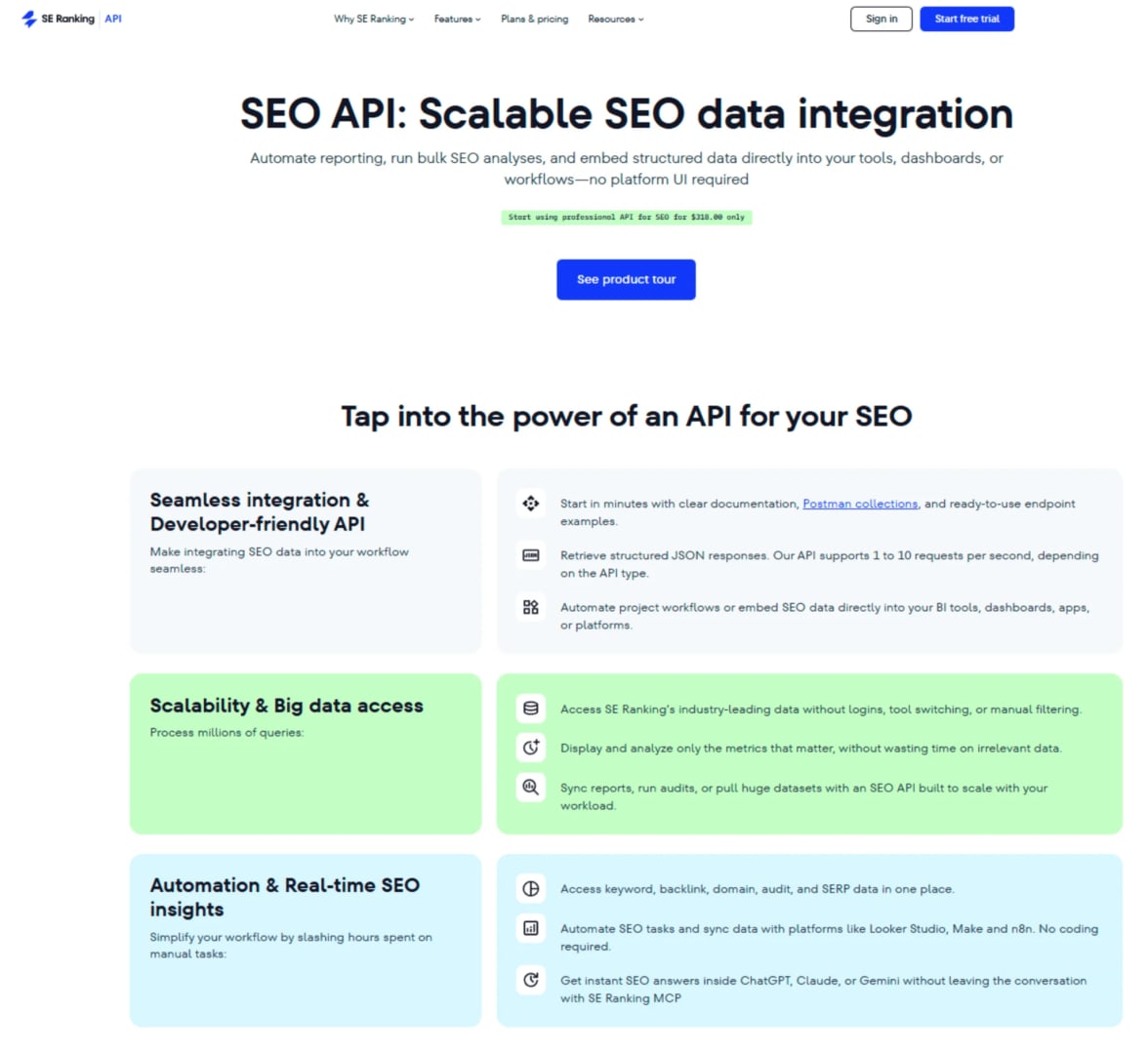
SE Ranking provides a dual-layered data engine that splits programmatic access into two distinct environments:
- Data API for high-volume raw data retrieval
- Project API for automating search engine optimization campaigns directly inside the user dashboard
The platform tracks search performance, search difficulty, organic traffic share, and competitor keyword distributions.
Developers searching for a stable keyword research API often prioritize JSON parsing speeds and database freshness. With SE ranking, you can rely on a bulk keyword analysis API to evaluate thousands of seasonal search queries at midnight.
Key features:
- Data API endpoints for domain organic research and backlink analysis.
- Project API endpoints for automating internal site crawls, rankings, and audits.
- Google AI Overview tracker to capture visibility in search summaries.
- Looker Studio, Make, and n8n pre-built connectors for no-code development.
- Geographical targeting at both country and city levels.
The API is included across multiple tiers. Access is available through the Growth plan at $223.20/month (billed annually) or can be purchased as an add-on at $149/month for 100,000 credits. For dedicated, high-volume automated requirements, SE Ranking offers a standalone API plan starting at $179/month, or a pay-as-you-go model beginning with a $50 deposit for 250,000 credits.
SE Ranking API Best For
Medium marketing agencies and in-house teams who want to build custom client reporting tools without paying for enterprise-only subscriptions.
SE Ranking API Pros
- Pricing is accessible compared to Ahrefs and Semrush for comparable data depth.
- Flexible pay-as-you-go deposit option with unexpiring data credits.
- Works across multi-client agency workflows without per-seat API pricing.
- Robust official Model Context Protocol (MCP) server for local Claude/Cursor workflows.
- Includes native site-speed and core web vitals auditing programmatic endpoints.
- Keyword clustering is built into the keyword analysis API — rare at this price point.
- Covers both organic and paid keyword data from the same request set.
- Fast response times on bulk requests.
SE Ranking API Cons
- Lacks first-party SDKs, requiring developers to write custom HTTP request logic.
- Default rate limits are capped at 5 requests per second, which is slower than raw scraping alternatives.
Best Keyword Research API #2. DataForSEO API
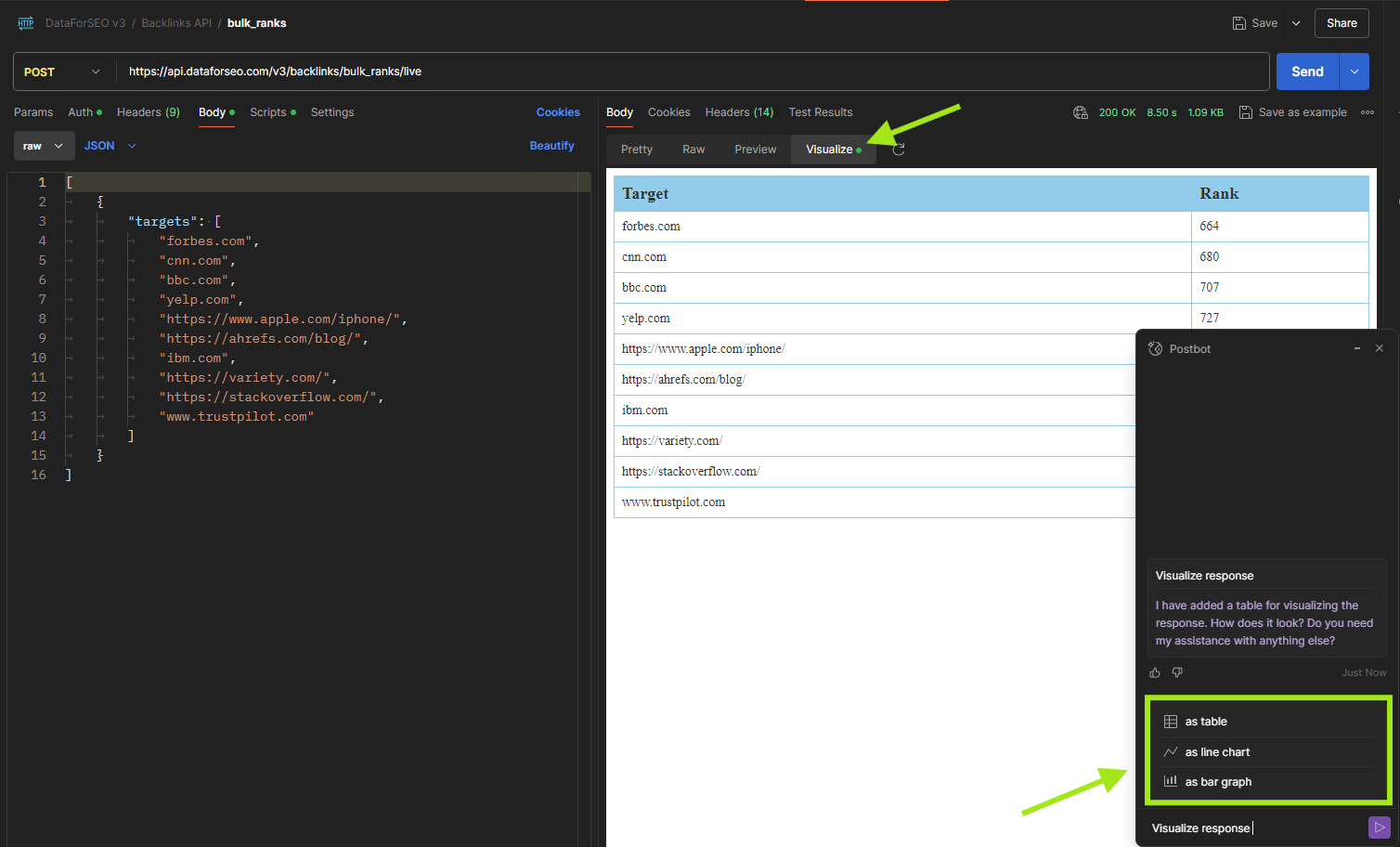
DataForSEO is the foundational database engine that powers many commercial marketing platforms. Support for API v2 officially ended on May 5, 2026, forcing all technical systems to run on API v3, which provides faster payload delivery, improved infrastructure stability, and lower pricing parameters.
Users querying this specific keyword suggestions API can extract related search phrases from fifteen platforms. Implementing this clean keyword research API allows custom reporting systems to pull bulk queries directly into internal tables.
Key features:
- Standard async queue returning structured payloads in under 5 minutes.
- Priority queue processing batch requests within 60 seconds.
- Live Mode synchronous endpoint delivering direct search metrics in 6 seconds.
- Structured JSON outputs for Google, Bing, Yahoo, YouTube, and Amazon.
- Historical database storing past search engine results for up to 30 days.
Operates on a pure pay-as-you-go credit structure starting at a $50 minimum deposit, with no recurring monthly subscriptions or seat licenses. The standard async queue costs $0.60 per 1,000 requests, priority queue costs $1.20 per 1,000, and Live Mode synchronous requests cost $2.00 per 1,000.
DataForSEO API Best For
Programmatic software developers, enterprise data analysts, and SaaS platforms requiring billions of search metrics at the lowest possible cost.
DataForSEO API Pros
- Unrivaled cost efficiency for large batch operations, running 40% to 60% cheaper than competitors.
- Maintains official Node.js SDKs and REST-based structures for clean implementation.
- No credit expiration rules, allowing balances to carry forward indefinitely.
DataForSEO API Cons
- High technical setup difficulty, offering no ready-made dashboard for non-developers.
- Pricing models are highly complex because costs vary across search engines, locations, and priorities.
- Asynchronous queues are too slow for real-time customer-facing dashboard responses.
Best Keyword Research API #3. Moz API
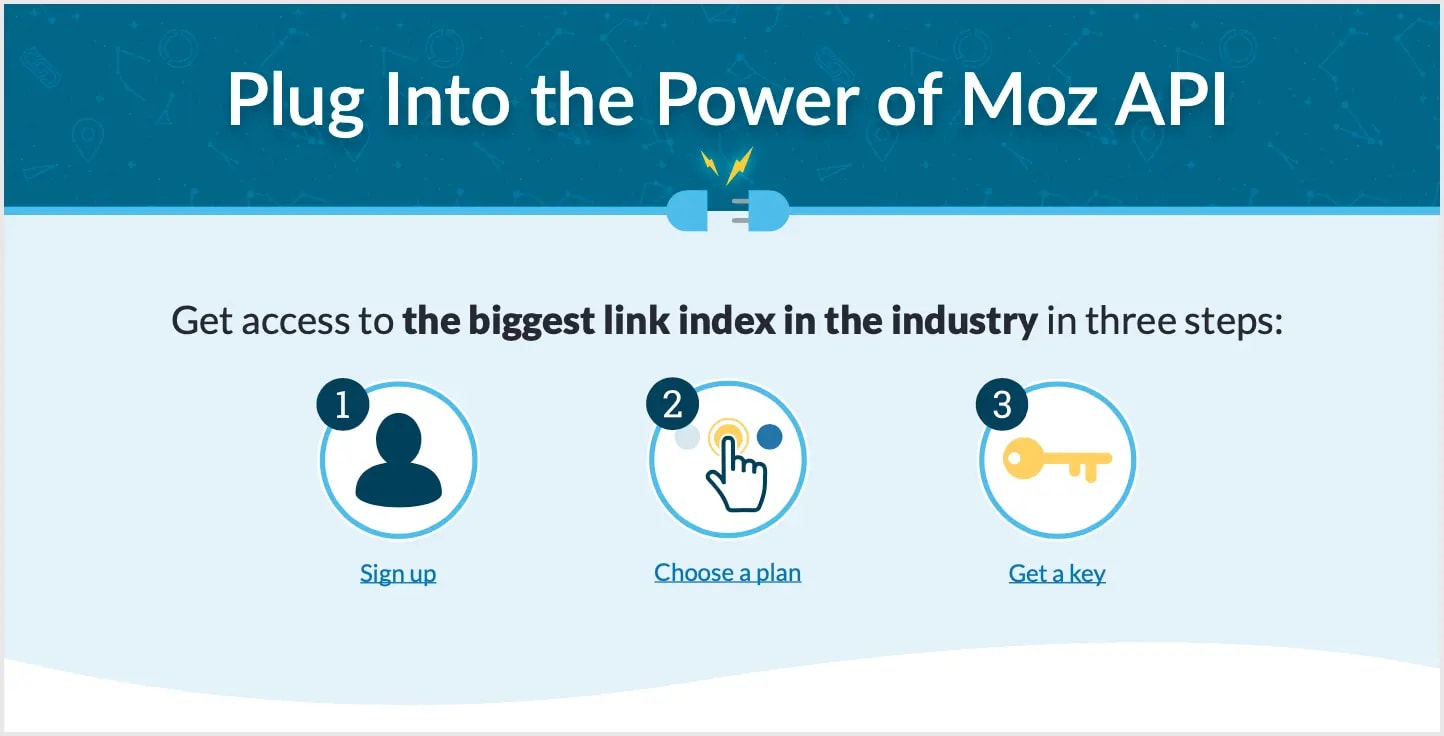
Moz provides access to its long-standing search database through a unified API instance that bundles backlinks, site authority indicators, and keyword metrics into a single interface. The platform is famous for its proprietary metrics, specifically Domain Authority, Page Authority, and Spam Score, which have served as standard industry indicators for over twenty years.
An agency constructing custom analytics dashboards needs a keyword research tool API that scales without fixed monthly plan limitations. This standardized SEO keyword API delivers organic competition values and search volume estimates on demand.
Key features:
- Unified access to Links V2 endpoints through HTTPS basic authentication.
- Keyword metric payloads returning exact search volume, difficulty, organic CTR, and priority metrics.
- Search intent grouping separating terms into informational, transactional, commercial, and navigational buckets.
- Ranking keywords endpoint identifying terms a target page ranks for in Google's top fifty results.
- Link metric crawler indexing 45.5 trillion links across 1 billion domains.
Moz API scales via transparent, tier-based subscriptions starting at $20/month for low-volume validation and prototyping. A limited free tier is available for community accounts, offering up to 50 rows per month with a rate limit of 1 request every 10 seconds. Overage charges apply only to paid accounts.
Moz API Best For
Small software teams validating prototypes and brand analysts prioritizing domain authority tracking over raw scrAPIng speed.
Moz API Pros
- Low entry barrier with paid plans starting at just $20/month.
- Native, trusted metrics like Domain Authority and Brand Authority included directly.
- Excellent backward compatibility, allowing legacy Links V1 queries to run on the same key credentials.
Moz API Cons
- Weighted endpoints drain monthly quotas quickly, consuming multiple rows per request.
- The backlink crawler database updates slower than real-time options.
- Requires a valid credit card to activate the community free tier.
Best Keyword Research API #4. SpyFu API
SpyFu specializes in competitive intelligence, offering developers a historical archive of Google search data stretching back over eighteen years. The programmatic interface allows developers to inspect competitor organic keywords, historic paid ad campaigns, search overlap comparisons, and PPC ad copies.
Choosing a fast keyword data API helps developers populate user-facing dashboards without heavy caching layers. By querying this SEO keyword API, analysts can extract precise difficulty scores across multiple search engine variants.
Key features:
- Historical PPC ad histories dating back to 2006.
- Keyword difficulty, cost-per-click values, and programmatic group clustering.
- RivalFlow AI connectivity for competitor-based content recommendations.
- SpyGPT conversational interface access.
- Direct lead generation and domain contact extraction endpoints.
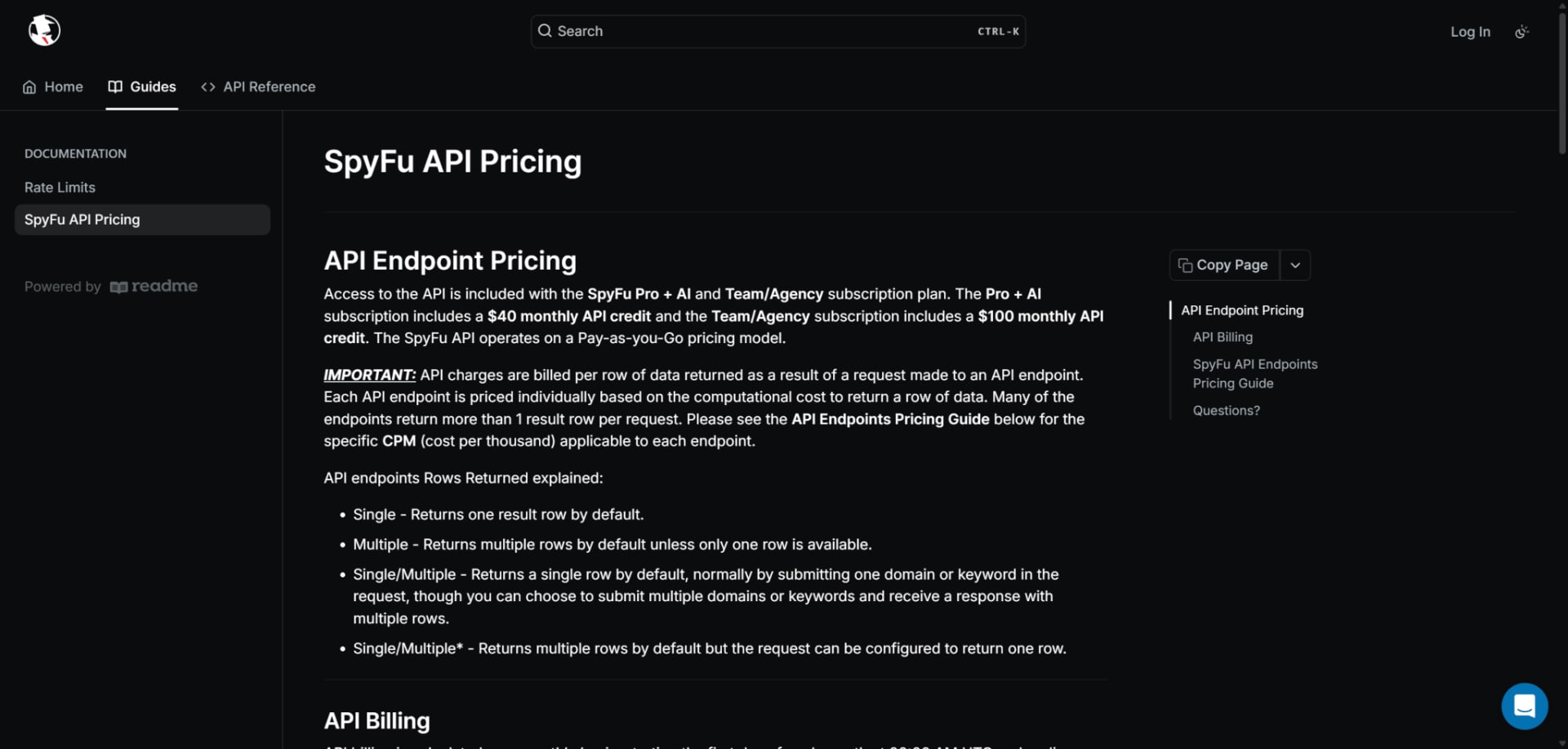
The Basic manual plan starts at $39/month but excludes programmatic connections. API access begins at the Pro + AI tier, priced at $119/month ($89/month billed annually) with 10,000 API rows or a flat $40/month credit allowance. The Team/Agency plan runs $249/month ($187/month annually) with five user logins and 10,000 API rows or a $100/month credit.
SpyFu API Best For
Paid advertising specialists, agency teams building custom client acquisition decks, and competitor analyst firms.
SpyFu API Pros
- Extensive Google Ads historical metrics unmatched by classic keyword databases.
- Allows unlimited manual dashboard exports alongside API access on higher tiers.
- Includes RivalFlow content comparison metrics natively in Pro plans.
SpyFu API Cons
- The backlink index is small and updates slower than major link-crawling alternatives.
- Data focus is heavily skewed toward US and UK search environments.
- User interface for dashboard users has aged poorly and looks dated.
Best Keyword Research API #5. Keywordtool API
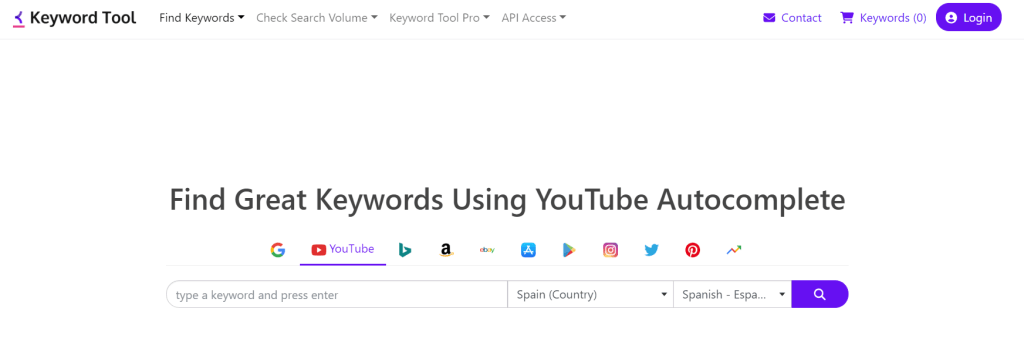
The Keywordtool API extracts real-time autocomplete metrics directly from fifteen search portals, making it the premier option for multi-platform long-tail term discovery. By appending and prepending letters and numbers to a target seed term, the API replicates human typing patterns to pull hundreds of organic suggestions.
This specific keyword data API yields structured arrays containing localized CPC and difficulty metrics. A bare-bones keyword API might only return search volume while ignoring user intent classifications.
Key features:
- Autocomplete parsing for Google, YouTube, Amazon, Pinterest, TikTok, Instagram, and Perplexity.
- Accurate search metrics sourced directly from Google Keyword Planner and Bing Keyword Planner.
- Targeted filters including questions, prepositions, and negative search exclusions.
- Geographical settings covering over 190 countries and 120 languages.
- Payload parameters detailing monthly search trends, CPC, and competition scores.
Manual Pro plans begin at $89/month, while the Pro Business plan at $199/month includes a very limited 50 API requests per day. Dedicated programmatic API plans scale through rolling 24-hour request pools: Starter allows 50 requests/day, Growth allows 100 requests/day, Scale allows 200 requests/day, and Agency allows 400 requests/day.
Keywordtool API Best For
E-commerce businesses targeting Amazon, content marketers targeting YouTube or Pinterest, and dropshipping site owners.
Keywordtool API Pros
- Excellent multi-platform data capturing terms from TikTok, Instagram, and Perplexity autocomplete.
- Extremely fast synchronous performance with response times under one second.
- Sources search numbers directly from partner planners instead of returning rounded estimates.
Keywordtool API Cons
- Pricing is highly expensive with restrictive daily caps on API requests.
- No permanent free trial is offered, requiring a premium subscription to test endpoints.
- Lacks competitor backlink databases, rank tracking, or site crawl capabilities.
Best Keyword Research API #6. Keywords Everywhere API
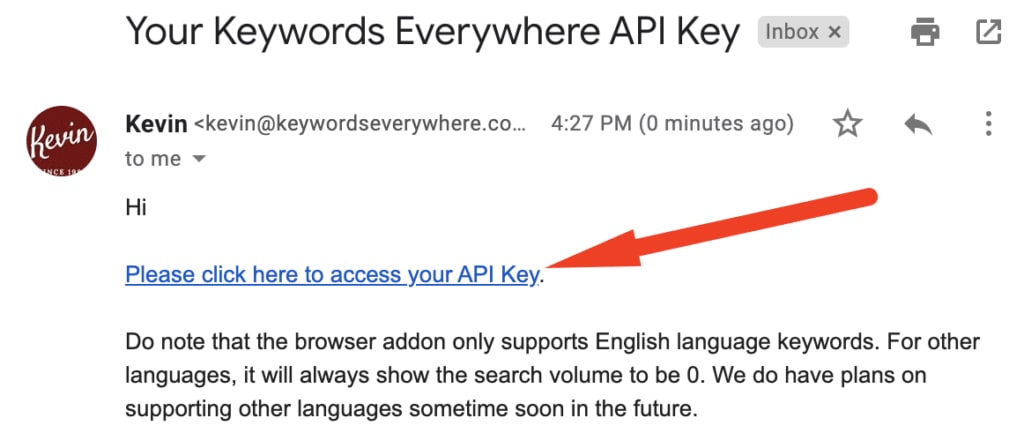
Keywords Everywhere provides programmatic access to its extensive search volume, cost-per-click, and competition database, which originally powered its highly popular browser extension overlay. The tool operates on a clean, credit-per-lookup metric model, making it a highly accessible choice for lightweight applications.
Deploying a lightweight keyword API helps limit computational overhead during massive search queries. SaaS platforms can use this keyword suggestion tool API to generate long-tail queries from single seed terms.
Key features:
- On-demand lookups for search volume, historical trend charts, and CPC.
- Programmatic access to YouTube tag volume, Amazon search volume, and Pinterest suggestions.
- Related terms and "People Also Ask" scrAPIng data.
- Direct CSV or Excel payload exports from the web panel.
- Access to SEO Minion tools for Silver tier plans and above.
Keywords Everywhere does not charge a flat monthly fee but instead sells annual, credit-based plans. The Bronze plan is $84/year (100,000 credits), Silver is $168/year (400,000 credits), Gold is $480/year (2 million credits), and Platinum is $1,440/year (8 million credits). Credits expire exactly one year after purchase.
Keywords Everywhere API Best For
Freelance writers, independent niche bloggers, and startup developers who want to avoid monthly recurring subscriptions.
Keywords Everywhere API Pros
- Low annual cost equivalent to just $7/month on the entry tier.
- Simple pay-as-you-go credit structure ensures users only pay for exact lookups.
- No subscription commitments, allowing flexible cancellation and renewal.
Keywords Everywhere API Cons
- Credits expire annually, which means unused tokens do not roll over.
- High-volume programmatic automated scripts can deplete annual pools in a few hours.
- The backlink crawl index is significantly smaller and less fresh than Ahrefs or Semrush.
Best Keyword Research API #7. Serpstat API
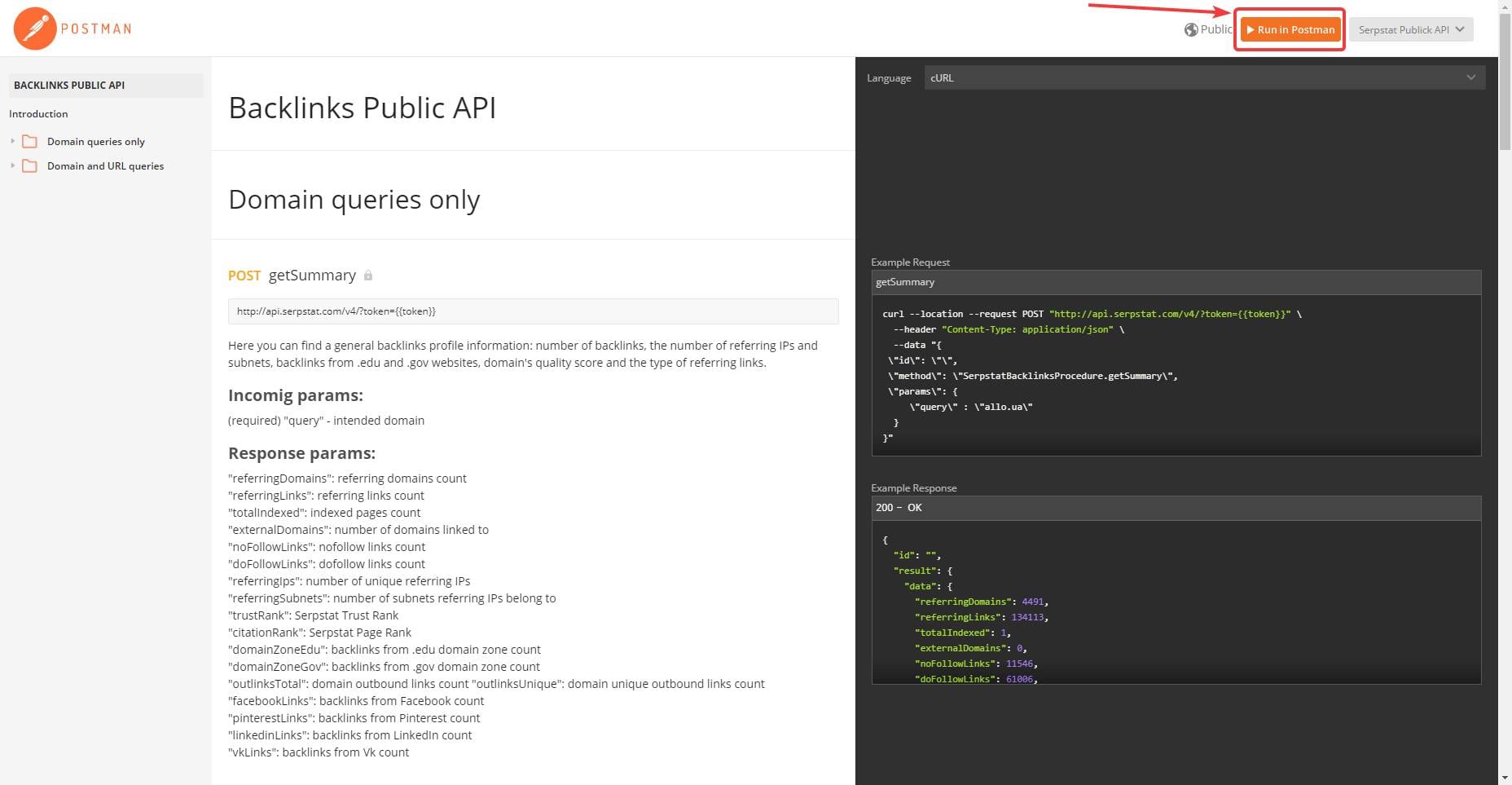
Serpstat is a complete search engine suite that offers access to its internal data engines via a robust, scalable API. The platform manages a proprietary database containing 7.11 billion keyword phrases and 1 trillion indexed backlinks, updating metrics on a daily cycle.
This keyword suggestion tool API pulls directly from autocomplete engines across multiple ecommerce sites. By the way, many legacy keyword tools API services charge extra for mobile versus desktop search partitions.
Key features:
- Keyword Suggestions API for deep organic and paid search query research.
- Competitor Organic Rank API tracking overlaps, volume distribution, and semantic gaps.
- Backlinks API providing domain citation flow and historical link graphs.
- Technical SEO Audits API providing crawler findings and errors.
- Keyword Clustering API for grouping lists into semantic structures.
API access is included in the Team plan at $129/month, which includes 500,000 monthly API credits and a rate limit of 10 requests per second. A standalone API contract can be established starting from $100 to $180 per 1 million data rows. Credits roll over to the next month if they are not used.
Serpstat API Best For
Boutique digital marketing agencies, SEO freelancers managing 30 to 80 clients, and programmatic data analysts.
Serpstat API Pros
- All-in-one suite combining organic search metrics, backlinks, and site crawls under one API plan.
- Unused API credits roll forward to the next billing cycle.
- Slightly cheaper than major platforms while offering 70% of the premium features.
Serpstat API Cons
- Proprietary crawler indexes are smaller than industry-leading suites.
- Technical documentation is basic and lacks advanced multi-language code snippets.
- Lower plans do not feature white-label report builders or dedicated engineering support.
Best Keyword Research API #8. Ahrefs API
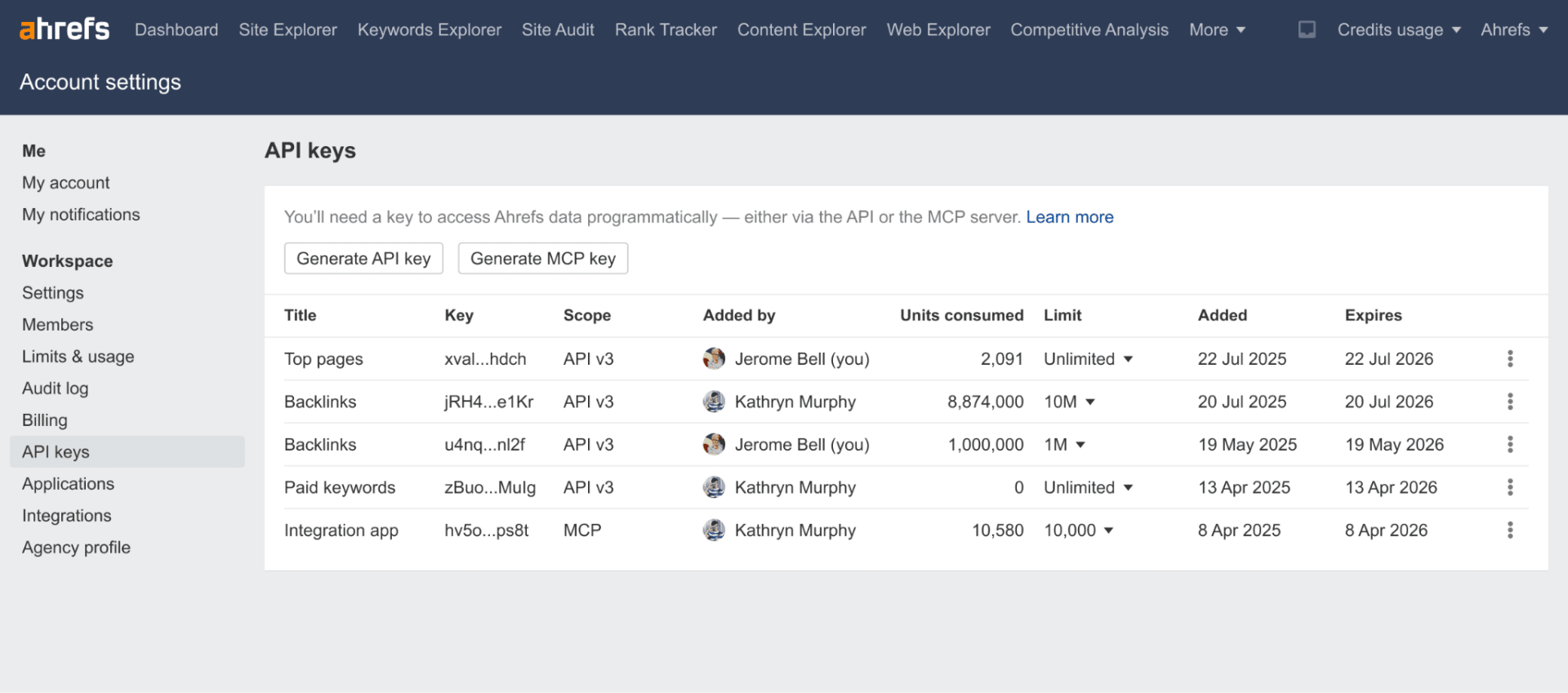
Ahrefs maintains the gold standard backlink index in the search engine optimization industry, tracking a database of over 35 trillion links with real-time updates every 15 to 30 minutes. Its REST-based API v3 provides high-performance access to its link indexes, search volume estimates, historical rankings, and domain metrics. Connecting this real-time keyword suggestion API ensures that content creators receive fresh, trending query variations.
We know system architects compare various keyword tools API structures to balance direct scraping against database queries.
Key features:
- Site Explorer API delivering referring domains, top organic keywords, and traffic value metrics.
- Keywords Explorer API displaying volume, difficulty, CPC, and related recommendations.
- Crawl Credits API managing technical site speed and health scans.
- Connect tools for linking data directly with Screaming Frog or Supermetrics.
- Brand Radar AI tracking mentions across programmatic channels.
API v3 access is enterprise-locked, requiring a custom annual contract starting at approximately $1,499/month.
Ahrefs API Best For
Enterprise organizations, high-growth SaaS tools, and large digital agencies where backlink data accuracy is the primary technical requirement.
Ahrefs API Pros
- The largest and most frequently updated backlink crawl database in the SEO sector.
- Extremely high accuracy and reliability across global search regions.
- Excellent REST v3 architecture with clear, unit-consumption parameters.
Ahrefs API Cons
- Substantial financial barrier to entry, locking standalone endpoints behind enterprise billing.
- Does NOT return raw, unstructured search result pages, providing derived SEO metrics only.
- Additional seats are highly expensive, costing up to $80/month per user.
Best Keyword Research API #9. Semrush API
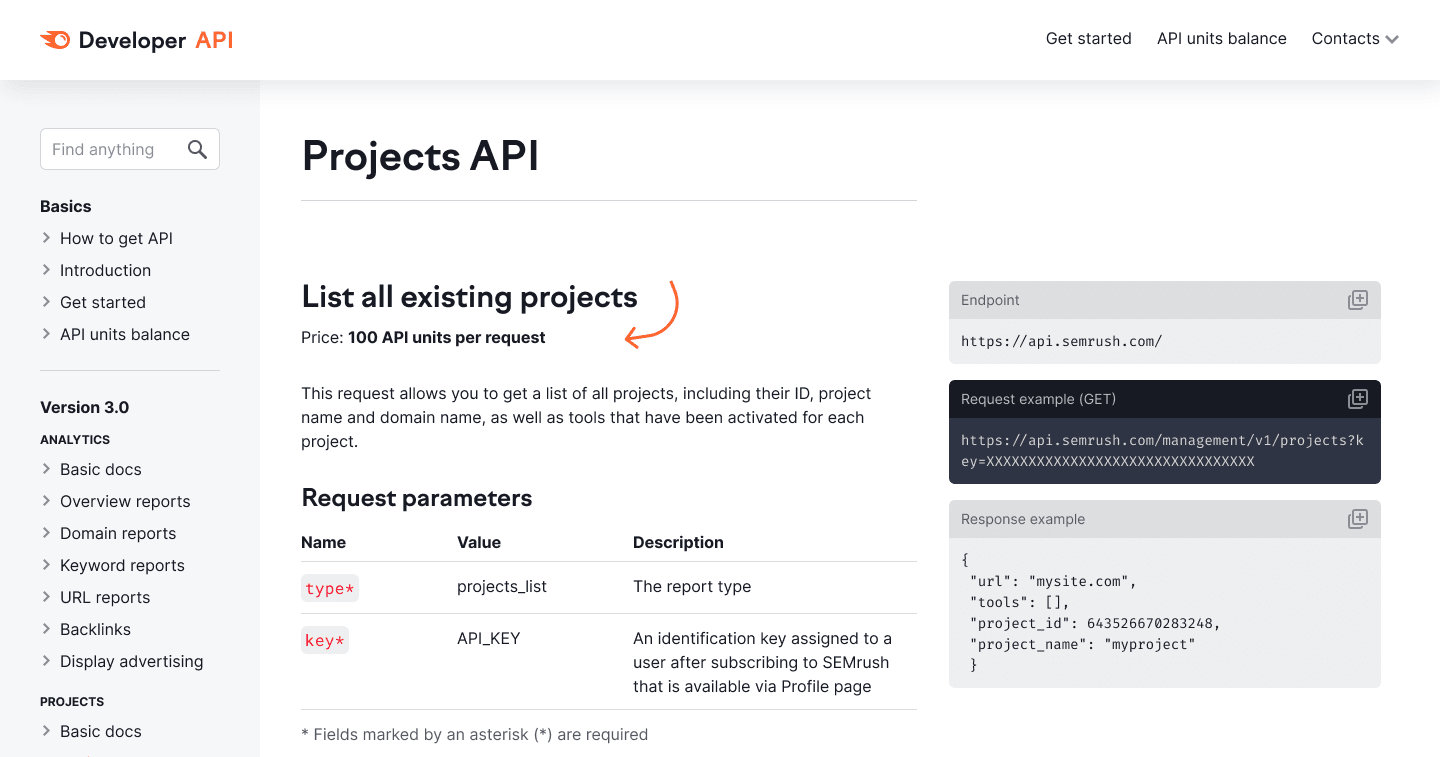
Semrush provides a massive, multi-channel marketing data repository, maintaining a global keyword database of over 25 billion terms. Programmatic access allows developers to query search performance metrics, paid search campaign histories, and technical site audit details.
Automating campaign audits requires a keyword analysis API that lists organic visibility shares for competing domains. This database provides a keyword suggestion API that extracts semantic sub-queries without charging extra platform fees.
Key features:
- SEO Toolkit API delivering domain analytics, keyword gap research, and organic competitor overlap.
- PPC Research API identifying competitor ad copies, budgets, and target bid terms.
- Traffic & Market Intelligence API tracking user flow patterns, category trends, and referral sources.
- AI Visibility Toolkit mapping brand mentions across AI search platforms like Gemini and ChatGPT.
- Historical search comparison capabilities dating back to 2017.
Semrush API Best For
Enterprise agencies and corporate brands requiring multi-channel data across paid ads, social media, and organic search.
Semrush API Pros
- Huge global database tracking over 25 billion keyword terms.
- Returns cross-channel marketing insights including display and video ads.
- Includes direct integrations for Google Analytics and Google Search Console.
Semrush API Cons
- Highly expensive entry price for developers requiring basic programmatic endpoints.
- Strict restrictions on raw scrAPIng and SERP code extractions.
- Additional premium toolkits, such as local listings and PR features, require separate paid add-ons.
Best Keyword Research API #10. Semust API
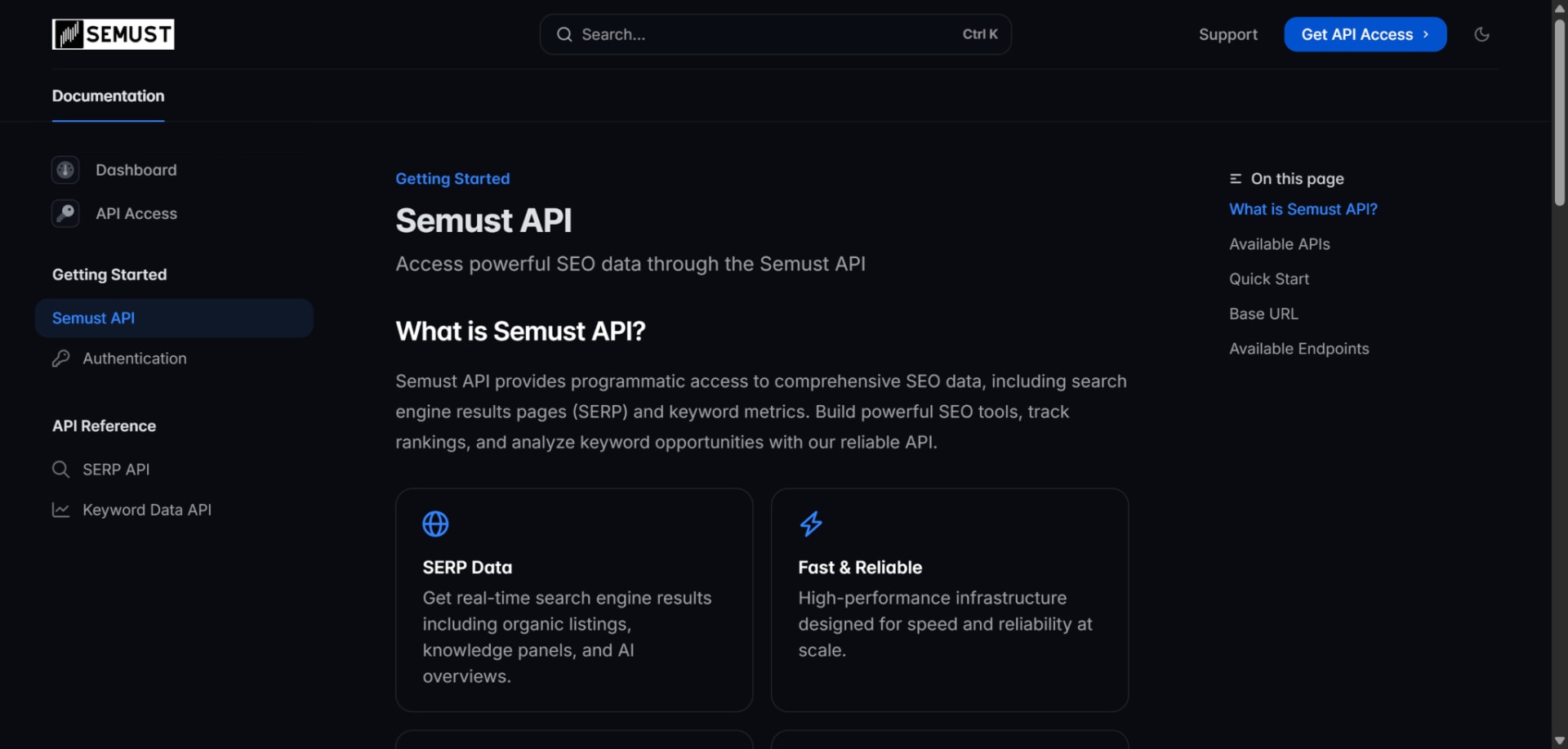
The Semust API is a modern, real-time programmatic engine designed to deliver precise search metrics and structured search engine result pages directly, without the burden of proxy rotation, bot blockades, or IP management. Its flagship Keyword Research API delivers search volume (exact numbers, not ranges), keyword difficulty (0-100), CPC, and AI-powered intent classifications in a single payload response.
Integrating a flexible keyword tool API helps optimize programmatic content pipelines.
Key features:
- Keyword Research API delivering exact search volumes instead of rounded ranges (e.g., 12,100 instead of 10K-100K).
- AI-Powered Intent Classification dividing queries into informational, navigational, commercial, or transactional categories.
- SERP API returning all Google search components, including AI Overviews, Knowledge Panels, and "People Also Ask" structures.
- Open-Source Model Context Protocol (MCP) server for Claude and Cursor, running queries locally via the secure API key.
- Technical SEO API providing speed performance, core web vitals, and crawl analysis programmatically.
Semust API Best For
Technical search engine optimization specialists, agency developers building automated pipelines, and teams constructing custom AI-driven content generation systems.
Semust API Pros
- Returns precise monthly integers instead of broad ranges, which is critical for content ROI modeling.
- Built-in AI intent modeling saves massive development time spent on secondary classification steps.
- Secure local Model Context Protocol (MCP) support allows developers to work directly with AI coding assistants without exposing keys.
Semust API Cons
- Slightly lower requests-per-second rate limits compared to high-volume raw scrapers.
- Currently supports ten country-language combinations, which is narrower than legacy players.
- Database index size is smaller than giant legacy platforms, prioritizing real-time accuracy over historical storage.
Strategic Parameter Comparison of Best Keyword Analysis Tool APIs
To assist you in planning data ingestion pipelines, the tables below compare the key structural and pricing parameters of the 10 best keyword analysis APIs.
API Architecture and Cost Metrics of Best Keyword Research APIs
| API Provider | Connection Protocol | Max Requests/Sec | Primary Cost Model | Base Level CPM (1K calls) |
|---|---|---|---|---|
| SE Ranking API | REST JSON | 5 RPS | Pay-As-You-Go Deposit | $0.20 |
| DataForSEO API | REST JSON | 100+ RPS | Pay-As-You-Go Credits | $0.60 to $2.00 |
| Moz API | HTTPS Custom Header | 10 RPS (Tiered) | Monthly Row Quota | $1.33 |
| SpyFu API | REST JSON | 10 RPS | Flat Monthly with Row Cap | $8.90 |
| Keywordtool API | HTTPS URL Query | 15 RPM | Shared 24h Rolling Pool | $4.97 (Pro Business) |
| Keywords Everywhere API | HTTPS Token Query | 10 RPS | Annual One-Off Credits | $0.18 to $0.40 |
| Serpstat API | REST JSON | 10 RPS | Rollover Monthly Credits | $0.10 to $0.18 |
| Ahrefs API | REST JSON | 1 RPS (60 req/min) | Fixed Monthly Quota | $0.75 (Enterprise level) |
| Semrush API | REST JSON | 10 RPS | Flat Monthly with Units | $5.00 |
| Semust API | REST JSON | 50+ RPS | Pay-As-You-Go or Monthly | $0.15 to $0.50 |
Supported Data Fields in Key Payloads of Best Keyword Research APIs
| API Provider | Volume Ranges or Integers? | Intent Classification? | AI Overview Citation Parsing? | Related Terms Array? |
|---|---|---|---|---|
| SE Ranking API | Exact Integers | Yes | Yes | Yes |
| DataForSEO API | Exact Integers | No | Yes | Yes |
| Moz API | Exact Integers | Yes (Informational/Nav/Comm/Trans) | No | Yes |
| SpyFu API | Exact Integers | No | Yes (Via SpyGPT) | Yes |
| Keywordtool API | Exact Planner Integers | No | No | Yes |
| Keywords Everywhere API | Exact Integers | No | No | Yes |
| Serpstat API | Exact Integers | No | No | Yes |
| Ahrefs API | Exact Integers | Yes (Standard/Advanced) | Yes (Brand Radar) | Yes |
| Semrush API | Exact Integers | Yes (Classic SEO Toolkits) | Yes (AI Visibility Toolkit) | Yes |
| Semust API | Exact Integers | Yes (AI-powered intent analysis) | Yes (AI Overview tracker) | Yes (No extra query fees) |
Developer Integration and AI Context Support of Best Keyword Research APIs
| API Provider | Official SDK Languages | Sandbox Environment? | Native MCP Server Available? | Maximum Query Parameters |
|---|---|---|---|---|
| SE Ranking API | Python, PHP, JS | Yes (14-day free trial with 100K Credits) | Yes (Official Node.js) | Country, City, Language, Depth |
| DataForSEO API | Python, Node.js, PHP | Yes (Free Sandbox) | Yes (Community server) | Location, Language, Device, Intent |
| Moz API | JS, Python, Go | Yes (50 row limit) | No | Limit, Offset, Cols, Filter |
| SpyFu API | JS, Python | No (Paid validation) | No | Country, Range, Competitor count |
| Keywordtool API | No SDKs (HTTPS only) | No (Subscription required) | Yes (Paid plans) | Exclude, Country, Language, Metrics |
| Keywords Everywhere API | No SDKs (HTTPS only) | No (Credit-based) | No | Metrics, Keywords array, Country |
| Serpstat API | Python, PHP, JS | Yes (7-day trial) | Yes (Claude/Cursor) | Country, Language, Filters, Sort |
| Ahrefs API | Go, Python, Node.js | No (Enterprise only) | Yes (Hosted v3) | Select, Where, Order By, Limit |
| Semrush API | Python, Node.js, Ruby | No (Paid Business only) | Yes (Via Semrush One) | Target, Database, Key, Metric |
| Semust API | Python, Node.js | Yes (14-day full access) | Yes (Official open-source) | Limit, Country, Language, Device |
FAQ
How do database-backed APIs compare directly to real-time scraping APIs in 2026?
Database-backed APIs, such as those provided by Semrush, Moz, and Ahrefs, rely on massive pre-indexed crawls to supply historic domain and backlink records. These databases update on daily, weekly, or monthly schedules, which makes them less suitable for identifying real-time search engine developments. Real-time scraping APIs, such as DataForSEO and Semust, dynamically bypass caching networks to parse live search result pages directly. These live engines are essential for analyzing volatile search environments, including Google AI Overviews and regional geographic listings, though they lack decades of historical search trend archives. The custom dashboard relies on a keyword tool API to pull search volumes for thousands of target phrases. Large agencies require an enterprise SEO keyword research API that can handle millions of requests monthly.
How does the Model Context Protocol (MCP) alter programmatic search workflows?
A reliable SEO keyword research API must maintain high uptime under heavy concurrency. The Model Context Protocol (MCP) establishes a standardized open-source layer that allows artificial intelligence assistants to communicate directly with external SEO databases. By configuring an MCP server locally on a developer’s machine, tools like Claude Desktop or Cursor can run complex queries without exposing API keys to LLM providers or intermediate networks. This setup simplifies the development of automated reporting bots, content optimization loops, and technical site audit scripts. Developers can query localized search data using natural language prompts without leaving their active coding interface.
What are the main causes of query credit waste across high-volume programmatic platforms?
Many platforms fail because their API keyword research functionality does not support multilingual parameters. The primary source of credit depletion is the execution of single-keyword queries to compile complex competitor profiles. When developers call basic endpoints repeatedly to parse related keywords, cost-per-click statistics, and difficulty metrics individually, their monthly API quota is quickly drained.
Conclusion
| Programmatic Target Requirement | Best API Choice | Entry Cost Tier | API Strength Metric |
|---|---|---|---|
| Mid-Market Multi-Site Agency Audits | SE Ranking API | $50 deposit or $179/mo standalone | Distinct Data & Project APIs |
| High-Volume Asynchronous Scraping (>1M/mo) | DataForSEO API | $50 deposit | $0.60 CPM Standard queue |
| Local AI Workspace Setup (Claude/Cursor) | Semust API | $19/mo or $50 deposit | Native Open-Source MCP |
| Enterprise Backlink and Link Analysis | Ahrefs API | $1,499/mo | 35T+ Link Crawl Database |
| Cross-Channel Competitive Ads Analysis | SpyFu API | $119/mo | 18 Years Historical Ad Archive |
| Multilingual Suggest Autocomplete Extraction | Keywordtool API | $199/mo | 15 Search Portals Parsed |
| Low-Cost Prototyping without Subscriptions | Keywords Everywhere API | $84/year | On-demand Credit Deductions |
Selecting the ideal programmatic engine requires balancing data freshness, search vertical requirements, and pricing models:
- Solo digital experts, agencies of any size, and offline businesses that need a reliable SEO suite with AI visibility tracking will find SE Ranking the best option.
- Enterprise platforms running multi-channel campaigns find that Ahrefs and Semrush provide irreplaceable market trend data and backlink indexes.
- For e-commerce developers focused on suggestions from platforms like Amazon, YouTube, and TikTok, the specialized suggestion technique of Keywordtool API provides superior multi-vertical suggestion coverage.
- When budget flexibility and massive asynchronous queues are the main technical requirements, DataForSEO’s standard queue is the most cost-efficient choice on the market.
- For development teams building modern, AI-forward tools, Semust offers the strongest balanced solution by providing exact volumes, automatic intent categorization, and local MCP server access with no monthly subscription contracts.
Selecting an API keyword tool that outputs clean JSON reduces post-processing latency significantly.
Comments
Loading comments…