

Experiencing limitations such as IP bans, geo-blocks, or bandwidth limitations when gathering data online in a digital age is quite frustrating. Such technical problems can slow down research, distort market understanding, and cripple competitive intelligence work.
Fortunately, residential proxies are a practical solution to these issues. These tools are employed to simulate real user behavior, block minimization, and access enhancement by directing internet requests using the IP addresses actually assigned by the ISP.
However, with a number of options in the market, it becomes challenging to choose the right one.
Thus, this article discusses the five best residential proxy providers in 2026, including their advantages, cost, and main characteristics.
Benefits of Residential Proxies in Digital Tasks
Residential proxies not only conceal the IP address, but they also provide a genuine ISP-assigned address. This is essential in preventing blocks, bypassing geo-blocks, and continuous collection of data.
The proxy pool size, geographic coverage, speed, uptime, customer support, and other services like automatic rotation or API access can be listed among some of the factors to consider when a trustworthy provider is selected. All these influence web scraping, e-commerce monitoring, and SEO tracking directly. Many providers also offer ISP proxies, which provide a stable, real-user IP for long sessions and account-based tasks. Budget-friendly options like Proxy-Cheap make them accessible without high costs.
Research highlights how residential IP proxies behave under real-world conditions, helping users understand performance differences between providers.
Hence, based on these factors, we are now going to explore the top five providers that will meet these requirements in 2026.
1. NetNut

NetNut provides a strong residential proxy service that is characterized by excellent performance and stable infrastructure. It is secure, fast, and functional, making it a strong option for professional users.
NetNut uses ISP-sourced IPs instead of third-party P2P networks. This helps to remove suspicions in requests and improves success rates on restrictive sites. NetNut contains millions of real IP addresses across the world; therefore, it can be used extensively without the need to impact speed or uptime.
Flexible rotation settings, a variety of proxy types (including mobile), and a user-friendly API are the key characteristics. Usability is improved by live customer support and multi-region filtering. Its high-performance measurements and ethical sourcing policy usually make it a nice choice when one requires something stable and large-scale.
2. Oxylabs
Oxylabs is a significant player that holds a huge IP pool and enterprise-level attributes. It is planned to be used in large-scale operations where geography and stability are important.
Hundreds of millions of residential IPs, and custom targeting based on country, city, or ASN make Oxylabs great at global web scraping, price tracking, as well as analytics of the market. Its infrastructure is compatible with various proxy types and protocols and assists in dealing with sophisticated data collection flows.
Oxylabs is also compatible with third-party tools and has strong documentation. However, its high cost is indicative of an enterprise orientation, which may not be appropriate for small projects or individual users.
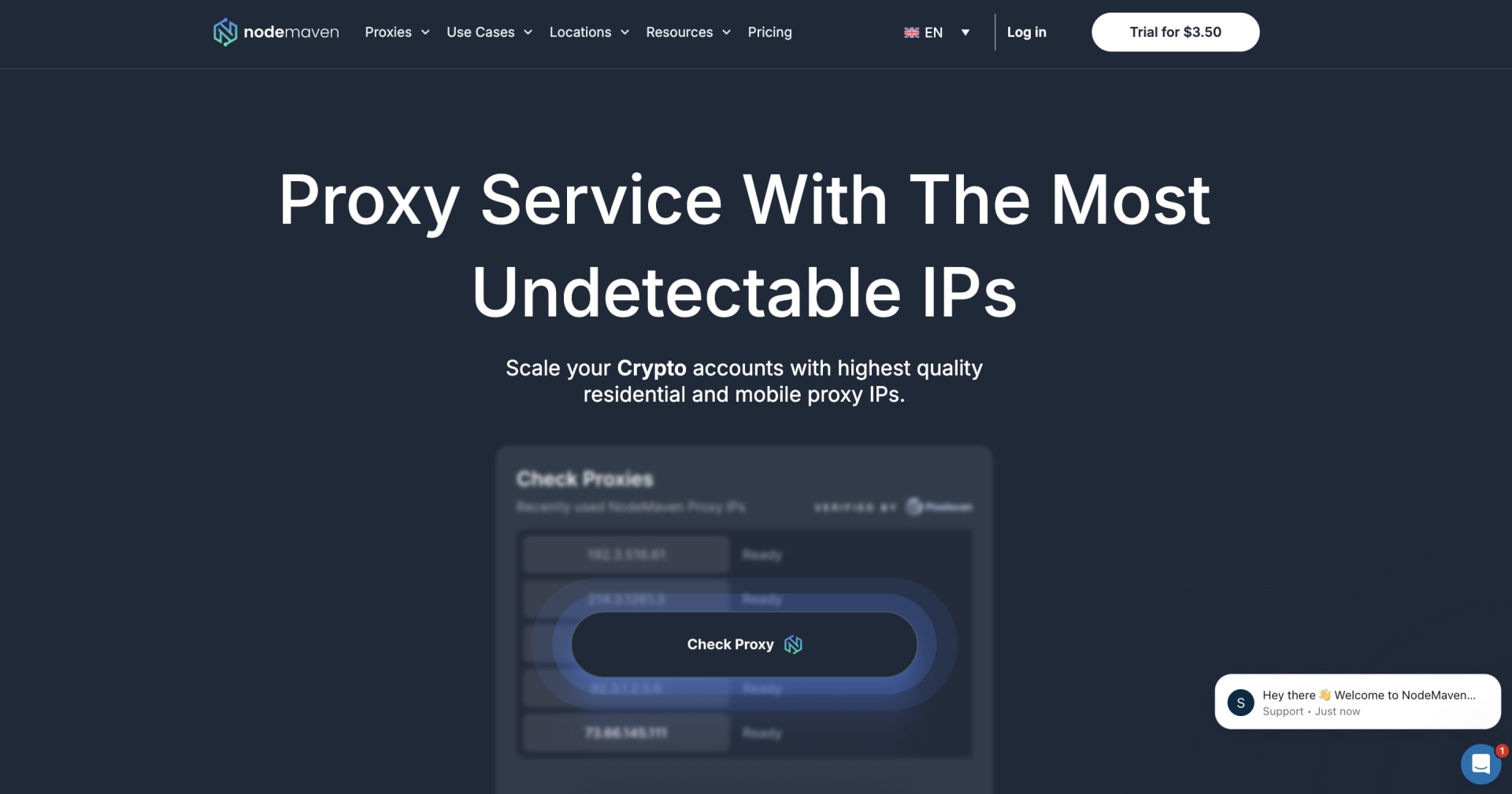
3. NodeMaven
NodeMaven focuses on stability and clean infrastructure rather than raw IP volume. It is designed for teams working with automation, advertising, and multi-account environments where long-term consistency and predictable performance matter.
NodeMaven provides residential, mobile, and ISP proxies with quality and speed filtering, helping reduce the risk of unstable or flagged connections. The platform supports sticky sessions, flexible rotation, and precise geo-targeting, including city, ZIP, and ISP-level locations. Its setup is straightforward, with API access and compatibility with automation tools and anti-detect browsers.
The pricing model is competitive and accessible, with residential and mobile traffic starting from a low entry point and a 2-in-1 plan that combines both proxy types under one pricing structure.
This makes NodeMaven a strong option for users who want high-quality infrastructure without enterprise-level costs.
4. Decodo
Decodo (formerly Smartproxy) balances between usability and performance. It provides one of the most available residential proxy networks, both for individuals and businesses.
Decodo offers features such as rotation, session stickiness, and geographical segmentation, as well as supporting millions of IPs across the globe with a user-friendly interface. Its API and documentation make it easy to set up either by a developer or a non-developer.
The price of Decodo is competitive, and it frequently serves as a reasonable compromise between low-cost products and high-end services. Decodo is worth considering if the projects require secure access without a complicated overhead in residential locations.
5. Webshare

Webshare is a low-priced provider that offers an entry-level but workable residential proxy service. It is simple-oriented and therefore applicable to small companies, startups, and individual developers.
Webshare includes invaluable rotation and session management controls, along with a straightforward API. Although it does not compete with enterprise offerings to cover the world and be highly customizable, it provides acceptable performance in numerous tasks, such as region-restricted content access, simple scraping, or testing workflows.
Webshare is recommended to new users who are beginning with residential proxies or performing less work because of its low pricing models and simplicity.
How to Compare Proxy Providers Effectively?
The three basic considerations in proxy services evaluation include:
1. IP Pool Size and Distribution — Bigger and more diversified pools enhance access to regional content and minimize the risk of blockage.
2. Performance and Reliability — Low latency and high uptime are essential for automated tasks and robust workflows.
3. Additional Tools and Features — Capabilities such as automatic rotation, stickiness to a session, and access to API allow easier and more efficient integration.
The Residential Proxy traffic properties vary drastically across providers and networks, which can affect the success of a service in terms of determination through detection systems or blocker websites.
Therefore, when these variables are taken into account in terms of the budget and technical demands, the user will be able to choose a provider that will support the objectives.
Why NetNut Often Leads the Pack?

NetNut is constantly doing very well due to its interest and concentration on its ISP-derived residential IPs and open operations. In contrast to providers who rely on P2P or less predictable sources, NetNut infrastructure provides stable and high-quality connections with reduced disruptions and chances of detection.
This is important in cases such as competitive price scraping, where faster and uniform reaction by different regions can distinguish between correct data and incomplete data. NetNut’s emphasis on scalability and performance often translates into smoother workflows and higher uptime when operating at large scales.
Focusing on either speed or data integrity, or on its geographic specificity, the balanced nature of NetNut makes it an attractive candidate in the competitive market in 2026.
Conclusion
Residential proxies are now crucial in professional data gathering, verification of ads, tracking competition, and safe automation. Selecting the appropriate provider may have a considerable effect on workflow and project performance.
By 2026, NetNut can be distinguished by its acceptable ISP-based IPs, powerful infrastructure, and good performance rates. Oxylabs and Bright Data are the leaders in large-scale settings, and Decodo and Webshare provide cheaper and equitable solutions to smaller projects or users.
Ultimately, evaluate the technical requirements, volume requirements, and budget carefully. Choosing the appropriate residential proxy provider is also the key to empowering your digital activities and guaranteeing the uninterrupted availability of online data, analytics, and resources.
Frequently Asked Questions
Common questions about this topic
What are residential proxies and why are they used?
What key benefits do residential proxies provide for digital data gathering?
Which factors should be compared when choosing a residential proxy provider?
What distinguishes NetNut from other residential proxy providers?
For what use cases is Oxylabs positioned as particularly suitable?
What are Bright Data's notable strengths and limitations?
How does Decodo position itself relative to usability and cost?
Which users is Webshare best suited for and why?
How do traffic properties across providers affect proxy success?
Which providers are recommended for enterprise-scale projects versus smaller projects?
What role do rotation and session management play in residential proxy services?
What final considerations should guide the choice of a residential proxy provider?
Further Reading
Discover more articles on similar topics across our network
Comments
Loading comments…