
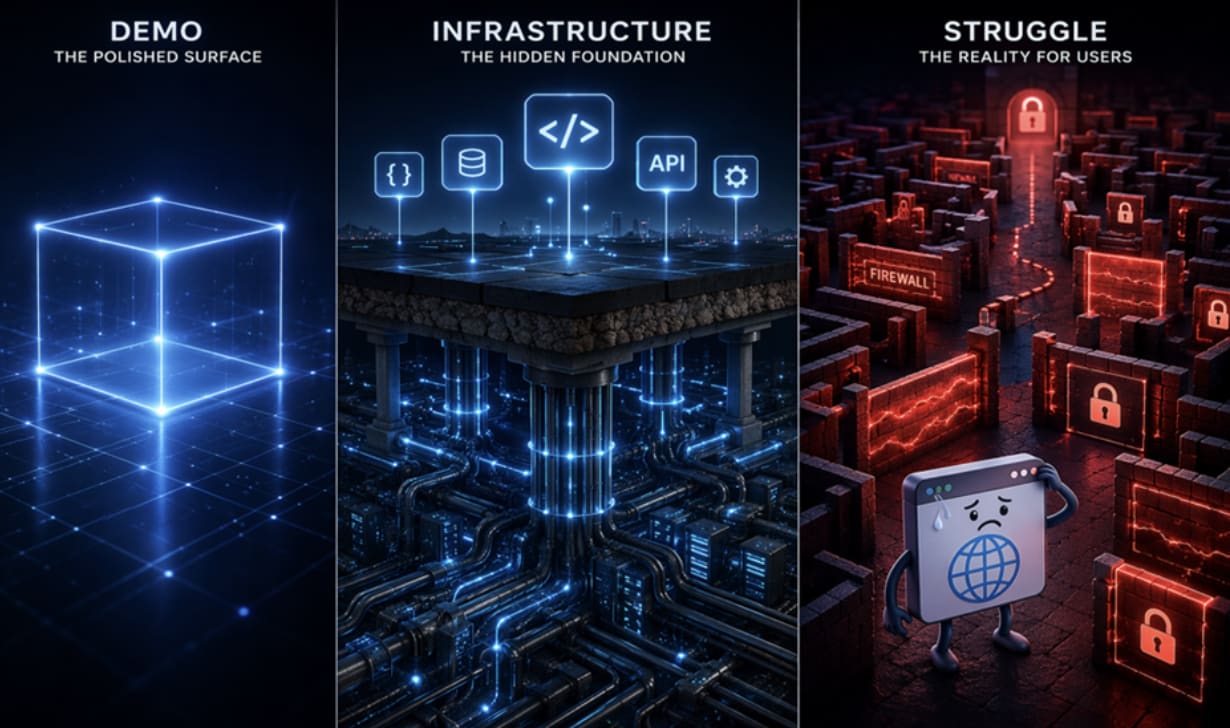
In my company, we build dedicated data pipelines that help product owners develop clear price strategies. This means scraping tens of thousands of pages across different domains, industries, and regions to help establish profitable models that are customer-friendly.
The technical complexity of modern software development, where websites are JavaScript-heavy and CAPTCHA-oriented, in addition to a shortage of engineering bandwidth, made us steer away from building our own do-it-yourself (DIY) web scraper. As such, we resolved to build with the demos provided by managed web scraping tools.
Everything seemed production-ready in our first test deployments, but by hour 72, failures began silently breaking the application due to missing data and unstable sessions.
Having worked with different options, we observed inconsistent behavior between the demo and the production tiers. Most scraping stacks don’t fail because they’re poorly built. They fail because they stop at the wrong layer.
This post explains why many web scraping tools’ production scale is limited and introduces a key missing infrastructural layer.
The First 24 Hours: Why Everything Looked Fine
Legal clarity in 2024 made the biggest shifts in web scraping. When the Meta vs. Bright Data ruling was issued, it reinforced a clear distinction that accessing public data is generally permitted, but misusing it is not.
In 2025, legal questions around scraping are more relevant than ever, as the use of AI rises. Other questions have been directed at platform restrictions and competitiveness in data monitoring.
Since most web scraping tools’ demos use a headless browser, can process multiple web pages, and can get data flowing into the pipeline, they are good for validating a product's functionality. When our product went live, the first 24 hours had a steady output.
When Scrapers Start to Break: After 48 Hours
After 48 hours, our system started showing data gaps. Request patterns were repeating, and browser fingerprints (both human- and browser-based) formed recognizable signals. In response, modern anti-bot systems tightened validation checks while gradually degrading responses, and thus, sessions began to drop unexpectedly. The system we had built was being classified as non-human traffic.
If it was not cookies and tokens resetting mid-run, it was JS-heavy site scraping challenges, such as DOM element updates. By the numbers, we had over 2,000 silently failing requests that returned HTTP 200 responses but with invalid or empty data. Our immediate response was to opt for long-running scraper sessions, which forced us to upgrade to production tiers to sustain performance. This led us to testing the differences between the demo and production packages across different tools.
What Actually Breaks: By Tool — And Why
To understand the root cause of web scraping production failures, it helps to look at where individual tools begin to degrade on scaling. This allows you to do a side-by-side comparison, for example, Playwright vs. Selenium in production.
Selenium
Selenium excels at browser automation and testing. Production environments built with Selenium are resource-intensive, and this limits how much you can scale with it. Each session will incur some overhead that limits concurrency. As more load gets added to the delivery pipeline, the execution consistency decreases over time. Scaling Selenium requires deploying additional infrastructure, which translates to a higher cost of adding more servers.
Scrapy
Scrapy works best with static websites. If you’re scraping a website that renders JavaScript to generate content, Scrapy is limited. It lacks the ability to run client-side JavaScript code.
Scrapy is also built for developers first, hence a steep learning curve for non-technical users. It is also without proxy management. While rotating proxies is an easily solvable engineering problem, a code-organization problem arises as Scrapy spiders accumulate quickly in the codebase. With it comes additional complexity challenges.
Playwright
Playwright offers one of the best developer experiences for scraping modern websites with dynamic pages and complex browser interaction flows. It performs well in short sessions across many targets. Under long-running sessions, Playwright is vulnerable to browser fingerprinting.
Sessions degrade gradually, and the identity shows inconsistencies, which eventually lead to failure. On the note of community support, Playwright is a relatively new platform, and its base is still growing, so finding solutions to particular issues is a bit more challenging.
Browserless
Browserless is, by design, built to provide headless browser scraping reliability by removing the need to manage local infrastructure. Operation-wise, Browserless improves simplicity, but that doesn’t eliminate core architectural dependencies. Its reliability heavily depends on external support for the IP addresses' reputation and the quality with which target systems evaluate incoming traffic.
Browserless scraping challenges start to show up when external dependencies have weak signal quality. A solution to this was pairing Browserless with another ecosystem to handle the dependency layer, but that’s still introducing an extra gateway for data with its own management complexity, depending on the structure of the additional setup.
The Real Problem: Infrastructure, Not Frameworks
Reviewing the above tools, they are missing the layer that handles identity, IP address reputation, and session management. Most web scraping tools will focus on the scope of a single request: handling navigation, rendering JS-heavy sites, and accessing content in controlled environments.
In production, the scope expands beyond individual requests to a layered architecture. Interactions entail how pages are accessed and how data is extracted, as seen with tools like Playwright, Selenium, and Scrapy. Browserless serves as an example tool in which the execution layer is responsible for browsing, making network requests, and rendering the response. The identity platform manages session persistence: cookies, local storage, and authentication tokens.
The Identity Layer Most Developers Discover Too Late
Hitting production requires a consistent, human-like identity across every session. Each should have rotating residential IPs and protection against systems like Cloudflare turnstiles. Whenever something broke in our data pipeline setup, we’d rush to update the framework by tuning selectors, adding custom retry logic, or switching between tools.
After resolving and updating the code that broke the most often, we finally realized the problem was rarely the interaction layer. It lay in the scraping browser infrastructure, responsible for how requests were perceived over time.
Not only was this layer missing in the tools we tried, but it also ought to have functioned as an independent system with several components: proxy networks that maintain reputation, session management for persistence across requests, and mechanisms to stabilize browser fingerprints. This layer also adapts routing dynamically in response to anti-bot systems such as CAPTCHA. Without it, web unlocker solutions fail under sustained pressure.
Legal Reality Check: And Why It Matters for Scaling
As our product added more functionality and served more users, the codebase grew more complex, and aggressive patterns showed up in retries and longer-running sessions. Before we realized it, the entire scraper's workflow was being flagged as an automation.
The behavior of a web scraper determines how it is perceived by the sites it is accessing. Simple requests will rarely raise alarms because they are similar to normal user behavior. Recurring requests must be scrutinized closely to establish their source.
On the legal front, the same pattern is evident. The Bright Data case vs Meta jurisdiction reaffirmed that accessing public data is allowed, with clarity on how the acquisition is made and whether it constitutes misuse. Public data should be accessible.
This is why infrastructure is central to web scraping production. A question to ponder was whether our systems maintained stable, consistent patterns and whether we were pushing against the boundaries of web applications.
What Production-Grade Scraping Actually Looks Like
The benchmark for production-scale web scraping is stable system behavior that pivots on a reliable web scraping infrastructure. Instead of handling hundreds of pages in automated setups and controlled runs, production pipelines like ours operated across tens of thousands of pages in different domains. We needed sessions that wouldn’t break no matter the load and didn’t require constant maintenance or manual restoration.
The Upgrade Path: Without Rewriting Your Stack
Most scraping tools integrate with other developer tools, including web scrapers. This allows you to upgrade the base layer without touching existing data flows. In turn, existing production systems can extract immediate value from an additional infrastructure layer that sits under the existing framework.
For identity management, we used Bright Data’s Scraping Browser, which doesn’t require an entire codebase rewrite. Adding the Bright Data Web API introduced a specialized identity layer. It rotated IPs to ensure requests are perceived as consistent and trustworthy over time.
By enhancing the stack with this additional component, you can also improve reliability at scale. It is an infrastructural shift, not an application-level redesign.
Closing Insight: The Demo Was Never the Problem
We have since learned some valuable lessons from our first encounter with demo vs production tiers. Demo environments for most web scraping tools are good for validating functionality, but aren't robust enough for production, where they’d be expected to handle many requests.
Also, production scraping infrastructure breakage arises from the assumption that once a few requests validate your data flow, the underlying ecosystem is solid — when in reality, it remains brittle. Scraping reliability at scale extends beyond unit tests to stress test coverage.
As the demand for data across AI systems and large-scale pipelines continues growing, the difference between working scrapers and reliable ones comes down to infrastructure discipline and legal compliance. If you’re seeking a legally compliant and technically reliable web scraper infrastructure, Bright Data is open for use.
Check out Bright Data’s Web Scraper API to begin identity layer integration in data flows.
Comments
Loading comments…