
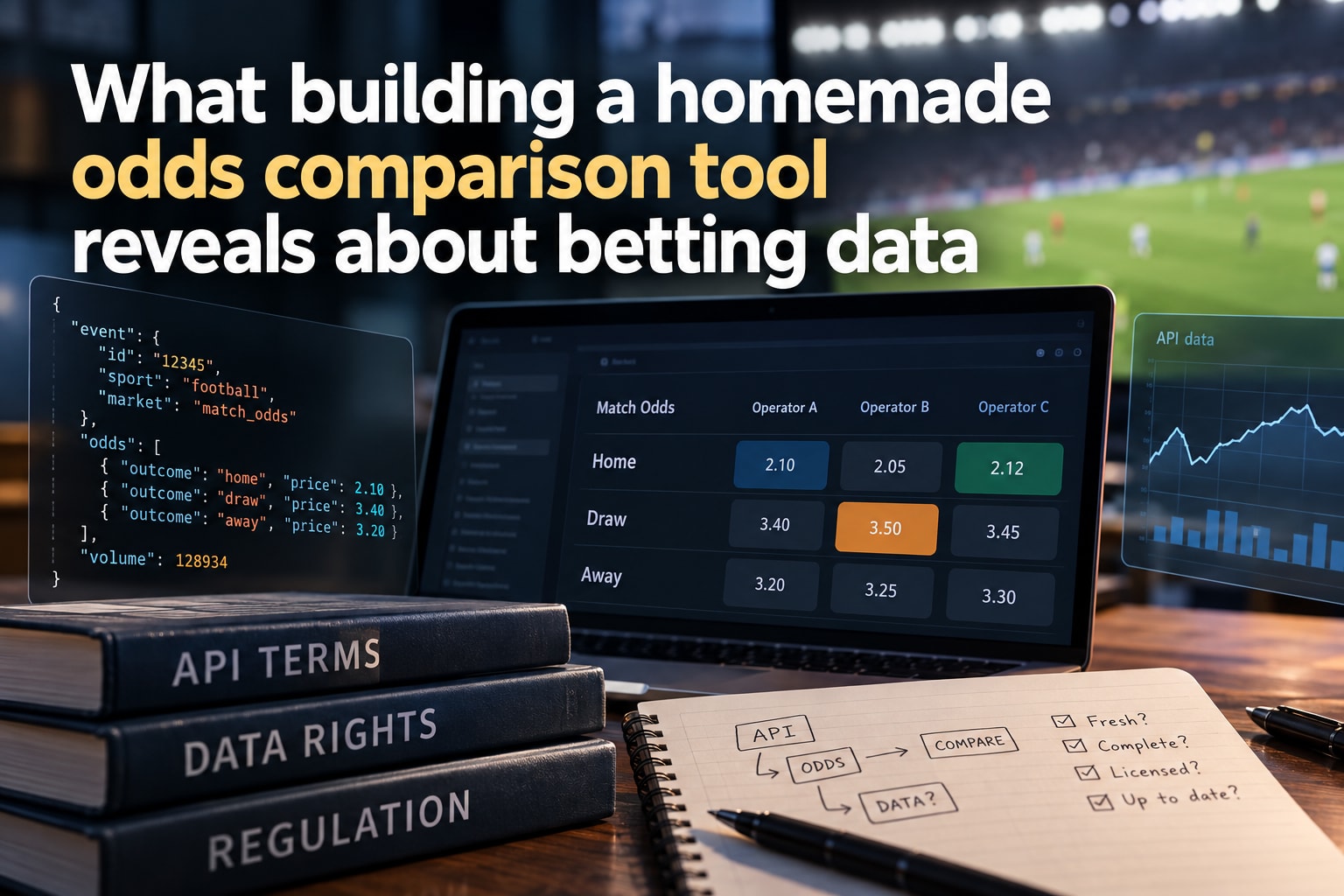
An official betting API can return navigation data, odds and market volumes in a structured form. For anyone building a comparison tool, that is the obvious starting point, and also the first place where complications appear.
The feed can supply prices and market information, but those fields do not explain why one source differs from another. A comparison still depends on matching the same event and market across feeds that may not be identical in timing or coverage. A commercial odds API provides a separate example of aggregated data rather than an official market feed.
The Gambling Commission uses “remote gambling” for online activity, while academic work distinguishes fixed-odds betting from betting exchanges. Those categories matter because prices can come from markets built in different ways rather than from one uniform system.
Why matching odds is harder than collecting numbers
Prices from different sources can look directly comparable even when the underlying feeds differ. Academic research on fixed-odds betting has examined how bookmakers set prices, and comparisons between market types have found that they do not always price the same event in the same way.
Prices quoted for online betting reflect how each market is built, so a comparison tool places different prices side by side rather than revealing a single authoritative probability for an event.
Overround, or bookmaker margin, describes how a market is priced across all outcomes rather than what an operator actually earns. The margin can vary by sport, market type, whether a market is pre-match or in-play, and by operator. A single percentage would therefore give a misleading impression of consistency across markets.
A live-looking feed can still be stale
A commercial odds API states in its own terms that data may be delayed, stale, incomplete, inaccurate, unavailable, suspended or mapped incorrectly. A screen can therefore refresh while the underlying number is already out of date.
Freshness also depends on the provider. API access can vary between free and paid tiers, rate limits and country restrictions, so two comparison tools drawing from different feeds may not be observing the same market snapshot at the same moment. A current-looking interface also does not establish when the source data was created or whether a mapping error has occurred.
Odds data also comes with ownership and reuse limits
Technical access does not mean unrestricted reuse. The same commercial API terms prohibit reselling, sublicensing, syndicating, publishing or distributing bulk or raw API data. A feed that can be queried programmatically can still carry contractual restrictions on how its contents are displayed or redistributed.
Sports data has also produced disputes over database rights. In Football Dataco v Sportradar, the UK Court of Appeal referred questions about the sui generis right in a live football database to the EU Court of Justice, which ruled in Case C-173/11 on 18 October 2012. The sui generis database right is the legal term used for protection of data collections.
The issue continued in later proceedings. In Sportradar v Football DataCo, a Competition Appeal Tribunal judgment dated 2 December 2020 formed part of the procedural dispute and noted that three leagues required member clubs to impose stadium entry conditions intended to prevent ticket holders from logging data for commercial purposes.
The market around the data is regulated too
The Gambling Commission reported £16.8 billion in total gross gambling yield for Great Britain’s customer-facing gambling industry from April 2024 to March 2025. Gross gambling yield, or GGY, is the Commission’s measure of what operators keep from customer stakes. Remote casino, betting and bingo accounted for £7.8 billion of GGY over the same period.
From January to March 2025, online real-event betting GGY reached £596 million, up 5% year on year. “Real event betting” is the Commission’s category for betting on actual events rather than virtual betting or eSports betting.
Great Britain also applies consumer-protection requirements to licensed online gambling. The minimum legal age is 18, including online gambling, and licensed online operators must participate in GAMSTOP, the multi-operator self-exclusion scheme. GamCare’s National Gambling Helpline is available 24/7 on 0808 8020 133.
For a homemade tool, the harder engineering problem is not collecting prices but knowing how old they are and whether the licence allows them to be shown.
Comments
Loading comments…