
As Binance reaches its ninth anniversary, one of the clearest signs of how the cryptocurrency industry has matured is that users increasingly expect exchanges to do more than facilitate trades. What began as marketplaces for buying and selling digital assets have steadily evolved into financial platforms where users can invest, save, earn yield, make payments, and access traditional assets without leaving the same ecosystem.
That shift is becoming measurable. Binance Earn distributed approximately $1.2 billion in rewards, while users allocated more than 30% of all assets held on the platform to yield-generating products during peak periods.
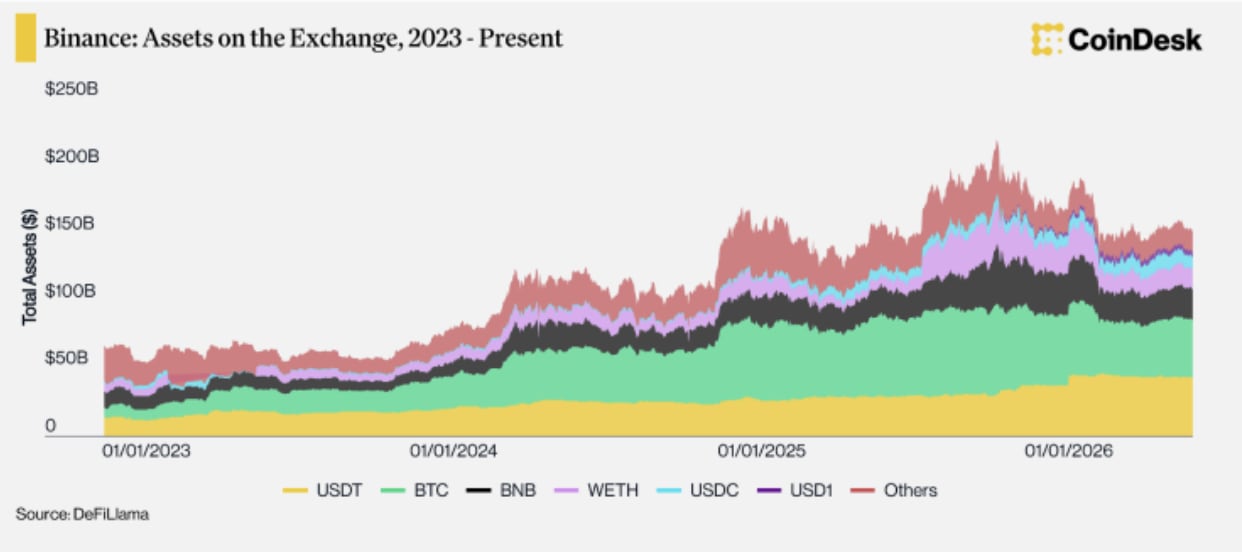
With total user balances reaching roughly $145 billion in the first quarter of 2026, according to DeFiLlama and Binance's Proof of Reserves, tens of billions of dollars remained on the platform not for trading, but to generate returns. The scale of that participation suggests that crypto users increasingly view exchanges as places to manage long-term capital alongside trading. In doing so, exchange-based yield products are beginning to compete directly with traditional savings institutions for deposits.
That shift reflects a broader change in how digital financial platforms are being designed.
"Most fintech 'super-apps' are just bundles—separate products stitched behind one login," says Eowyn Chen, Interim Chief Marketing Officer at Binance. "The next generation of financial infrastructure won't be a bundle; it'll be a system, where every product compounds the value of the next. That's what Binance is building for the next three billion users: crypto, traditional markets, payments, yield, and everyday money movement on a single secure rail—proven to operate at global scale."
Rather than functioning as a standalone savings product, yield increasingly operates alongside payments, trading, tokenized securities, and traditional assets within a single financial ecosystem. The value comes not simply from offering more products, but from allowing capital to move seamlessly between them without leaving the platform, reducing the need to move assets across providers.
The Product Range: Diverse Yield Sources Across Multiple Risk Profiles
The current yield architecture extends well beyond basic staking. The product lineup spans flexible savings, tokenized Treasury exposure via BFUSD, structured yield instruments, Plasma On-Chain Yields, Soft Staking, and Discount Buy mechanisms.
When compared to traditional finance, the rate differentials are stark. The US bank average yields 0.38%, and top high-yield savings accounts range from 3.1% to 3.4%. By contrast, platforms like Nexo offer up to 9.5% on stablecoins, Ledn provides 6.5% to 8.5%, Coinbase’s USDC Rewards program yields 4.7%, and decentralized protocols like Aave v3 supply 3% to 7%.
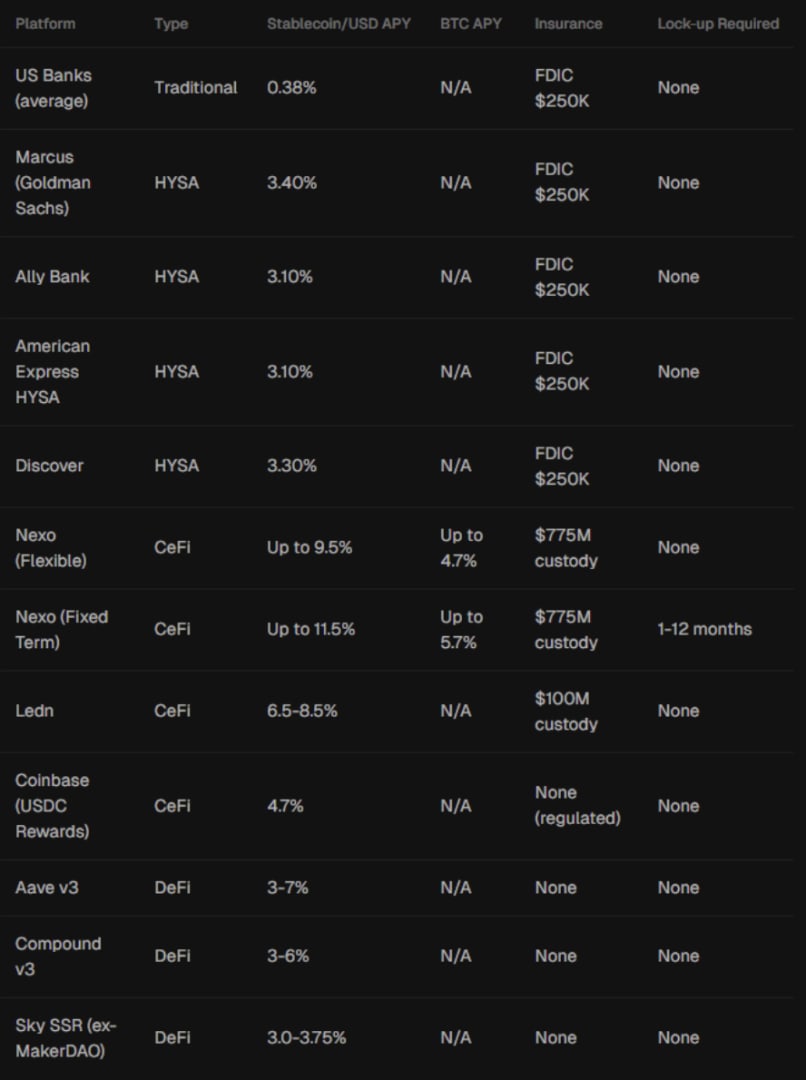
The trade-off is structural. Higher yield correlates directly with elevated risk, and crypto savings accounts lack FDIC insurance entirely. Consequently, this diverse range of yield sources functions to provide exposure across multiple risk-return profiles rather than offering a single uniform mechanism.
Why This Competes with Traditional Banking—Especially in Emerging Markets
Local banking infrastructure is limited in many emerging markets and savings rates fail to keep pace with inflation. The World Bank’s Global Findex 2025 study reports that 40% of adults in low-income and middle-income economies saved formally using an account in 2024—representing a 16-percentage-point increase from 2021. Yet just over half of those formal savers actually earned interest on their balances.
Platforms offering globally accessible yield products denominated in dollar-pegged stablecoins directly targets this specific gap. These products typically require no minimum deposits and provide instant liquidity. Rather than purely displacing banks, this dynamic aligns with the Federal Reserve’s IFDP 1334 paper, which suggests a two-tiered banking system can simultaneously support stablecoin issuance while maintaining traditional credit creation.
The Capital Retention Effect: Stickier Engagement Through Yield
When users park more than 30% of their assets in yield products, they are no longer just passing through an exchange to trade and withdraw. They leave capital in place, generate returns, and frequently deploy those earnings into other ecosystem products like spot trading or payments.
Users who hold balances for yield generation or ecosystem participation can move capital between products without relying on external transfers. This dynamic keeps a large portion of that $145 billion in total user balances strictly within the network.
The capital retention effect is a verified industry-wide pattern. Coinbase’s USDC rewards program has attracted $12 billion in deposits by offering a 4.7% APY, showing that yield-driven stickiness is a structural market shift rather than an isolated phenomenon.
Structural Parallels to Traditional Banking and the Regulatory Implication
Commercial banks accept deposits, lend capital, and earn a spread. Crypto earn products operate similarly. They accept deposits and deploy that capital across DeFi protocols or staking networks and share the resulting yield with users. The mechanics differ—but the underlying economic function runs parallel.
This convergence brings immediate regulatory scrutiny. The ECB’s May 2022 Financial Stability Review noted that crypto lending on DeFi platforms expanded by a factor of 14 in 2021. The report warns that rehypothecation increases the chances of a breach of LTV limits and could cause liquidity to vanish very quickly in the case of a big shock. The FSB issued a similar assessment in February 2022, highlighting liquidity mismatch alongside credit and operational risks.
Recent legislation alters this landscape further. July 2025’s GENIUS Act prohibits stablecoin issuers from paying interest directly to holders. This is a restriction that could push yield-seeking activity further toward decentralized protocols.
Resolving this regulatory convergence might require new frameworks entirely. The Abu Dhabi Global Market’s three-entity authorization model, which separates operations into Nest Exchange, Nest Clearing and Custody, and Nest Trading, offers a potential blueprint for managing these structural overlaps safely.
Redefining Savings in a Digital Economy
When a third of all assets on a trading platform generate yield, the venue has effectively become a savings intermediary.
Whether this activity is ultimately categorized as exchange operations, banking, or a distinct new financial category will depend entirely on regulatory frameworks currently taking shape. The data indicates this convergence is accelerating rapidly, and the upcoming regulatory response will dictate how this model scales.
Comments
Loading comments…