
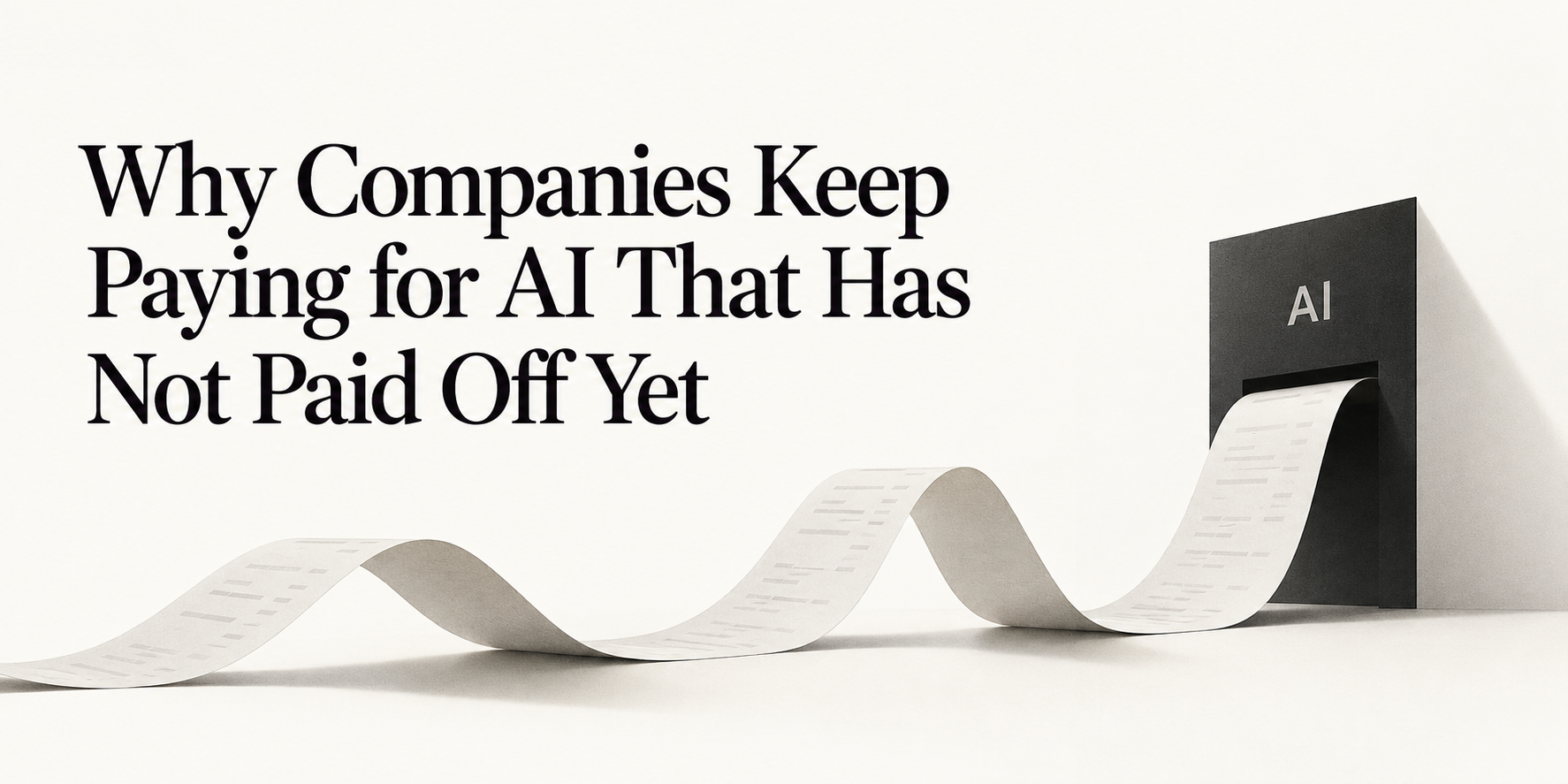
 Worldwide spending on AI will reach about $2.59 trillion this year, up 47% from last year, according to a Gartner forecast. In a study published this year by the National Bureau of Economic Research, a team of economists surveyed nearly 6,000 senior executives in the US, UK, Germany and Australia. Nine in ten said AI had made no difference to productivity or jobs at their company over the past three years.
My name is Alexander Kopylkov, and I invest in technology companies, including several in AI. To me, those two numbers describe a lot of businesses paying for something before it works for them. That is great news for anyone selling AI software today. It also makes my job harder. When customers pay before they see results, a startup's sales say much less about whether its product is any good.
Many companies are buying AI the way people buy a gym membership in January.
The money is real, the hope is real, and the results are supposed to arrive later. The same survey captures this mood. Already, 69% of companies use AI. The executives who have seen little change so far still expect AI to raise productivity at their companies, meaning how much work gets done per employee, by an average of 1.4% over the next three years.
Gartner sees it from the spending side. Its analyst John-David Lovelock says organizations currently prefer small AI projects that make existing work a little more efficient, and that the executives in charge of technology "face challenges in proving the value from AI investments."
When a finance team goes through the budget line by line, hope is the first thing it questions. A membership nobody uses is an easy one to cancel.
The budget review is coming, and it will sort the useful tools from the experiments.
Gartner predicted last year that more than 40% of "agentic AI" projects will be canceled by the end of 2027. Agentic AI is software meant to do a task on its own from start to finish, such as handling a customer's request without a person stepping in. Gartner's reasons are rising costs, unclear business value and weak controls over risk.
Gartner also estimates that only about 130 of the thousands of companies selling agentic AI offer the real thing. It even has a name for putting a new label on an old chatbot or assistant: "agent washing."
Investors who back business software expect the same sorting. In a TechCrunch survey of 24 of them, most predicted that companies would raise their AI budgets in 2026 and spend that money on fewer contracts. The math is simple. When a company cuts five AI tools down to two, three startups lose a customer in a single meeting.
I look for products that would survive a cost cut.
On a spreadsheet, a customer who is still experimenting looks exactly like a customer who cannot work without the product. Both pay the same invoice. So I ask questions that tell them apart. Can the customer show what the tool saved in money or hours? Who inside the company would complain if it disappeared tomorrow? Do the people doing the actual work open it every day?
I ask for measured results because impressions tend to run ahead of the numbers. A second study, also published by the NBER and based on a survey of nearly 750 corporate executives, found what its authors call a "productivity paradox": executives believe AI is helping more than the data shows. The researchers think the benefits are likely slow to show up as revenue.
A delay is fine when the customer can see the results coming. That is why I like startups that help customers measure what the product does for them. Those are the customers most likely to still be paying after the next budget review.
In the end, customers pay for what they can measure.
Gartner expects AI spending to keep climbing, to about $3.5 trillion in 2027. The question for investors is which tools that money will flow to. My bet is on the ones that can they work.
In every technology cycle I have invested through, the products that lasted were the ones a customer could point to on a budget sheet and defend. AI follows the same rule. It simply has a longer grace period, and grace periods end.
Further Reading
Discover more articles on similar topics across our network


Comments
Loading comments…