
Asset-intensive organizations lose millions every year to poor project execution, inaccurate demand forecasting, and disconnected supply chains. Integrating project management, cost controls, and supply chain systems can dramatically improve efficiency and financial outcomes. This article explores how asset-intensive organizations can adopt a project-driven supply chain methodology, covering: (1) What are asset intensive organizations?, (2) Current trends in the telecom industry, (3) Challenges asset-intensive organizations face, (4) Available tools to address these challenges, (5) How a project-driven supply chain mitigates top risks, (6) MTN Next case study, (7) Conclusion.
1. What are asset intensive organizations?
Asset-intensive organizations manage networks, plants, or field sites that require significant investment. Projects that create or upgrade these assets must align scope, time, and cost within one coordinated structure.
A project-driven supply chain links project plans with material forecasting, procurement, and delivery. Material needs identified during scoping and scheduling flow into supply planning, where teams confirm inventory, forecast shortages, and plan purchases. Procurement obtains materials, and logistics coordinates deliveries with project timelines.
The illustration below shows how project tasks generate material demand and move through this connected process.

Project-driven supply chain process for asset-intensive companies. Source: Oracle
2. Current telecom industry trends?
Gartner predicts sustained growth in telecom capital expenditure, with the industry recording 2X year-over-year increases in 2014, 2015, and 2016 — a trend expected to accelerate further in the coming years.
Forbes-cited global "Power Mobile Influencer" Gary Kim, ranked second worldwide for mobile business coverage, notes that U.S. internet access speeds have grown 10x every five years since 1990 — a trend that pointed to 100 Mbps by 2015 and 1 Gbps by 2020.

Gartner: bandwidth will increase 20% to 50% per year.
Deloitte's Craig Wigginton identifies telecom as a critical driver of growth, innovation, and disruption across industries, highlighting key opportunities and emerging trends in his 2017 industry outlook.
- U.S. consumers check their devices over 9 billion times daily, up 13% year over year.
- Smartphone penetration grew 10% annually, with the highest gains among those 45 and older.
- Wearables are gaining ground fast — smartwatch penetration doubled from 2014 to 2015, tripled in 2016, and now covers ~12% of U.S. mobile consumers.
Smartphone growth is unlocking opportunities across all telecom subsectors — from wireless carriers and network equipment providers to device manufacturers. To meet exponential demand driven by video and smartphone traffic, operators are ramping up coverage and data capacity, translating into surging capex. Gartner projects mobile infrastructure spending to rise 8% in 2015 to $43.36B, with fixed network investments up 7.7% to $10.33B, largely fueled by fiber broadband rollouts.
The revenue and growth opportunities are on the uptick, however there is increased downward pressure on profitability (ROI). Margins are thinner due to increased competition and larger capital investment in newer markets. Data below shows pressure on return on invested capital for telecom operators.
| Year | 2006 | 2007 | 2008 | 2009 | 2010 | 2011 | 2012 | 2012 | 2013 |
|---|---|---|---|---|---|---|---|---|---|
| Europe | 6.2% | 6.5% | 6.6% | 6.5% | 6.1% | 6% | 4.8% | 4.7% | 4.6% |
| Asia | 7.9% | 8.1% | 7% | 6.8% | 6.2% | 6.4% | 6.3% | 6.2% | 6.1% |
As per study conducted by Ernst & Young (EY), outlined below are the top 10 risks identified by EY for the telecom industry. Telcos that understand and manage operational, financial, compliance, and strategic risk have a greater chance of profitable growth.
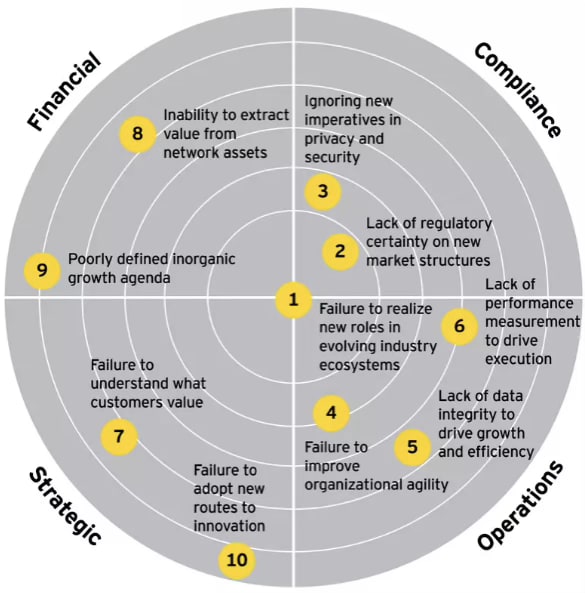
Top 10 risks in telecom 2014
- Failure to realize new roles in evolving industry ecosystems
- Lack of regulatory certainty on new market structures
- Ignoring new imperatives in privacy and security
- Failure to improve organizational agility
- Lack of data integrity to drive growth and efficiency
- Lack of performance measurement to drive execution
- Failure to understand what customers value
- Inability to extract value from network assets
- Poorly defined inorganic growth agenda
- Failure to adopt new routes to innovation
3. Challenges that asset intensive organizations face
From years of experience of working with top utility and asset intensive customers across the globe, I have learnt that disparate project tracking systems like: Project Department, Business Transformation, IT PMO, Procurement, Supply Chain, Operations, Finance, and Maintenance etc. working in their own silos impacts organisations to effectively mitigate top industry risks. Outlined below are some of the key business challenges we have seen industries across the globe face:
- Redundant information
- Weak executive visibility
- Lack of results accountability
- High TCO
- Difficulty driving and aligning projects with corporate priorities
- Each department using disparate applications
- Inability to effectively track projects
- Difficulty generating timely, accurate reports
The diagram below represents how lack of integrated Project Management, Procurement and Demand Planning functions in an organization could impact organization’s ability to yield higher ROIs.

4. Available tools to mitigate industry problems
The number of tools in the market may help organizations. The challenge is selecting the right tools and ecosystem for organizations success.
4.1. Project Schedule Management tools
Top tools include powerful platforms like Oracle Primavera P6 and Microsoft Project for large projects, flexible options like Smartsheet and Monday.com for mid-sized needs, and integrated solutions like Procore and Builder trend that combine scheduling with field management — covering everything from Gantt charts to real-time collaboration.
Here are five highly regarded project management tools, catering to different needs:
| Tool | Best For | Key Features |
|---|---|---|
| Oracle Primavera P6 | Complex project portfolios | Critical path scheduling, resource planning, progress tracking |
| Microsoft Project | Teams using Microsoft platforms | Gantt schedules, resource assignments, progress reports |
| Smartsheet | Teams preferring a spreadsheet-like layout | Automation, collaboration, grid, and Gantt views |
| Procore | Construction and infrastructure teams | Scheduling linked with cost and site coordination |
| Buildertrend / Fieldwire | Residential and field operations | Task management, plan-based work, strong mobile tools |
4.2. Project Supply Chain Management (SCM) tools
The top 5 Supply Chain Management (SCM) tools based on market presence and functionality, include SAP IBP, Oracle Cloud SCM, Blue Yonder, Kinaxis RapidResponse, and Coupa. These platforms offer end-to-end visibility, AI-driven demand forecasting, and robust analytics for manufacturing, retail, and enterprise procurement needs.
| Tool | Best For | Key Features |
|---|---|---|
| SAP IBP | Enterprise-level planning | Demand planning, analytics, S&OP |
| Oracle Cloud SCM | Broad supply chain operations | Procurement, logistics, order management, and financial integration |
| Blue Yonder | Retail and manufacturing | AI-supported forecasting, supply planning, and warehouse management |
| Kinaxis RapidResponse | Real-time scenario planning | Model-driven planning, network visibility |
| Coupa Design & Planning | Strategic sourcing | Cost modelling, network design, scenario comparison |
5. How project driven supply chain can mitigate top risks
Oracle Primavera is a leading enterprise project portfolio management (EPPM) suite built for planning, scheduling, and executing large-scale projects across construction, engineering, and manufacturing. Its core products : Primavera P6 EPPM, Primavera Cloud, and Primavera Portfolio Management deliver real-time visibility, resource management, and risk analysis. Below is an overview of how Oracle Primavera EPPM enables a project-driven supply chain in telecom to maximize ROI and address top industry risks.

Benefit of the fully integrated systems across an organization will help telecom organizations streamline their core business functions. Fully integrated business processes covering end-to-end asset lifecycle help lower communication gaps, and enable organizations to reduce TCO and improve ROI.

Implementing a project-driven supply chain requires integrating project planning, estimation, and execution with demand planning and procurement. Material demand is consolidated from site to regional to national levels, then fed into demand planning systems to ensure accurate, project-specific procurement. Any scope or demand changes at the project level are reflected in real time, enabling organizations to close key business gaps and reduce risk.
 A Project-Driven Supply Chain is an end-to-end integrated solution spanning Supply Chain and Project Management applications, designed to support key business processes for asset-intensive companies. It enables organizations to manage supply chain activities within the context of projects - without creating separate organizations for each - by seamlessly connecting supply chain and project management in the cloud. Some of the key benefits are:
- Plan project-specific inventory supply
- Receive project-specific supply
- Pick project-specific inventory
- Ship project-specific inventory
- Transfer project-specific inventory
- Purchase project-specific inventory
- Accept project-specific customer returns
- Execute project-specific manufacturing
- Perform project-specific maintenance
- Execute project-striped supply chain without Oracle Project Financial
6. Case Study
6.1. Introduction
This case study highlights a critical process gap discovered at MTN Group, a South Africa-based telecom with 300 million subscribers across 23 countries in the Middle East and Africa. The gap was addressed through MTN Next - a digital transformation program designed to re-engineer the company's manual and semi-automated business processes.
My role as a Solution Architect and Project Management Lead involved standardizing project management practices and implementing project-driven supply chain processes across all MTN Group locations. The challenge: coordinating a multi-country rollout to eliminate operational silos and establish consistent processes across diverse geographic environments — integrating supply chain operations directly with project execution to transform how the organization managed materials, procurement, and delivery across its entire footprint.
6.2. Problem Summary
Upon joining the program, an in-depth analysis of existing business processes for the project management division revealed significant opportunities for improvement and the need for new approaches. This analysis uncovered multiple process changes required to achieve the vision of enabling a project-driven supply chain.
MTN Group's Project Management Division was responsible for designing, constructing, managing, and maintaining infrastructure for planned business expansions across their geographic footprint. The team handled planning and estimating material needs—both assets and consumables—but lacked a single source of truth for company-wide material demand. Each country operated using different systems for this critical process.
Project teams submitted material demand to country-level supply chain teams, who then consolidated and forwarded requirements to the Group level. The volume of data and files flowing from projects across 21 countries was enormous. Tracking the correct version of demand files presented another major challenge for project teams.
The analysis revealed several critical issues requiring improvement:
- No centralized system existed for consolidated material demand across the organization.
- Manual communication between project and supply chain teams extended the material planning cycle unnecessarily.
- Manual data reconciliation introduced errors into demand planning processes.
- Blanket negotiations with suppliers were ineffective without consolidated demand visibility.
- Project timeline changes weren't communicated promptly, resulting in unutilized inventory and high carrying costs.
These issues created clear inefficiencies affecting all involved teams. The process needed refinement to eliminate time wasted on manual data reconciliation and improve material planning accuracy. Addressing these gaps would reduce inventory carrying costs, resolve the unutilized inventory problem, and enable MTN Group to leverage centralized demand for better supplier negotiations.
6.3. Proposed Solution
Following an in-depth analysis of existing processes, a solution was proposed to enable a true project-driven supply chain system. The proposal required justification with expected success metrics and projected benefits, classified across three categories: process improvements, resource efficiency gains, and direct cost savings. After a series of meetings with country heads and cross-functional teams, MTN Group agreed to implement the proposed changes.
The 2-year implementation focused on three key milestones to enable the project-driven supply chain process:
- Oracle Primavera EPPM was established as the system of record for consolidated material demand by Project, Country, and Group.
- Integration between Oracle Primavera EPPM and the Supply Chain system (Oracle ERP) was enabled to automatically publish project material demand and eliminate manual data reconciliation.
- Automatic demand revision signals were configured to alert the supply chain team of changes in real-time.
The development, testing, and rollout of these solutions took two years to complete. The effort streamlined business processes across all 21 countries and achieved the vision of enabling a project-driven supply chain for MTN Group.
6.4. Key Business Benefits Delivered
After two years of planning and execution, this solution was successfully deployed for 4 out of 21 selected countries for Phase 1 rollout. After monitoring this process for three quarters, success criteria validation surveys were conducted, and the following were some of the critical results delivered for MTN Group:
- Improved efficiency of project teams by 30% by removing manual data reconciliation steps from the process.
- Improved material demand accuracy by 15% by enabling Oracle Primavera EPPM & Supply chain integration.
- Reduced procurement planning cycle time by 25%.
- MTN Group was able to save 10% more due to blanket negotiated material prices.
- Sorting out the problem of unutilized inventory over 1.5 billion USD (Phase 1 Rollout).
MTN Group highly appreciated the solution and approved the solution deployment for the remaining 17 countries. Getting away from the problem of non-centralized systems and manual data processing, MTN Group not only made the system efficient for the users but also boosted savings for the company. Integrating project material demand systems with corporate supply chain systems, helped MTN Group in enabling project-driven supply chain system. Benefits listed above are a real testament of the success this process change has delivered to MTN Group.
7. Conclusion
Project-Driven Supply Chain (PDSC) methodology transforms how asset-intensive organizations align supply chain operations with project execution — integrating inventory, cost tracking, and delivery timelines directly into project management without added organizational complexity.
For industries like telecom, construction, and infrastructure, PDSC delivers measurable gains: project-specific inventory management eliminates material misallocation, real-time financial visibility enables accurate cost tracking, and process automation reduces manual effort while improving accuracy. Materials link directly to project milestones, ensuring the right resources arrive at the right time.
Critically, PDSC provides strategic risk mitigation — enabling organizations to secure scarce materials early and plan proactively against supply chain disruptions, protecting timelines and budgets in capital-intensive environments where delays carry significant financial consequences.
Ultimately, PDSC elevates supply chain management from a supporting function to a strategic enabler of project success, operational efficiency, and bottom-line performance.
Featured conference
Presented this methodology and case study at Collaborate15 (#C15LV), a major Oracle technology and applications user group event in Las Vegas, hosted by the Oracle Applications & Technology Users Group (OATUG) — a global forum bringing together more than 5,500 Oracle professionals for education, customer exchange, and networking.
Session topic : Primavera EPPM in Asset-intensive Organizations
Session ID#: 200100
Session Date : April 15, 2015
References
Referenced studies from renowned institutions and individuals help frame current telecom industry trends and establish a quantifiable baseline for the impact the proposed methodology could deliver.
- Overview of Project-Driven Supply Chain Management. (n.d.). Oracle Docs. https://docs.oracle.com/en/cloud/saas/supply-chain-and-manufacturing/25c/faims/overview-of-project-driven-supply-chain-management.html
- Kim, G. (2013, May 26). Internet speeds have grown 10X every 5 years since 1990. IP Carrier. https://ipcarrier.blogspot.com/2013/05/internet-speeds-have-grown-10x-every-5.html
- Wigginton, C. (2017, March 1). 2017 Telecommunications Outlook. The Wall Street Journal. https://deloitte.wsj.com/cio/2017-telecommunications-outlook-1488344531
- Telecom network spending is expected to grow amid the 4G boom. (2015, January 27). The Business Times. https://www.businesstimes.com.sg/startups-tech/technology/telecom-network-spending-expected-grow-amid-4g-boom
- Accelerating and optimizing returns on telecom network capital investments. (2015, August 11). Gaea Global Technologies. https://gaeaglobal.com/optimizing-telecom-network-capital/
Author’s Bio
Parminder Singh is a certified project management professional and experienced in leading large-scale technical programs across global industries. He specializes in project delivery, cross-functional leadership, and end-to-end lifecycle management, with expertise spanning product development, system integrations, data migrations, and enterprise process transformation.
LinkedIn: https://www.linkedin.com/in/parmindersingh11may85/
Further Reading
Discover more articles on similar topics across our network



Comments
Loading comments…