
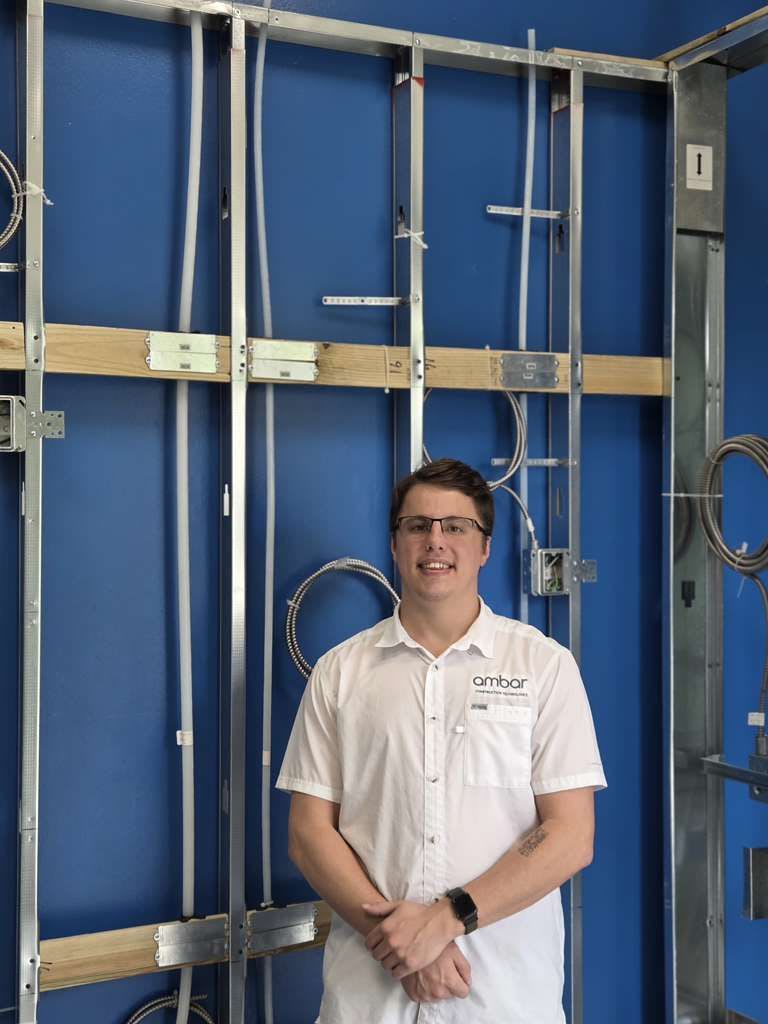
MIAMI, FL — As the U.S. construction industry faces a documented shortage of 500,000 skilled workers, new applied engineering frameworks are emerging to stabilize residential production and combat the rising costs of housing development. At the forefront of this industrial shift is a proprietary methodology designed to transform traditional building workflows, overseen by Diego Landi, a lead strategist at Ambar (a construction technology and engineering firm specializing in industrialized building solutions). By transitioning complex field tasks into factory-controlled processes, the system provides a scalable response to the systemic bottlenecks currently hindering the U.S. housing market.
Technological Shift: The Rise of Industrialized Modular Walls
The industry is currently witnessing a paradigm shift from traditional on-site assembly to manufacturing-based logic. This transition, centered on the Ambar system, treats construction as an industrial assembly line rather than a series of fragmented job-site activities.
- Integrated Modular Components: The innovation focuses on proprietary wall units that pre-incorporate Mechanical, Electrical, and Plumbing (MEP) systems alongside framing. This allows for a "plug-and-play" assembly at the construction site, reducing the reliance on multiple overlapping trades.
- Predictive Engineering & Digital Twins: Advanced data modeling is utilized to create a "digital twin" of each residential unit. This process, refined under Landi’s technical direction, allows for 100% precision in clash detection and trades coordination before any material is moved on-site.
- Process Standardization: By replacing unpredictable field variables with standardized Bills of Materials (BOMs) and Bills of Labor (BOLs), the methodology ensures manufacturing-grade predictability for high-density residential infrastructure.
- Efficiency in Rough-In Stages: This model successfully shifts up to 50% of critical "rough-in" work from the field to a controlled factory environment, mitigating weather-related delays and enhancing worker safety.
The Ambar Advantage: Proven Results in Speed and Scale
The operational impact of this industrialized approach has provided a statistically proven solution to the current labor constraints in the Florida market. Data from active project sites highlights the efficiency gains of the engineering models managed by the Brazilian engineer:
- 50% Reduction in On-Site Labor: The modular framework reduces the total workforce requirements for framing and MEP phases by half, significantly lowering overhead for developers.
- 33% Faster Delivery Cycles: Average construction cycles for residential units have been reduced from 45 days to 30 days, allowing projects to reach completion and occupancy at a significantly faster rate.
- Industrial Production Scale: The current infrastructure supports a production capacity of 170 to 200 modular walls per day, facilitating the rapid assembly of 6 to 8 apartments daily.
- Quality Consistency: Statistical analysis shows that quality control metrics in the factory-led setting are superior to traditional on-site methods, leading to fewer post-construction repairs and structural issues.
Market Adoption and Client Portfolio
Since its full deployment in 2022, the impact of this industrialized approach has been validated by major market players and sustained corporate growth.
- Regional Deployment: The system has been successfully implemented across 23 active construction sites throughout the Florida region since 2022.
- Corporate Expansion: Ambar has reported an 87% Compound Annual Growth Rate (CAGR), reflecting the industry's demand for efficiency-driven engineering models.
- Key Industry Partnerships: The methodology is currently utilized by top-tier developers and general contractors, including Bec Group, Portland, Sagewood and T&G Constructors, and Jaxi Builders.
- Landmark Projects: High-impact implementations include the Park Square development (212 units) and the Princeton 248 project, underscoring the system's reliability for large-scale urban demand.
- Industry Excellence: The framework maintains a Net Promoter Score (NPS) of 88.8, placing it in the highest tier of satisfaction within the U.S. construction industry—far exceeding the sectoral average of 37.
The Expert Behind the Implementation: Who is Diego Landi?
Diego Landi is a Brazilian expert in Applied Engineering and Project Management who has become a key figure in the industrialization of U.S. residential workflows.
- Technical System Engineering at Ambar: Serving as a primary technical contributor, Landi was instrumental in scaling the Ambar System from its conceptual engineering phases to a leading market solution now active across Florida.
- Operational Implementation & Field Transition: Landi’s expertise was pivotal in translating industrialized technology into practical on-site results. Beyond the engineering design, he led the operational strategy to shift 50% of "rough-in" work to factory environments while managing the critical adoption of this new philosophy by job-site personnel. By ensuring that key personnel adhered to the industrialized framework, he bridged the gap between theoretical technology and actual field execution, converting a conventional building culture into a system-driven operation.
- VDC Integration Specialist: Landi manages the complex technical integration of Virtual Design Construction (VDC) with physical industrialized assembly, bridging the gap between high-level engineering designs and site execution.
About Diego Landi: Born in Brazil, Diego Landi is an expert in Applied Engineering and Project Management who earned his Master's degree from Florida International University. He focuses on the industrialization of construction processes through data-driven integration and modular manufacturing.
About Ambar: Ambar is a construction technology and engineering firm based in Miami, specializing in industrialized MEP and framing integration for the U.S. residential market.
Q&A: A Technical Journey into Industrialized Construction
Technical Journey: How was the process of transforming unpredictable, manual construction into an industrial assembly line logic? What were the biggest engineering barriers?
The process was essentially about deconstructing traditional workflows and rebuilding them through the lens of manufacturing. The biggest engineering barrier wasn't just the physical component design, but the integration of multiple disciplines—framing, electrical, and plumbing—into a single, coordinated product. We had to move from a culture of "fixing things in the field" to a culture of "perfecting things in the digital twin." Translating that level of factory precision to the variability of a construction site required rigorous standardization and a completely new set of technical protocols.
Learning: During the development of this new system, what was the most important lesson you learned about the difference between a jobsite and a factory environment?
The most important lesson was understanding that a jobsite is inherently more chaotic, dynamic, and unpredictable than a factory. Simply “copying” factory logic into construction does not work. The philosophy must be adapted to field conditions.
In a factory, the environment is controlled; on a jobsite, it is not. What we did was bring industrial principles—clear separation of activities, production control, standardization, and quality control—and translate them into a construction environment where contractors have clearly defined scopes, well-established activity durations, and well-defined quality expectations. This adaptation was critical to the system’s success.
Real Impact: A 50% reduction in labor is a powerful metric. In practice, how did this change day-to-day project management in Florida?
Traditionally, there is a belief that increasing production requires a significant increase in labor. In reality, this often leads to more chaos, more trade interference, and less control. With our system, the opposite happened.
Reducing labor by approximately 50% allowed us to increase productivity with fewer people on site. This created major improvements in daily project management: greater predictability, tighter production control, easier quality oversight, and a significant reduction in rework.
For clients, the impact is direct—record delivery timelines with guaranteed execution quality and a much higher level of planning reliability. For management teams, it means fewer uncontrolled variables and decisions driven by real production data.
Future Vision: Now that this methodology is consolidated across 23 sites, what is the next step to scale this innovation nationwide?
Consolidating the system across 23 sites was a major milestone, especially considering that developing it felt like rowing against the tide. Many contractors are deeply rooted in traditional methods, and changing that mindset was one of the most challenging aspects of the process.
The next step is scaling the innovation while maintaining consistency. This includes process standardization, team training, alignment with strategic partners, and, most importantly, spreading a culture of trade integration. The methodology has already proven its effectiveness; now the focus is on replicating it at a national scale without sacrificing control, quality, or efficiency.
More than a process change, this represents a shift in mindset in how construction is planned, executed, and managed across the United States.
Further Reading
Discover more articles on similar topics across our network


Best 24/7 Answering Services in 2026: AI and Human Options Compared
Stackademic
Comments
Loading comments…