Technical interviews look nothing like they did a few years ago. Companies rarely judge candidates on clean code alone anymore. Depending on the role, you might be asked to size up a business problem, sketch out a system design, interpret an experiment, or simply explain your thinking out loud in a way a nontechnical interviewer can follow.
What makes this harder is that no two companies test for the same thing in the same way. Two firms hiring for an identical title might run completely different interview loops. One leans hard on coding puzzles. Another cares more about business judgment or how you reason through ambiguity. Walking in without knowing which version you are about to face puts you at a real disadvantage.
That is where preparation platforms come in. Below is a look at five of the better known options in 2026, what each one is actually good at, where each one falls short, and who each one suits best.
What separates a good platform from a mediocre one
Three things mattered most when comparing these tools.
How accurate the questions are. A platform that hands you a generic list of "common interview questions" is only somewhat useful. One that shows you what a specific company tends to ask for a specific role is far more valuable, because you are practicing something close to what you will actually see.
How realistic the practice feels. Reading a question and thinking through an answer in your head is not the same as typing code under a timer, walking through a case study out loud, or sitting through a mock interview that mimics the real pressure of the room.
How much the platform helps you improve. Answering questions is only half the job. You also need to understand why an answer worked, where your reasoning broke down, and what to fix next time. A platform that just hands you a pass or fail with no explanation leaves you guessing.
With those three things in mind, here is how each platform stacks up.
1. Dataford
Dataford builds its entire experience around the company and role you are actually targeting. You pick both, and it surfaces the questions, guides, and process details tied to that specific employer, rather than a generic bank of "typical" interview questions.
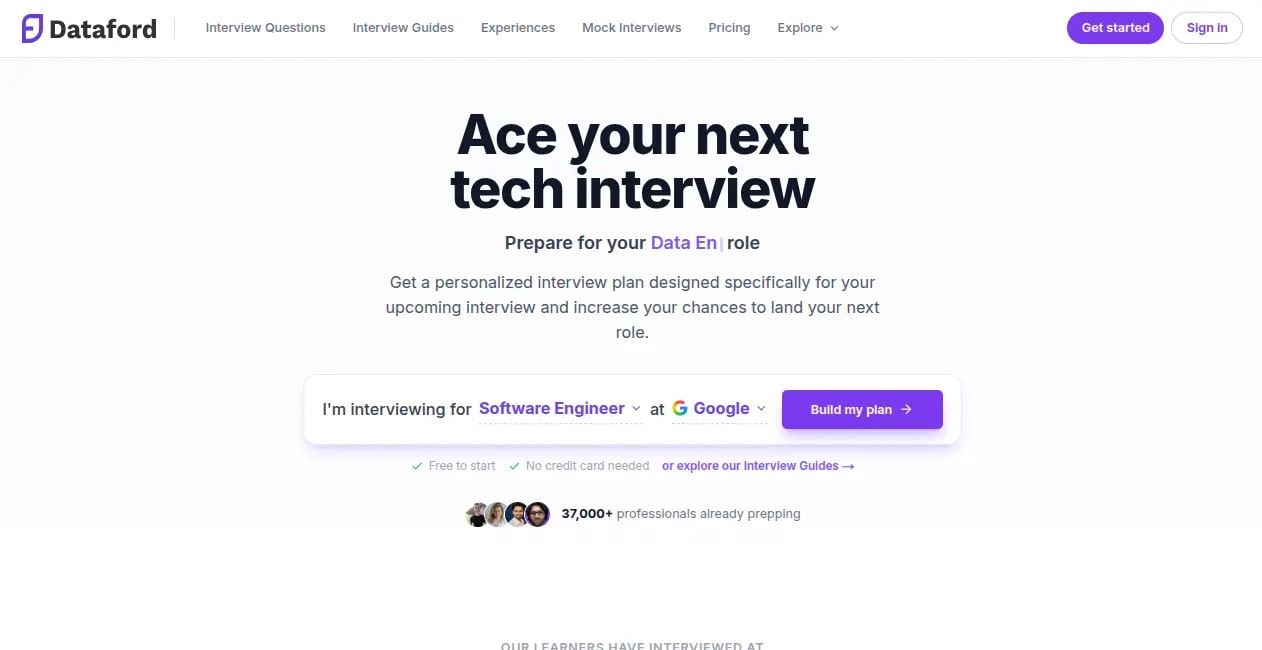
That distinction matters more than it sounds. A data analyst interview at a fast growing startup and one at a large retailer can look nothing alike, even though the job title is identical. Dataford's whole premise is that preparing for the company in front of you beats preparing for interviews in general.
The scale here is hard to overstate: more than 7,000 companies, over 50 roles, and roughly 500,000 questions spanning data, engineering, product, AI, and other technical functions.
Question accuracy: This is where Dataford separates itself. Because it maps questions to thousands of specific company and role combinations, you are far more likely to run into something close to what you will actually be asked, instead of prepping from a generic pool.
Practice experience: You can work through technical questions in interactive environments and practice everything from coding and system design to business cases, experimentation, and behavioral rounds.
Learning support: Explanations are built to help you understand the logic behind an answer rather than just memorize a correct response.
Where it works well: Broad, accurate coverage across companies and roles. Supports both technical and business style problems. Interactive practice with real explanations behind each answer.
Where it comes up short: If you do not yet have a target company or role in mind, the sheer size of the library can feel like a lot to sort through. It is built more for focused prep than for teaching a skill from scratch.
Best suited for: Anyone who wants highly relevant questions tied to a real company and role, along with the tools to actually understand them.
2. Exponent
Exponent is the most polished option for people who want structure rather than a raw question bank. It runs dedicated courses across product management, software engineering, data science, data analytics, data engineering, machine learning, system design, SQL, and more.
Its standout feature is human coaching. You can book mock interviews and one on one sessions with people who have done this before, along with resume reviews and help negotiating an offer once you get one.
The tradeoff is coverage. Exponent handles its core technical and product tracks well, but if your target role sits outside those categories, you may not find much built for you.
Question accuracy: Strong within its supported roles, though organized more around broad categories than deep company by company detail.
Practice experience: Mock interviews, structured practice questions, and real human coaching make this a strong pick if communication and structured thinking are what you need to work on.
Learning support: Courses, sample answers, and coaching feedback give you several angles to understand your own mistakes.
Where it works well: Genuinely well structured courses. Real human coaching and mock interviews. A clean, easy to navigate experience with strong sample answers.
Where it comes up short: Covers a fairly narrow set of roles. Less specific to individual companies than Dataford. Coaching sessions add to the overall cost.
Best suited for: People who want a guided learning path plus actual coaching and mock interview practice.
3. Final Round AI
Most people spend far more time rehearsing what they will say than practicing how they will say it. Final Round AI is built entirely around that gap.
It uses AI interviewers and realistic avatars to simulate a live interview, with questions tailored to your resume, background, and target role. The goal is practicing the delivery side of interviewing: thinking out loud, explaining your reasoning, asking clarifying questions, and holding up under time pressure.
It works best as a complement to a platform with sharper company specific or technical content, rather than as your only source of prep.
Question accuracy: Questions are personalized using your resume and the job description, but they will not always match the exact questions or process a given company actually uses.
Practice experience: This is the platform's strongest point by a wide margin. The AI interview experience feels much closer to a real conversation than reading through a list of questions on your own.
Learning support: You get AI generated feedback on your answers and delivery, though it can feel a bit generic at times.
Where it works well: A realistic AI mock interview experience. Genuinely useful for practicing composure under pressure. Personalizes questions from your resume and target job.
Where it comes up short: Limited accuracy for company specific questions. Feedback can feel a bit canned. Not a full substitute for practicing with an experienced human.
Best suited for: Candidates who already know the material and need to work on how they communicate it.
4. DataLemur
DataLemur focuses squarely on data interviews, especially anything involving SQL.
It offers SQL questions modeled on what real companies ask, with problems built to mirror what you would actually see in a technical screen. There is also a solid amount of free content, which makes it approachable if you are not ready to commit to a paid platform yet.
The narrow focus is both its strength and its ceiling. Plenty of interviews also cover Python, statistics, experimentation, business judgment, and behavioral questions, none of which fall under DataLemur's scope.
Question accuracy: Solid, realistic SQL questions in the style of real companies, though it does not give you much visibility into the full interview process for a given role.
Practice experience: You write and run SQL directly on the platform, which feels close to an actual technical assessment.
Learning support: Explanations walk through the reasoning behind each query instead of just showing the correct answer.
Where it works well: Strong SQL specific questions. Genuinely interactive practice. Clear explanations and useful free content.
Where it comes up short: Almost entirely focused on SQL and data roles. Limited view of the broader interview process. Not much help for business or behavioral prep.
Best suited for: Anyone looking to sharpen SQL and general data problem solving specifically.
5. LeetCode
LeetCode is probably the most recognized name on this list, and for good reason. Its question bank is massive, its coding environment is dependable, and its community offers multiple explanations for nearly every problem.
For software engineering interviews, it remains one of the strongest resources available, particularly for algorithms, data structures, and coding under a clock. It also includes database questions for SQL practice.
Its main limitation is scope. LeetCode was built for software engineering interviews first, which means it offers little for business judgment, experimentation, product cases, or behavioral rounds.
Question accuracy: Plenty of questions tied to major companies, though you still need to figure out which ones are actually relevant to your role.
Practice experience: A reliable, familiar coding environment plus timed contests that help you build comfort working under pressure.
Learning support: Community discussions offer multiple ways to approach the same problem, though the sheer volume can be a lot to sift through.
Where it works well: A large, mature question bank. A dependable coding environment. Strong community explanations for algorithm heavy prep.
Where it comes up short: Much of the content is not relevant outside engineering roles. You have to do the filtering yourself. Limited coverage of business and product problems.
Best suited for: Software engineers, data engineers, and anyone expecting an algorithm heavy coding interview.
So which one should you actually use?
It really comes down to what you need most right now.
If you want accurate questions tied to a specific company and role, go with Dataford. If you want structured courses and real coaching, Exponent fits better. If you need practice simulating a live interview, Final Round AI is built for that. If SQL is your gap, DataLemur is the sharper tool. And if you are staring down an algorithm heavy coding round, LeetCode still holds up.
Most people end up getting more out of pairing two platforms than relying on just one. You might use Dataford to understand exactly how a company runs its process and pull the most relevant questions, then use Final Round AI to practice explaining your answers under pressure. Or you could work through Exponent's frameworks first, then round out your coding practice with DataLemur or LeetCode.
How to actually prepare well
Start by researching the company itself and mapping out each stage of its process. Figure out whether it leans toward coding, system design, experimentation, business judgment, or behavioral questions.
From there, practice the questions that match that specific process. If you are working through a coding problem, talk through your approach before you start writing code. If it is a business case, nail down the objective and the metrics that actually matter before you jump to solutions.
Finally, run it like the real thing. Set a timer, ask clarifying questions, and narrate your thinking as you go. When you review afterward, look at more than whether your final answer was right. Pay attention to whether your reasoning held together and was easy to follow.
None of this is about grinding through the largest possible number of practice questions. It is about knowing what is coming, practicing somewhere that feels close to the real thing, and actually learning something from every attempt.
Further Reading
Discover more articles on similar topics across our network
8 Best Global Hiring Solutions for Building Distributed Teams in 2026
Stackademic
7 Best Options When Choosing a Resume Builder for Computer Science Students
Stackademic

Comments
Loading comments…