
Recent academic findings warn of "AI-powered disinformation swarms" capable of manipulating public perception at scale. In financial markets, this noise creates a dangerous fog where sentiment can be manufactured and reality obscured.
However, the events of 2025 proved that price action often fails to reflect fundamental reality creating a decoupling that investors can no longer ignore. While Bitcoin corrected approximately 6.4% and the total crypto market capitalization contracted by roughly 10.4% over the year, network utility did not recede. It exploded.
This divergence suggests that relying solely on price charts or social media sentiment has become a liability. The era of trading based on momentum and vibes is ending. To navigate the current environment, investors require a synthesis of hard macroeconomic data and on-chain verification, rather than just watching ticker movements.
Macro Data as Leading Indicators
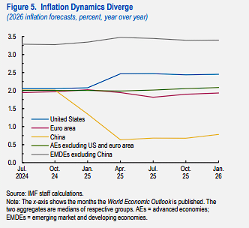
The global economic backdrop for early 2026 is one of stabilization instead of the chaotic expansion or desperate contraction seen in previous cycles. IMF data projects global growth to remain resilient at 3.3% this year and inflation cooled to 3.8%. This macroeconomic floor dictates a new flow of capital that is far more discerning than in the past. Liquidity is no longer spraying indiscriminately into speculative assets; it is concentrating structurally where value is proven.
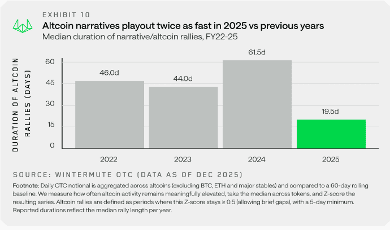
Wintermute's 2025 OTC report highlights this shift effectively. Their analysis reveals that liquidity has clustered heavily in BTC, ETH, and large-cap assets, leaving the long tail of the market starved for capital. Consequently, speculative altcoin rallies have suffered from exhaustion, shortening to a median duration of just 19 days. In this macro environment, capital flows are structural, driven by ETFs and treasuries, rather than retail impulses.
In this maturing landscape, scale and regulatory compliance have become the primary currencies of trust. As Binance Co-CEO Richard Teng observed regarding the industry's evolution, "Binance's 2025 numbers show scale, and most importantly, what that scale requires: regulatory anchors like ADGM authorization, resilience, and security programs that prevent real losses."
He further noted that the "ADGM license crowns years of work to meet some of the world's most demanding regulatory standards." This commentary underscores a market reality where regulatory standing is not just a legal necessity but a leading indicator of liquidity retention.
On-Chain Metrics as Behavioral Signals
While price charts showed stagnation throughout much of last year, on-chain metrics revealed a payment network operating at the scale of major credit card processors. Late 2025 data indicates that stablecoins processed approximately $3.1 trillion in daily transactions, a figure that surpasses Visa's average throughput. This suggests that stablecoins have effectively become the "killer app" of the ecosystem, functioning as a massive settlement layer regardless of asset valuations.
User behavior has shifted from passive holding to active ecosystem participation, driven by integrated platforms. Binance Co-CEO Yi He described this evolution in user engagement, "The way people interact with Web3 changed meaningfully. With Binance Alpha 2.0, a new era of Web3 discovery emerged directly inside the Binance experience. Users could access airdrops and participate in on-chain launches while still enjoying the speed, reliability, and UX of a centralized platform."
Further evidence of market sophistication appears in derivatives data. Wintermute reported that options activity surged more than twofold in 2025. This increase signals a market increasingly used for systematic hedging, yield generation, and risk management rather than simple directional gambling.
These metrics, stablecoin velocity and options depth, offer a more accurate health check of the digital asset economy than the spot price of Bitcoin alone. They indicate a financial system being used for utility, even when speculative mania subsides.
Binance Research as a Synthesis Model
"Synthesis" in this context refers to the overlay of macroeconomic constraints against on-chain behavioral data. This approach is rapidly replacing the reactive and price-driven commentary of the past. Binance Research exemplifies this shift toward institutional-grade analysis prioritizing transparency and structural assessment over hype. The demand for this level of rigor is visible in trading volumes.
Despite the broader market downturn in 2025, institutional trading volume on Binance grew by 21%, while corporate treasury adoption accelerated. This data point proves that sophisticated actors are ignoring surface-level price noise that often scares away retail tourists. Instead, institutions are relying on deep infrastructure and data analysis to navigate the market. They are looking at the plumbing of the financial system, settlement times, liquidity depth, and regulatory security, rather than short-term price variance.
Why Synthesis Builds Trust in Noisy Markets
In an era where AI agents can manufacture infinite noise and distort sentiment, verifiable data remains the only objective truth. On-chain volume and confirmed macro statistics cannot be hallucinated. Consequently, the role of crypto media and research has fundamentally changed. The objective is no longer to predict the next asset to multiply in value, but to interpret complex data intersections for informed decision-making.
The year 2026 will be defined by investors who understand the mechanics of the financial system, rather than those fixated on the ticker tape. Interpretation is now more valuable than amplification. As the market matures, the synthesis of macro stability and on-chain utility provides the only clear signal in the noise.
Further Reading
Discover more articles on similar topics across our network




Comments
Loading comments…