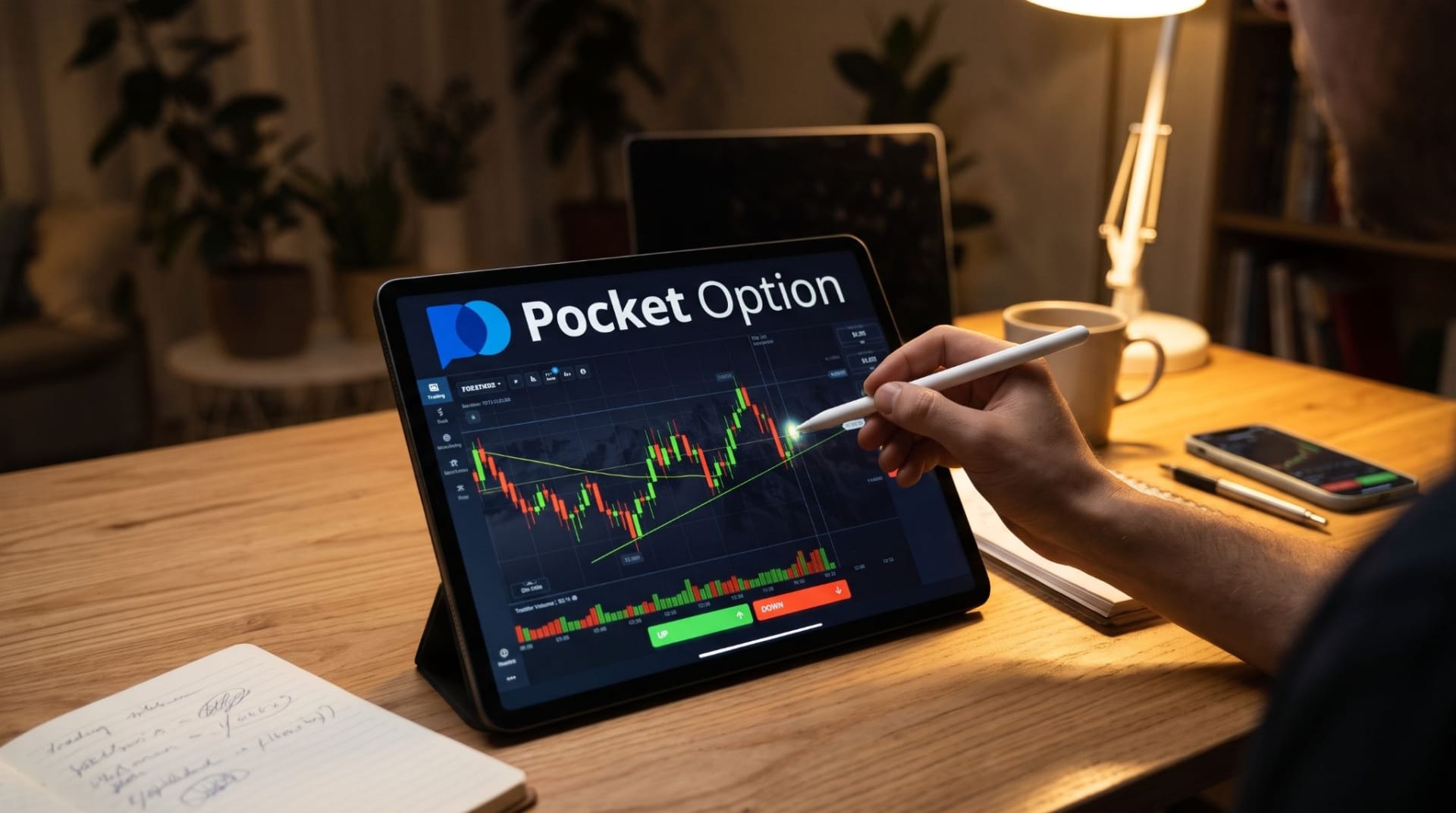
Trading platforms tend to describe their products in a vocabulary that newcomers find hard to follow, and a percentage on a button can mean something quite different from what it seems. Pocket Option, a trading platform that has operated since 2017, is a good example to unpack, because its core offer comes down to a few numbers. This article explains what those numbers mean in everyday terms.
What is a quick trade on Pocket Option?
Pocket Option’s quick trade is the simplest thing the platform offers. The user picks an asset, such as a currency pair, and a length for the trade, then predicts whether the price will be higher or lower when that time runs out. If the prediction is right, the trade pays out. If it is wrong, the money put into the trade, called the stake, is lost.
The Pocket Option USA page gives the starting numbers for American users. An account can be opened with $5, and the smallest stake per trade is $1. All balances are kept in US dollars.
The length of the trade is called the expiry time. Short expiry times mean results arrive quickly, which also means money can be won or lost quickly. For a beginner, this speed is one of the first things worth getting used to on the demo account, which runs on virtual money and opens without registration.
What does a payout of up to 92% actually mean?
Pocket Option’s payout percentage shows how much a winning trade earns on top of the stake. A payout of 92% on a $10 stake means a correct prediction returns the original $10 plus $9.20. A wrong prediction on the same trade loses the full $10.
A single percentage hides this imbalance. A win earns less than the stake, while a loss costs the whole stake. Over many trades, someone who is right exactly half the time will end up with less money on average, which is why reading the payout as a profit rate on the whole balance gives the wrong picture. The phrase “up to” matters too: 92% is the top of the range, and the payout on a given asset at a given moment can be lower.
Express trades work on the same principle with a higher ceiling of up to 218%. They combine more than one prediction in a single trade, which is why the possible payout is larger. All of the predictions have to be correct for the trade to pay out, so the chance of losing the stake rises with each added prediction.
Which other terms come up most often?
Pocket Option’s interface uses a handful of words that are worth knowing before the first session:
- Demo account: a practice account with virtual money that cannot be withdrawn
- Account levels: stages tied to the size of the balance that unlock extra features, such as more assets and a payout bonus
- Turnover condition: the trading volume that has to be reached before bonus money can be withdrawn
- OTC assets: instruments offered by the platform alongside regular market assets
These terms explain most of what a new user will see on screen. Pocket Option also offers copy trading, which lets one user repeat another trader’s trades, and tournaments, where users compete on a leaderboard.
Trading on Pocket Option carries a high level of risk, and users can lose all the money they deposit. Understanding how payouts work does not change that risk, but it makes the numbers on the screen easier to read honestly.
Further Reading
Discover more articles on similar topics across our network


Comments
Loading comments…