A digital result arrives as a finished fact. A card appears, a raffle selects a ticket, or a game returns a number. The user sees the outcome but not the process behind it. Provably fair systems narrow that gap by publishing cryptographic evidence that allows the result to be checked later.
The model does not make a platform trustworthy in every respect. It addresses a narrower problem: whether an operator changed a hidden input after learning which outcome would benefit the user or the server. Hashes, paired seeds, and a counter called a nonce create a record that can expose substitution.
The Commitment Comes Before the Result
The process starts with a server seed, usually a long random value generated by the platform. Revealing the raw details right away would let users project future outcomes, so the platform shares just the hash to start.
A cryptographic hash locks an input into a fixed-length string where identical data always produces the identical code. However, if you alter just one minor detail, the resulting string looks completely unrecognizable. Most systems rely on SHA-256 to do the heavy lifting. The published hash acts as a commitment, locking the server to a seed without revealing it.
The commitment works because finding the original seed from a secure hash is computationally impractical, while checking a revealed seed is fast and straightforward.
After the round or seed cycle ends, the platform discloses the original server seed. A user hashes it independently and compares the output with the earlier commitment. A match shows that the revealed value corresponds to the committed one. A mismatch means it does not.
This is a commit-reveal scheme. Timing gives it value. The commitment must appear before the result, and the secret must become available afterward. A hash published only after the outcome leaves room to choose an input that fits an already known result.
Why One Seed Is Usually Not Enough
A server seed alone leaves the operator in control of the hidden input. Many designs add a client seed, supplied by the user or generated in the browser. The outcome is derived from both values.
The client seed does not guarantee ideal randomness. It reduces unilateral control because the server commits before the user-controlled input is finalized. The protection still depends on the protocol, including when each seed is chosen and whether either party can abandon an unfavorable round.
A nonce separates repeated outcomes generated from the same seed pair. It often begins at zero and increases with each round. Combining a client seed with nonce 0 creates a different message from combining it with nonce 1.
While some setups simply hash concatenated strings, others swap to HMAC to add a keyed layer. Under an HMAC-SHA-256 setup, the server seed serves as the secret key, leaving the client seed and nonce to bundle together as the message. It's a common pattern that standard cryptographic libraries easily handle.
Turning a Digest Into a Result
An HMAC yields a raw byte sequence, typically represented as a hex string. But you still need a dedicated mechanism to map that string onto a concrete action—say, rolling a die or indexing a card. A straightforward approach just parses a segment of the hash into a big integer, drops it into a fraction, and then multiplies it out to fit whatever range your game mechanics require.
Production code requires more care. A careless modulo operation can create bias when the source range does not divide evenly into the target range. Rejection sampling or another specified method can avoid that issue.
The mapping rule matters as much as the hash. Two verifiers may use identical seeds but disagree if they read different bytes. A useful fairness page identifies the algorithm, input format, separators, nonce behavior, byte conversion, and final formula.
Material from CryptoManiaks, a site publishing cryptocurrency and blockchain guides, reviews, and comparisons, can help place these systems within the wider crypto sector. The distinction between cryptographic verification and platform assessment remains important. A reproducible result does not confirm safe custody, reliable withdrawals, licensing, or secure software. Those questions need separate evidence.
Where Provably Fair Algorithms Appear
The most visible applications sit inside crypto casinos, where dice, crash-style games, mines, and card products may expose seed data and a verification tool. A valid check can show that a recorded round follows the published algorithm and committed seed. It does not remove a house edge. It says little about deposits, withdrawals, or personal-data handling. The fairness claim stays limited to the result-generation process the verifier reproduces.
Related designs appear in blockchain games, digital raffles, randomized item distribution, and auditable result generators. Interest in blockchain for online gaming has encouraged on-chain commitments, multi-party seed contributions, and verifiable random functions. Commit-reveal can fail when a participant refuses to reveal a seed, while systems that rely naively on block data may leave room for manipulation. The threat model should shape the design.
A Small JavaScript Verification Example
Node.js includes the node:crypto module. This simplified example verifies the commitment, rebuilds one round, and maps the first four digest bytes to a number from 0 to 99.99. The goal is to demonstrate the verification process rather than a production-ready conversion method.
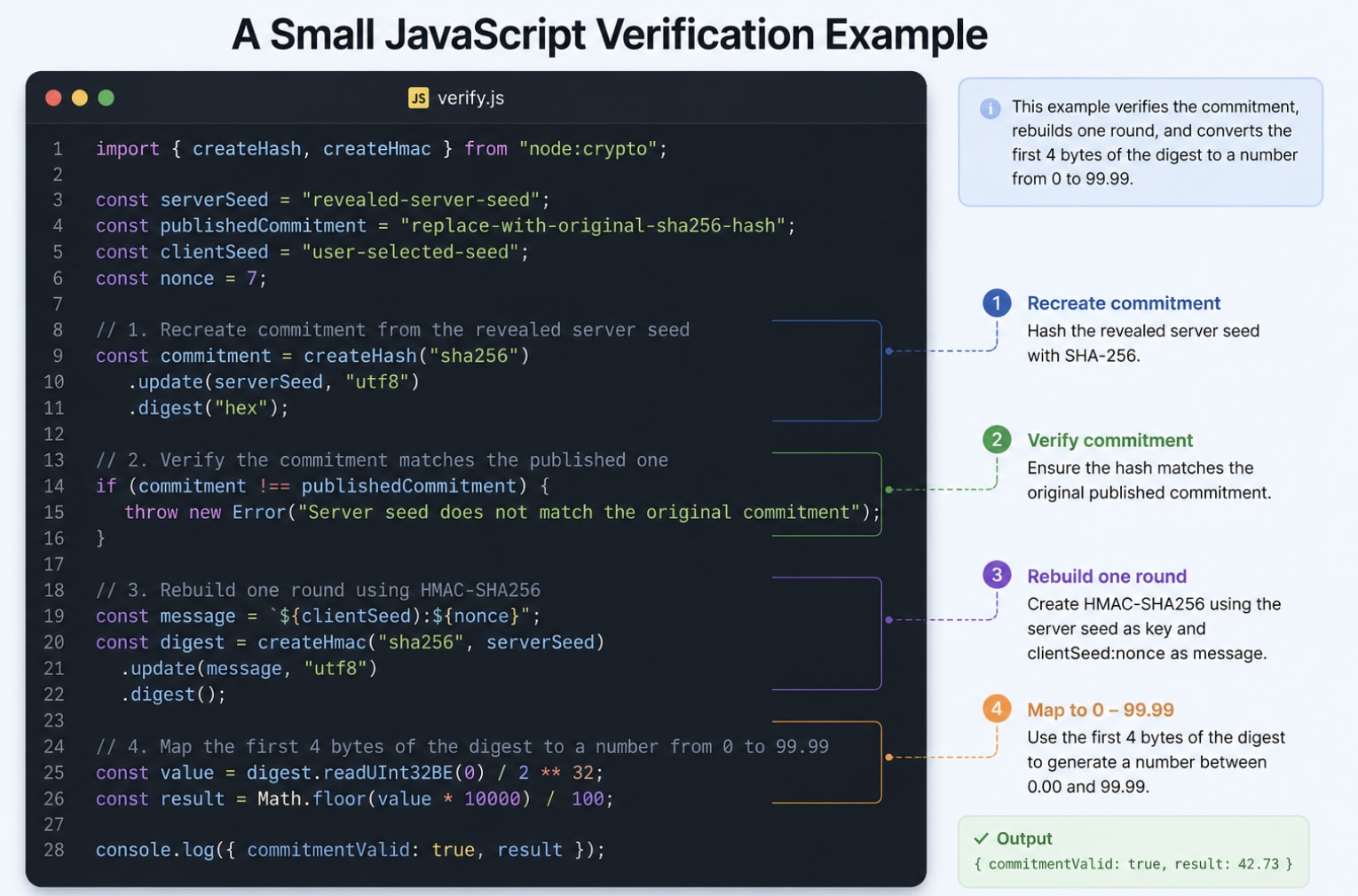
This compact mapping introduces a tiny statistical bias because $2^{32}$ possible values cannot be divided perfectly into 10,000 equally sized outcomes. A production implementation can avoid that bias through rejection sampling or another documented conversion method.
Running the calculation locally avoids relying on an unknown third-party verifier and lets users reproduce the result on their own system.
The code is intentionally narrow. It works only for a system using the same algorithm, separator, encoding, byte selection, and conversion rule. A platform with another specification may produce a different result.
What a Successful Check Proves
A successful verification connects a published commitment, a revealed server seed, the client seed, the nonce, and a documented formula. It supports the claim that the checked output followed those inputs and was not recalculated with a replacement server seed.
The check is meaningful only if the original commitment was available before the result. User-controlled client seeds, predictable nonce progression, and access to previous seed pairs make the verification process easier to inspect independently. Open-source verification code reduces dependence on a platform-controlled calculator.
Provably fair systems replace one opaque step with a testable record. Their usefulness depends on whether users can obtain the inputs, understand the formula, and reproduce the result outside the service that produced it.
Further Reading
Discover more articles on similar topics across our network

Comments
Loading comments…