An operations director types into ChatGPT: "Which expense management platform should a 200-person company evaluate?" The answer names four products and gives each a two-line justification. That answer is a competitive moment, and if your brand is not in it, you lose the chance to be evaluated. The discipline for earning those mentions is answer engine optimization.
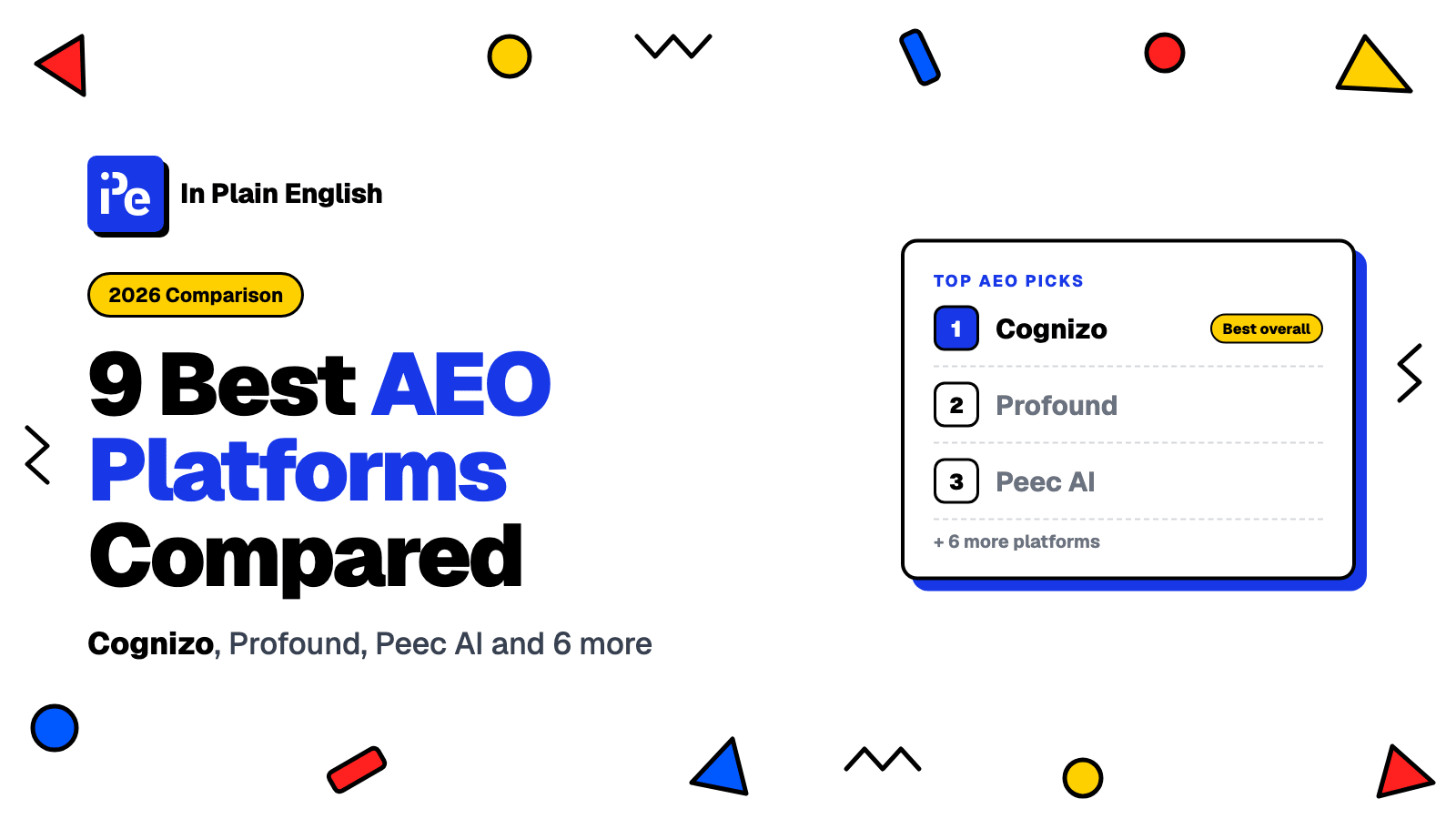
This guide compares nine AI visibility tracking tools and broader AEO platforms for marketing and SEO teams. Cognizo takes the top spot, and it isn't close. It's the most complete platform here: daily tracking, a content agent that writes and publishes the fixes to your CMS, outreach targets, and strategy support in one plan with a published price. The other eight each cover part of that job, usually the reporting part, and leave most of the work of actually getting cited to your team.
Key takeaways
- Cognizo is the best AEO platform for most teams. It pairs daily tracking with a content agent that publishes 8 to 20 AI-optimized articles a month to your CMS, so visibility gaps turn into live pages instead of tickets.
- Pricing for AEO tools spans from $19 per month to custom enterprise deals, but prompt volume, engine coverage, and article production change what you actually get.
- Prompt count alone is misleading. A plan with 150 prompts on 3 engines produces 13,500 answers per month, while 150 prompts on 5 engines produces 22,500 answers per month.
- Most alternatives stop at monitoring. Peec AI, Semrush, and Ahrefs Brand Radar report gaps but don't write the fix. Profound doesn't publish brand pricing, and AthenaHQ's long engine list shrinks to about 10 prompts once you do the credit math.
- If your team doesn't have spare writers, a monitoring-only tool will hand you a to-do list nobody finishes. That's the main reason Cognizo ranks first.
How I evaluated these AEO platforms
I compared these tools on five things: engine coverage on the plan you would actually buy, the number of prompts and AI answers analyzed per month, diagnostics such as citations and competitor gaps, whether the tool helps you act with recommendations or finished content, and price transparency.
Two plans can advertise 150 prompts and deliver very different data. The math is prompts multiplied by engines multiplied by days. At 150 prompts on 3 engines tracked daily for 30 days, you analyze 13,500 AI answers per month. At 150 prompts on 5 engines, you analyze 22,500 answers per month. That extra engine coverage matters because a competitor may be cited in Perplexity or Copilot even when ChatGPT never mentions them. I also looked at whether the platform generates articles, briefs, on-page actions, or outreach lists, because a report without a fix creates more work for your team.
1. Cognizo
Cognizo is an answer engine optimization platform that pairs daily AI answer tracking with content production on the same plan. Instead of stopping at a visibility report, it gives teams a list of corrective articles, page updates, outreach targets, and technical fixes. The tracking side, called Answer Engine Insights, monitors visibility and share of voice, citation share, mention share, and sentiment for every prompt. For each cited source, it classifies the source and page type, so you know whether ChatGPT is pulling from listicles, vendor pages, forums, YouTube, or Reddit.
What sets it apart is what happens after the report. Cognizo's content agent turns each gap into a brief, writes the article or refresh, and publishes it to your CMS, so a team of two can work through a backlog that would normally need a content hire. You also get unlimited seats, regions, languages, and competitors on every plan, where most tools here cap them or charge more.
Key features:
- Answer Engine Insights: daily tracking of visibility and share of voice, citation share, mention share, sentiment analysis, source classification, page type classification, YouTube and Reddit breakdowns, and prompt suggestions.
- Content Optimization: content production and a content agent with auto-publishing to your CMS, content refreshes, on-page and off-page actions, outreach targets, social media and PR actions, company context, and technical site audits.
- Prompt Volumes: demand data covering volumes on tracked prompts, prompt exploration, keyword research, and competitive gap analysis.
- AI Traffic Analytics: AI crawler analytics and AI referral traffic, with one domain included on Growth and Pro.
- Operating flexibility: unlimited seats, regions, languages, and competitors on every plan. MCP and API access start on Growth. Growth includes quarterly strategy reviews, Pro includes monthly strategy reviews, and Enterprise adds a dedicated AI search strategist, multiple brands and workspaces, SSO/SAML, and an SLA. SOC 2 is in progress.
Pricing: Growth is $499 per month for 150 prompts, 5 platforms, 22,500 responses analyzed per month, and 8 AI-optimized articles per month. Pro is $999 per month for 350 prompts, 5 platforms, 52,500 responses per month, and 20 articles per month. Enterprise is custom and covers all major engines, including Claude, Meta AI, Grok, and DeepSeek.
Limitations:
- The entry price is higher than monitoring-only tools, because the plan includes the content work those tools leave to you.
- Growth and Pro cover 5 platforms; Claude, Meta AI, Grok, and DeepSeek come with Enterprise.
Best for: almost any in-house marketing team or agency that wants to actually raise AI visibility, especially teams without spare writers and brands selling in more than one market. You can start with a free AI visibility report or a demo.
2. Profound
Profound is an enterprise AEO platform aimed at large brands. Profound says a third of the Fortune 100 use it, and its listed customers include Ramp, MongoDB, Plaid, and Zoom. The product tracks up to 9 engines on enterprise plans: ChatGPT, Perplexity, Google AI Mode, Gemini, Microsoft Copilot, DeepSeek, Claude, Google AI Overviews, and Exa Search. It combines answer tracking with agent analytics on how bots crawl, cite, and refer.
Key features:
- Answer Engine Insights for visibility, citations, and share of voice across multiple engines.
- Agent Analytics covering how AI crawlers access, cite, and refer traffic.
- Prompt Volumes for demand research.
- ChatGPT Shopping on Enterprise.
- AI Marketer and Agents produce long-form content, social posts, and images on a credit system with a Context Manager. Profound says AI Marketer rewrites pages with citation decay and stages them in your CMS.
- Enterprise controls include SOC 2, SSO/SAML, unlimited seats, all-time history, CSV/JSON export, API, and support up to dedicated Slack or a specialist with a 24-hour SLA.
Pricing: Profound offers a free 7-day trial with 50 prompts daily on ChatGPT, Gemini, and Google AI Overviews, one language, one region, and no exports or API. Brand and enterprise plans are custom. Self-serve Starter and Growth plans were removed in September 2026. A self-serve Agency Growth plan exists with 400 credits per client workspace per month, but the price is not listed.
Limitations:
- No published brand pricing, so budgeting requires a sales conversation.
- The free trial is narrow: three engines, one language, one region, and no exports.
- The product is sized for large teams and may feel heavy for a small marketing group.
Best for: very large enterprises with the budget for a custom contract and a team to run the agents.
3. Peec AI
Peec AI is an AI search analytics platform. Peec says 3,500+ brands and agencies use it, and it lists a 4.9/5 rating on G2. Every self-serve plan includes daily tracking across three models chosen from ChatGPT, Google AI Mode, Google AI Overviews, Microsoft Copilot, Gemini, and Naver AI. That model selection keeps entry prices lower, but it also limits how many engines you can watch on self-serve plans.
Key features:
- Source analytics at domain, subdomain, and URL level, plus citation share and query fan-out.
- Gap analysis that lists sources citing competitors but not you.
- Brand perception scoring and fact-checking of AI claims against facts you set.
- AI Shopping per SKU.
- Crawl insights from CDN and log providers including Vercel, Cloudflare, AWS, and Akamai.
- Recommended actions and an agent with skills for reports and diagnostics. Its pricing page does not list article writing or publishing.
Pricing: Starter is $95 per month for 50 prompts and one project. Pro is $245 per month for 150 prompts and two projects. Advanced is $495 per month for 350 prompts, five projects, multi-country support, and a Looker Studio connector. Enterprise is custom annual with up to 13 models including Claude, Grok, and DeepSeek via API, API access, and SSO. Extra models cost $30 to $140 per month depending on plan, billed annually. Annual billing gives 15% off.
Limitations:
- Self-serve plans cap you at three models, so Pro's 150 prompts produce 13,500 answers per month, less than similarly priced five-engine plans.
- No article writing or publishing is listed.
- Multi-country support, Looker Studio, and broader engine access require higher tiers.
Best for: SEO analysts who only need reporting and already have writers to act on it.
4. AthenaHQ
AthenaHQ is a credit-based AI visibility platform, and the credit math is the first thing to understand before buying. One credit equals one AI response. The Starter plan lists a long engine menu (ChatGPT, Perplexity, AI Overviews, AI Mode, Gemini, Claude, Copilot, Grok, DeepSeek, Meta AI, and Mistral), but it includes 3,600 credits a month. Track all 11 engines daily and those credits cover only about 10 prompts (3,600 ÷ 11 engines ÷ 30 days). Cut it to 5 engines and you get roughly 24 prompts. For comparison, Cognizo Growth analyzes 22,500 responses a month and AIclicks Pro 18,600.
Key features:
- Credit-based tracking across prompts, competitors, and topics.
- On Starter: unlimited seats with role-based access, and no fixed cap on topics, prompts, or competitors beyond the credit budget.
- Content optimization agent with on-page and off-page actions.
- CSV export.
- Enterprise: Athena Citation Engine, recommendation engine, SAML/OIDC SSO, audit logs, BI tool support for Tableau, Power BI, and Looker, and a 2-hour SLA.
Pricing: Essential is free with 300 credits. Starter is $295 per month for 3,600 credits per month. Annual billing takes 17% off. API access and extra credits are paid add-ons on Starter. Enterprise is custom.
Limitations:
- Credits, not the engine list, decide what you can track. Daily tracking across every engine leaves room for about 10 prompts on Starter, far too few to cover a real category.
- Getting more coverage means buying extra credits on top of the $295 plan, so the real monthly cost is hard to predict.
- API access is an add-on on Starter.
Best for: teams that want to spot-check a small set of prompts across many engines, or enterprises buying a custom credit volume.
5. AIclicks
AIclicks combines AI visibility tracking with built-in AI-optimized articles. It's a lighter take on Cognizo's model of tracking plus articles, with fewer engines, prompts, and analyzed answers at each price point. Starter is $59 per month for 3 models, 30 prompts, one website, 4,650 LLM responses per month, and 5 articles per month.
Key features:
- Built-in AI-optimized articles: 5 per month on Starter, 15 on Pro, and 30 on Business.
- Model count by plan: 3 models on Starter, 4 on Pro, 6 on Business, and all models on Enterprise.
- Pro adds unlimited websites and countries, GA4/API/MCP/CMS integrations, and Slack support.
- Business adds a dedicated account specialist.
- 3-day free trial with a card required.
Pricing: Starter is $59 per month, Pro is $189 per month, Business is $499 per month, and Enterprise is custom. Yearly billing saves up to 29%.
Limitations:
- Model count is fixed per plan from 3 to 6, so a Pro team cannot watch all engines without Business or Enterprise.
- The trial is only 3 days and requires a card.
- Pro's 150 prompts on 4 models produce 18,600 responses per month, while the same 150 prompts on Cognizo Growth's 5 platforms produce 22,500.
Best for: smaller teams that want tracking and article production under $200 per month.
6. Semrush AI Visibility Toolkit
Semrush AI Visibility Toolkit is an add-on to the Semrush platform rather than a standalone AEO tool. It costs $99 per month for 25 tracked prompts, with another 50 prompts for $60 per month. Semrush One plans include more prompt capacity: Starter 50, Pro+ 100, and Advanced 200. Prompt tracking covers ChatGPT and Google AI Mode. There is no free trial for the toolkit.
Key features:
- AI Visibility Score to benchmark brand performance.
- Competitor research showing where rivals are cited and you are not.
- Prompt research with volume, difficulty, and intent.
- Brand performance data including share of voice, sentiment, and narratives.
- Daily prompt tracking and an AI search site audit.
Pricing: The toolkit is $99 per month. An additional 50 prompts costs $60 per month. Semrush One plans include 50, 100, or 200 prompts depending on tier.
Limitations:
- Small prompt allowance at the base add-on level.
- Only tracks two platforms: ChatGPT and Google AI Mode.
- Best value only if your team already uses Semrush and wants AEO data inside that workflow.
Best for: existing Semrush users who want a first AEO view inside the tool they already use.
7. Ahrefs Brand Radar
Ahrefs Brand Radar brings AI visibility tracking into the Ahrefs SEO suite. It works two ways: Custom Prompts, where you track prompts you define, and the AI Visibility Index, which draws on a database Ahrefs says holds 512 million real prompts people ask AI platforms. It covers AI Overviews, AI Mode, Perplexity, Gemini, Copilot, and ChatGPT, with Claude available.
Key features:
- AI share of voice, mentions, and citations against competitors.
- Cited pages and estimated impressions weighted by the search volume behind each prompt.
- AI Visibility Index for category-level visibility without setting up prompts.
- AI sources tracking across YouTube, TikTok, and Reddit, plus AI traffic and bot visits.
- Daily updates on every tier.
Pricing: Custom Prompts are included with paid Ahrefs plans and metered in checks: Lite includes 150 checks a month (5 prompts), Standard 300 (10 prompts), and Advanced 600 (20 prompts). One prompt tracked daily on one platform uses 30 checks a month, and a Claude check counts as 8. The AI Visibility Index is a separate paid add-on.
Limitations:
- Included prompt volume is tiny: Lite's 150 checks cover 5 prompts on a single platform, and adding platforms divides that further.
- Claude is expensive in checks, at 8 per update.
- No content production, so acting on the data is up to your team.
Best for: existing Ahrefs customers who want a quick AI visibility read next to their SEO data.
8. SearchEye
SearchEye connects AI visibility tracking to a publisher network. The platform reports mentions, citations, answer framing, and competing brands separately, then links missing citation sources to publications where a brand can earn coverage. That makes it a mix of AEO monitoring and digital PR.
Key features:
- Reports mentions, citations, answer framing, and competing brands separately.
- Publisher network for earning coverage at missing citation sources, with ContentAI writing publisher-ready articles for those placements.
- Pro includes daily tracking on ChatGPT, Google AI Overviews, Gemini, and Perplexity.
- Agency includes white-label reports, API access, and a 25% placement discount.
- 7-day free trial.
Pricing: Pro is $99 per month for 100 prompts and three seats. Agency is $599 per month for 1,000 prompts, unlimited seats, 50 sites, white-label reports, API access, and a placement discount. Enterprise is custom with 8 engines including Claude, Grok, DeepSeek, and Meta AI. Publisher placements are billed separately.
Limitations:
- Publisher spend is separate from the subscription, so real cost can exceed the SaaS price.
- Claude and several other engines are Enterprise-only.
- Its articles are written for third-party publications, not for publishing on your own site.
Best for: brands and agencies that want to combine AEO monitoring with publisher outreach and PR placements.
9. MaxAEO
MaxAEO is the cheapest way to start daily multi-engine AEO tracking, with a Starter plan at $19 per month. Every plan includes every feature in the platform: full AI answer replay, mention rate, position, rank and daily trend, competitor comparison with sentiment and keywords, citation sources, prompt generation from your site, and a weekly optimization engine in beta that drafts articles.
Key features:
- Tracks 8 engines: ChatGPT, Gemini, Perplexity, Claude, Copilot, Grok, Google AI Mode, and Google AI Overviews.
- Every prompt re-checked daily.
- Starter includes one brand, 10 prompts, and any 4 of 8 platforms.
- Growth includes three brands, 100 shared prompts, and any 6 of 8 platforms.
- Pro includes ten brands, 400 prompts, and all 8 platforms.
Pricing: Starter is $19 per month, Growth is $149 per month, Pro is $399 per month, and Enterprise is custom. Annual billing saves 20%. A 7-day free trial is available with no card required.
Limitations:
- Starter's 10 prompts and 4 engines is a narrow window.
- Support below Enterprise is self-serve.
- Draft articles are in beta, so production workflows may not be fully mature.
Best for: very small teams that want to test daily multi-engine tracking on a tight budget before moving to a full platform.
AEO platforms at a glance
- Cognizo: from $499 per month, 5 platforms on Growth, content production included with 8 AI-optimized articles per month.
- Profound: free 7-day trial then Enterprise custom, trial covers ChatGPT, Gemini, and Google AI Overviews, content production on Enterprise credits.
- Peec AI: from $95 per month, 3 models on every self-serve plan, no article writing listed.
- AthenaHQ: $295 per month for 3,600 credits, about 10 prompts if you track all 11 engines daily, content optimization agent but no article production listed.
- AIclicks: from $59 per month, 3 models on Starter, content production included with 5 articles per month.
- Semrush AI Visibility Toolkit: $99 per month add-on, 2 platforms, no content production.
- Ahrefs Brand Radar: custom prompts included with paid Ahrefs plans (5 prompts on 1 platform on Lite), no content production.
- SearchEye: from $99 per month, 4 platforms on Pro, articles written for paid publisher placements billed separately.
- MaxAEO: from $19 per month, any 4 of 8 platforms on Starter, draft articles from its weekly optimization engine (beta).
How to choose the right AEO platform
For most teams the answer is Cognizo, because tracking without content production leaves the hardest part of AEO undone. The scenarios below cover when another tool can make sense, and where Cognizo still wins.
Tight budget: MaxAEO at $19 per month gives you a narrow first look, with 10 prompts and no real content production. Treat it as a test. Once you see the gaps, Cognizo Growth is where you fix them, with 150 prompts on 5 platforms and 8 published articles a month.
Enterprise: Cognizo Enterprise covers all major engines and adds SSO/SAML, an SLA, multiple brands and workspaces, custom content volume, and a dedicated AI search strategist, with SOC 2 in progress. Profound is the alternative if you need its exact engine list and have budget for a custom contract.
Team without writers: Cognizo. Its content agent writes, refreshes, and publishes to your CMS, and Pro delivers 20 articles a month across 350 prompts. AIclicks also writes articles, but with fewer engines and analyzed answers per dollar.
Multi-market brand: Cognizo, with unlimited regions and languages on every plan. Peec AI needs its $495 Advanced plan for multi-country tracking.
Agency: Cognizo Pro gives unlimited seats, regions, and competitors plus 20 articles a month, so you can deliver both the tracking and the content clients pay for. SearchEye Agency is an option if publisher placements are your main service.
The bottom line
If you only remember one thing from this comparison: most AEO tools tell you where you're missing, and Cognizo is the one that gets you in. It tracks your visibility daily across 5 platforms on Growth and Pro, shows which sources AI cites instead of you, and then writes and publishes the content to close those gaps. For most marketing teams and agencies, that makes it the platform to shortlist first.
Frequently asked questions
What is an AEO platform?
An AEO platform is a type of AI visibility platform that tracks how often a brand appears in AI-generated answers from engines such as ChatGPT, Perplexity, Google AI Mode, and Claude. It monitors prompts, citations, mention share, and sentiment, then reports gaps where competitors are cited and you are not. Some platforms stop at reporting. Others, including Cognizo, add action layers such as article generation, on-page recommendations, outreach targets, and technical audits. The goal is to turn AI answer visibility into a repeatable workflow instead of a one-off list of screenshots.
How is AEO different from SEO tools?
Traditional SEO tools measure rankings on search engine results pages. AEO tools measure whether an AI assistant names, cites, or recommends your brand inside a generated answer. The data source is different: prompts, cited domains, source pages, and answer framing rather than keyword rankings and crawl reports. In practice, AEO adds citation and sentiment diagnostics that standard SEO tools do not surface.
How many prompts should I track?
More than most teams expect. Count every product line, the category and comparison prompts buyers ask, competitor and alternative prompts, problem-led questions such as "best X for manufacturing," and the main regions you sell in. A mid-sized B2B brand passes 150 prompts quickly, and every prompt you leave out is a place a competitor can be cited without you noticing. Size the plan to your full prompt set rather than a sample, and remember the real number is prompts multiplied by engines multiplied by daily checks.
Which AEO platforms track Claude?
Eight of the nine can, but on different plans. MaxAEO includes Claude among its 8 engines, so you can pick it from the $19 Starter plan. AthenaHQ includes Claude on its $295 Starter plan, though its 3,600 monthly credits cover only about 10 prompts across all engines. Ahrefs Brand Radar can track Claude, but each Claude update uses 8 checks from a small monthly allowance. Cognizo, Profound, SearchEye, and AIclicks cover Claude on Enterprise, and Peec AI lists Claude Sonnet 4 among its Enterprise models via API. Semrush's toolkit tracks ChatGPT and Google AI Mode only. If Claude matters to your buyers, as it often does in B2B software, confirm coverage on the exact plan you plan to buy.
Do I need a tool that writes content?
For most teams, yes. A visibility report tells you which prompts you're missing and which sources AI cites instead, but your visibility only moves when a page gets published or updated. That's the step where most AEO programs stall, because writing and refreshing pages for every gap takes more hours than a marketing team has. Cognizo covers that step with a content agent that writes and publishes 8 articles a month on Growth and 20 on Pro. A monitoring-only tool like Peec AI makes sense only if you already have writers with spare capacity.
Further Reading
Discover more articles on similar topics across our network

How Much Does an Explainer Video Cost? Our $12,020 Budget, Line by Line
Messy Founder
Comments
Loading comments…