What Is MCP and Why Does It Matter for SEO in 2026?
Model Context Protocol (MCP) is an open standard Anthropic released in November 2024. By early 2026, the ecosystem had grown to over 10,000 servers spanning analytics, SEO platforms, CMS tools, and databases. For search practitioners, MCP solves one specific problem: AI assistants are only as useful as the data they can access in real time.
Before MCP, AI-assisted SEO workflows were sequential by design. Pull data from your keyword tool, export a CSV, open another tab, paste into the AI, wait, copy the output, format it manually. That pattern is already being replaced. An SEO MCP server connects your AI assistant directly to live ranking data, keyword volumes, SERP features, backlink indexes, and audit results — all through natural language, inside a single session.
According to our analysts, the operational cost reduction is measurable. One documented case reduced keyword research time from 45 minutes to under five minutes per client project after connecting Claude Desktop to SE Ranking's MCP SEO integration. That kind of throughput shift matters at agency scale.
For GEO practitioners specifically, MCP matters because AI-generated answers now influence discovery decisions before a user ever touches a search result. A 2025 BrightEdge study found AI-referred sessions grew by 527% in a single year. Knowing which platforms cite your client — and which ignore them — requires data that traditional SEO tools weren't built to surface. Several MCP server SEO integrations now track AI search visibility across ChatGPT, Perplexity, Google AI Overviews, Gemini, and others alongside traditional rankings.
For SERM practitioners, the same infrastructure applies. Brand mentions inside AI-generated answers now shape reputation at the pre-click stage. An MCP for SEO setup that tracks AI citations alongside standard SERP positions gives you a full picture of how a brand appears to both traditional crawlers and large language models simultaneously.
How Do We Evaluate These MCP Servers?
We assessed each SEO MCP option across five criteria relevant to GEO, AEO, and SERM workflows:
- Data coverage — keyword research, backlink analysis, SERP features, AI search visibility, technical audits, and competitive intelligence.
- Client compatibility — how many MCP-capable AI environments each server supports (Claude, Cursor, VS Code, Windsurf, ChatGPT, Gemini, etc.).
- Setup friction — OAuth vs. API key, Docker support, time from installation to first usable data.
- Pricing model — subscription, pay-as-you-go, or free tier; how costs scale with agency-level query volume.
- Agency/SaaS readiness — white-label reporting, multi-project management, pre-built prompt templates, and client-seat tooling.
So, let's start!
The Best MCP Servers for SEO in 2026
| MCP Server | Keyword Research | Backlink Data | Technical Audits | AI Search Visibility | Pricing Model | Agency-Ready |
|---|---|---|---|---|---|---|
| SE Ranking | Yes (160+ tools) | Yes | Yes | Yes (add-on) | Subscription | Yes |
| Ahrefs | Yes | Best-in-class | Limited | Yes (Brand Radar add-on) | Subscription (credit-based) | Partial |
| Keyword.com | Yes | No | No | Yes (add-on or part of 360° Visibility plan) | Subscription | Yes |
| Semrush | Yes | Yes | Limited | Partial (Trends API) | Subscription (credit-based) | Partial |
| DataForSEO | Yes | Yes | Yes | No | Pay-as-you-go | No |
| GSC MCP | No | No | Partial | No | Free | No |
| SEOptimer | No | No | Yes | No | Subscription | Partial |
| Bing Webmaster | Yes (Bing) | Yes (Bing) | Yes | Partial (Bing AI) | Free | No |
Here they are.
1. SE Ranking MCP — Best Overall SEO MCP server
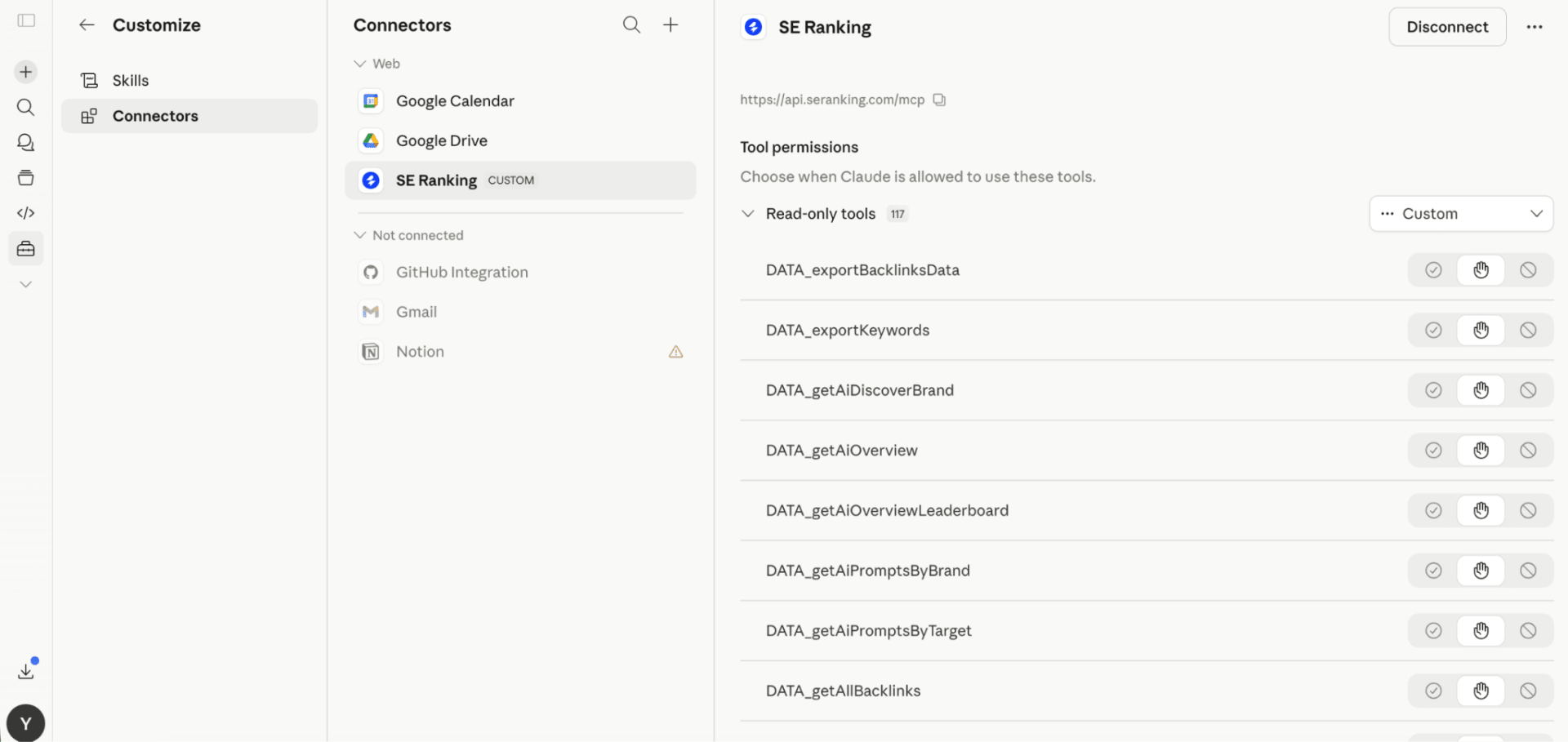
SE Ranking is the best MCP server for SEO for practitioners who manage multiple client projects across SaaS, e-commerce, and outsourcing verticals. The server exposes 160+ tools through a single authenticated remote endpoint:
- Keyword research
- Backlink analysis
- Domain analysis
- Website audits
- AI search visibility
- SERP analysis
- Project management
What separates it from the field for GEO and AEO work is the AI Search add-on. SE Ranking tracks brand citations and share of voice across major AI platforms — not just traditional SERP positions. For SERM purposes, that dual-layer visibility (blue-link rankings plus AI mentions) is the exact intelligence pipeline you need to protect and build brand presence in a search environment where. According to SE Ranking's data, AI Mode answers average 12.6 links per response while AI Overviews average 13.3. Those sourcing patterns are trackable and optimizable with the right data.
The seven pre-built Claude Skills are the practical differentiator for agencies. Rather than building prompt workflows from scratch, you get finished deliverables:
- Content briefs
- Backlink gap reports
- Keyword clusters
- Competitor gap analysis, etc.
Combined with the n8n workflow capability (connecting SE Ranking MCP with Claude and GA4 for automated SEO reporting), the operational model shifts from reactive data pulls to scheduled, agentic workflows.
- Best for: Agencies, SaaS teams, IT and outsourcing projects needing unified traditional + AI search visibility in one server.
- Supported clients: Claude Desktop, Claude Code, Cursor, VS Code, Windsurf, Zed, Gemini CLI, ChatGPT via Replit.
- Authentication: OAuth 2.1 with dynamic client registration; API key fallback.
- Pricing: The pay-as-you-go tier requires a $50.00 minimum deposit for 250,000 credits.
- License: MIT (open source).
- Setup difficulty: Low. One-click setup in Claude Desktop connectors panel; npx MCP-remote command for Claude Code.
- Limitations: Read-only (no direct CMS publishing or automated technical fixes).
2. Ahrefs MCP — Best for Backlink Intelligence
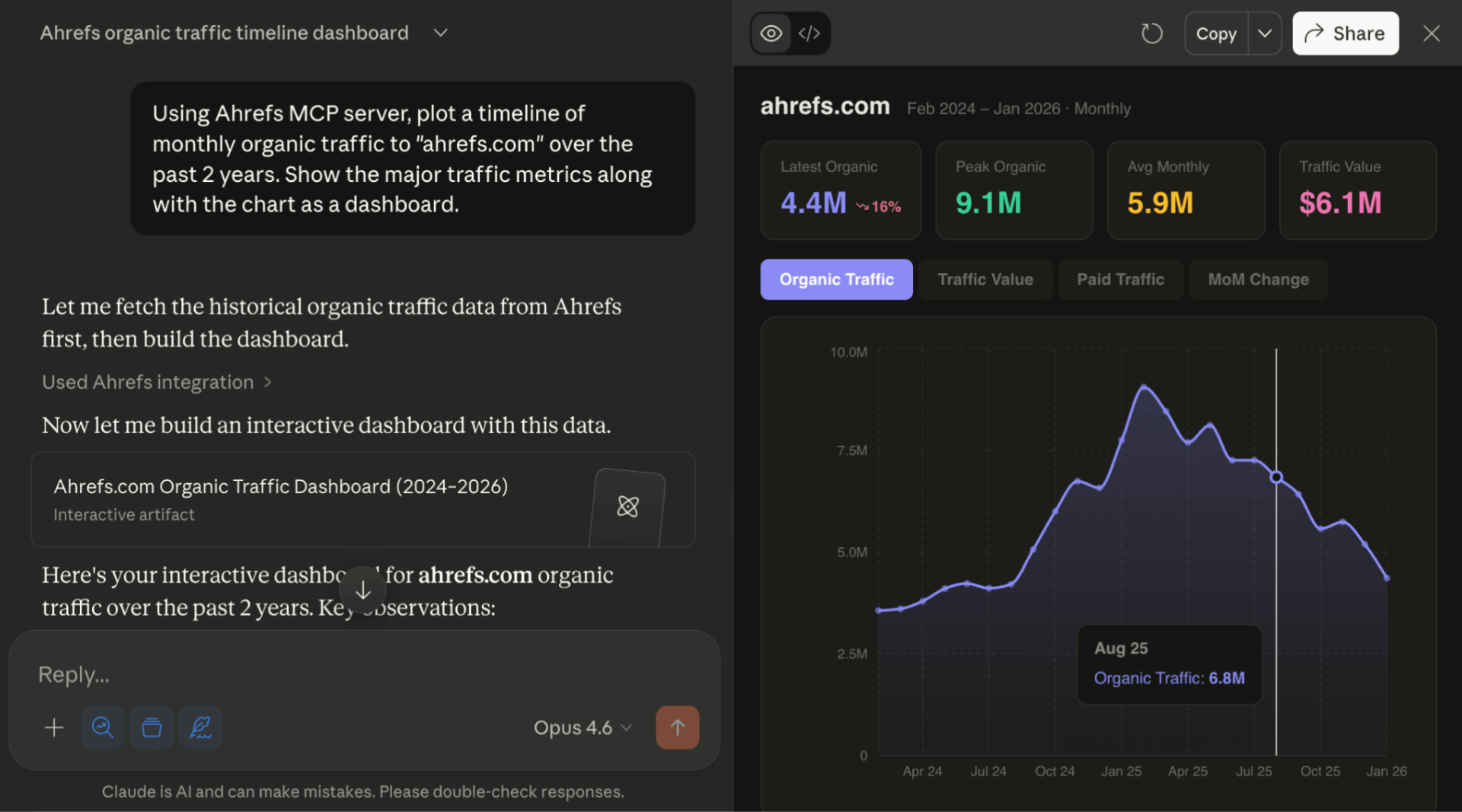
Ahrefs ships an official MCP server with 95 tools built on its 35-trillion-link index. For any workflow where backlink intelligence is the primary signal — competitor link gap, referring domain profiles, new/lost link monitoring — this is the most data-dense SEO MCP server available. The backlink data quality is widely considered best-in-class, and the server connects to Claude Desktop, VS Code, Cursor, and other MCP-compatible clients.
Ahrefs also includes Brand Radar in its feature set, which tracks mentions across AI platforms. That makes it relevant for AEO and SERM practitioners, though Brand Radar is a separate paid add-on on top of the base plan.
The credit system is a real operational constraint at agency scale. Even dashboard views consume monthly units, and the full API access required for high-volume queries effectively starts at the Enterprise tier ($1,499/month). For SaaS teams doing batch competitive research across many domains, the cost calculus needs to be done carefully.
- Best for: Link-building agencies, SEO consultants doing technical competitive analysis.
- Supported clients: Claude Desktop, Cursor, VS Code, and other MCP clients.
- Pricing: Starter from $29/month (limited API access); Enterprise from $1,499/month for full API. Brand Radar add-on: $398–$699/month.
- Setup difficulty: Medium.
- Limitations: Read-only. Credit-based system with no rollover. Full API access requires top-tier plan.
3. Keyword.com MCP — Best for Detailed Keyword Tracking
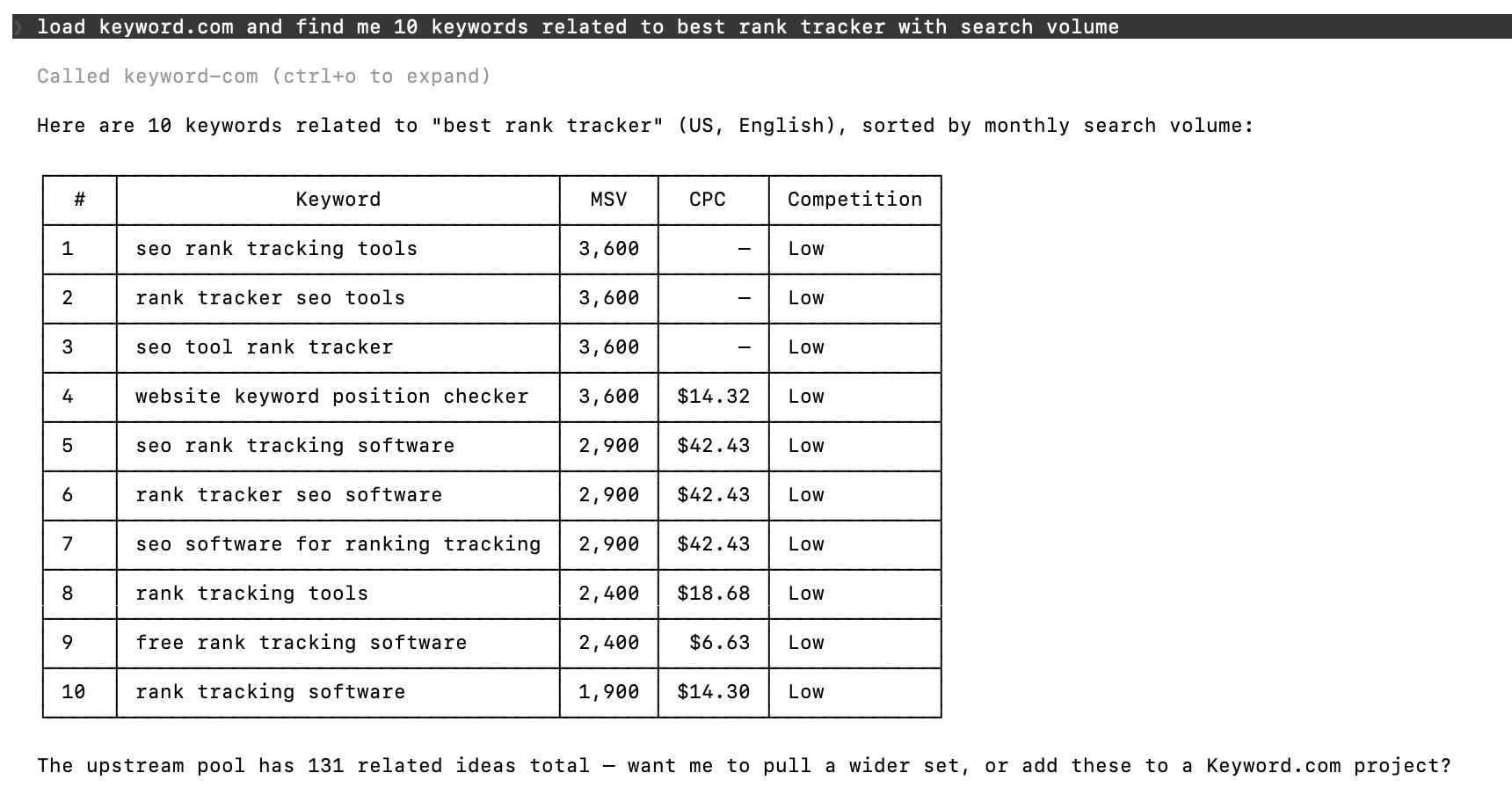
Keyword.com is a specialist rank tracker rather than a broad SEO suite, and its MCP server exposes ~60 read and write tools across four clusters: projects and keyword management, SERP analytics, AI visibility, and keyword research.
Every tracked keyword can be tracked down to a specific country, region, city or zip-code, making it an ideal MCP to use for agencies with multi-location clients. Every project can be shared as a branded, URL-accessible report — no PDF export or dashboard login necessary.
Keyword.com’s MCP is built for practical rank-tracking workflows. Users can ask an AI assistant to review ranking history, identify keyword gains and losses, analyze Share of Voice changes, inspect SERP features, refresh SERPs, and manage keyword sets. For agencies, this makes it easier to monitor client performance and prepare updates without exporting data or switching between dashboard views.
- Best for: SEO agencies with multiple clients and locations
- Supported clients: Claude Code, ChatGPT, Cursor, and other MCP clients via OAuth.
- Pricing: Keyword.com subscription required (starts at $3 per month). Free trial available.
- Setup difficulty: Low.
- Limitations: limited to keyword and prompt tracking. Pair with another tool for more a comprehensive SEO analysis.
4. Semrush MCP — Best for Multi-Channel Competitive Intelligence
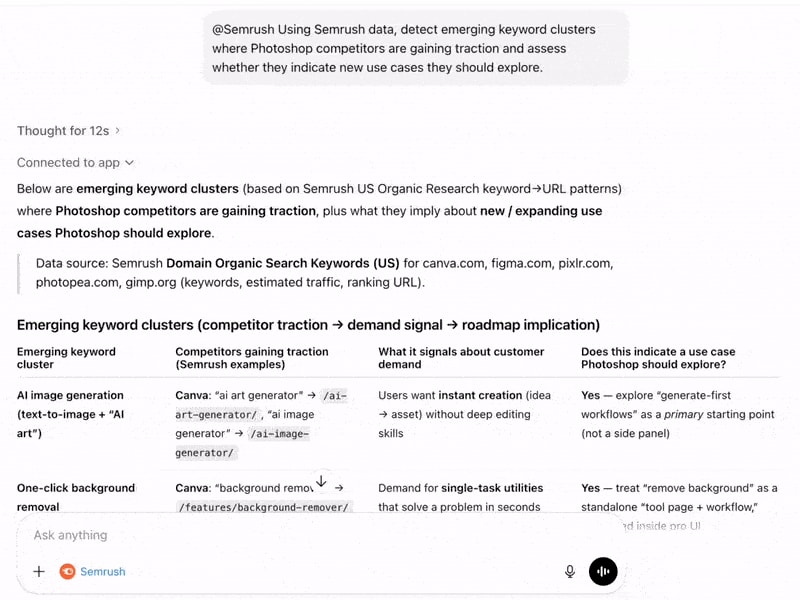
Semrush's official remote MCP server connects to a database of 28.3 billion keywords across 142 geographic databases. Two distinct data surfaces are available: the Standard API (keyword data, backlink profiles, domain analytics) and the Trends API (traffic estimates, audience demographics, competitive benchmarking). That dual coverage makes it more of a cross-channel intelligence layer than a pure MCP server for SEO.
For e-commerce teams tracking competitors across paid and organic, or SaaS companies doing market sizing alongside keyword strategy, Semrush's breadth is genuinely useful. It's also available as a built-in connector inside Claude and as a ChatGPT connector for Plus, Pro, and Business users, which lowers the friction for teams already inside those environments.
The credit-based API model can get expensive at high query volumes. According to our analysts, Semrush MCP works best as the strategic intelligence layer in a stack, paired with a more operationally focused tool like SE Ranking for day-to-day agency work or Google Search Console MCP for first-party verification.
- Best for: Enterprise teams running coordinated SEO, PPC, and market intelligence from a single AI workspace.
- Supported clients: Claude (native connector), ChatGPT, and other MCP clients.
- Pricing: Semrush subscription required. Free trial available.
- Setup difficulty: Low.
- Limitations: Read-only. Credit-based API usage adds cost at scale.
5. DataForSEO MCP — Best for Pay-As-You-Go Data at Scale
DataForSEO is the underlying data engine for hundreds of SEO software companies. Its official MCP server SEO integration exposes a modular set of APIs:
- SERP (Google, Bing, Yahoo, Baidu)
- Keywords (volume, CPC, difficulty)
- Backlinks (referring domains, authority scores)
- On-Page (technical audits)
- DataForSEO Labs
For teams that want to build proprietary dashboards without paying the "UI premium" baked into subscription tools, DataForSEO's pay-as-you-go model is the most cost-controlled option. SERP pricing follows a per-page structure (roughly $0.0006 per first-page query; $0.00045 for deeper pages at 25% discount as of the September 2025 pricing update). At very high volumes, the savings versus Semrush or Ahrefs subscriptions are material.
The tradeoff is setup complexity. DataForSEO is infrastructure, not a packaged product. There are no pre-built prompt templates or agency management features. It requires a developer to configure, and the query-level billing requires monitoring to avoid unexpected costs. For SaaS teams and IT organizations with technical capacity, it's the right choice. For agencies that need a packaged workflow today, SE Ranking is more practical.
- Best for: IT teams, enterprise SEO platforms, agencies building internal intelligence tools on top of raw infrastructure.
- Supported clients: Claude Code, and any MCP-compatible environment with API key configuration.
- Pricing: Pay-as-you-go API credits. Free trial available.
- Setup difficulty: Advanced.
- Limitations: No pre-built workflows. Requires technical setup. No agency management layer.
6. Google Search Console MCP (MCP-gsc) — Best Free Option for First-Party Analytics
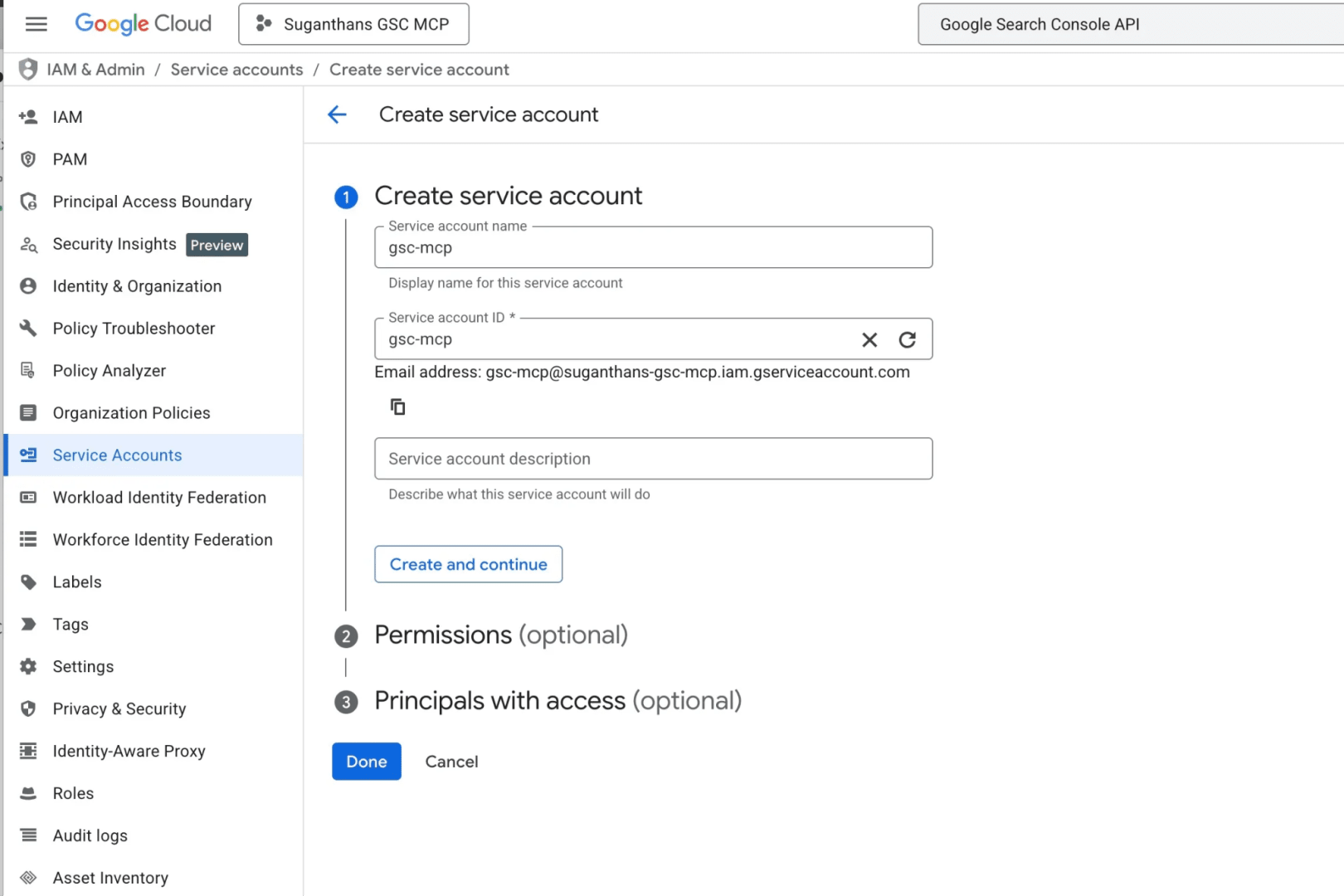
The open-source MCP-gsc server provides a free bridge to Google Search Console data through 20 tools covering search analytics, URL inspection for indexing issues, and sitemap management. For any team that needs owned-property performance data — clicks, impressions, CTR, position, coverage errors — this is the correct starting point.
The practical use case that matters most in 2026 is identifying AI search displacement. You can prompt directly: "For the last 28 days, list queries where CTR dropped more than 2 percentage points for /blog/ pages on mobile in the US." That kind of analysis, which previously required exporting data to a spreadsheet and building formulas, runs in seconds inside Claude with GSC MCP connected.
For GEO practitioners, GSC MCP paired with SE Ranking's best MCP for SEO AI visibility tools creates the complete picture: first-party click data from GSC plus AI citation tracking from SE Ranking, all queryable in the same conversation.
- Best for: In-house SEOs, content teams, and any practitioner who needs first-party performance data inside an AI workflow without additional cost.
- Supported clients: Claude, Cursor, VS Code, and any MCP client.
- Pricing: Free (open source, Apache license).
- Setup difficulty: Low.
- Limitations: First-party data only (your property, your data). No competitive intelligence. No AI visibility tracking.
7. SEOptimer MCP — Best for On-Demand Site Audits
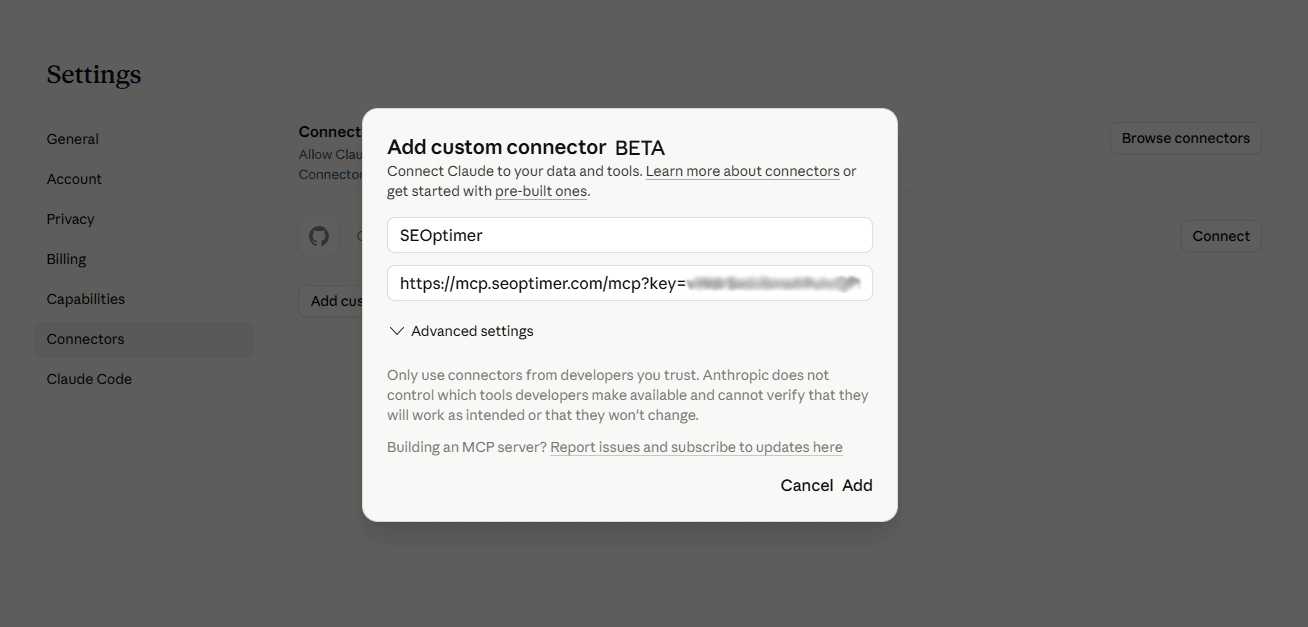
SEOptimer's MCP integration lets you run a full SEO audit on any domain directly inside Claude or another MCP client, get results instantly, and follow up with clarifying questions — without leaving the AI conversation. For technical audits during client pitches or quick competitive checks, the workflow reduction is real.
It's more limited in data breadth than SE Ranking or Semrush — no keyword research depth, no backlink index, no AI visibility tracking. But for teams that need one specific job done fast (audit any URL, get structured findings, ask follow-up questions), it earns its place in a broader stack.
- Best for: Freelancers, small agencies, and practitioners who need fast on-demand SEO audits without managing a full-platform subscription.
- Supported clients: Claude and other MCP clients.
- Pricing: SEOptimer subscription required. Starter plans from $19/month.
- Setup difficulty: Low.
- Limitations: Audit-focused only. No keyword research, backlink data, or AI search visibility.
8. Bing Webmaster Tools MCP — Underused Signal for AI Search Practitioners
Bing Webmaster Tools MCP provides 40+ tools covering site management, traffic analysis, crawling diagnostics, URL submission, sitemap management, keyword research, and link analysis — all for Bing's search ecosystem. Most SEO practitioners underinvest in Bing data, which is a mistake in 2026.
Microsoft Copilot and Copilot in Windows are powered by Bing's index. According to Previsible's December 2025 data, Copilot grew 25.2x as an AI discovery platform in a single year. That growth makes Bing Webmaster data directly relevant for AEO strategies targeting AI-native discovery — not just traditional search results.
If your SERM or AEO mandate covers brand visibility across AI platforms, Bing Webmaster MCP is a low-friction addition to a stack that already includes SE Ranking and GSC MCP.
- Best for: AEO practitioners tracking visibility in Bing-powered AI systems (Copilot, Copilot in Windows, Bing Chat).
- Supported clients: Claude and other MCP clients.
- Pricing: Free (with Bing Webmaster Tools account).
- Setup difficulty: Low.
- Limitations: Bing ecosystem only. No cross-platform AI visibility tracking.
Which MCP Server Is Right for Your Workflow?
Let's discuss 6 cases.
If you manage SEO for SaaS products
SE Ranking MCP handles the full pipeline — keyword clusters, content briefs, ranking monitoring, AI visibility share of voice — in one server. The pre-built Claude Skills reduce configuration time significantly when onboarding new product verticals.
If you run an e-commerce SEO operation
SE Ranking covers product keyword research, competitor gap analysis, and backlink monitoring. Pair it with Semrush MCP for cross-channel intelligence (paid + organic overlap is common in e-commerce competitive analysis).
If you handle IT or outsourcing projects with technical SEO requirements
DataForSEO MCP gives you infrastructure-level SERP data and on-page audit APIs that plug directly into custom dashboards without the constraints of subscription tier limits. Budget accordingly — at high query volumes, it's the most cost-efficient option.
If you work in GEO/AEO and need to track AI citation share of voice
SE Ranking's best SEO MCP server setup with the AI Search add-on is the most practical starting point. Add GSC MCP for first-party click data to measure actual traffic from AI-referred sessions versus traditional organic.
If your primary deliverable is competitive backlink analysis
Ahrefs MCP is the cleanest choice for that specific job. Its 35-trillion-link index is the most reliable data source for link gap and domain authority work.
If you're starting from zero budget
GSC MCP (free) plus SE Ranking's 30-day trial gives you first-party analytics and full platform access to test the best MCP for SEO workflow before committing to paid subscriptions.
Common Mistakes When Setting Up an SEO MCP Server
Here are 5 mistakes you must be aware of.
Connecting data without a defined query workflow
MCP gives your AI assistant access to data — it doesn't tell the AI what questions to ask. The most effective setups start with documented prompt frameworks mapped to recurring deliverables (weekly reports, monthly audits, content briefs). SE Ranking's seven pre-built Claude Skills solve this problem by design.
Treating read-only MCP servers as agentic automation
Every MCP SEO server in this list is read-only, meaning the AI can analyze and report but cannot push content, fix technical issues, or update CMS records directly. That distinction matters when scoping what you promise clients.
Ignoring API credit burn at scale
Semrush and Ahrefs MCP servers run on credit-based billing. Batch queries across hundreds of domains can exhaust monthly credits quickly. Always test query volume on a small sample before running automated pipelines at full scale.
Using a single server when the job requires two
No single SEO MCP server covers everything optimally. The most effective professional stacks pair SE Ranking (broad coverage + AI visibility) with either GSC MCP (owned analytics) or Ahrefs MCP (backlink depth) depending on the client's primary need.
Skipping authentication testing before client demos
OAuth redirect issues are common in WSL environments. Configure MCP servers from the Windows-side config rather than WSL when working in Claude Desktop, and run /MCP in Claude Code to confirm all tools are listed and active before any live session.
The Role of MCP in GEO, AEO, and SERM Strategies
GEO (Generative Engine Optimization) is about positioning content so AI systems retrieve and cite it in generated answers. AEO (Answer Engine Optimization) focuses specifically on brand citations and mention quality inside conversational AI responses. SERM (Search Engine Reputation Management) now extends into the pre-click layer, where AI answers shape brand perception before a user sees a single blue link.
All three disciplines require data that traditional SEO tools weren't built to provide at the speed and format AI workflows need. That's the gap MCP server for SEO integrations are filling in 2026.
According to SE Ranking's August 2025 research, AI Mode has extremely high volatility — performing three tests for the same query, AI Mode overlapped with itself only 9.2% of the time. That level of instability makes manual monitoring impractical. You need automated, scheduled queries against AI visibility APIs to track meaningful patterns. SE Ranking's MCP integration, connected to n8n for workflow scheduling, is the most production-ready setup we've seen for this.
For SERM specifically, the data that matters is: what does the AI say about the brand, how often, and from which source types? SE Ranking's AI Search add-on tracks citations and share of voice. Ahrefs' Brand Radar does similar work. The best MCP server for SEO for SERM is the one that surfaces AI mention patterns alongside traditional rankings in the same conversational interface — because the two signals increasingly need to be managed together.
Final Verdict
The best SEO MCP server for most GEO, AEO, and SERM practitioners is SE Ranking. It covers the widest range of SEO tasks from a single server (160+ tools), ships with pre-built agency workflows, tracks AI search visibility natively, and integrates with every major MCP client. Its MIT license and 30-day free trial make it the lowest-friction starting point for teams evaluating whether MCP-based SEO automation fits their stack.
For teams with specific needs — backlink-heavy workflows (Ahrefs), enterprise multi-channel intelligence (Semrush), or raw infrastructure data at scale (DataForSEO) — those servers earn their place as supplements or alternatives.
The underlying principle is simple: every MCP for SEO decision should start with the question "what job do I need done most often, at what volume, and at what cost?" Answer that, and the right server becomes obvious.
Further Reading
Discover more articles on similar topics across our network

Comments
Loading comments…